Thank you for visiting SNEWPapers!
Sign up free
The Liberator
Boston, Suffolk County, Massachusetts
What is this article about?
The Essex County Anti-Slavery Society held its quarterly meeting in Essex on November 26-27, 1842, with discussions on Christianity and abolitionism, resolutions condemning slavery and church complicity, speeches by Frederick Douglass, George Latimer, and others, and addresses on Thomas P. Beach's imprisonment and Maria French's church ejection.
Clipping
OCR Quality
Full Text
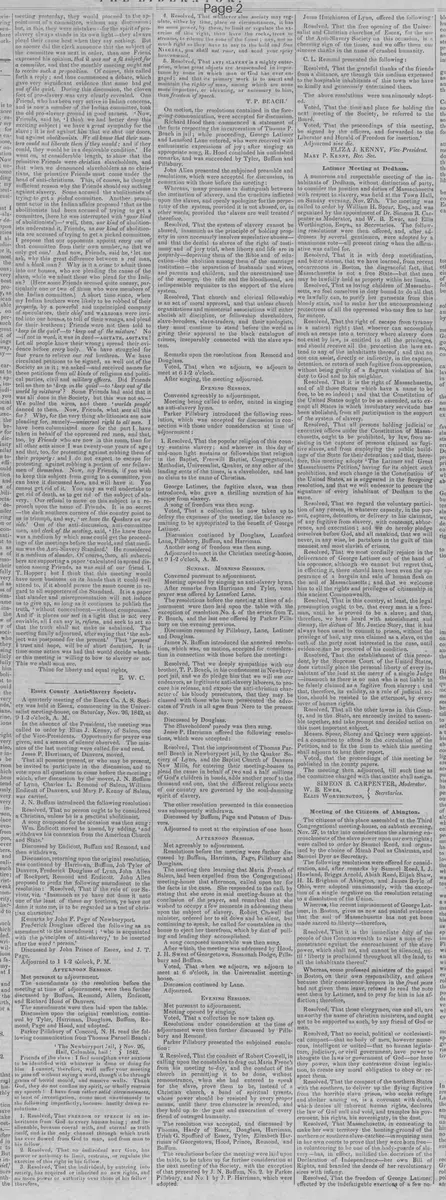
A quarterly meeting of the Essex Co. A. S. Society was held in Essex, commencing in the Universalist meeting-house, on Saturday, Nov. 26, 1842, at 9 1-2 o'clock, A. M.
In the absence of the President, the meeting was called to order by Eliza J. Kenny, of Salem, one of the Vice-Presidents. Opportunity for prayer was given, and a season of silence observed. The minutes of the last meeting were called for and read.
Jesse P. Harriman, of Danvers, moved.
That all persons present, or who may be present, be invited to participate in the discussion, and to vote upon all questions to come before the meeting; which, after discussion by the mover, J. N. Buffum of Lynn, Charles L. Remond of Salem, William Endicott of Danvers, and Mary P. Kenny of Salem, was carried.
J. N. Buffum introduced the following resolution:
Resolved, That no person ought to be considered a Christian, unless he is a practical abolitionist.
A song composed for the occasion was then sung:
Wm. Endicott moved to amend, by adding, 'and withdraws his connexion from the American Church and State.'
Discussed by Endicott, Buffum and Remond, and then withdrawn.
Discussion, returning upon the original resolution. was continued by Harriman, Buffum, Job Tyler of Danvers, Frederick Douglass of Lynn, John Allen of Rockport, Remond and Endicott. John Allen proposed to prefix the following amendment to the resolution: Resolved, That if the rule of our Saviour, viz. 'Inasmuch as ye have not done it unto one of the least of these my brethren, ye have not done it unto me, is to be regarded as a test of christian character.'
Remarks by John F. Page of Newburyport.
Frederick Douglass offered the following as an amendment to the amendment; 'who is acquainted with the principles of anti-slavery,' to be inserted after the word 'person.'
Discussed by John Prince of Essex, and J. T. Page.
Adjourned to 1 1-2 o'clock, P. M.
AFTERNOON SESSION.
Met pursuant to adjournment.
The amendments to the resolution before the meeting at time of adjournment, were then further discussed by Buffum, Remond, Allen, Endicott, and Richard Hood of Danvers.
The amendments were then laid upon the table.
Discussion upon the original resolution, continued by Tyler, Harriman, Douglass, Buffum, Remond, Page and Hood. and adopted.
Parker Pillsbury of Concord. N. H. read the following communication from Thomas Parnell Beach :
The Newburyport Jail, } Nov. 26, 1842.
Hail, Columbia, hail!
Friends of the slave: I feel more than ever anxious to be identified with whatever is done or doing for him. I cannot, therefore, well suffer your meeting to pass off without saying a word, though it be through grates of horrid mould, and massive walls. Thank God, they do not confine my spirit, or wholly restrain my speech ! I have from rather solid circumstances, at least of investigation, come most unanimously to the following imperfectly, because hastily drawn resolutions:
1. Resolved, That FREEDOM OF SPEECH is an inheritance from God to every human being ; and inalienable, because coeval with, and eternal as truth itself, and is the only channel through which truth has ever flowed from God to man, and from man to his fellow.
2. Resolved, That no individual but GOD, has power or authority to limit, restrain, or regulate the exercise of this right in his fellow.
3. Resolved, That the individual, by entering into society, has acquired or inherited no new rights, and no more power or authority over those of his fellow therefore,
4. Resolved, That whatever else society may regulate, either by time, place or circumstances, it has no more power, by these, to limit or regulate the exercise of this right, than have the rocks, trees or streams, to silence the sons of the forest; nay, not so much right as they have to say to the bold and free NIAGARA, you shall not roar, and send your spray heavenward.
5. Resolved, That Anti-slavery is a mighty enterprise, whose great objects are transcended in importance by none in which man or God has ever engaged; and that its primary work is to assert and maintain the rights of man, among which are none more important, or elevating, or necessary to him, than freedom of speech.
T. P. BEACH.
On motion, the resolutions contained in the foregoing communication, were accepted for discussion.
Richard Hood then commenced a statement of the facts respecting the incarceration of Thomas P. Beach in jail; while proceeding, George Latimer and Lunsford Lane entered, who were received with enthusiastic expressions of joy; after singing an appropriate song. R. Hood concluded his unfinished remarks, and was succeeded by Tyler, Buffum and Pillsbury.
John Allen presented the subjoined preamble and resolutions, which were accepted for discussion, in connexion with those before the meeting:
Whereas, many presume to distinguish between the institution of slavery, and the cruelties inflicted upon the slaves, and openly apologize for the perpetuity of the system, provided it is not abused, or, in other words, provided the ' slaves are well treated : therefore,
Resolved, That the system of slavery cannot be abused, inasmuch as the principle of holding property in man necessarily involves superlative abuses— and that the denial to slaves of the right of testimony and of jury trial, when liberty and life are in jeopardy-depriving them of the Bible and of education—the abolition among them of the marriage institution—the separation of husbands and wives, and parents and children, and the unrestrained use of the scourge, the rifle and the bloodhound, are indispensable requisites to the support of the slave system.
Resolved, That church and clerical fellowship is an act of moral approval, and that unless church organizations and ministerial associations will either abolish all discipline, or fellowship slaveholders, slave-breeders, slave-traders, and their apologists, they must continue to stand before the world as giving their approval to the black catalogue of crimes, inseparably connected with the slave system.
Remarks upon the resolutions from Remond and Douglass.
Voted, That when we adjourn, we adjourn to meet at 6 1-2 o'clock.
After singing, the meeting adjourned.
Evening Session.
Convened agreeably to adjournment.
Meeting being called to order, united in singing an anti-slavery hymn.
Parker Pillsbury introduced the following resolution, which was accepted for discussion in connection with those under consideration at time of adjournment:
1. Resolved, That the popular religion of this country sustains slavery; and whoever in this day of mid-noon light sustains or fellowships that religion in the Baptist, Freewill Baptist, Congregational, Methodist, Universalist, Quaker, or any other of the leading sects of the times, is a slaveholder, and has no claim to the name of Christian.
George Latimer, the fugitive slave, was then introduced, who gave a thrilling narration of his escape from slavery.
A song of freedom was then sung.
Voted, That a collection be now taken up to defray the expenses of the meeting, the balance remaining to be appropriated to the benefit of George Latimer.
Discussion continued by Douglass, Lunsford Lane, Pillsbury, Buffum, and Harriman.
Another song of freedom was then sung.
Adjourned to meet in the Christian meeting-house at 9 1-2 o'clock, A. M.
Sunday. Morning Session.
Convened pursuant to adjournment.
Meeting opened by singing an anti-slavery hymn
After remarks from Harriman and Tyler, vocal prayer was offered by Lunsford Lane.
The resolutions before the meeting at time of adjournment were then laid upon the table with the exception of resolution No. 4. of the series from T. P. Beach. and the last one offered by Parker Pillsbury on the evening previous.
Discussion resumed by Pillsbury, Lane, Latimer and Douglass.
James N. Buffum introduced the annexed resolution, which was, on motion, accepted for consideration in connection with those before the meeting:
Resolved, That we deeply sympathize with our brother, T. P. Beach, in his confinement in Newburyport jail, and we do pledge him that we will use our endeavors, as legitimate anti-slavery laborers, to procure his release, and expose the anti-christian character of his bloody persecutors, that they may be classed with those who have persecuted the advocates of Truth in all ages from Nero to the present day.
Discussed by Douglass.
The Slaveholders' parody was then sung
Jesse P. Harriman offered the following resolutions, which were accepted:
Resolved, That the imprisonment of Thomas Parnell Beach in Newburyport jail, by the Quaker Society of Lynn, and the Baptist Church of Danvers New Mills, for entering their meeting-houses to plead the cause in behalf of two and a half millions of God's children in bonds, adds another proof to the thousand and one, that the different religious sects of our country are governed by the soul-damning spirit of slavery.
The other resolution presented in this connection was subsequently withdrawn.
Discussed by Buffum, Page and Putnam of Danvers.
Adjourned to meet at the expiration of one hour.
Afternoon Session.
Met agreeably to adjournment.
Resolutions before the meeting were further discussed by Buffum, Harriman, Page, Pillsbury and Douglass.
The meeting then learning that Maria French of Salem, had been expelled from the Congregational meeting-house that afternoon, called upon her for the facts in the case. She responded to the call, by stating that she arose in said meeting-house at the conclusion of the prayer, and remarked that she wished to occupy a few moments in addressing them upon the subject of slavery. Robert Crowell the minister, ordered her to sit down and be silent, but continuing to speak, he called for constables in the house to eject her therefrom, which by dint of pulling and leading they accomplished.
A song composed meanwhile was then sung.
After which, the meeting was addressed by Hood, J. H. Sweat of Georgetown, Susannah Dodge, Pillsbury and Buffum.
Voted, That when we adjourn, we adjourn to meet at 6 o'clock, in the Universalist meeting-house.
Discussion continued by Lane
Adjourned.
Evening Session.
Met pursuant to adjournment.
Meeting opened by singing.
Voted, That a collection be now taken up.
Resolutions under consideration at the time of adjournment were then further discussed by Pillsbury and Remond.
Parker Pillsbury presented the subjoined resolution:
2. Resolved, That the conduct of Robert Crowell, in calling upon the constables to drag out Maria French from his meeting to-day, and the conduct of the church in permitting it to be done, without remonstrance, when she had entered to speak for the slave, prove them to be, instead of a Christian church, a band of spiritual tyrants, whose power should be resisted by every proper means, until their true character is revealed, and they held up to the gaze and execration of every friend of outraged humanity.
The resolution was accepted, and discussed by Thomas, Hardy of Essex, Douglass, Harriman, Uriah G. Spofford of Essex. Tyler. Elizabeth Harrington of Georgetown, Hood, Prince, Remond, and Buffum.
The resolutions before the meeting were laid upon the table, to be taken up for further consideration at the next meeting of the Society, with the exception of that presented by J. N. Buffum, No. 2. by Parker Pillsbury, and No. 1. by J. P. Harriman, which were adopted.
Jesse Hutchinson of Lynn, offered the following
Resolved, That the free opening of the Universalist and Christian churches of Essex, for the use of the Anti-Slavery Society on this occasion, is a cheering sign of the times, and we offer them our sincere thanks in the name of crushed humanity.
C. L. Remond presented the following:
Resolved, That the grateful thanks of the friends from a distance, are through this medium expressed to the hospitable inhabitants of this town who have so kindly and generously entertained them.
The above resolutions were unanimously adopted.
Voted, That the time and place for holding the next meeting of the Society, be referred to the Board.
Voted, That the proceedings of this meeting be signed by the officers, and forwarded to the Liberator and Herald of Freedom for insertion.'
Adjourned sine die.
ELIZA J. KENNY, Vice-President.
MARY P. KENNY, Rec. Sec.
What sub-type of article is it?
What keywords are associated?
What entities or persons were involved?
Where did it happen?
Domestic News Details
Primary Location
Essex
Event Date
Saturday, Nov. 26, 1842
Key Persons
Outcome
resolutions adopted condemning slavery, church support for it, and specific incidents; collections taken for expenses and george latimer; thanks extended to hosts and churches; next meeting referred to board.
Event Details
Quarterly meeting of the Essex County Anti-Slavery Society held in Essex, starting November 26, 1842, in Universalist meeting-house. Included prayers, minutes reading, discussions, amendments, and adoption of resolutions on Christianity requiring abolitionism, freedom of speech, slavery's abuses, church fellowship with slaveholders, and specific cases like Thomas P. Beach's jail incarceration and Maria French's expulsion from Congregational church. Featured speeches by Frederick Douglass, George Latimer's escape narrative, Lunsford Lane, and songs.