Thank you for visiting SNEWPapers!
Sign up free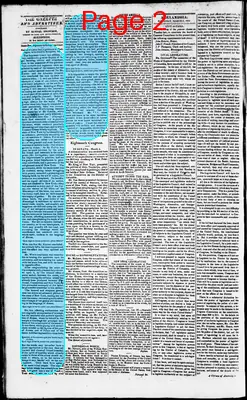
Story
March 6, 1824
Alexandria Gazette & Advertiser
Alexandria, Virginia
What is this article about?
Account of a heated Supreme Court argument on steamboat navigation monopoly, featuring eloquent closing speeches by Mr. Emmet praising New York's role in Fulton's invention and Mr. Wirt warning of potential civil strife, using a Virgil quote for dramatic effect.
Clipping
OCR Quality
95%
Excellent
Full Text
Steam Boat Argument in the Supreme Court.
Extract of a letter from a gentleman in Washington, to his friend in Richmond, Va.
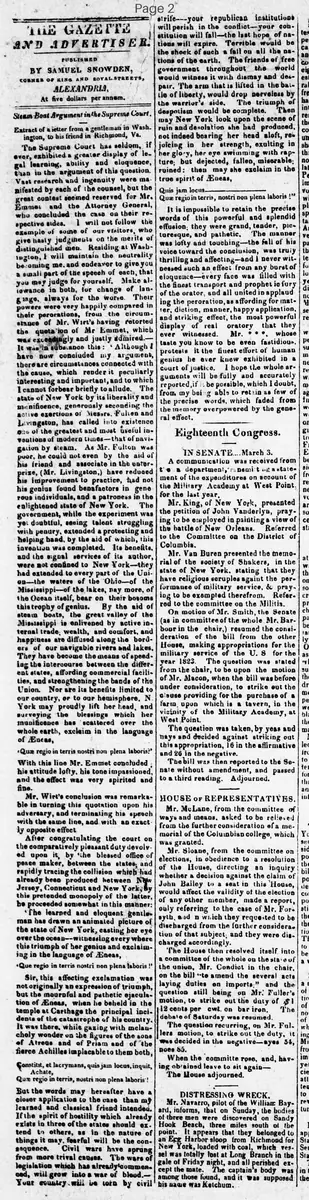
The Supreme Court has seldom, if ever, exhibited a greater display of legal learning, ability and eloquence, than in the argument of this question. Vast research and ingenuity were manifested by each of the counsel, but the great contest seemed reserved for Mr. Emmet and the Attorney General, who concluded the case on their respective sides. I will not follow the example of some of our visitors, who give hasty judgments on the merits of distinguished men. Residing at Washington, I will maintain the neutrality becoming me, and endeavor to give you a small part of the speech of each, that you may judge for yourself. Make allowance in both, for change of language, always for the worse. Their powers were very happily compared in their perorations, from the circumstance of Mr. Wirt's having retorted the quotation of Mr. Emmet, which was exceedingly and justly admired. It was in substance this: 'Although I have now concluded my argument, there are circumstances connected with the cause, which render it peculiarly interesting and important, and to which I cannot forbear briefly to allude. The state of New York by its liberality and munificence, generously seconding the active exertions of Messrs. Fulton and Livingston, has called into existence one of the greatest and most useful inventions of modern times—that of navigation by steam. As Mr. Fulton was poor, he could not even by the aid of his friend and associate in the enterprise, (Mr. Livingston,) have reduced his improvement to practice, had not his genius found benefactors in generous individuals, and a patroness in the enlightened state of New York. The government, while the experiment was yet doubtful, seeing talent struggling with penury, extended a protecting and helping hand, by the aid of which, this innovation was completed. Its benefits, and the signal services of its author, were not confined to New York—they had extended to every part of the Union—the waters of the Ohio—of the Mississippi—of the lakes, nay more, of the Ocean itself, bear on their bosoms this trophy of genius. By the aid of steam boats, the great valley of the Mississippi is enlivened by active internal trade: wealth, and comfort, and happiness are diffused along the borders of our navigable rivers and lakes. They have become the means of speeding the intercourse between the different states, affording commercial facilities, and strengthening the bands of the Union. Nor are its benefits limited to our country, or to our hemisphere. New York may proudly lift her head, and surveying the blessings which her munificence has 'scattered over the whole earth, exclaim in the language of Aeneas,
Quæ regio in terris nostri non plena laboris?'
With this line Mr. Emmet concluded: his attitude lofty, his tone impassioned, and the effect was very spirited and fine.
Mr. Wirt's conclusion was remarkable in turning this quotation upon his adversary, and terminating his speech with the same line, and with an exactly opposite effect. After congratulating the court on the comparatively pleasant duty devolved upon it, by the blessed office of peace maker, between the states: and rapidly tracing the collision which had already been produced between New Jersey, Connecticut and New York by this pretended monopoly of the latter, he proceeded somewhat in this manner:
The learned and eloquent gentleman has drawn an animated picture of the state of New York, casting her eye over the ocean—witnessing every where this triumph of her genius and exclaiming in the language of Aeneas,
Quæ regio in terris nostri non plena laboris!'
Sir, this affecting exclamation was not originally an expression of triumph, but the mournful and pathetic ejaculation of Aeneas, when he beheld in the temple at Carthage the principal incidents of the catastrophe of his country. It was there, while gazing with melancholy wonder on the figures of the son of Atreus and of Priam and of the fierce Achilles implacable to them both,
Constitit, et lacrymans, quis jam locus, inquit,
Achate,
Quæ regio in terris, nostri non plena laboris!
But the words may hereafter have a closer application to the case than my learned and classical friend intended. If the spirit of hostility which already exists in three of the states should extend to others, as in the nature of things it may, fearful will be the consequence. Civil wars have sprung from more trivial causes. The war of legislation which has already commenced, will grow into a war of blood. Your country—will be torn by civil strife—your republican institutions will perish in the conflict—your constitution will fall—the last hope of nations will expire. Terrible would be the shock of such a fall on all the nations of the earth. The friends of free government throughout the world would witness it with dismay and despair. The arm that is lifted in the battle of liberty, would drop nerveless by the warrior's side. The triumph of despotism would be complete. Then way New York look upon the scene of ruin and desolation she had produced, not indeed bearing her head aloft, rejoicing in her strength, exulting in her glory, her eye swimming with rapture: but dejected, fallen, miserable: ruined: then may she exclaim in the true spirit of Aeneas,
Quis jam locus.
Quæ regio in terris, nostri non plena laboris!"
It is impossible to retain the precise words of this powerful and splendid effusion: they were grand, tender, picturesque, and pathetic. The manner was lofty and touching—the fall of his voice toward the conclusion, was truly thrilling and affecting—and I never witnessed such an effect from any burst of eloquence—every face was filled with the finest transport and prophetic fury of the orator, and all united in applauding the peroration, as affording for matter, diction, manner, happy application, and striking effect, the most powerful display of real oratory that they ever witnessed.
Mr. _____, whose taste you know to be even fastidious, protests it the finest effort of human genius he ever knew exhibited in a court of justice. I hope the whole arguments will be fully and accurately reported, if it be possible, which I doubt, from my being able to retain so few of the precise words, which faded from the memory overpowered by the general effect.
Extract of a letter from a gentleman in Washington, to his friend in Richmond, Va.
The Supreme Court has seldom, if ever, exhibited a greater display of legal learning, ability and eloquence, than in the argument of this question. Vast research and ingenuity were manifested by each of the counsel, but the great contest seemed reserved for Mr. Emmet and the Attorney General, who concluded the case on their respective sides. I will not follow the example of some of our visitors, who give hasty judgments on the merits of distinguished men. Residing at Washington, I will maintain the neutrality becoming me, and endeavor to give you a small part of the speech of each, that you may judge for yourself. Make allowance in both, for change of language, always for the worse. Their powers were very happily compared in their perorations, from the circumstance of Mr. Wirt's having retorted the quotation of Mr. Emmet, which was exceedingly and justly admired. It was in substance this: 'Although I have now concluded my argument, there are circumstances connected with the cause, which render it peculiarly interesting and important, and to which I cannot forbear briefly to allude. The state of New York by its liberality and munificence, generously seconding the active exertions of Messrs. Fulton and Livingston, has called into existence one of the greatest and most useful inventions of modern times—that of navigation by steam. As Mr. Fulton was poor, he could not even by the aid of his friend and associate in the enterprise, (Mr. Livingston,) have reduced his improvement to practice, had not his genius found benefactors in generous individuals, and a patroness in the enlightened state of New York. The government, while the experiment was yet doubtful, seeing talent struggling with penury, extended a protecting and helping hand, by the aid of which, this innovation was completed. Its benefits, and the signal services of its author, were not confined to New York—they had extended to every part of the Union—the waters of the Ohio—of the Mississippi—of the lakes, nay more, of the Ocean itself, bear on their bosoms this trophy of genius. By the aid of steam boats, the great valley of the Mississippi is enlivened by active internal trade: wealth, and comfort, and happiness are diffused along the borders of our navigable rivers and lakes. They have become the means of speeding the intercourse between the different states, affording commercial facilities, and strengthening the bands of the Union. Nor are its benefits limited to our country, or to our hemisphere. New York may proudly lift her head, and surveying the blessings which her munificence has 'scattered over the whole earth, exclaim in the language of Aeneas,
Quæ regio in terris nostri non plena laboris?'
With this line Mr. Emmet concluded: his attitude lofty, his tone impassioned, and the effect was very spirited and fine.
Mr. Wirt's conclusion was remarkable in turning this quotation upon his adversary, and terminating his speech with the same line, and with an exactly opposite effect. After congratulating the court on the comparatively pleasant duty devolved upon it, by the blessed office of peace maker, between the states: and rapidly tracing the collision which had already been produced between New Jersey, Connecticut and New York by this pretended monopoly of the latter, he proceeded somewhat in this manner:
The learned and eloquent gentleman has drawn an animated picture of the state of New York, casting her eye over the ocean—witnessing every where this triumph of her genius and exclaiming in the language of Aeneas,
Quæ regio in terris nostri non plena laboris!'
Sir, this affecting exclamation was not originally an expression of triumph, but the mournful and pathetic ejaculation of Aeneas, when he beheld in the temple at Carthage the principal incidents of the catastrophe of his country. It was there, while gazing with melancholy wonder on the figures of the son of Atreus and of Priam and of the fierce Achilles implacable to them both,
Constitit, et lacrymans, quis jam locus, inquit,
Achate,
Quæ regio in terris, nostri non plena laboris!
But the words may hereafter have a closer application to the case than my learned and classical friend intended. If the spirit of hostility which already exists in three of the states should extend to others, as in the nature of things it may, fearful will be the consequence. Civil wars have sprung from more trivial causes. The war of legislation which has already commenced, will grow into a war of blood. Your country—will be torn by civil strife—your republican institutions will perish in the conflict—your constitution will fall—the last hope of nations will expire. Terrible would be the shock of such a fall on all the nations of the earth. The friends of free government throughout the world would witness it with dismay and despair. The arm that is lifted in the battle of liberty, would drop nerveless by the warrior's side. The triumph of despotism would be complete. Then way New York look upon the scene of ruin and desolation she had produced, not indeed bearing her head aloft, rejoicing in her strength, exulting in her glory, her eye swimming with rapture: but dejected, fallen, miserable: ruined: then may she exclaim in the true spirit of Aeneas,
Quis jam locus.
Quæ regio in terris, nostri non plena laboris!"
It is impossible to retain the precise words of this powerful and splendid effusion: they were grand, tender, picturesque, and pathetic. The manner was lofty and touching—the fall of his voice toward the conclusion, was truly thrilling and affecting—and I never witnessed such an effect from any burst of eloquence—every face was filled with the finest transport and prophetic fury of the orator, and all united in applauding the peroration, as affording for matter, diction, manner, happy application, and striking effect, the most powerful display of real oratory that they ever witnessed.
Mr. _____, whose taste you know to be even fastidious, protests it the finest effort of human genius he ever knew exhibited in a court of justice. I hope the whole arguments will be fully and accurately reported, if it be possible, which I doubt, from my being able to retain so few of the precise words, which faded from the memory overpowered by the general effect.
What sub-type of article is it?
Historical Event
What themes does it cover?
Justice
Tragedy
Triumph
What keywords are associated?
Supreme Court Argument
Steamboat Monopoly
Mr Emmet Speech
Mr Wirt Peroration
Fulton Livingston Invention
Virgil Quotation
Civil Strife Warning
What entities or persons were involved?
Mr. Emmet
Mr. Wirt
Messrs. Fulton
Mr. Livingston
Where did it happen?
Supreme Court, Washington
Story Details
Key Persons
Mr. Emmet
Mr. Wirt
Messrs. Fulton
Mr. Livingston
Location
Supreme Court, Washington
Story Details
Letter excerpt describing the Supreme Court argument on steamboat monopoly, with Mr. Emmet's peroration praising New York's support for Fulton's steam navigation invention and its national benefits, quoting Virgil triumphantly; Mr. Wirt retorts by reinterpreting the quote as a warning of potential civil war and ruin from the monopoly.