Thank you for visiting SNEWPapers!
Sign up free
Norfolk Gazette And Publick Ledger
Norfolk, Virginia
What is this article about?
Account of the 1813 naval battle between USS Chesapeake under Capt. Lawrence and HMS Shannon, where initial success turned to defeat after Lawrence's wounding and crew desertion. Court martial report vindicates Lawrence's bravery and attributes loss to specific failures, honoring the fallen.
Merged-components note: Merged continuations of the detailed report on the Chesapeake-Shannon engagement across pages and components; resulting label story differs from original notice label
Clippings
1 of 2
OCR Quality
Full Text
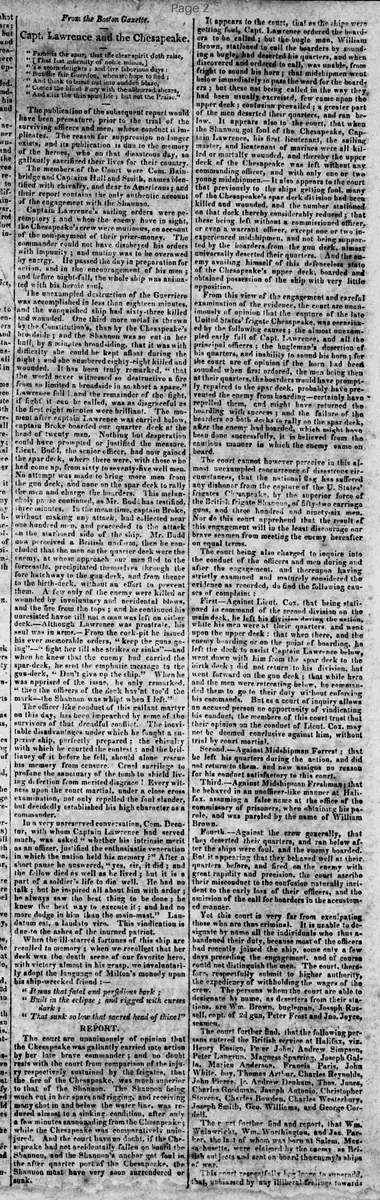
Capt. Lawrence and the Chesapeake.
"Fame is the spur that the clear spirit doth raise,
That last infirmity of noble minds,
In scorn delights; and lives laborious days:
But the fair Guerdon when we hope to find;
And think to burst out into sudden blaze,
Comes the blind Fury with the abhorred shears,
And slits the thin-spun life; but not the praise."
The publication of the subsequent report would have been premature, prior to the trial of the surviving officers and men, whose conduct it implicates. The reason for suppression no longer exists, and its publication is due to the memory of the heroes, who on that disastrous day, so gallantly sacrificed their lives for their country. The members of the Court were Com. Bainbridge and Captains Hull and Smith, names identified with chivalry, and dear to Americans; and their report contains the only authentic account of the engagement with the Shannon.
Captain Lawrence's sailing orders were peremptory; and when the enemy hove in sight, the Chesapeake's crew were mutinous, on account of the non-payment of their prize-money. The commander could not have disobeyed his orders with impunity; and mutiny was to be overawed by energy. He passed the day in preparation for action, and in the encouragement of his men; and before night-fall, the whole ship was animated with his heroic soul.
The unexampled destruction of the Guerriere was accomplished in less than eighteen minutes, and the vanquished ship had sixty-three killed and wounded. One third more metal is thrown by the Constitution's, than by the Chesapeake's broadside: and the Shannon was so cut in her hull, by 8 minutes broadsiding, that it was with difficulty she could be kept afloat during the night and she numbered eighty-eight killed and wounded. It has been truly remarked, "that the world never witnessed so destructive a fire from so limited a broadside in so short a space."
Lawrence fell! and the remainder of the fight, if fight it can be called, was as disgraceful as the first eight minutes were brilliant. The moment after captain Lawrence was carried below, captain Broke boarded our quarter deck at the head of twenty men. Nothing but desperation could have prompted or justified the measure. Lieut. Budd, the senior officer, had now gained the spar deck, where there were, with those who had come up, from sixty to seventy-five well men. No attempt was made to bring more men from the gun deck, and none on the spar deck to rally the men and charge the boarders. This melancholy pause continued, as Mr. Budd has testified, three minutes. In the mean time, captain Broke, without making any attack, had collected near one hundred men, and proceeded to the attack on the starboard side of the ship. Mr. Budd now perceived a British uniform, then he concluded that the men on the quarter deck were the enemy, at whose approach our men fled to the forecastle, precipitated themselves through the fore hatchway to the gun-deck, and from thence to the birth-deck, without an effort to prevent them. A few only of the enemy were killed or wounded by involuntary and accidental blows, and the fire from the tops; and he continued his unresisted havoc till not a man was left on either deck.—Although Lawrence was prostrate, his soul was in arms.—From the cock-pit he issued his ever memorable orders, "keep the guns going"—"fight her till she strikes or sinks"—and when he knew that the enemy had carried the spar-deck, he sent the emphatic message to the gun-deck, "Don't give up the ship." When he was apprised of the issue.. he only remarked, "then the officers of the deck hav'nt toed the mark—the Shannon was whipt when I left."
The officer-like conduct of this gallant martyr on this day, has been impeached by some of the survivors of that dreadful conflict. The inevitable disadvantages under which he fought a superior ship, perfectly prepared; the chivalry with which he courted the contest: and the brilliancy of it before he fell, should alone rescue his memory from censure. Cruel sacrilege to profane the sanctuary of the tomb to shield living defection from merited disgrace! Every witness upon the court martial, under a close cross examination, not only repelled the foul slander, but decidedly established his high character as a commander.
In a very unreserved conversation, Com. Decatur, with whom Captain Lawrence had served much, was asked "whether his intrinsic merit as an officer, justified the enthusiastic veneration in which the nation held his memory?" After a short pause he answered, "yes, sir, it did; and the fellow died as well as he lived; but it is a part of a soldier's life to die well. He had no talk; but he inspired all about him with ardor; he always saw the best thing to be done; he knew the best way to execute it; and had no more dodge in him than the main-mast." Laudatum est, a laudato viro.. This vindication is due to the ashes of the immortal patriot.
When the ill-starred fortunes of this ship are recalled to memory; when we recollect that her deck was the death scene of our favorite hero, with victory almost in his grasp, we involuntarily adopt the language of Milton's monody upon his ship-wrecked friend:—
"It was that fatal and perfidious bark,
Built in the eclipse; and rigged with curses dark,
That sunk so low that sacred head of thine!"
REPORT
The court are unanimously of opinion that the Chesapeake was gallantly carried into action by her late brave commander; and no doubt rests with the court from comparison of the injury respectively sustained by the frigates, that the fire of the Chesapeake, was much superior to that of the Shannon. The Shannon being much cut in her spars and rigging, and receiving many shot in and below the water line, was reduced almost to a sinking condition, after only a few minutes cannonading from the Chesapeake; while the Chesapeake was comparatively uninjured. And the court have no doubt, if the Chesapeake had not accidentally fallen on board the Shannon, and the Shannon's anchor got foul in the after quarter port of the Chesapeake, the Shannon must have very soon surrendered or
sunk.
It appears to the court, that as the ships were getting foul, Capt. Lawrence ordered the boarders to be called; but the bugle man, William Brown, stationed to call the boarders by sounding a bugle had deserted his quarters, and when discovered and ordered to call, was unable, from fright to sound his horn; that midshipmen went below immediately to pass the word for the boarders; but these not being called in the way they had been usually exercised, few came upon the upper deck; confusion prevailed; a greater part of the men deserted their quarters, and ran below. It appears also to the court, that when the Shannon got foul of the Chesapeake, Captain Lawrence, his first lieutenant, the sailing master, and lieutenant of marines were all killed or mortally wounded, and thereby the upper deck of the Chesapeake was left without any commanding officer, and with only one or two young midshipmen.—It also appears to the court that previously to the ships getting foul, many of the Chesapeake's spar deck division had been killed and wounded, and the number stationed on that deck thereby considerably reduced; that these being left without a commissioned officer, or even a warrant officer, except one or two inexperienced midshipmen, and not being supported by the boarders from the gun deck, almost universally deserted their quarters. And the enemy availing himself of this defenceless state of the Chesapeake's upper deck, boarded and obtained possession of the ship with very little opposition.
From this view of the engagement and careful examination of the evidence, the court are unanimously of opinion that the capture of the late United States' frigate Chesapeake, was occasioned by the following causes; the almost unexampled early fall of Capt. Lawrence, and all the principal officers; the bugleman's desertion of his quarters, and inability to sound his horn: for the court are of opinion if the horn had been sounded when first ordered, the men being then at their quarters, the boarders would have promptly repaired to the spar deck, probably have prevented the enemy from boarding—certainly have repelled them, and might have returned the boarding with success; and the failure of the boarders on both decks to rally on the spar deck, after the enemy had boarded, which might have been done successfully, it is believed from the cautious manner in which the enemy came on board.
The court cannot however perceive in this almost unexampled concurrence of disastrous circumstances, that the national flag has suffered any dishonor from the capture of the U. States' frigate Chesapeake, by the superior force of the British frigate Shannon, of fifty-two carriage guns, and three hundred and ninety-six men. Nor do this court apprehend that the result of this engagement will in the least discourage our brave seamen from meeting the enemy hereafter on equal terms.
The court being also charged to inquire into the conduct of the officers and men during and after the engagement, and thereupon having strictly examined and maturely considered the evidence as recorded, do find the following causes of complaint:
First—Against Lieut. Cox, that being stationed in command of the second division on the main deck, he left his division during the action, while his men were at their quarters, and went upon the upper deck: that when there, and the enemy boarding or on the point of boarding, he left the deck to assist Captain Lawrence below, went down with him from the spar deck to the birth deck; did not return to his division, but went forward on the gun deck: that while here and the men were retreating below, he commanded them to go to their duty without enforcing his commands. But as a court of inquiry allows an accused person no opportunity of vindicating his conduct, the members of this court trust that their opinion on the conduct of Lieut. Cox, may not be deemed conclusive against him, without trial by court martial.
Second.—Against Midshipman Forrest; that he left his quarters during the action, and did not return to them, and now assigns no reason for his conduct satisfactory to this court.
Third.—Against Midshipman Freshman: that he behaved in an un-officer-like manner at Halifax, assuming a false name at the office of the commissary of prisoners, when obtaining his parole, and was paroled by the name of William Brown.
Fourth.—Against the crew generally, that they deserted their quarters, and ran below after the ships were foul, and the enemy boarded. But it appearing that they behaved well at their quarters before, and fired on the enemy with great rapidity and precision, the court ascribe their misconduct to the confusion naturally incident to the early loss of their officers, and the omission of the call for boarders in the accustomed manner. Yet this court is very far from excusing those who are thus criminal. It is unable to designate by name all the individuals who thus abandoned their duty, because most of the officers had recently joined the ship, some only a few days preceding the engagement, and of course could not distinguish the men. The court, therefore, respectfully submit to higher authority the expediency of withholding the wages of the crew. The persons whom the court are able to designate by name, as deserters from their stations, are Wm. Brown, bugleman, Joseph Russell, capt. of 2d gun, Peter Frost and Jno. Joyce, seamen.
The court further find, that the following persons entered the British service at Halifax, viz. Henry Bosign, Peter John, Andrew Simpson, Peter Langrum, Magness Sparring, Joseph Gale, Jas. Marion Anderson, Francis Paris, John White, boy, Thomas Arthur, Charles Reynolds, John Pierce, J. Andrew Denham, Thos. Jones, Charles Goodman, Joseph Antonio, Christopher Stevens, Charles Bowden, Charles Westerbury, Joseph Smith, Geo. Williams, and George Cordell.
The court further find and report, that Wm. Westwright, Wm. Worthington, and Jas. Parker, the last of whom was born at Salem, Massachusetts, were claimed by the enemy, as British subjects and sent on board the enemy's ships of war.
This court respectfully begs leave to suggest, that, unbiased by any illiberal feelings towards
The enemy, they feel it their duty to state, that the conduct of the enemy after boarding, and carrying the Chesapeake, was a most unwarrantable abuse of power after success.
The court is aware, that in carrying a ship by boarding, the full extent of the command of an officer cannot be readily exercised: and that improper violence may unavoidably ensue. When this happens in the moment of contention, a magnanimous conquered foe will not complain.
But the fact has been clearly established, before this court, that the enemy met with little opposition on the upper deck, and none on the gun-deck. Yet after they had carried the ship, they fired from the gun deck down the hatchway upon the birth deck, and killed and wounded several of the Chesapeake's crew, who had retreated there, were unarmed and incapable of making any opposition: that some balls were fired even into the cockpit: and what excites the utmost abhorrence, this outrage was committed in the presence of a British officer standing at the hatchway.
WILLIAM BAINBRIDGE, President.
What sub-type of article is it?
What themes does it cover?
What keywords are associated?
What entities or persons were involved?
Where did it happen?
Story Details
Key Persons
Location
At Sea
Story Details
The USS Chesapeake under Capt. Lawrence engaged HMS Shannon, initially dominating with superior fire but lost after Lawrence and key officers fell, bugler deserted, and crew panicked allowing boarding. Court report praises Lawrence's gallantry, attributes defeat to misfortunes, and criticizes specific misconduct while condemning British post-capture atrocities.