Thank you for visiting SNEWPapers!
Sign up free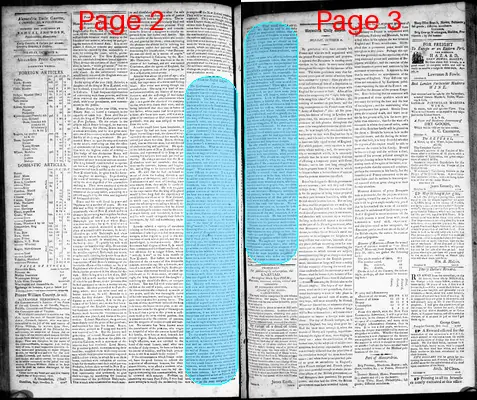
Editorial
October 8, 1810
Alexandria Daily Gazette, Commercial & Political
Alexandria, Virginia
What is this article about?
Editorial from Norfolk Ledger critiques Napoleon's Continental System excluding US commerce from Europe, blames US embargo and non-intercourse for aiding France, contrasts with potential British restrictions, and calls for independent stance against French tyranny while rejecting anti-British prejudice.
Merged-components note: Merged continuation of the editorial from the Norfolk Ledger across pages 2 and 3.
Clippings

1 of 2
OCR Quality
95%
Excellent
Full Text
From the Norfolk Ledger.
The Continental System.-
To the accomplishment of the objects of this system, it appears that the commerce of the United States is to be excluded from the continent of Europe.
The Berlin decree, which was published in our last, is a comment upon the text which is to be found in the celebrated Berlin decree of November, 1806. The exclusion of our vessels from the ports of that degraded and despicable wretch, called the king of Prussia, but more properly Bonaparte's valet, can be no great evil, tho it serves to prove the hostility of Napoleon, and the meanness of the other. Denmark (poor Denmark!) has also adopted the same system upon the same principle, and at the same command. Sweden and Russia, it is probable, have received and obeyed their master's commands to the same effect before this day.
What are we to do under these circumstances? To answer this question let us suppose a case. Suppose by his day's mail we were to receive authentic advices, that, at the request of the British government, our ships were excluded from the extensive dominions of Spain and Portugal? What would be done in such a case is not difficult to predict. Yes, a general burst of indignation would be heard. It would be remembered that one of our great causes of complaint against the British government, was, the restricting our trade with all parts of the world. Now that Napoleon restricts or excludes our commerce, we hear not a murmur of complaint, from those, who, for the temporary disgrace, if not the ultimate ruin of this country, have the direction of our national concerns.
Events are daily occurring, which serve to demonstrate the truth of what was said at the time, that our embargo, and our non-intercourse, were parts of this famous continental system: well might Mr. Gardner say, "the hand of Napoleon is in this thing" well (this sarcastically) might Mr. Canning observe, that if our embargo was not a part of Bonaparte's plans against the commerce of England.-it came very much in aid of these plans. It will be remembered by every one, the applauses which the emperor of France bestowed upon our embargo system ;-while we were acting in conformity to his wishes, if not by his orders, we were a loyal people ; but, when we presume to exercise the right which every independent nation will exercise, this tyrant undertakes to punish us by plundering and confiscating all the property, which comes within his reach, and by restricting our commerce with those nations, who are so base and degraded, as to become the passive instruments of his abominable injustice. History will record, and posterity will view with astonishment, the patience with which a people, so feelingly alive to whatever concerned their honor and their interests, submitted to disgrace and ruin, when inflicted by a tyrant's hand. The conduct of a great part of the people is to us so unaccountable, that we should be almost tempted to believe in magic spells and incantations, if we had not witnessed the deceptions and arts which have been practised to produce a temper in this nation, that has brought disgrace upon it, and may bring down the ruin of our government, and finally produce the loss of our freedom and independence.
To that deadly hostility against G. Britain, which, for purposes too well known to need repetition, is fostered and diffused, with a zeal and an activity, worthy of a better cause, we are to ascribe our submission to the will of France. If men would dispassionately consider this subject, and listen more to the dictates of policy and reason, and less to their prejudices, it is impossible that they could longer remain under those delusions, which have precipitated the nation into measures as disgraceful as they have been ruinous. England is humbled as low as Prussia, Holland, or any other vassal state in Europe now is, or as the most malignant jacobins could wish her to be.
would wish. What would then be our situation? We shall be told in the lofty strains of an anniversary oration, that the sight of a nation of freemen in arms would appal the mercenary legions of despotism. Alas! we forget that we should be half conquered by previous habitual submission (in which if we longer continue) we should not, as the eloquent Ames predicted, raise an arm. There are some who affect to believe, and endeavor to persuade others, that the emperor of France has no designs against our country. We are not surprised at any thing which a profligate partizan of faction should say, to cover his treasonable designs, but we are astonished at the credulity of honest but deluded converts. We expect that Bonaparte will treat us with justice and moderation! Upon what, we ask, is this expectation founded? From what has happened, we may form some judgment of what will happen, under similar circumstances. Look at Bonaparte's conduct to Spain, a faithful ally, whose blood had flowed, and whose treasures had been poured into his coffers, whose commerce was ruined, and whose valuable colonies were jeopardized, and all to gratify his implacable hatred to England. Look at Holland, whose sufferings in his cause, would excite our sympathy, if her previous baseness was not recollected. In that country, neither the submission of the people, nor the ties of blood which connected him with the sovereign, who he had appointed over them, formed any barriers in the way of his ambitious and iniquitous designs. But why should we wander in the devious paths of conjecture, when we can travel in the high road of fact? Why trouble ourselves with speculations, when proof is furnished? Why should we enquire what Bonaparte would do, when we see what he actually does? He commanded us to make war upon England - we adopted an embargo and a non-intercourse, and he was satisfied - We continued them until disgrace and ruin stared us in the face, when we relinquished them. Fired with indignation, that unlike those wretched states, who have ruined themselves to gratify him, we chose to exercise our independence, and consult our own interests -- Bonaparte confiscates our property, orders us to be excluded from the commerce of all that part of the world where his influence extends, and in one word has made war upon us. We say he has made war upon us, because he commits every act of hostility, that in the present situation of the two countries, it is in his power to commit. He has not invaded our country, and for reasons which have no connexion with his justice or moderation. The time has arrived when we should assume the tone of an independent nation, a longer submission may plunge us into inevitable ruin and disgrace. We should discharge those prejudices which have been so injurious. We ought not longer to load with terms of reproach, those, who taking a comprehensive view of the situation of the world, have endeavored to stop the progress of the most impolitic prejudice against a nation, who defies the tyrant's rage, and stands between us and his iron despotism.
The Continental System.-
To the accomplishment of the objects of this system, it appears that the commerce of the United States is to be excluded from the continent of Europe.
The Berlin decree, which was published in our last, is a comment upon the text which is to be found in the celebrated Berlin decree of November, 1806. The exclusion of our vessels from the ports of that degraded and despicable wretch, called the king of Prussia, but more properly Bonaparte's valet, can be no great evil, tho it serves to prove the hostility of Napoleon, and the meanness of the other. Denmark (poor Denmark!) has also adopted the same system upon the same principle, and at the same command. Sweden and Russia, it is probable, have received and obeyed their master's commands to the same effect before this day.
What are we to do under these circumstances? To answer this question let us suppose a case. Suppose by his day's mail we were to receive authentic advices, that, at the request of the British government, our ships were excluded from the extensive dominions of Spain and Portugal? What would be done in such a case is not difficult to predict. Yes, a general burst of indignation would be heard. It would be remembered that one of our great causes of complaint against the British government, was, the restricting our trade with all parts of the world. Now that Napoleon restricts or excludes our commerce, we hear not a murmur of complaint, from those, who, for the temporary disgrace, if not the ultimate ruin of this country, have the direction of our national concerns.
Events are daily occurring, which serve to demonstrate the truth of what was said at the time, that our embargo, and our non-intercourse, were parts of this famous continental system: well might Mr. Gardner say, "the hand of Napoleon is in this thing" well (this sarcastically) might Mr. Canning observe, that if our embargo was not a part of Bonaparte's plans against the commerce of England.-it came very much in aid of these plans. It will be remembered by every one, the applauses which the emperor of France bestowed upon our embargo system ;-while we were acting in conformity to his wishes, if not by his orders, we were a loyal people ; but, when we presume to exercise the right which every independent nation will exercise, this tyrant undertakes to punish us by plundering and confiscating all the property, which comes within his reach, and by restricting our commerce with those nations, who are so base and degraded, as to become the passive instruments of his abominable injustice. History will record, and posterity will view with astonishment, the patience with which a people, so feelingly alive to whatever concerned their honor and their interests, submitted to disgrace and ruin, when inflicted by a tyrant's hand. The conduct of a great part of the people is to us so unaccountable, that we should be almost tempted to believe in magic spells and incantations, if we had not witnessed the deceptions and arts which have been practised to produce a temper in this nation, that has brought disgrace upon it, and may bring down the ruin of our government, and finally produce the loss of our freedom and independence.
To that deadly hostility against G. Britain, which, for purposes too well known to need repetition, is fostered and diffused, with a zeal and an activity, worthy of a better cause, we are to ascribe our submission to the will of France. If men would dispassionately consider this subject, and listen more to the dictates of policy and reason, and less to their prejudices, it is impossible that they could longer remain under those delusions, which have precipitated the nation into measures as disgraceful as they have been ruinous. England is humbled as low as Prussia, Holland, or any other vassal state in Europe now is, or as the most malignant jacobins could wish her to be.
would wish. What would then be our situation? We shall be told in the lofty strains of an anniversary oration, that the sight of a nation of freemen in arms would appal the mercenary legions of despotism. Alas! we forget that we should be half conquered by previous habitual submission (in which if we longer continue) we should not, as the eloquent Ames predicted, raise an arm. There are some who affect to believe, and endeavor to persuade others, that the emperor of France has no designs against our country. We are not surprised at any thing which a profligate partizan of faction should say, to cover his treasonable designs, but we are astonished at the credulity of honest but deluded converts. We expect that Bonaparte will treat us with justice and moderation! Upon what, we ask, is this expectation founded? From what has happened, we may form some judgment of what will happen, under similar circumstances. Look at Bonaparte's conduct to Spain, a faithful ally, whose blood had flowed, and whose treasures had been poured into his coffers, whose commerce was ruined, and whose valuable colonies were jeopardized, and all to gratify his implacable hatred to England. Look at Holland, whose sufferings in his cause, would excite our sympathy, if her previous baseness was not recollected. In that country, neither the submission of the people, nor the ties of blood which connected him with the sovereign, who he had appointed over them, formed any barriers in the way of his ambitious and iniquitous designs. But why should we wander in the devious paths of conjecture, when we can travel in the high road of fact? Why trouble ourselves with speculations, when proof is furnished? Why should we enquire what Bonaparte would do, when we see what he actually does? He commanded us to make war upon England - we adopted an embargo and a non-intercourse, and he was satisfied - We continued them until disgrace and ruin stared us in the face, when we relinquished them. Fired with indignation, that unlike those wretched states, who have ruined themselves to gratify him, we chose to exercise our independence, and consult our own interests -- Bonaparte confiscates our property, orders us to be excluded from the commerce of all that part of the world where his influence extends, and in one word has made war upon us. We say he has made war upon us, because he commits every act of hostility, that in the present situation of the two countries, it is in his power to commit. He has not invaded our country, and for reasons which have no connexion with his justice or moderation. The time has arrived when we should assume the tone of an independent nation, a longer submission may plunge us into inevitable ruin and disgrace. We should discharge those prejudices which have been so injurious. We ought not longer to load with terms of reproach, those, who taking a comprehensive view of the situation of the world, have endeavored to stop the progress of the most impolitic prejudice against a nation, who defies the tyrant's rage, and stands between us and his iron despotism.
What sub-type of article is it?
Foreign Affairs
War Or Peace
Economic Policy
What keywords are associated?
Continental System
Napoleon Hostility
Us Embargo
Non Intercourse
French Tyranny
British Relations
Trade Exclusion
Berlin Decree
What entities or persons were involved?
Napoleon
Bonaparte
King Of Prussia
Denmark
Sweden
Russia
British Government
Spain
Portugal
Mr. Gardner
Mr. Canning
Emperor Of France
G. Britain
England
Holland
Ames
Editorial Details
Primary Topic
Criticism Of Napoleon's Continental System And Us Submission To France
Stance / Tone
Strongly Anti Napoleon And Pro Independence Against French Tyranny
Key Figures
Napoleon
Bonaparte
King Of Prussia
Denmark
Sweden
Russia
British Government
Spain
Portugal
Mr. Gardner
Mr. Canning
Emperor Of France
G. Britain
England
Spain
Holland
Ames
Key Arguments
Us Commerce Excluded From Europe By Napoleon's Continental System
Berlin Decree Of 1806 Targets Us Vessels
Us Embargo And Non Intercourse Aided Napoleon's Plans Against Britain
Hypothetical British Exclusion Would Provoke Indignation But French Does Not
Napoleon Punishes Us For Ending Embargo By Confiscating Property And Restricting Trade
Anti British Prejudice Leads To Submission To France
England Is Humbled Like Other European States
Bonaparte's Actions Against Allies Like Spain And Holland Show His Intentions
Us Must Assume Independent Tone To Avoid Ruin
Reject Prejudices Against Britain Which Stands Against French Despotism