Thank you for visiting SNEWPapers!
Sign up free
Lynchburg Virginian
Lynchburg, Virginia
What is this article about?
In the Virginia Senate, Mr. Cocke delivers a speech supporting reconsideration of a rejected bill requiring banks to issue one- and two-dollar notes for public relief. He praises Mr. McMullen for changing his vote, criticizes quorum evasion tactics by opponents, and argues the bill benefits the poor and promotes a metallic currency by mandating specie-redeemable notes.
Clipping
OCR Quality
Full Text
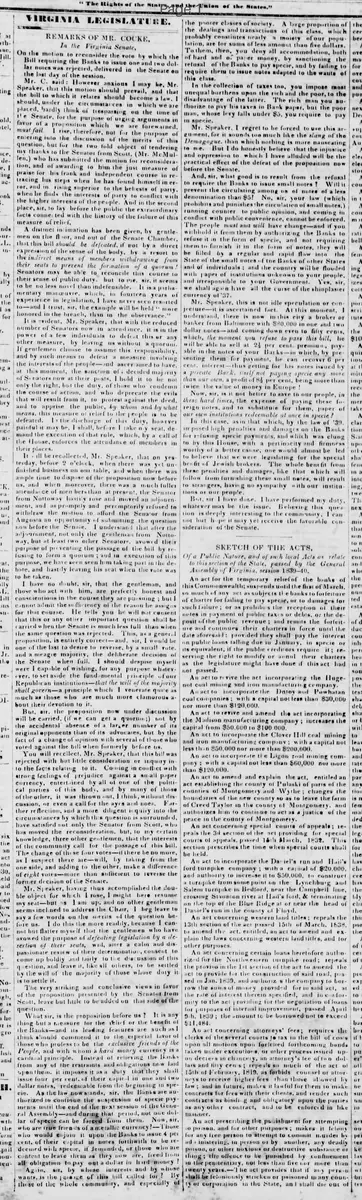
REMARKS OF MR. COCKE.
In the Virginia Senate
On the motion to reconsider the vote by which the Bill requiring the Banks to issue one and two dollar notes was rejected, delivered in the Senate on the last day of the session.
Mr. C. said: However anxious I may be, Mr. Speaker, that this motion should prevail, and that the bill to which it relates should become a law, I should, under the circumstances in which we are placed, hardly think of trespassing on the time of the Senate, for the purpose of urging arguments in favor of a proposition which we are forewarned must fail. I rise, therefore, not for the purpose of entering into the discussion of the merits of this question, but for the two fold object of tendering my thanks to the Senator from Scott, (Mr. McMullen,) who has submitted the motion for reconsideration, and of awarding to him the just measure of praise for his frank and independent course in retracing his steps when he has found himself in error, and in rising superior to the behests of party, when he finds the interests of party to conflict with the higher interests of the people. And in the second place, sir, to lay before the public the extraordinary facts connected with the history of the failure of this measure of relief.
A distinct intimation has been given, by gentlemen on the floor, and out of the Senate Chamber, that this bill should be defeated, if not by a direct expression of the sense of the body, by a resort to the indirect means of members withdrawing from their seats to prevent the formation of a quorum! Senators may be able to reconcile this course to their sense of public duty, but to me, sir, it seems to be no less novel than indefensible. It is a parliamentary manoeuvre, which, in fourteen years of experience in legislation, I have never seen resorted to—and I trust, sir, the example will be held "more honored in the breach, than in the observance."
It is evident, Mr. Speaker, that with the reduced number of Senators now in attendance, it is in the power of a few individuals to defeat this or any other measure, by leaving us without a quorum. If gentlemen choose to assume this responsibility, and by such means to defeat a measure involving the interests of the people—and ascertained to have, at this moment, the sanction of a decided majority of Senators now at their posts, I hold it to be not only the right, but the duty, of those who condemn the course of action, and who deprecate the evils that will result from it, to protest against the deed, and to apprise the public, by whom and by what means, this measure of relief to the people is to be defeated. In the discharge of this duty, however painful it may be, I shall, before I take my seat, demand the execution of that rule, which, by a call of the House, enforces the attendance of members in their places.
It will be recollected, Mr. Speaker, that on yesterday, before 2 o'clock, when there was yet unfinished business on our table, and when there was ample time to dispose of the proposition now before us, and when moreover, there was a much fuller attendance of members than at present, the Senator from Nottoway hastily rose and moved an adjournment, and as promptly and peremptorily refused to withdraw the motion to afford the Senator from Augusta an opportunity of submitting the question now before the Senate. I understand that after the adjournment, not only the gentleman from Nottoway, but at least two other Senators, avowed their purpose of preventing the passage of the bill by refusing to form a quorum; and in execution of this purpose, we have seen him taking part in the debate, and hastily leaving his seat when the vote was to be taken.
I have no doubt, sir, that the gentleman, and those who act with him, are perfectly honest and conscientious in the course they are pursuing; but I cannot admit the sufficiency of the reason he assigns for that course. He tells you he will not consent that this or any other important question shall be carried when the Senate is much less full than when the same question was rejected. This, as a general proposition, is entirely correct—and, sir, I would be one of the last to desire to reverse, by a small vote and a meagre majority, the deliberate decision of the Senate when full. I should despise myself were I capable of wishing, for any purpose whatever, to set aside the fundamental principle of our Republican institutions—that the will of the majority shall govern—a principle which I venerate quite as much as those who are much more clamorous about their devotion to it.
But, sir, the proposition now under discussion will be carried, (if we can get a quorum;) not by the accidental absence of a larger number of its original opponents than of its advocates, but by the fact of a change of opinion with several of those who voted against the bill when formerly before us.
You will recollect, Mr. Speaker, that this bill was rejected with but little consideration or inquiry into the facts relating to it. Coming in conflict with strong feelings of prejudice against a small paper currency, entertained by all of one of the political parties of this body, and by many of those of the other, it was thrown out, I think, without discussion, or even a call for the ayes and noes. Further reflection, and a more diligent inquiry into the circumstances by which this question is surrounded, have satisfied not only the Senator from Scott, who has moved the reconsideration, but, to my certain knowledge, three other gentlemen, that the interests of the community call for the passage of this bill.
The change of these four votes—if there be no more, as I suspect there are—will, by taking from the one side, and adding to the other, make a difference of eight votes—more than sufficient to reverse the former decision of the Senate.
Mr. Speaker, having thus accomplished the double object for which I rose, I might here resume my seat—but as I am up, and no other gentleman seems inclined to address the Chair, I beg leave to say a few words on the merits of the question before us. I do this the more readily, because I cannot but flatter myself that the gentlemen who have avowed the purpose of defeating legislation by a desertion of their seats, will, after a calm and dispassionate review of their determination, consent to come up boldly and fairly to the discussion of this question, and leave it, like all others, to be settled by the will of the majority of those whose duty it is to settle it.
The very striking and conclusive views in favor of the proposition presented by the Senator from Scott, leave but little to be added on that side of the question.
What sir, is the proposition before us? It is anything but a measure for the relief or the benefit of the Banks—and its leading features are such as I think should commend it to the especial favor of those who profess to be the exclusive friends of the People, and with whom a hard money currency is a cardinal principle. Instead of relieving the Banks from any of the restraints and obligations now laid upon them, it imposes it as a duty that they shall issue four per cent. of their capital in one and two dollar notes, redeemable from the beginning in specie. As the law now stands, sir, the Banks are authorized to continue the suspension of specie payments until the end of the next session of the General Assembly—and during that period, not one dollar of specie can be forced from them. Now, sir, who are true friends of a metallic currency?—Those who would enjoin it upon the Banks to issue 4 per cent. of their capital in notes forthwith to be redeemed with specie, if demanded, or those who are content to leave them as they now are, freed from all obligation to pay out a dollar in hard money?
Again, sir, by whose interests and by whose wants, is the passage of this bill called for? By those of the whole community, and especially of the poorer classes of society. A large proportion of the dealings and transactions of this class, which probably constitutes nearly a moiety of our population, are for sums of less amount than five dollars. To them, then, you deny all accommodation, both of hard and paper money, by sanctioning the refusal of the Banks to pay specie, and by failing to require them to issue notes adapted to the wants of this class.
In the collection of taxes too, you impose most unequal burdens upon the rich and the poor, to the disadvantage of the latter. The rich man you authorize to pay his taxes in Bank paper, but the poor man, whose levy falls under $5, you require to pay in specie.
Mr. Speaker, I regret to be forced to use this argument, for it sounds too much like the slang of the Demagogue, than which nothing is more nauseating to me. But I do honestly believe that the injustice and oppression to which I have alluded will be the practical effect of the defeat of the proposition now before the Senate.
And, sir, what good is to result from the refusal to require the Banks to issue small notes? Will it prevent the circulating among us of notes of a less denomination than $5? No, sir, your law (which prohibits and punishes the circulation of small notes,) running counter to public opinion, and coming in conflict with public convenience, cannot be enforced. The people must and will have change—and if you withhold it from them by authorizing the Banks to refuse it in the form of specie, and not requiring them to furnish it in the form of notes, they will be filled by a regular and rapid flow into the State of the small notes of the Banks of other States and of individuals; and the country will be flooded with paper of institutions unknown to your people, and irresponsible to your Government. Yes, sir, we shall again have all the curse of the shinplaster currency of '37.
Mr. Speaker, this is not idle speculation or conjecture—it is ascertained fact. At this moment, I understand, there is now in this city a broker or banker from Baltimore with $50,000 in one and two dollar notes—and coming down even to fifty cents, which, the moment you refuse to pass this bill, he will be able to sell at 2½ per cent. premium, payable in the notes of your Banks—in which, by presenting them for payment, he can recover 6 per cent. interest—thus getting for his notes issued by a private Bank, itself not paying specie any more than our own, a profit of 8½ per cent, being more than twice the value of money in Europe!
Now, sir, is it not better to save to our people, in these hard times, the expense of paying these foreign notes, and to substitute for them, paper of our own institutions redeemable at once in specie?
In this case, as in that which, by the law of '39, imposed high penalties and damages on the Banks for refusing specie payments, and which was clung to by this House, with a pertinacity and firmness worthy of a better cause, one would almost be led to believe that we were legislating for the special benefit of Jewish brokers. The whole benefit from these penalties and damages, like that which will follow from furnishing these small notes, will result to strangers, having no sympathy with our institutions or our people.
But, sir, I have done. I have performed my duty, whatever may be the issue. Believing this question is deeply interesting to the community, I cannot but hope I may yet receive the favorable consideration of the Senate.
What sub-type of article is it?
What themes does it cover?
What keywords are associated?
What entities or persons were involved?
Where did it happen?
Story Details
Key Persons
Location
Virginia Senate
Event Date
Last Day Of The Session
Story Details
Mr. Cocke speaks in favor of reconsidering a bill requiring banks to issue small denomination notes redeemable in specie, praises Mr. McMullen for changing his vote, condemns quorum evasion by opponents, and argues the bill aids the poor, ensures metallic currency, and prevents influx of foreign small notes.