Thank you for visiting SNEWPapers!
Sign up free
Story
February 22, 1869
The Evening Telegraph
Philadelphia, Philadelphia County, Pennsylvania
What is this article about?
The New York Tribune critiques Dion Boucicault's defense of T.W. Robertson's drama 'School' as original, arguing Boucicault misinterprets Horace's 'Ars Poetica' to claim legitimate drama forbids originality, while Horace actually praises Roman innovation and warns of imitation's pitfalls.
Clipping
OCR Quality
98%
Excellent
Full Text
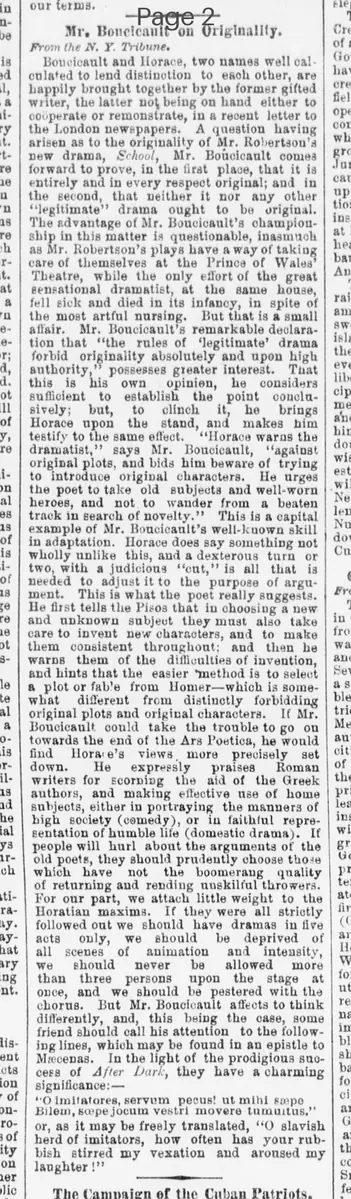
Mr. Boucicault on Originality.
From the N. Y. Tribune.
Boucicault and Horace, two names well calculated to lend distinction to each other, are happily brought together by the former gifted writer, the latter not being on hand either to cooperate or remonstrate, in a recent letter to the London newspapers. A question having arisen as to the originality of Mr. Robertson's new drama, School, Mr. Boucicault comes forward to prove, in the first place, that it is entirely and in every respect original; and in the second, that neither it nor any other 'legitimate' drama ought to be original.
The advantage of Mr. Boucicault's championship in this matter is questionable, inasmuch as Mr. Robertson's plays have a way of taking care of themselves at the Prince of Wales Theatre, while the only effort of the great sensational dramatist, at the same house, fell sick and died in its infancy, in spite of the most artful nursing. But that is a small affair. Mr. Boucicault's remarkable declaration that 'the rules of 'legitimate' drama forbid originality absolutely and upon high authority,' possesses greater interest. That this is his own opinion, he considers sufficient to establish the point conclusively; but, to clinch it, he brings Horace upon the stand, and makes him testify to the same effect. 'Horace warns the dramatist,' says Mr. Boucicault, 'against original plots, and bids him beware of trying to introduce original characters. He urges the poet to take old subjects and well-worn heroes, and not to wander from a beaten track in search of novelty.' This is a capital example of Mr. Boucicault's well-known skill in adaptation. Horace does say something not wholly unlike this, and a dexterous turn or two, with a judicious 'cut,' is all that is needed to adjust it to the purpose of argument. This is what the poet really suggests. He first tells the Pisos that in choosing a new and unknown subject they must also take care to invent new characters, and to make them consistent throughout; and then he warns them of the difficulties of invention, and hints that the easier method is to select a plot or fable from Homer—which is somewhat different from distinctly forbidding original plots and original characters. If Mr. Boucicault could take the trouble to go on towards the end of the Ars Poetica, he would find Horace's views more precisely set down.
He expressly praises Roman writers for scorning the aid of the Greek authors, and making effective use of home subjects, either in portraying the manners of high society (comedy), or in faithful representation of humble life (domestic drama). If people will hurl about the arguments of the old poets, they should prudently choose those which have not the boomerang quality of returning and rending unskilful throwers.
For our part, we attach little weight to the Horatian maxims. If they were all strictly followed out we should have dramas in five acts only, we should be deprived of all scenes of animation and intensity, we should never be allowed more than three persons upon the stage at once, and we should be pestered with the chorus. But Mr. Boucicault affects to think differently, and, this being the case, some friend should call his attention to the following lines, which may be found in an epistle to Maecenas. In the light of the prodigious success of After Dark, they have a charming significance:-
'O imitatores, servum pecus! ut mihi saepe
Bilem, saepe jocum vestri movere tumultus.'
or, as it may be freely translated, 'O slavish herd of imitators, how often has your rubbish stirred my vexation and aroused my laughter!'
From the N. Y. Tribune.
Boucicault and Horace, two names well calculated to lend distinction to each other, are happily brought together by the former gifted writer, the latter not being on hand either to cooperate or remonstrate, in a recent letter to the London newspapers. A question having arisen as to the originality of Mr. Robertson's new drama, School, Mr. Boucicault comes forward to prove, in the first place, that it is entirely and in every respect original; and in the second, that neither it nor any other 'legitimate' drama ought to be original.
The advantage of Mr. Boucicault's championship in this matter is questionable, inasmuch as Mr. Robertson's plays have a way of taking care of themselves at the Prince of Wales Theatre, while the only effort of the great sensational dramatist, at the same house, fell sick and died in its infancy, in spite of the most artful nursing. But that is a small affair. Mr. Boucicault's remarkable declaration that 'the rules of 'legitimate' drama forbid originality absolutely and upon high authority,' possesses greater interest. That this is his own opinion, he considers sufficient to establish the point conclusively; but, to clinch it, he brings Horace upon the stand, and makes him testify to the same effect. 'Horace warns the dramatist,' says Mr. Boucicault, 'against original plots, and bids him beware of trying to introduce original characters. He urges the poet to take old subjects and well-worn heroes, and not to wander from a beaten track in search of novelty.' This is a capital example of Mr. Boucicault's well-known skill in adaptation. Horace does say something not wholly unlike this, and a dexterous turn or two, with a judicious 'cut,' is all that is needed to adjust it to the purpose of argument. This is what the poet really suggests. He first tells the Pisos that in choosing a new and unknown subject they must also take care to invent new characters, and to make them consistent throughout; and then he warns them of the difficulties of invention, and hints that the easier method is to select a plot or fable from Homer—which is somewhat different from distinctly forbidding original plots and original characters. If Mr. Boucicault could take the trouble to go on towards the end of the Ars Poetica, he would find Horace's views more precisely set down.
He expressly praises Roman writers for scorning the aid of the Greek authors, and making effective use of home subjects, either in portraying the manners of high society (comedy), or in faithful representation of humble life (domestic drama). If people will hurl about the arguments of the old poets, they should prudently choose those which have not the boomerang quality of returning and rending unskilful throwers.
For our part, we attach little weight to the Horatian maxims. If they were all strictly followed out we should have dramas in five acts only, we should be deprived of all scenes of animation and intensity, we should never be allowed more than three persons upon the stage at once, and we should be pestered with the chorus. But Mr. Boucicault affects to think differently, and, this being the case, some friend should call his attention to the following lines, which may be found in an epistle to Maecenas. In the light of the prodigious success of After Dark, they have a charming significance:-
'O imitatores, servum pecus! ut mihi saepe
Bilem, saepe jocum vestri movere tumultus.'
or, as it may be freely translated, 'O slavish herd of imitators, how often has your rubbish stirred my vexation and aroused my laughter!'
What sub-type of article is it?
Literary Criticism
Dramatic Debate
What themes does it cover?
Deception
Moral Virtue
What keywords are associated?
Dramatic Originality
Boucicault
Robertson
Horace
Ars Poetica
Imitation
Legitimate Drama
What entities or persons were involved?
Mr. Boucicault
Mr. Robertson
Horace
Where did it happen?
Prince Of Wales Theatre, London
Story Details
Key Persons
Mr. Boucicault
Mr. Robertson
Horace
Location
Prince Of Wales Theatre, London
Story Details
Critique of Boucicault's letter defending Robertson's 'School' as original while claiming legitimate drama forbids originality, misinterpreting Horace's advice in 'Ars Poetica' which praises Roman innovation over Greek imitation and warns against slavish copying.