Thank you for visiting SNEWPapers!
Sign up free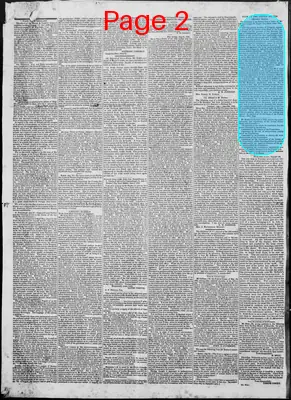
Editorial
September 3, 1831
Alabama State Intelligencer
Tuscaloosa, Tuscaloosa County, Alabama
What is this article about?
Editorial quotes Thomas Jefferson's 1813 letter opposing renewal of the Bank of the United States charter on constitutional grounds, critiques James Madison for later supporting it, and reprints Madison's 1791 speech against the bank's constitutionality.
Clipping
OCR Quality
92%
Excellent
Full Text
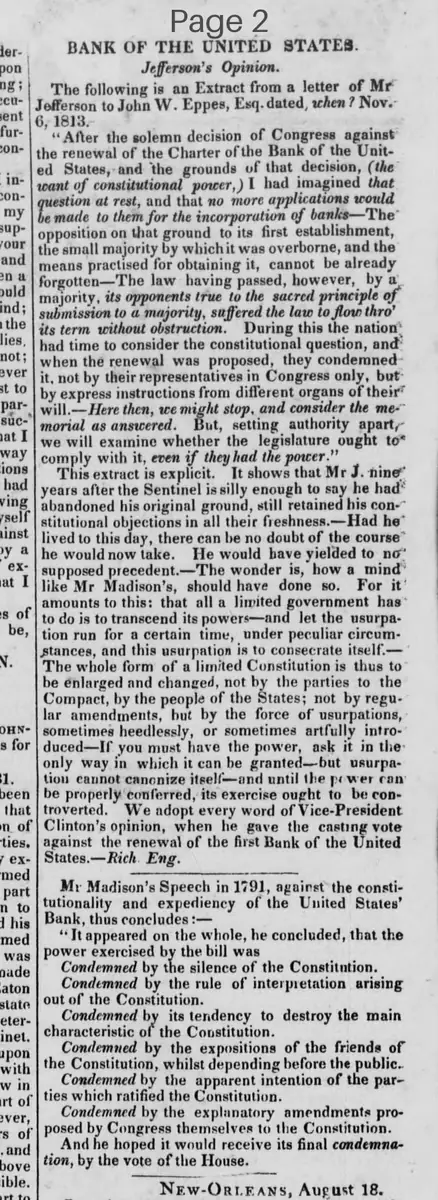
BANK OF THE UNITED STATES.
Jefferson's Opinion.
The following is an Extract from a letter of Mr Jefferson to John W. Eppes, Esq. dated, Washington, Nov. 6, 1813.
"After the solemn decision of Congress against the renewal of the Charter of the Bank of the United States, and the grounds of that decision, (the want of constitutional power,) I had imagined that question at rest, and that no more applications would be made to them for the incorporation of banks—The opposition on that ground to its first establishment, the small majority by which it was overborne, and the means practised for obtaining it, cannot be already forgotten— The law having passed, however, by a majority, its opponents true to the sacred principle of submission to a majority, suffered the law to run through its term without obstruction. During this the nation had time to consider the constitutional question, and when the renewal was proposed, they condemned it, not by their representatives in Congress only, but by express instructions from different organs of their will.-Here then, we might stop, and consider the memorial as answered. But, setting authority apart, we will examine whether the legislature ought to comply with it, even if they had the power.'
This extract is explicit. It shows that Mr J. nine years after the Sentinel is silly enough to say he had abandoned his original ground, still retained his constitutional objections in all their freshness.-Had he lived to this day, there can be no doubt of the course he would now take. He would have yielded to no supposed precedent.-The wonder is, how a mind like Mr Madison's. should have done so. For it amounts to this: that all a limited government has to do is to transcend its powers-and let the usurpation run for a certain time, under peculiar circumstances. and this usurpation is to consecrate itself.— The whole form of a limited Constitution is thus to be enlarged and changed, not by the parties to the Compact, by the people of the States; not by regular amendments, but by the force of usurpations, sometimes heedlessly, or sometimes artfully introduced-If you must have the power, ask it in the only way in which it can be granted-but usurpation cannot canonize itself-and until the power can be properly conferred. its exercise ought to be controverted. We adopt every word of Vice-President Clinton's opinion, when he gave the casting vote against the renewal of the first Bank of the United States.-Rich Eng.
Mr Madison's Speech in 1791, against the constitutionality and expediency of the United States Bank, thus concludes:-
"It appeared on the whole, he concluded, that the power exercised by the bill was
Condemned by the silence of the Constitution.
Condemned by the rule of interpretation arising out of the Constitution.
Condemned by its tendency to destroy the main characteristic of the Constitution.
Condemned by the expositions of the friends of the Constitution, whilst depending before the public.
Condemned by the apparent intention of the parties which ratified the Constitution.
Condemned by the explanatory amendments proposed by Congress themselves to the Constitution.
And he hoped it would receive its final condemnation, by the vote of the House."
Jefferson's Opinion.
The following is an Extract from a letter of Mr Jefferson to John W. Eppes, Esq. dated, Washington, Nov. 6, 1813.
"After the solemn decision of Congress against the renewal of the Charter of the Bank of the United States, and the grounds of that decision, (the want of constitutional power,) I had imagined that question at rest, and that no more applications would be made to them for the incorporation of banks—The opposition on that ground to its first establishment, the small majority by which it was overborne, and the means practised for obtaining it, cannot be already forgotten— The law having passed, however, by a majority, its opponents true to the sacred principle of submission to a majority, suffered the law to run through its term without obstruction. During this the nation had time to consider the constitutional question, and when the renewal was proposed, they condemned it, not by their representatives in Congress only, but by express instructions from different organs of their will.-Here then, we might stop, and consider the memorial as answered. But, setting authority apart, we will examine whether the legislature ought to comply with it, even if they had the power.'
This extract is explicit. It shows that Mr J. nine years after the Sentinel is silly enough to say he had abandoned his original ground, still retained his constitutional objections in all their freshness.-Had he lived to this day, there can be no doubt of the course he would now take. He would have yielded to no supposed precedent.-The wonder is, how a mind like Mr Madison's. should have done so. For it amounts to this: that all a limited government has to do is to transcend its powers-and let the usurpation run for a certain time, under peculiar circumstances. and this usurpation is to consecrate itself.— The whole form of a limited Constitution is thus to be enlarged and changed, not by the parties to the Compact, by the people of the States; not by regular amendments, but by the force of usurpations, sometimes heedlessly, or sometimes artfully introduced-If you must have the power, ask it in the only way in which it can be granted-but usurpation cannot canonize itself-and until the power can be properly conferred. its exercise ought to be controverted. We adopt every word of Vice-President Clinton's opinion, when he gave the casting vote against the renewal of the first Bank of the United States.-Rich Eng.
Mr Madison's Speech in 1791, against the constitutionality and expediency of the United States Bank, thus concludes:-
"It appeared on the whole, he concluded, that the power exercised by the bill was
Condemned by the silence of the Constitution.
Condemned by the rule of interpretation arising out of the Constitution.
Condemned by its tendency to destroy the main characteristic of the Constitution.
Condemned by the expositions of the friends of the Constitution, whilst depending before the public.
Condemned by the apparent intention of the parties which ratified the Constitution.
Condemned by the explanatory amendments proposed by Congress themselves to the Constitution.
And he hoped it would receive its final condemnation, by the vote of the House."
What sub-type of article is it?
Constitutional
Economic Policy
What keywords are associated?
Bank Of The United States
Constitutional Power
Jefferson Letter
Madison Speech
Charter Renewal
Usurpation
What entities or persons were involved?
Thomas Jefferson
James Madison
John W. Eppes
Congress
Bank Of The United States
Vice President Clinton
Editorial Details
Primary Topic
Opposition To Renewal Of Bank Of The United States Charter On Constitutional Grounds
Stance / Tone
Strongly Anti Bank Constitutionality, Critical Of Madison's Reversal
Key Figures
Thomas Jefferson
James Madison
John W. Eppes
Congress
Bank Of The United States
Vice President Clinton
Key Arguments
Congress Lacks Constitutional Power To Charter The Bank
Opponents Submitted To Majority But Opposed Renewal
Usurpation Cannot Legitimize Itself Through Time Or Precedent
Constitution Should Be Amended Properly For Such Powers
Madison's 1791 Speech Condemns Bank On Multiple Constitutional Grounds