Thank you for visiting SNEWPapers!
Sign up free
Alexandria Daily Advertiser
Alexandria, Virginia
What is this article about?
Excerpt from Aaron Burr's trial in Richmond on October 2, 1807, featuring examination of Commodore Shaw on letters from General Jackson to Governor Claiborne, rumors of threats to New Orleans, defenses, and cross-examination; followed by debate on grand juror Littleton W. Tazewell's testimony regarding General Wilkinson's statements on cyphers and letters to Burr.
Merged-components note: This is a continuation of the trial of Colonel A. Burr story from page 2 to page 3, as indicated by the direct textual continuation and '(To be continued)'. The second component was mislabeled as domestic_news; merge into story.
Clippings
1 of 2
OCR Quality
Full Text
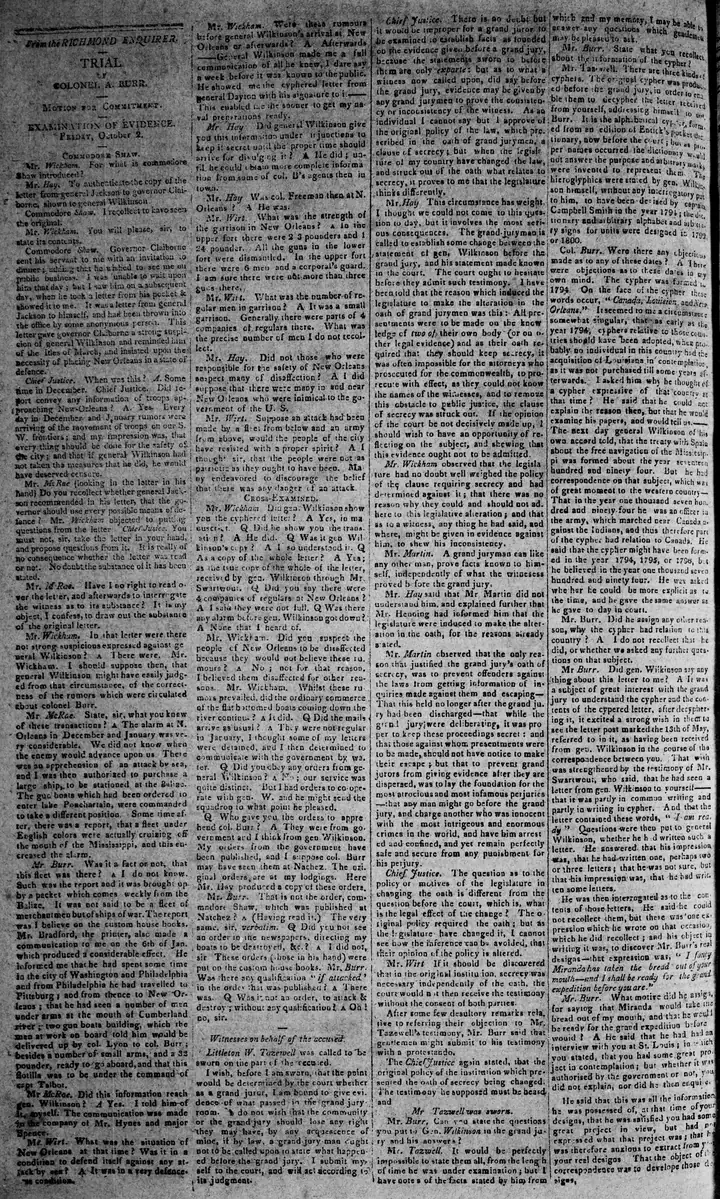
TRIAL
COLONEL A. BURR.
MOTION FOR COMMITMENT
EXAMINATION OF EVIDENCE
Friday October 2.
Court. On Shaw.
Mr. Wickham. For what is commitment?
Mr. Hay. No authentication to the copy of the letter from general Jackson to governor Claiborne shown to general Wilkinson.
Shaw introduced?
Letter from general Jackson to governor Claiborne shown to general Wilkinson.
Commodore Shaw. I recollect to have seen the original.
Mr. Hay. You will please, sir, to state its contents.
Commodore Shaw. Governor Claiborne sent his servant to me with an invitation to dinner; and that he wished to see me on public business. I was unable to wait upon him that day; but I saw him on a subsequent day, when he took a letter from his pocket and showed it to me. It was a letter from general Jackson to himself, and had been thrown into the office by some anonymous person. This letter gave governor Claiborne a strong suspicion of general Wilkinson and reminded him of the Ides of March, and insisted upon the necessity of placing New Orleans in a state of defence.
Chief Justice. When was this? A. Some time in December. Chief Justice. Did he report any information of troops approaching New-Orleans? A. Yes. Every day in December and January rumors were arriving of the movement of troops on our S. W. frontiers; and my impression was, that every thing should be done for the safety of the city; and that if general Wilkinson had not taken the measures that he did, he would have deserved censure.
Mr. McRae (looking in the letter in his hand). Do you recollect whether general Jackson recommended in his letter, that the governor should use every possible means of defence? Mr. Wickham objected to putting questions from the letter. Chief Justice. You must not, sir, take the letter in your hand, and propose questions from it. It is really of no consequence whether the letter was read or not. No doubt the substance of it has been stated.
Mr. McRae. Have I no right to read over the letter, and afterwards to interrogate the witness as to its substance? It is my object, I confess, to draw out the substance of the original letter.
Mr. Wickham. In that letter were there not strong suspicions expressed against general Wilkinson? A. There were. Mr. Wickham. I should suppose then, that general Wilkinson might have easily judged from that circumstance, of the correctness of the rumors which were circulated about colonel Burr.
Mr. McRae. State, sir, what you know of these transactions? A. The alarm at New Orleans in December and January was very considerable. We did not know when the enemy would advance upon us. There was an apprehension of an attack by sea, and I was then authorized to purchase a large ship, to be stationed at the Balize. The gun boats which had been ordered into Lake Ponchartrain, were commanded to take a different position. Some time after, there was a report, that a fleet under English colors were actually cruising off the mouth of the Mississippi, and this increased the alarm.
Mr. Burr. Was it a fact or not, that this fleet was there? A. I do not know. Such was the report and it was brought up by a packet which comes weekly from the Balize. It was but said to be a fleet of merchantmen but of ships of war. The report as I believe on the custom house books.
Mr. Bradford, the printer, also made a communication to me on the 6th of Jan. which produced a considerable effect. He informed me that he had spent some time in the city of Washington and Philadelphia and from Philadelphia he had travelled to Pittsburgh; and from thence to New Orleans; that he had seen a number of men under arms at the mouth of Cumberland river: two gun boats building, which the men at work on board told him would be delivered up by col. Lyon to col. Burr; besides a number of small arms, and a 33 pounder, ready to go aboard, and that this flotilla was to be under the command of capt. Talbot.
Mr. McRae. Did this information reach Gen. Wilkinson? A. Yes. I told him of it myself: The communication was made to the company of Mr. Hynes and major Bowyer.
Mr. Wirt. What was the situation of New Orleans at that time? Was it in a condition to defend itself against any attack by sea? It was in a very defenceless
Before general Wilkinson's arrival at New Orleans or afterwards. General Wilkinson made me a full communication of all he knew. I dare say a week before it was known to the public. He showed me the cyphered letter from general Dayton with his signature to it. This enabled me the sooner to get my own preparations ready.
Mr. Hay. Did general Wilkinson give you this information under injunctions to keep it secret until the proper time should arrive for divulging it? He did; until he could obtain more complete information from some of col. B's agents then in town.
Mr. Hay. Was col. Freeman then at New Orleans? A. He was.
Mr. Wirt. What was the strength of the garrison in New Orleans? A. In the upper fort there were 2 3 pounders and 1 24 pounder. All the guns in the lower fort were dismounted. In the upper fort there were 6 men and a corporal's guard. I am sure there were not more than three guns there.
Mr. Wirt. What was the number of regular men in garrison? A. It was a small garrison. Generally there were parts of 4 companies of regulars there. What was the precise number of men I do not recollect.
Mr. Hay. Did not those who were responsible for the safety of New Orleans suspect many of disaffection? A. I did suppose that there were many in and near New Orleans who were inimical to the government of the U. S.
Mr. Wirt. Suppose an attack had been made by a fleet from below and an army from above, would the people of the city have resisted with a proper spirit? A. I thought, sir, that the people were not as patriotic as they ought to have been. Many endeavored to discourage the belief that there was any danger of an attack.
CROSS-EXAMINED.
Mr. Wickham. Did gen. Wilkinson show you the cyphered letter? A. Yes, in my own house. Q. Did he show you the translation? A. He did. Q. Was it gen. Wilkinson's copy? A. I so understood it. Q. As a copy of the whole letter? A. Yes: as the true copy of the whole of the letter, received by gen. Wilkinson through Mr. Swartwout. Q. Did you say there were 4 companies of regulars at New Orleans? A. I said they were not full. Q. Was there any alarm before gen. Wilkinson got down? A. None that I heard of.
Mr. Wickham. Did you suspect the people of New Orleans to be disaffected because they would not believe these rumors? A. No, not for that reason. I believed them disaffected for other reasons. Mr. Wickham. Whilst these rumors prevailed, did the ordinary commerce of the flat bottomed boats coming down the river continue? A. It did. Q. Did the mails arrive as usual? A. They were not regular in January, I thought some of my letters were detained, and I then determined to communicate with the government by water. Q. Did you obey any orders from general Wilkinson? A. No; our service was quite distinct. But I had orders to co-operate with gen. W. and he might send the squadron to what point he pleased.
Q. Who gave you the orders to apprehend col. Burr? A. They were from government and I think from gen. Wilkinson. My orders from the government have been published, and I suppose col. Burr may have seen them at Natchez. The original orders are at my lodgings. Here Mr. Hay produced a copy of these orders.
Mr. Burr. That is not the order, commodore Shaw, which was published at Natchez? A. (Having read it.) The very same, sir, verbatim. Q. Did you not see an order in the newspapers, directing my boats to be destroyed, &c.? A. I did not, sir. These orders (those in his hand) were put on the custom house books. Mr. Burr. Was there any qualification 'if attacked' in the order that was published? A. There was. Q. Was it not an order, to attack & destroy; without any qualification? A. Oh! no, sir.
Witnesses on behalf of the accused
Littleton W. Tazewell was called to be sworn on the part of the accused.
I wish, before I am sworn, that the point would be determined by the court whether as a grand juror, I am bound to give evidence of what passed in the grand jury room. I do not wish that the community or the grand jury should lose any right they may have, by any argument of mine if by law, a grand jury-man ought not to be called upon to state what happened before the grand jury. I submit myself to the court, and will act accordingly to its judgment.
Chief Justice. There is no doubt but it would be improper for a grand juror to be examined to establish facts as founded on the evidence given before grand jury, because the statements sworn to, before them are only ex parte, but as to what a witness now called upon, did say before the grand jury, evidence may be given by any grand juryman to prove the consistency or inconsistency of the witness. As an individual I cannot say but I approve of the original policy of the law, which is ascribed in the oath of grand jurymen, a clause of secrecy but when the legislature of my country have changed the law and struck out of the oath what relates to secrecy, it proves to me that the legislature thinks differently.
Mr. Hay. This circumstance has weight. I thought we could not come to this question to day, but it involves the most serious consequences. The grand-juryman is called to establish some change between the statement of gen. Wilkinson before the grand jury, and his statement made known in the court. The court ought to hesitate before they admit such testimony. I have been told that the reason which induced the legislature to make the alteration in the oath of grand jurymen was this: All presentments were to be made on the knowledge of two of their own body (or on other legal evidence) and as their oath required that they should keep secrecy, it was often impossible for the attorneys who prosecuted for the commonwealth, to prosecute with effect, as they could not know the names of the witnesses, and to remove this obstacle to public justice, the clause of secrecy was struck out. If the opinion of the court be not decisively made up, I should wish to have an opportunity of reflecting on the subject, and shewing that this evidence ought not to be admitted.
Mr. Wickham observed that the legislature had no doubt well weighed the policy of the clause requiring secrecy and had determined against it; that there was no reason why they could and should not adhere to this legislative alteration: and that as to a witness, any thing he had said, and where, might be given in evidence against him, to shew his inconsistency.
Mr. Martin. A grand juryman can like any other man, prove facts known to himself, independently of what the witnesses proved before the grand jury.
Mr. Hay said that Mr. Martin did not understand him, and explained further that Mr. Henning had informed him that the legislature were induced to make the alteration in the oath, for the reasons already stated.
Mr. Martin observed that the only reason that justified the grand jury's oath of secrecy, was to prevent offenders against the laws from getting information of inquiries made against them and escaping. That this held no longer after the grand jury had been discharged-that while the grand jury were deliberating, it was proper to keep these proceedings secret: and that those against whom presentments were to be made, should not have notice to make their escape; but that to prevent grand jurors from giving evidence after they are dispersed, was to lay the foundation for the most atrocious and most infamous perjuries-that any man might go before the grand jury, and charge another who was innocent with the most outrageous and enormous crimes in the world, and have him arrested and confined, and yet remain perfectly safe and secure from any punishment for his perjury.
Chief Justice. The question as to the policy or motives of the legislature in changing the oath is different from the question before the court, which is, what is the legal effect of the change? The original policy required the oath; but as the legislature have changed it, I cannot see how the inference can be avoided, that their opinion of the policy is altered.
Mr. Wirt. If it should be discovered that in the original institution, secrecy was necessary independently of the oath, the court would not then receive the testimony without the consent of both parties.
After some few desultory remarks relative to referring their objection to Mr. Tazewell's testimony, Mr. Burr said that gentlemen might submit to his testimony with a protestation.
The Chief Justice again stated, that the original policy of the institution which prescribed the oath of secrecy being changed, the testimony he supposed must be heard and
Mr. Tazewell was sworn.
Mr. Burr: Can you state the questions you put to Gen. Wilkinson in the grand jury and his answers?
Mr. Tazewell. It would be perfectly impossible to state them all, from the length of time he was under examination; but I have notes of the facts stated by him from which, and my memory, may be able to answer any questions which gentlemen may be pleased to ask.
Mr. Burr. State what you recollect about the information of the cypher?
Mr. Tazewell. There are three kinds of cyphers. The general cypher was produced before the grand jury, in order to enable them to decypher the letter received from yourself, addressing himself to col. Burr. It is the alphabetical cypher, formed from an edition of Entick's pocket dictionary, now before the court; but as proper names occurred the dictionary would not answer the purpose and arbitrary marks were invented to represent them. The hieroglyphics were stated by gen. Wilkinson himself, without any interrogatory put to him, to have been devised by captain Campbell Smith in the year 1791; the dictionary and arbitrary alphabet and arbitrary signs for units were designed in 1799 or 1800.
Col. Burr. Were there any objections made as to any of these dates? A. There were objections-as to these dates in my own mind. The cypher was formed in 1794. On the face of the cypher these words occur, "Canada, Louisiana, and New Orleans."- It seemed to me a circumstance somewhat singular, that as early as the year 1794, cyphers relative to those countries should have been adopted, when probably no individual in this country had the acquisition of Louisiana in contemplation as it was not purchased till some years afterwards. I asked him why he thought of a cypher expressive of that country at that time? He said that he could not explain the reason then, but that he would examine his papers, and would tell us.
The next day general Wilkinson of his own accord told, that the treaty with Spain about the free navigation of the Mississippi was formed about the year seventeen hundred and ninety four. But he had correspondence on that subject, which was of great moment to the western country. That in the year one thousand seven hundred and ninety four he was an officer in the army, which marched near Canada against the Indians, and thus therefore part of the cypher had relation to Canada. He said that the cypher might have been formed in the year 1794, 1795, or 1796, but he believed in the year one thousand seven hundred and ninety four. He was asked whether he could be more explicit as to the time, and he gave the same answer as he gave to day in court.
Mr. Burr. Did he assign any other reason, why the cypher had relation to this country? A. I do not recollect that he did, or whether we asked any further questions on that subject.
Mr. Burr. Did gen. Wilkinson say anything about this letter to me? A. It was a subject of great interest with the grand jury to understand the cypher and the contents of the cyphered letter, after decyphering it, it excited a strong wish in them to see the letter post marked the 13th of May, referred to in it, as having been received from gen. Wilkinson in the course of the correspondence between you. That wish was strengthened by the testimony of Mr. Swartwout, who said, that he had seen a letter from gen. Wilkinson to yourself-that it was partly in common writing and partly in writing in cypher. And that the letter contained these words, "I am ready". Questions were then put to general Wilkinson, whether he had written such a letter. He answered that his impression was, that he had written one, perhaps two or three letters; that he was not sure, but that his impression was, that he had written some letters.
He was then interrogated as to the contents of those letters. He said he could not recollect them, but there was one expression which he wrote on that occasion, which he did recollect; and his object in writing it was, to discover Mr. Burr's real designs that expression was, "I once Miranda has taken the bread out of your mouth-and I shall be ready for the grand expedition before you are."
be ready for the grand expedition before bread out of my mouth, and that he would for saying that Miranda would take the
Mr. Burr. What motive did he assign would I? A. He said that he had had an interview with you at St. Louis; in which subject in contemplation; but whether it was you stated, that you had some great project authorised by the government or not, you did not explain, nor did he then enquire.
He said that this was all the information he was possessed of, at that time of your designs, that he was satisfied you had some great project in view, but had no expressed what that project was; that he your real designs That the object of (l was therefore anxious to extract from y correspondence was to develope those d sigus,
Burr. Did he assign any reason? The avowed object was to communicate recollection that he did, or did not think to develop my designs to the government.
(To be continued)
What sub-type of article is it?
What themes does it cover?
What keywords are associated?
What entities or persons were involved?
Where did it happen?
Story Details
Key Persons
Location
Richmond; New Orleans
Event Date
Friday October 2
Story Details
Trial proceedings include examination of Commodore Shaw on Jackson's letter suspecting Wilkinson, rumors of attacks on New Orleans, defensive preparations, and orders to apprehend Burr; debate on grand juror Tazewell's testimony revealing Wilkinson's statements on cyphers, letters to Burr, and Burr's alleged projects.