Thank you for visiting SNEWPapers!
Sign up free
Literary
March 14, 1933
The Key West Citizen
Key West, Monroe County, Florida
What is this article about?
In 'Giant Dust' by Percival Christopher Wren, Chapter 32 depicts Margaret Maliont, fearing Raisul in Mekazzen, seeking aid from German agent Herr Schlacht. He gives her a pistol and asks her to spy on gossip and entice French Major Riccoli to reveal ambitions by mentioning Aurelie de Tounens, hinting at a new kingdom.
Clipping
OCR Quality
98%
Excellent
Full Text
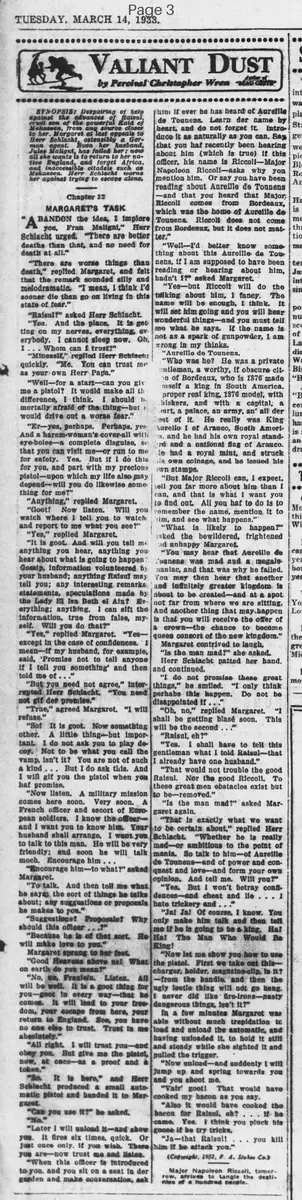
GIANT DUST
by Percival Christopher Wren
SYNOPSIS: Despairing of help against the advances of Raisul, cruel son of the powerful Raid of Mekazzen, from any source closer to her, Margaret at last appeals to Herr Schlacht. Ostensibly a German agent. Even her husband, Jules Maliont, has failed her; now all she wants is to return to her native England, and forget Africa and inaccessible citadels such as Mekazzen. Herr Schlacht warns her against trying to escape alone.
Chapter 32
Margaret's Task
"Abandon the idea, I implore you, Frau Maligni," Herr Schlacht urged.
"There are better deaths than that, and no need for death at all."
"There are worse things than death," replied Margaret, and felt that the remark sounded silly and melodramatic. "I mean, I think I'd sooner die than go on living in this state of fear."
"Raisul?" asked Herr Schlacht.
"Yes. And the place. It is getting on my nerves, everything, everybody. I cannot sleep now. Oh, I... Whom can I trust?"
"Myself," replied Herr Schlacht quickly. "Me. You can trust me as your own Herr Papa."
"Well—for a start—can you give me a pistol? It would make all the difference, I think. I should be mortally afraid of the thing—but it would drive out a worse fear."
"Er—yes, perhaps. Perhaps, yes. And a harem-woman's cover-all with eye-holes—a complete disguise, so that you can visit me—or run to me for safety. Yes. But if I do this for you, and part with my precious pistol—upon which my life also may depend—will you do likewise something for me?"
"Anything," replied Margaret.
"Good! Now listen. Will you watch where I tell you to watch and report to me what you see?"
"Yes," replied Margaret.
"It is good. And will you tell me anything you hear, anything you hear about what is going to happen: Gossip, information volunteered by your husband; anything Raisul may tell you; any interesting remarks, statements, speculations made by the Lady El Isa Beth el Ain? Everything; anything. I can sift the information, true from false, myself. Will you do that?"
"Yes," replied Margaret. "Yes, except in the case of confidences. I mean—if my husband, for example, said, 'Promise not to tell anyone if I tell you something' and then told me of..."
"But you need not agree," interrupted Herr Schlacht. "You need not give the promise."
"True," agreed Margaret. "I will refuse."
"So! It is good. Now something other. A little thing—but important. I do not ask you to play decoy. Not to be what you call the vamp, isn't it? You are not of such a kind... But I do ask this. And I will give you the pistol when you have promised.
"Now listen. A military mission comes here soon. Very soon. A French officer and escort of European soldiers. I know the officer—and I want you to know him. Your husband shall arrange. I want you to talk to this man. He will be very friendly: and soon he will talk much. Encourage him...
"Encourage him—to what?" asked Margaret.
"To talk. And then tell me what he says: the sort of things he talks about; any suggestions or proposals he makes to you."
"Suggestions? Proposals? Why should this officer...?"
"Because he is of that sort. He will make love to you."
Margaret sprang to her feet.
"Good Heavens above us! What on earth do you mean?"
"No, no. Fraulein. Listen. All will be well. It is a good thing for you—good in every way—that he comes. It will lead to your freedom, your escape from here, your return to England. See. You have no one else to trust. Trust in me absolutely."
"All right. I will trust you—and obey you. But give me the pistol, now, at once—as a proof and a token."
"So. It is here," and Herr Schlacht produced a small automatic pistol and handed it to Margaret.
"Can you use it?" he asked.
"No."
"Later I will unload it—and show you. It fires six times, quick. Or just once only. If you wish. There you are—now trust me and listen.
"When this officer is introduced to you, and you sit on a seat in the garden and make conversation, ask him if ever he has heard of Aurelie de Tounens. Learn the name by heart, and do not forget it. Introduce it as naturally as you can. Say that you have recently been hearing about him (which is true if this officer, his name is Riccoli—Major Napoleon Riccoli—asks why you mention him). Or say you have been reading about Aurelie de Tounens—and that you heard that Major Riccoli comes from Bordeaux, which was the home of Aurelie de Tounens. Riccoli does not come from Bordeaux, but it does not matter."
"Well, I'd better know something about this Aurelie de Tounens, if I am supposed to have been reading, or hearing about him, hadn't I?" asked Margaret.
"Yes—but Riccoli will do the talking about him, I fancy. The name will be enough, I think. It will set him going and you will hear wonderful things—and you must tell me what he says. If the name is not as a spark of gunpowder, I am wrong in my thinks."
"Aurelie de Tounens.
"Who was he? He was a private gentleman, a worthy, if obscure citizen of Bordeaux, who in 1876 made himself a king in South America. A proper real king, 1876 model, with whiskers, and with a capital; a court, a palace, an army, and all the rest of it. He really was King Orelie I of Araucania, South America, and he had his own royal standard and a national flag of Araucania. He had a royal mint, and struck his own coinage, and he issued his own stamps.
"But Major Riccoli can, I expect, tell you far more about him than I can, and that is what I want you to find out. All you have to do is to remember the name, mention it to him, and see what happens."
"What is likely to happen?" asked the bewildered, frightened and unhappy Margaret.
"You may hear that Aurelie de Tounens was mad and a megalomaniac, and that was why he failed. You may then hear that another and infinitely greater kingdom is about to be created—and at a spot not far from where we are sitting. And another thing that may happen is that you will receive the offer of a crown—the chance to become queen consort of the new kingdom."
Margaret contrived to laugh.
"Is the man mad?" she asked.
Herr Schlacht patted her hand, and continued.
"I do not promise these great things," he smiled. "I only think perhaps this happen. Do not be disappointed if..."
"Oh, no," replied Margaret. "I shall be getting blase soon. This will be the second..."
"Raisul, eh?"
"Yes. I shall have to tell this gentleman what I told Raisul—that I already have one husband."
"That would not trouble the good Raisul. Nor the good Riccoli. To these great men obstacles exist but to be removed."
"Is the man mad?" asked Margaret again.
"That is exactly what we want to be certain about," replied Herr Schlacht. "Whether he is really mad—or ambitious to the point of mania. So talk to him—of Aurelie de Tounens—and of power and conquest and love—and form your own opinion. And tell me. Will you?"
"Yes. But I won't betray confidences—and cheat and lie... I hate trickery and..."
"Ja! Ja! Of course, I know. You only make him talk and then tell me if he is going to be a king. Ha! Ha! The Man Who Would Be King!
"Now let me show you how to use the pistol. First we take out this—charger, holder, magazine—clip. Is it?—from the handle, and then the ugly little thing will not go bang. I never did like fire-arms—nasty dangerous things, isn't it?"
In a few minutes Margaret was able without much trepidation to load and unload the automatic, and having unloaded it, to hold it still and steady while she sighted it and pulled the trigger.
"Now unload—and suddenly I will jump up and spring towards you and you shoot me."
"Very good! That would have cooked my bacon as you say. Also it would have cooked the bacon for Raisul, eh?... if—he came.
Yes. I think you pluck his goose if he try tricks.
"Ja—that Raisul!... you kill him if he attack you."
(Copyright, 1932, E. A. Stokes Co.)
Major Napoleon Riccoli, tomorrow, arrives to tangle the destinies of a hundred people.
by Percival Christopher Wren
SYNOPSIS: Despairing of help against the advances of Raisul, cruel son of the powerful Raid of Mekazzen, from any source closer to her, Margaret at last appeals to Herr Schlacht. Ostensibly a German agent. Even her husband, Jules Maliont, has failed her; now all she wants is to return to her native England, and forget Africa and inaccessible citadels such as Mekazzen. Herr Schlacht warns her against trying to escape alone.
Chapter 32
Margaret's Task
"Abandon the idea, I implore you, Frau Maligni," Herr Schlacht urged.
"There are better deaths than that, and no need for death at all."
"There are worse things than death," replied Margaret, and felt that the remark sounded silly and melodramatic. "I mean, I think I'd sooner die than go on living in this state of fear."
"Raisul?" asked Herr Schlacht.
"Yes. And the place. It is getting on my nerves, everything, everybody. I cannot sleep now. Oh, I... Whom can I trust?"
"Myself," replied Herr Schlacht quickly. "Me. You can trust me as your own Herr Papa."
"Well—for a start—can you give me a pistol? It would make all the difference, I think. I should be mortally afraid of the thing—but it would drive out a worse fear."
"Er—yes, perhaps. Perhaps, yes. And a harem-woman's cover-all with eye-holes—a complete disguise, so that you can visit me—or run to me for safety. Yes. But if I do this for you, and part with my precious pistol—upon which my life also may depend—will you do likewise something for me?"
"Anything," replied Margaret.
"Good! Now listen. Will you watch where I tell you to watch and report to me what you see?"
"Yes," replied Margaret.
"It is good. And will you tell me anything you hear, anything you hear about what is going to happen: Gossip, information volunteered by your husband; anything Raisul may tell you; any interesting remarks, statements, speculations made by the Lady El Isa Beth el Ain? Everything; anything. I can sift the information, true from false, myself. Will you do that?"
"Yes," replied Margaret. "Yes, except in the case of confidences. I mean—if my husband, for example, said, 'Promise not to tell anyone if I tell you something' and then told me of..."
"But you need not agree," interrupted Herr Schlacht. "You need not give the promise."
"True," agreed Margaret. "I will refuse."
"So! It is good. Now something other. A little thing—but important. I do not ask you to play decoy. Not to be what you call the vamp, isn't it? You are not of such a kind... But I do ask this. And I will give you the pistol when you have promised.
"Now listen. A military mission comes here soon. Very soon. A French officer and escort of European soldiers. I know the officer—and I want you to know him. Your husband shall arrange. I want you to talk to this man. He will be very friendly: and soon he will talk much. Encourage him...
"Encourage him—to what?" asked Margaret.
"To talk. And then tell me what he says: the sort of things he talks about; any suggestions or proposals he makes to you."
"Suggestions? Proposals? Why should this officer...?"
"Because he is of that sort. He will make love to you."
Margaret sprang to her feet.
"Good Heavens above us! What on earth do you mean?"
"No, no. Fraulein. Listen. All will be well. It is a good thing for you—good in every way—that he comes. It will lead to your freedom, your escape from here, your return to England. See. You have no one else to trust. Trust in me absolutely."
"All right. I will trust you—and obey you. But give me the pistol, now, at once—as a proof and a token."
"So. It is here," and Herr Schlacht produced a small automatic pistol and handed it to Margaret.
"Can you use it?" he asked.
"No."
"Later I will unload it—and show you. It fires six times, quick. Or just once only. If you wish. There you are—now trust me and listen.
"When this officer is introduced to you, and you sit on a seat in the garden and make conversation, ask him if ever he has heard of Aurelie de Tounens. Learn the name by heart, and do not forget it. Introduce it as naturally as you can. Say that you have recently been hearing about him (which is true if this officer, his name is Riccoli—Major Napoleon Riccoli—asks why you mention him). Or say you have been reading about Aurelie de Tounens—and that you heard that Major Riccoli comes from Bordeaux, which was the home of Aurelie de Tounens. Riccoli does not come from Bordeaux, but it does not matter."
"Well, I'd better know something about this Aurelie de Tounens, if I am supposed to have been reading, or hearing about him, hadn't I?" asked Margaret.
"Yes—but Riccoli will do the talking about him, I fancy. The name will be enough, I think. It will set him going and you will hear wonderful things—and you must tell me what he says. If the name is not as a spark of gunpowder, I am wrong in my thinks."
"Aurelie de Tounens.
"Who was he? He was a private gentleman, a worthy, if obscure citizen of Bordeaux, who in 1876 made himself a king in South America. A proper real king, 1876 model, with whiskers, and with a capital; a court, a palace, an army, and all the rest of it. He really was King Orelie I of Araucania, South America, and he had his own royal standard and a national flag of Araucania. He had a royal mint, and struck his own coinage, and he issued his own stamps.
"But Major Riccoli can, I expect, tell you far more about him than I can, and that is what I want you to find out. All you have to do is to remember the name, mention it to him, and see what happens."
"What is likely to happen?" asked the bewildered, frightened and unhappy Margaret.
"You may hear that Aurelie de Tounens was mad and a megalomaniac, and that was why he failed. You may then hear that another and infinitely greater kingdom is about to be created—and at a spot not far from where we are sitting. And another thing that may happen is that you will receive the offer of a crown—the chance to become queen consort of the new kingdom."
Margaret contrived to laugh.
"Is the man mad?" she asked.
Herr Schlacht patted her hand, and continued.
"I do not promise these great things," he smiled. "I only think perhaps this happen. Do not be disappointed if..."
"Oh, no," replied Margaret. "I shall be getting blase soon. This will be the second..."
"Raisul, eh?"
"Yes. I shall have to tell this gentleman what I told Raisul—that I already have one husband."
"That would not trouble the good Raisul. Nor the good Riccoli. To these great men obstacles exist but to be removed."
"Is the man mad?" asked Margaret again.
"That is exactly what we want to be certain about," replied Herr Schlacht. "Whether he is really mad—or ambitious to the point of mania. So talk to him—of Aurelie de Tounens—and of power and conquest and love—and form your own opinion. And tell me. Will you?"
"Yes. But I won't betray confidences—and cheat and lie... I hate trickery and..."
"Ja! Ja! Of course, I know. You only make him talk and then tell me if he is going to be a king. Ha! Ha! The Man Who Would Be King!
"Now let me show you how to use the pistol. First we take out this—charger, holder, magazine—clip. Is it?—from the handle, and then the ugly little thing will not go bang. I never did like fire-arms—nasty dangerous things, isn't it?"
In a few minutes Margaret was able without much trepidation to load and unload the automatic, and having unloaded it, to hold it still and steady while she sighted it and pulled the trigger.
"Now unload—and suddenly I will jump up and spring towards you and you shoot me."
"Very good! That would have cooked my bacon as you say. Also it would have cooked the bacon for Raisul, eh?... if—he came.
Yes. I think you pluck his goose if he try tricks.
"Ja—that Raisul!... you kill him if he attack you."
(Copyright, 1932, E. A. Stokes Co.)
Major Napoleon Riccoli, tomorrow, arrives to tangle the destinies of a hundred people.
What sub-type of article is it?
Prose Fiction
Dialogue
What themes does it cover?
Liberty Freedom
Political
What keywords are associated?
Escape Intrigue
Political Conspiracy
Aurelie De Tounens
Major Riccoli
Mekazzen Citadel
Herr Schlacht
Raisul Advances
French Mission
What entities or persons were involved?
By Percival Christopher Wren
Literary Details
Title
Chapter 32 Margaret's Task
Author
By Percival Christopher Wren
Subject
Margaret Seeks Escape From Fear And Intrigue In Mekazzen
Key Lines
"There Are Worse Things Than Death," Replied Margaret, And Felt That The Remark Sounded Silly And Melodramatic. "I Mean, I Think I'd Sooner Die Than Go On Living In This State Of Fear."
"Aurelie De Tounens. Who Was He? He Was A Private Gentleman, A Worthy, If Obscure Citizen Of Bordeaux, Who In 1876 Made Himself A King In South America."
"You May Then Hear That Another And Infinitely Greater Kingdom Is About To Be Created—And At A Spot Not Far From Where We Are Sitting."
"Is The Man Mad?" Asked Margaret Again.
"Ja! Ja! Of Course, I Know. You Only Make Him Talk And Then Tell Me If He Is Going To Be A King. Ha! Ha! The Man Who Would Be King!"