Thank you for visiting SNEWPapers!
Sign up free
The Enquirer
Richmond, Henrico County, Virginia
What is this article about?
In this editorial from Cobbett's Weekly Register, October 29, 1814, William Cobbett vehemently opposes the War of 1812, recounting British failures at Alexandria, Baltimore, Washington, and especially the defeat at Plattsburg and Lake Champlain. He criticizes the warmongering press, government policy, and public delusion, arguing the war will end in British defeat and American naval rise.
Merged-components note: Continuation of the reprinted article from Cobbett's Weekly Register on the American War; relabeled to editorial as it is opinionated political commentary.
Clippings
1 of 2
OCR Quality
Full Text
FROM COBBETT'S WEEKLY REGISTER OF
OCTOBER 29, 1814
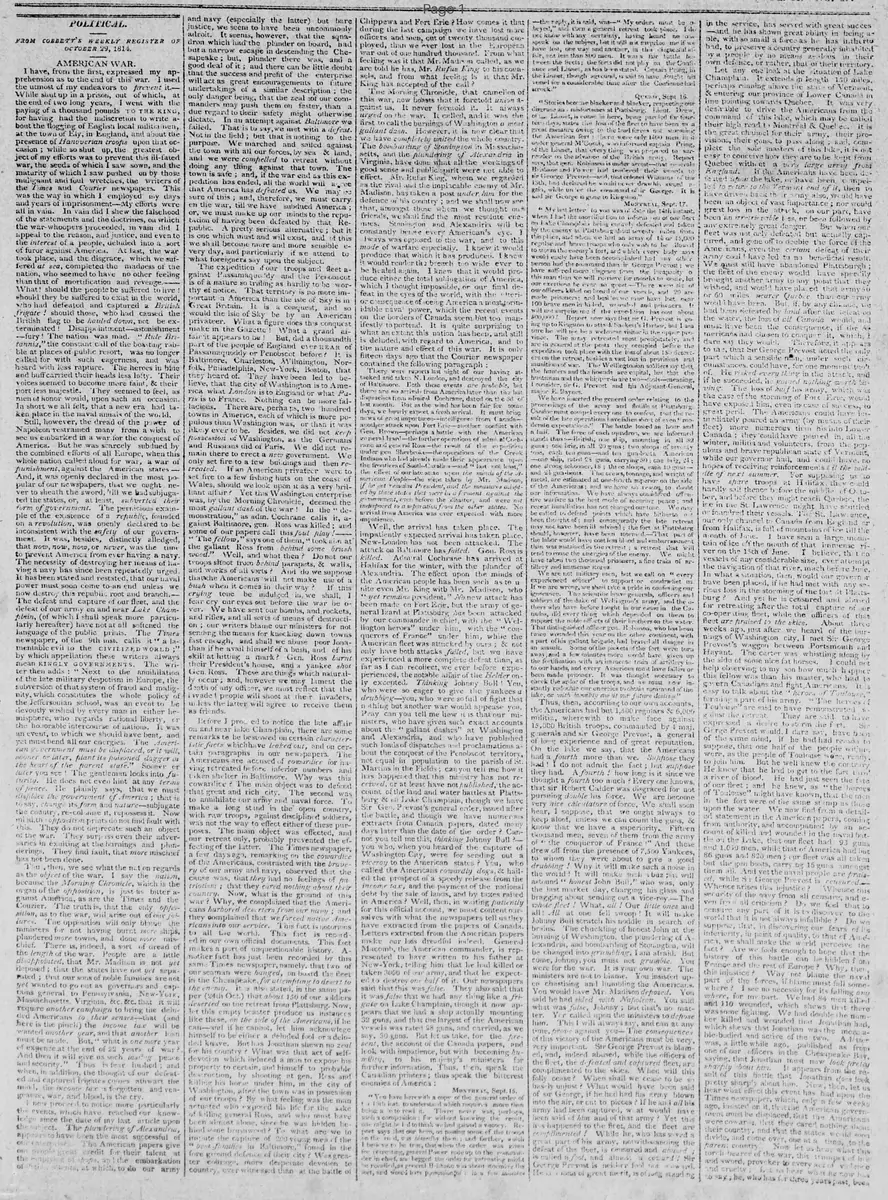
AMERICAN WAR.
I have, from the first, expressed my apprehension as to the end of this war. I used the utmost of my endeavors to prevent it.-- While shut up in a prison, out of which, at the end of two long years, I went with the paying of a thousand pounds TO THE KING, for having had the indiscretion to write about the flogging of English local militia men, at the town of Ely, in England, and about the presence of Hanoverian troops upon that occasion; while so shut up, the greatest object of my efforts was to prevent this ill-fated war, the seeds of which I saw sown, and the maturity of which I saw pushed on by those malignant and foul wretches, the writers of the Times and Courier newspapers. This was the way in which I employed my days and years of imprisonment--My efforts were all in vain. In vain did I shew the falsehood of the statements and the doctrines, on which the war-whoopers proceeded, in vain did I appeal to the reason, and justice, and even to the interest of a people, deluded into a sort of fury against America. At last, the war took place, and the disgrace, which we suffered at sea, completed the madness of the nation, who seemed to have no other feeling than that of mortification and revenge.-- What! should the people be suffered to live! should they be suffered to exist in the world, who had defeated and captured a British frigate! should those, who had caused the British flag to be hauled down, not be exterminated! Disappointment--astonishment--fury! The nation was mad. "Rule Britannia," the constant call of the boasting rabble at places of public resort, was no longer called for with such eagerness, and was heard with less rapture. The heroes in blue and buff carried their heads less lofty. Their voices seemed to become more faint, & their port less majestic. They seemed to feel, as men of honor would, upon such an occasion. In short we all felt, that a new era had taken place in the naval annals of the world. Still, however, the dread of the power of Napoleon restrained many from a wish to see us embarked in a war for the conquest of America. But he was scarcely subdued by the combined efforts of all Europe, when this whole nation called aloud for war, a war of punishment, against the American states--. And, it was openly declared in the most popular of our newspapers, that we ought never to sheath the sword, 'till we had subjugated the states, or, at least, subverted their form of government. The pernicious example of the existence of a republic, founded on a revolution, was openly declared to be inconsistent with the safety of our government. It was, besides, distinctly alledged, that now, now, now, or never, was the time to prevent America from ever having a navy. The necessity of destroying her means of having a navy has since been repeatedly urged. It has been stated and restated, that our naval power must soon come to an end unless we now destroy this republic root and branch.-- The defeat and capture of our fleet, and the defeat of our army on and near Lake Champlain, (of which I shall speak more particularly hereafter) have not at all softened the language of the public prints. The Times newspaper, of the 9th inst. calls it "a lamentable evil to the CIVILIZED WORLD;" by which appellation these writers always mean KINGLY GOVERNMENTS. The writer then adds: "Next to the annihilation of the late military despotism in Europe, the subversion of that system of fraud and malignity, which constitutes the whole policy of the Jeffersonian school, was an event to be devoutly wished by every man in either hemisphere, who regards rational liberty, or the honorable intercourse of nations. It was an event, to which we should have bent, and yet must bend all our energies. The American government must be disgraced, or it will, sooner or later, plant its poisoned dagger in the heart of the parent state." Sooner or later you see! The gentleman looks into futurity. He does not even hint at any terms of peace. He plainly says, that we must disgrace the government of America; that is to say, change its form and nature--subjugate the country, re-colonise it, repossess it. Now mind, the opposition prints do not find fault with this. They do not deprecate such an object of the war. They surpass even their adversaries in exulting at the burnings and plunderings. They find fault, that more mischief has not been done. Thus, then, we see what the nation regards as the object of the war. I say the nation, because the Morning Chronicle, which is the organ of the opposition, is just as bitter against America, as are the Times and the Courier. The truth is, that the only opposition, as to the war, will arise out of our failures. The opposition will only blame the ministers for not having burnt more ships, plundered more towns, and done more mischief. There is, indeed, a sort of dread of the length of the war. People are a little disappointed, that Mr. Madison is not yet deposed; that the states have not yet separated; that our sons of noble families are not yet wanted to go out as governors and captains general to Pennsylvania, New-York, Massachusetts, Virginia, &c. &c. that it will require another campaign to bring the deluded Americans to their senses--that (and here is the pinch) the income tax will be wanted another year, and that another loan must be made. But, "what is one more year of expense at the end of 22 years of war? And then it will give us such a solid good peace and security." Thus is fear hushed; and when, in addition, the thought of our defeated and captured Frigates comes athwart the mind, the income tax is forgotten and vengeance, war, and blood, is the cry.
I now proceed to notice more particularly the events, which have reached our knowledge since the date of my last article upon the subject. The plundering of Alexandria, appears to have been the most successful of our attempts. The American papers give our people great credit for their talent at the plundering of goods, and the embarkation of his tents, at which, to do our army and navy (especially the latter) but bare justice, we seem to have been uncommonly adroit. It seems, however, that the squadron which had the plunder on board, had but a narrow escape in descending the Chesapeake; but, plunder there was, and a good deal of it; and there can be little doubt that the success and profit of the enterprise will act as great encouragements to future undertakings of a similar description; the only danger being, that the zeal of our commanders may push them on faster, than a due regard to their safety might otherwise dictate. In an attempt against Baltimore we failed. That is to say, we met with a defeat. Not in the field; but that is nothing to the purpose. We marched and sailed against the town with all our forces, by sea & land, and we were compelled to retreat without doing any thing against that town. The town is safe; and, if the war end as this expedition has ended, all the world will see that America has defeated us. We may be sure of this; and, therefore, we must carry on the war, till we have subdued America; or, we must make up our minds to the reputation of having been defeated by that Republic. A pretty serious alternative; but it is one which must and will exist, and of this we shall become more and more sensible every day, and particularly if we attend to what foreigners say upon the subject. The expedition of our troops and fleet against Passamaquoddy and the Penobscot is of a nature so trifling as hardly to be worthy of notice. That territory is no more important in America than the isle of Sky is in Great Britain. It is a conquest, and so would the isle of Sky be by an American privateer. What a figure does this conquest make in the Gazette! What a grand affair it appears to be! But, did a thousandth part of the people of England ever hear of Passamaquoddy or Penobscot before? It is Baltimore, Charleston, Wilmington, Norfolk, Philadelphia, New-York, Boston, that they heard of. They have been led to believe, that the city of Washington is to America what London is to England or what Paris is to France. Nothing can be more fallacious. There are, perhaps, two hundred towns in America, each of which is more populous than Washington was, or than it was likely ever to be. Besides, we did not keep possession of Washington, as the Germans and Russians did of Paris. We did not remain there to erect a new government. We only set fire to a few buildings and then retreated. If an American privateer were to set fire to a few fishing huts on the coast of Wales, should we look upon it as a very brilliant affair? Yet this Washington enterprise was, by the Morning Chronicle, deemed the most gallant dash of the war! In the "demonstration," as adm. Cochrane calls it, against Baltimore, gen. Ross was killed: and some of our papers call this foul play!-- "The fellow," says one of them, "took aim at the gallant Ross from behind some brush wood." Well, and what then? Do not our troops shoot from behind parapets, & walls, and works of all sorts? And do we suppose that the Americans will not make use of a bush when it comes in their way? If this crying tone be indulged in, we shall, I fear, cry our eyes out before the war be over. We have sent our bombs, and rockets, and rifles, and all sorts of means of destruction; our writers blame our ministers for not sending the means for knocking down towns fast enough, and shall we abuse poor Jonathan if he avail himself of a bush, and of his skill at hitting a mark? Gen. Ross burnt their President's house, and a yankee shot Gen. Ross. These are things which naturally occur; and, however we may lament the death of any officer, we must reflect that the invaded people will shoot at their invaders, unless the latter will agree to receive them as friends.
Before I proceed to notice the late affair on and near Lake Champlain, there are some remarks to be bestowed on certain characteristic facts which have leaked out, and on certain paragraphs in our newspapers. The Americans are accused of cowardice for having retreated before inferior numbers and taken shelter in Baltimore. Why was this cowardice? The main object was to defend that great and rich city. The second was to annihilate our army and naval force. To make a long stand in the open country, with raw troops, against disciplined soldiers, was not the way to effect either of these purposes. The main object was effected, and our retreat only, probably prevented the effecting of the latter. The Times newspaper, a few days ago, remarking on the cowardice of the Americans, contrasted with the bravery of our army and navy, observed that the cause was, that they had no feelings of patriotism; that they cared nothing about their country. Now, what is the ground of this war? Why, we complained that the Americans harbored deserters from our navy; and they complained that we forced native Americans into our service. This fact is notorious to all the world. This fact is recorded in our own official documents. This fact makes a part of unquestionable history. Another fact has just been recorded by this same Times newspaper, namely, that two of our seamen were hanged, on board the fleet in the Chesapeake, for attempting to desert to the enemy. It is also stated, in the same paper (24th Oct.) that about 150 of our soldiers deserted on the retreat from Plattsburg. Now, let this empty braggart produce us instances like these, on the side of the Americans, if he can--and if he cannot, let him acknowledge himself to be either a deluded fool or a deluded knave. But has Jonathan shewn no zeal for his country? What was that act of self-devotion which induced a man to expose his property to certain, and himself to probable destruction, by shooting at gen. Ross and killing his horse under him, in the city of Washington, after the town was in possession of our troops? By what feeling was the man actuated when he exposed his life for the sake of killing general Ross, and who must have been almost alone, since he was hidden behind some brushwood? To what are we to impute the capture of 200 young men of the best families in Baltimore, found in the foreground defence of their city? Was greater courage, more desperate devotion to country, ever witnessed than at the battle of Chippewa and Fort Erie? How comes it that during the last campaign we have lost more officers and men, out of twenty thousand employed, than we ever lost in the European war out of one hundred thousand. From what feeling was it that Mr. Madison called, as we are told he has, Mr. Rufus King to his councils, and from what feeling is it that Mr. King has accepted of the call? The Morning Chronicle, that chameleon of this war, now boasts that it foretold union against us. It never foretold it. It always urged on the war. It called, and it was the first to call the burnings of Washington a most gallant dash. However, it is now clear that we have completely united the whole country. The bombarding of Stonington in Massachusetts, and the plundering of Alexandria in Virginia, have done what all the workings of good sense and public spirit were not able to effect. Mr. Rufus King, whom we regarded as the rival and the implacable enemy of Mr. Madison, has taken a post under him for the defence of his country; and we shall now see that, amongst those whom we thought our friends, we shall find the most resolute enemies. Stonington and Alexandria will be constantly before every American's eye. I always was opposed to the war, and to this mode of warfare especially. I knew it would produce that which it has produced. I knew it would render the breach too wide ever to be healed again. I knew that it would produce either the total subjugation of America, which I thought impossible, or our final defeat in the eyes of the world, with the bitter consequence of seeing America a most formidable naval power, which the recent events on the borders of Canada seem but too manifestly to portend. It is quite surprising to what an extent this nation has been, and still is deluded, with regard to America, and to the nature and effect of this war. It is only fifteen days ago that the Courier newspaper contained the following paragraph:
There were reports last night of our having attacked and taken N. London, and destroyed the city of Baltimore. Both these events are probable, but there are no arrivals from America later than the last dispatches from admiral Cochrane, dated on the 3d of last month. But as the wind has been fair for some days, we hourly expect a fresh arrival. It must bring news of great importance--intelligence from Canada--another attack upon Fort Erie--another conflict with Gen. Brown--perhaps a battle with the American general Izard!--the further operations of admiral Cochrane and general Ross--the result of the expedition under gen. Sherbrooke--the operations of the "Creek Indians who had already made their appearance upon the frontiers of South-Carolina--and "last not least," the effect of our late attack upon the minds of the American People--the steps taken by Mr. Madison, if he yet remains President, and the measures adopted by those states that were in a ferment against the government, even before the disaster, and were not indisposed to a separation from the other states. No arrival from America was ever expected with more impatience.
Well, the arrival has taken place. The impatiently expected arrival has taken place. New-London has not been attacked. The attack on Baltimore has failed. Gen. Ross is killed. Admiral Cochrane has arrived at Halifax for the winter, with the plunder of Alexandria. The effect upon the minds of the American people has been such as to unite even Mr. King with Mr. Madison, who "yet remains president." No new attack has been made on Fort Erie, but the army of general Izard at Plattsburg has been attacked by our commander in chief, with the "Wellington heroes" under him, with the "conquerors of France" under him, while the American fleet was attacked by ours; & not only have both attacks failed, but we have experienced a more complete defeat than, as far as I can recollect, we ever before experienced, the notable affair of the Helder only excepted. Thinking Johnny Bull: You, who were so eager to give the yankees a drubbing--you, who were so fond of fight that nothing but another war would appease you. Pray can you tell me how it is that our ministers, who have given such exact accounts about the "gallant dashes" at Washington and Alexandria, and who have published such loads of dispatches and proclamations about the conquest of the Penobscot territory, not equal in population to the parish of St. Martins in the Fields; can you tell me how it has happened that this ministry has not received, or at least have not published, the account of the land and water battles at Plattsburg & on Lake Champlain, though we have Sir Geo. Prevost's general order, issued after the battle, and though we have numerous extracts from Canada papers, dated many days later than the date of the order? Cannot you tell me this, thinking Johnny Bull?-- you who, when you heard of the capture of Washington City, were for sending out a viceroy to the American states? You, who called the Americans cowardly dogs, & hailed the prospect of a speedy release from the income tax, and the payment of the national debt by the sale of lands, and by taxes raised in America? Well, then, in waiting patiently for this official account, we must content ourselves with what the newspapers tell us they have extracted from the papers of Canada. Letters extracted from the American papers make our loss dreadful indeed. General Macomb, the American commander, is represented to have written to his father at New-York, telling him that he had killed or taken 3000 of our army, and that he expected to destroy one half of it. Our newspapers said that this was false. They also said that it was false that we had any thing like a frigate on Lake Champlain, though it now appears that we had a ship actually mounting 32 guns, and that the largest of the American vessels was rated 28 guns, and carried, as we say, 30 guns. But let us take, for the present, the account of the Canada papers, and look with impatience, but with becoming humility, to his majesty's ministers for further information. Thus, then, speak the Canadian printers: thus speak the "bitterest enemies of America:
MONTREAL, Sept. 15.
"You have herewith a copy of the general order of this inst. to understand which requires more than being able to read it. There never was, perhaps, such a composition: For without knowing the event, one might be led to think we had gained a victory. Report says that our hero, on passing some of the troops on the road, was hissed by them; and further, which I believe to be true, that when the order was given for retreating, general Porter rode up to the commander in chief, and begged the order for retreating might be recalled, as general Bissel was about storming the fort, and would have possession in a few minutes--the reply, it is said, was--"My orders must be obeyed," and then a general retreat took place. I do not know with any certainty, having heard no one speak on the subject, but it will not surprise me if we have lost, one way and another, in this disgraceful affair, not less than 800 men. It was a fair battle between the fleets; the forts did not play on the Confiance and Linnet, as has been stated. Captain Pring, in the Linnet, though aground, is said to have fought his vessel for a considerable time after the Confiance had struck."
QUEBEC, Sept 16.
"Stories become blacker and blacker, respecting our disgrace and misfortunes at Plattsburg. Lieut. Drew, of H.M.S. Linnet, is come in here, being paroled till four- teen days, states the loss of the fleet to have been in a great measure owing to the land forces not storming the American fort: there were only 140 men in it under general M'Comb, who informed captain Pring, of the Linnet, that every thing was prepared to surrender on the advance of the British army. Report says, that gen. Robinson is under arrest--that generals Brisbane and Power had tendered their swords to sir George Prevost--and, that colonel Williams of the 13th, had declared he would never draw his sword again, while under the command of sir George. It is said sir George is gone to Kingston."
MONTREAL, Sept. 17.
"My last letter to you was of date--the 10th instant, when I had the mortification to inform you of our fleet on Lake Champlain being entirely defeated and taken by the enemy at Plattsburg about seventy miles from this place, and when we had an army of 10 or 15,000 regular and brave troops who only wish to be allowed to storm the enemy's fort, and which every body says would easily have been accomplished had any other person had the command than sir George Prevost; we have suffered more disgrace from the incapacity of this man than we will retrieve for months to come, let our exertions be ever so great--There were 3 of our officers killed on board of our vessels, and 20 are made prisoners; and besides we must have lost near 100 brave men in killed, wounded, and prisoners. It will not surprise me if the expedition has cost about 500,000l. Report now says that sir G. Prevost is going up to Kingston to attack Sackett's Harbor, but I am sure he will make a welcome visitor in the upper province. The army retreated most precipitately, and are in general at the posts they occupied before the expedition took place with the loss of about 150 deserters on the retreat, besides a vast loss in provisions and ammunition of war. The Wellingtonian soldiers say that the hunters and the hounds are capital, but that the huntsman and the whipper-in are two fools--meaning, I consider, sir G. Prevost and his Adjutant-General, major E. Baynes.
We have inserted the general order relating to the proceedings of the army and flotilla at Plattsburg. Candor must compel every one to confess, that the result of the late operations have fallen short of even moderate expectations." The battle lasted an hour and a half. The force of each squadron, we are informed stands thus:--British, one ship, mounting in all 32 guns; one brig, in all 20 guns; two sloops of seventy tons, each ten guns--and ten gun-boats. American--one ship, rated 28 guns, carrying 30; one brig, 24: one strong schooner, 18; three sloops, each 10 guns-- and 21 gun-boats. The crews, tonnage, and weight of metal, are estimated at one-fourth superior on the side of the Americans; and we have no reason, to doubt our information. We have always considered offensive warfare as the best mode of securing peace; and recent humiliation has not changed our tone. We may be called to defend points which have hitherto not been thought of: and consequently the late retreat may not have been ill advised; the fort at Plattsburg should, however, have been stormed.--That part of the labor would have cost less blood and embarrassment than was sustained in the retreat; a retreat that will tend to rouse the energies of the enemy. We might have taken two thousand prisoners, a fine train of artillery and immense stores
We are not military men, but we call on "every experienced officer" to support or contradict us. If we are wrong, we shall take a pride in confessing our ignorance. The scientific brave generals, officers and soldiers of the duke of Wellington's army, and the others who have before fought in our cause in the Canadas, did every thing which depended on them to support the noble efforts of their brothers on the water. That distinguished officer gen. Robinson, who has been twice wounded this year on the other continent, with a part of his gallant brigade, had braved all danger in an assault. Some of the pickets of the fort were torn away, and a few minutes more would have given up the fortification with an immense train of artillery into our hands, and every American must have fallen or been made prisoner. It was thought necessary to check the ardor of the troops, and we must now instantly redouble our energies to obtain command of the lake, or with humility await our future destiny"
Thus, then, according to our own accounts, the Americans had but 1,500 regulars & 6,000 militia, wherewith to make face against 15,000 British troops, commanded by 4 major generals and sir George Prevost, a general of long experience and of great reputation. On the lake we say, that the Americans had a fourth more than we. Suppose they had! I do not admit the fact; but suppose they had. A fourth! how long is it since we thought a fourth too much? Every one knows, that sir Robert Calder was disgraced for not pursuing double his force. We are become very nice calculators of force. We shall soon hear, I suppose, that we ought always to keep aloof, unless we can count the guns, & know that we have a superiority. Fifteen thousand men, seven of them from the army of "the conqueror of France!" And these drew off from the presence of 7,500 Yankees, to whom they were about to give a good drubbing! Why it will make such a noise in the world! It will make such a buzz; it will astound "honest John Bull," who was, only the last market day, charging his glass and bragging about sending out a viceroy.--The whole fleet! What, all! Our little ones and all! All at one fell swoop! It will make Johnny Bull scratch his noddle in search of brains. The chuckling of honest John at the burning of Washington, the plundering of Alexandria, and bombarding of Stonington, will be changed into grumbling, I am afraid. But come, Johnny, you must not grumble. You were for the war. It is your own war. The ministers are not to blame. You insisted upon chastising and drubbing the Americans. You would have Mr. Madison deposed. You said he had sided with Napoleon. You said what was false, Johnny; but that's no matter. You called upon the ministers to depose him. This I will always say, and can at any time, grope against you-- The consequences of this victory of the Americans must be very, very important. Sir George Prevost is blamed, and, indeed abused, while the officers of the fleet, the defeated and captured fleet, are complimented to the skies. When will this folly cease? When shall we cease to be so basely unjust? What would have been said of sir George, if he had had his army blown into the air, or cut to pieces? If he and all his army had been captured, what would have been said of him and of that army? Yet this has happened to the fleet, and the fleet are complimented! While he, who has saved a great part of his army, notwithstanding the defeat of the fleet, is censured and abused; is called a fool, and almost a coward! Sir George Prevost is neither fool nor coward. He is a man of proven merit, is of long standing in the service, has served with great success--and he has shown great ability in being able, with so small a force as he has hitherto had, to preserve a country generally inhabited by a people by no means zealous in their own defence, or rather, that of their territory. Let any one look at the situation of Lake Champlain. It extends in length 150 miles, perhaps running above the state of Vermont, & entering our province of Lower Canada in a line pointing towards Quebec. It was very desirable to drive the Americans from the command of this lake, which may be called their high road to Montreal & Quebec. It is the great channel for their army, their provisions, their guns, to pass along; and, complete the sole masters of this lake, it is not easy to conceive how they are to be kept from Quebec without a very large army from England. If the Americans have been defeated upon the lake, or have been compelled to retire to the Vermont end of it, then to have driven back their army also, would have been an object of vast importance; nor would great loss in the attack, on our part, have been an irretrievable loss, or been followed by any extremely great danger. But when our fleet was not only defeated but actually captured, and gone off to double the force of the Americans, even the certain defeat of their army could have led to no beneficial result. We must still have abandoned Plattsburgh; the fleet of the enemy would have speedily brought another army to any point that they wished, and would have placed that army 50 or 60 miles nearer Quebec than our army would have been. But, if, by any chance, we had been defeated by land after the defeat on the water, the loss of all Canada would, and must have been the consequence, if the Americans had chosen to conquer it, which, I dare say they would. Therefore, it appears to me, that Sir George Prevost acted the only part which a sensible man, under such circumstances, could have, for one moment thought of. He risked every thing in the attack, and if he succeeded, he gained nothing worth having. The loss of half his army, which was the case of the storming of Fort Erie, would have exposed him, even in case of success, to great peril. The Americans could have immediately poured an army (by means of their fleet) more numerous than his into Lower Canada; they could have poured in, all the winter, militia and volunteers, from the populous and brave republican state of Vermont, while our governor had, and could have, no hopes of receiving reinforcements till the middle of next summer. For supposing us to have spare troops at Halifax, they could hardly sail thence before the middle of October, and before they might reach Quebec, the ice in the St. Lawrence might have scuttled or foundered their vessels. The St. Lawrence, our only channel to Canada from England or from Halifax, is full of mountains of ice till the month of June. I have seen a large mountain of ice at the mouth of that immense river on the 15th of June. I believe, that no vessels of any considerable size, ever attempt the navigation of that river, much before June. In what a situation, then, would our governor have been placed, if he had met with any serious loss in the storming of the fort at Plattsburg? And yet he is censured and abused for retreating after the total capture of our co-operating fleet, while the officers of that fleet are praised to the skies. About three weeks ago, just after we heard of the burnings of Washington city, I met Sir George Prevost's waggon between Portsmouth and Hayant. The carter was whistling along by the side of some nice fat horses. I could not help observing to my son how much happier this fellow was than his master, who had to govern Canadians and fight Americans. It's easy to talk about the "heroes of Toulouse," forming a part of his army. "The heroes of Toulouse" are said to have remonstrated against the retreat. They are said to have expressed a desire to storm the fort. Sir George Prevost would, I dare say, have been of the same mind, if he had had reason to suppose, that one half of the people with, were, as the people of Toulouse were, ready to join him. But he well knew the country. He knew that he had to get to the fort through a river of blood. He had just seen the fate of our fleet; and he knew, as "the heroes of Toulouse" might have known, that the men in the fort were of the same stamp as those upon the water. We now find from a detailed statement in the American papers, coming from authority, and accompanied by an account of killed and wounded in the naval battle on the Lake, that our fleet had 93 guns and 1,050 men, while that of America had but 86 guns and 820 men; our fleet was all taken but the gun boats, carrying 15 guns amongst them all. And yet the naval people are praised, while Sir George Prevost is censured.-- Whence arises this injustice? Whence comes this security of the navy from all censure, and even from all criticism? Do we feel that to censure any part of it is to discover to the world that it is not always infallible? Do we suppose, that, in discovering our fears of inferiority, in point of quality, to that of America, we shall make the world perceive the fact? Are we fools enough to hope that the history of this battle can be hidden from France and the rest of Europe? Why, then, this injustice? Why not blame the naval part of the forces, if blame must fall somewhere? I see no necessity for its falling any where, for my part. We had 84 men killed and 110 wounded, which shews that there was some fighting. We had double the number killed and wounded that Jonathan had, which shews that Jonathan was the more able-bodied and active of the two. All this was, a little while ago, published as from one of our officers in the Chesapeake Bay, saying, that Jonathan must now look sharply about him. It appears from the result of this battle that Jonathan does look pretty sharply about him. Now, then, let us hear what effect this event has had upon the Times newspaper, which, only a few weeks ago, insisted on it, that the American government and country must be displaced, that the Americans were cowards, that they cared nothing about their country, and that the states would soon divide, and come over, one at a time, to the
Now let us hear what this torch bearer of the war, this trumpet of the hand and sword, provoker to every act of violence and cruelty, has to say, he, who has for three years past, been
urging the government on to this disastrous contest. "Halifax papers to the 6th instant, New-York to the 22d ult. and Boston to the 25th, have been received. There is no dissembling that the popular outcry in Canada against Sir George Prevost's conduct, on occasion of the late operations against Plattsburg, is very general and very loud. We cannot pretend to determine on the talents of this officer, or on the wisdom of his plans: but recur to the suggestions which he made at a very early period of the campaign, and regret exceedingly that one of our most experienced generals from Spain was not sent at once, flushed with victory from the fields of Toulouse, to the heart of the U. States. Was it beneath the dignity of Lord Hill, or even of the Duke of Wellington? Fatal prejudice! To despise, to irritate, and, after all, not to subdue our adversaries, is the worst & weakest of all policy. Now we have reduced ourselves to this dilemma of being obliged to carry our point by main force, or to retire from the contest ten times worse than we began it, with the mere postponement of an abstract question, which has no reference to our present state of peace, with a fund of the bitterest animosity laid up against us in future, with our flag disgraced on the ocean & on the lakes, and with the laurels withered at Plattsburg, which were so hardly but so gloriously earned in Portugal, Spain & France. The spirit of the British nation cannot stoop to the latter alternative, and therefore, at whatever risk, at whatever expense we must embrace the former. The invaluable year 1814, when the treachery of America was fresh in the minds of the European powers, is past. Already do they begin to relax in their deep and merited contempt of the servile hypocrite Madison. Already do they turn a compassionate look on the smoking rafters of the would-be capitol. Presently, perhaps, the Russian Cabinet may forget that the Empress Catharine, to her dying day, treated the Americans as rebels to their legal sovereign; or the Spanish court, while it is endeavoring to rivet its yoke on Buenos Ayres, may join, with the philosophers of Virginia, in contending for the liberty of the seas. Such, and still greater political inconsistencies we have before now witnessed. Therefore let time be taken by the forelock; let not another campaign be wasted in diversions and demonstrations; let not another autumnal sun go down in DISGRACE TO THE BRITISH ARMS. Commodore Macdonough's laconic note savors a little of affectation: but we are sorry he has so favorable an opportunity for displaying the brevity of his style to advantage. Gen. Macomb's orders, however, are sufficiently lengthy—and, unfortunately, he has also some unpleasant information to give us. He states that 14,000 British veterans have been foiled by 1,500 American regulars and some few militia, the whole not exceeding 2,500 men. If he is correct in these estimates, it is surely high time that we should either give up teaching the Americans war, or send them some better instructors. The former is the best be assured! Why should Commodore Macdonough be charged with affectation, because he writes a short letter? He has no sons or cousins, or patron's sons or cousins, or bastards, to recommend for the receipt of presents or pensions. But I have, at present, no room for further comment on this article. I will resume the subject in my next.
What sub-type of article is it?
What keywords are associated?
What entities or persons were involved?
Editorial Details
Primary Topic
Critique Of British War Efforts Against America In 1814
Stance / Tone
Strongly Anti War And Critical Of British Government, Press, And Public Fervor
Key Figures
Key Arguments