Thank you for visiting SNEWPapers!
Sign up free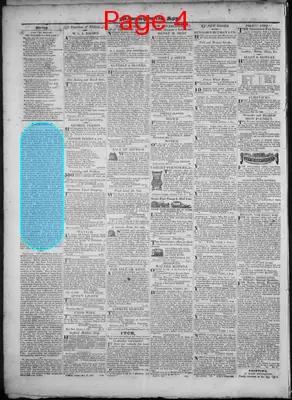
Literary
December 19, 1827
The Massachusetts Spy, And Worcester County Advertiser
Worcester, Worcester County, Massachusetts
What is this article about?
An essay reflecting on the hour glass as an ancient, flawed time-measuring device invented by monks, symbolizing the fleeting, irrecoverable nature of human existence and evoking themes of mortality and resurrection, as published in the New Monthly Magazine.
Clipping
OCR Quality
98%
Excellent
Full Text
MISCELLANY.
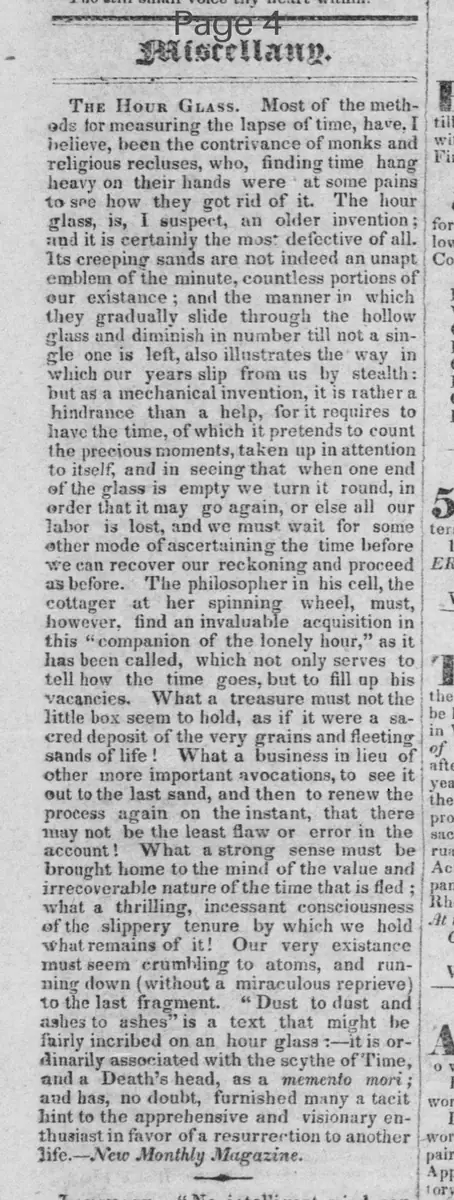
The Hour Glass. Most of the methods for measuring the lapse of time, have, I believe, been the contrivance of monks and religious recluses, who, finding time hang heavy on their hands were at some pains to see how they got rid of it. The hour glass, is, I suspect, an older invention; and it is certainly the most defective of all. Its creeping sands are not indeed an unapt emblem of the minute, countless portions of our existence; and the manner in which they gradually slide through the hollow glass and diminish in number till not a single one is left, also illustrates the way in which our years slip from us by stealth: but as a mechanical invention, it is rather a hindrance than a help, or it requires to have the time, of which it pretends to count the precious moments, taken up in attention to itself, and in seeing that when one end of the glass is empty we turn it round, in order that it may go again, or else all our labor is lost, and we must wait for some other mode of ascertaining the time before we can recover our reckoning and proceed as before. The philosopher in his cell, the cottager at her spinning wheel, must, however, find an invaluable acquisition in this "companion of the lonely hour," as it has been called, which not only serves to tell how the time goes, but to fill up its vacancies. What a treasure must not the little box seem to hold, as if it were a sacred deposit of the very grains and fleeting sands of life! What a business in lieu of other more important avocations, to see it out to the last sand, and then to renew the process again on the instant, that there may not be the least flaw or error in the account! What a strong sense must be brought home to the mind of the value and irrecoverable nature of the time that is fled: what a thrilling, incessant consciousness of the slippery tenure by which we hold what remains of it! Our very existence must seem crumbling to atoms, and running down (without a miraculous reprieve) to the last fragment. "Dust to dust and ashes to ashes" is a text that might be fairly inscribed on an hour glass: it is ordinarily associated with the scythe of Time, and a Death's head, as a memento mori; and has, no doubt, furnished many a tacit hint to the apprehensive and visionary enthusiast in favor of a resurrection to another life.—New Monthly Magazine.
The Hour Glass. Most of the methods for measuring the lapse of time, have, I believe, been the contrivance of monks and religious recluses, who, finding time hang heavy on their hands were at some pains to see how they got rid of it. The hour glass, is, I suspect, an older invention; and it is certainly the most defective of all. Its creeping sands are not indeed an unapt emblem of the minute, countless portions of our existence; and the manner in which they gradually slide through the hollow glass and diminish in number till not a single one is left, also illustrates the way in which our years slip from us by stealth: but as a mechanical invention, it is rather a hindrance than a help, or it requires to have the time, of which it pretends to count the precious moments, taken up in attention to itself, and in seeing that when one end of the glass is empty we turn it round, in order that it may go again, or else all our labor is lost, and we must wait for some other mode of ascertaining the time before we can recover our reckoning and proceed as before. The philosopher in his cell, the cottager at her spinning wheel, must, however, find an invaluable acquisition in this "companion of the lonely hour," as it has been called, which not only serves to tell how the time goes, but to fill up its vacancies. What a treasure must not the little box seem to hold, as if it were a sacred deposit of the very grains and fleeting sands of life! What a business in lieu of other more important avocations, to see it out to the last sand, and then to renew the process again on the instant, that there may not be the least flaw or error in the account! What a strong sense must be brought home to the mind of the value and irrecoverable nature of the time that is fled: what a thrilling, incessant consciousness of the slippery tenure by which we hold what remains of it! Our very existence must seem crumbling to atoms, and running down (without a miraculous reprieve) to the last fragment. "Dust to dust and ashes to ashes" is a text that might be fairly inscribed on an hour glass: it is ordinarily associated with the scythe of Time, and a Death's head, as a memento mori; and has, no doubt, furnished many a tacit hint to the apprehensive and visionary enthusiast in favor of a resurrection to another life.—New Monthly Magazine.
What sub-type of article is it?
Essay
What themes does it cover?
Death Mortality
Moral Virtue
Religious
What keywords are associated?
Hour Glass
Time Measurement
Mortality
Fleeting Life
Memento Mori
Resurrection
Literary Details
Title
The Hour Glass
Key Lines
Its Creeping Sands Are Not Indeed An Unapt Emblem Of The Minute, Countless Portions Of Our Existence;
"Dust To Dust And Ashes To Ashes" Is A Text That Might Be Fairly Inscribed On An Hour Glass: It Is Ordinarily Associated With The Scythe Of Time, And A Death's Head, As A Memento Mori;