Thank you for visiting SNEWPapers!
Sign up free
Editorial
August 30, 1802
Alexandria Advertiser And Commercial Intelligencer
Alexandria, Virginia
What is this article about?
Judge Richard Bassett's protest argues that 1802 congressional acts repealing the 1801 Judiciary Act unconstitutionally abolish federal circuit courts, deprive appointed judges of their offices and powers, and undermine judicial independence guaranteed by the Constitution's good behavior clause. Dated August 14, 1802.
Clipping
OCR Quality
95%
Excellent
Full Text
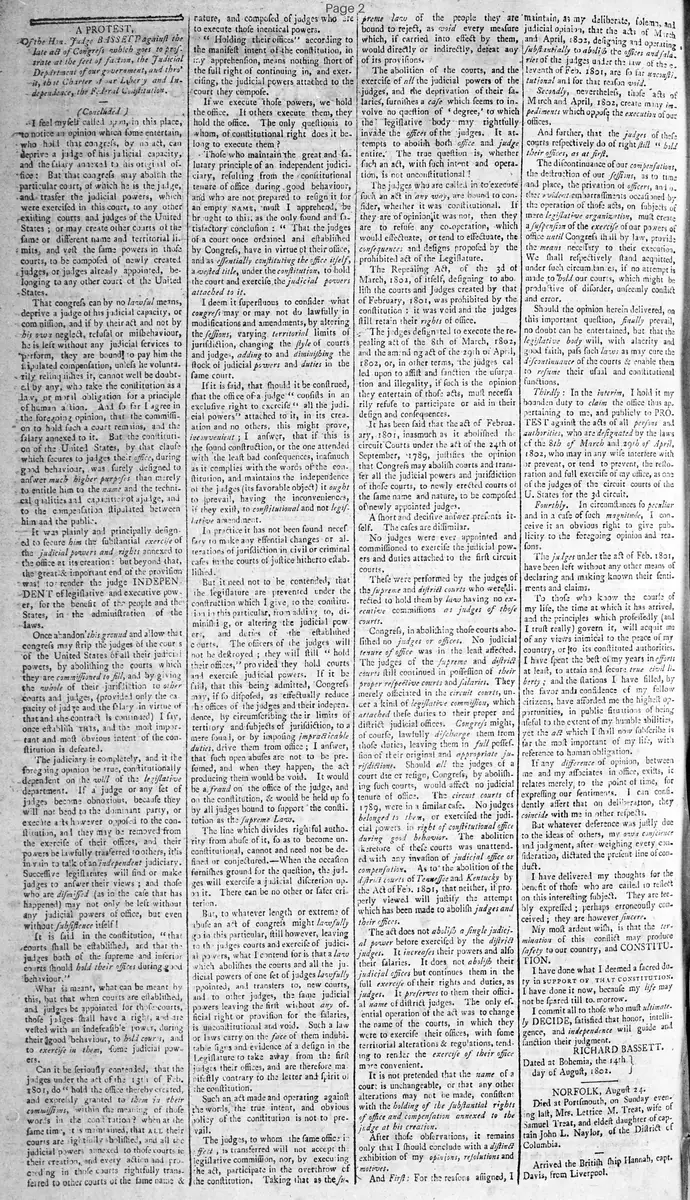
A PROTEST
Of the Hon. Judge BASSETT against the
late act of Congress which goes to prostrate
at the feet of faction, the Judicial
Department of our government, and thro'
it, the Charter of our Liberty and Inde-
pendence: the Federal Constitution.
(Concluded)
I feel myself called upon, in this place,
to notice an opinion which some entertain,
who hold that congress, by no act, can
dephrive a judge of his judicial capacity,
and the salary annexed to his original of-
fice: But that congress may abolish the
particular court, of which he is the judge,
and transfer the judicial powers, which
were exercised in this court, to any other
existing courts and judges of the United
States; or may create other courts of the
same or different name and territorial li-
mits, and vest the same powers in those
courts, to be composed of newly created
judges, or judges already appointed, be-
longing to any other court of the United
States.
That congress can by no lawful means,
dephrive a judge of his judicial capacity, or
commission, and if by their act and not by
his own neglect, refusal or misbehaviour,
he is left without any judicial services to
perform, they are bound to pay him the
stipulated compensation, unless he volunta-
rily relinquishes it, cannot well be doubt-
ed, by any, who take the constitution as a
law, or moral obligation for a principle
of human action. And so far I agree in
the foregoing opinion, that the commission
to hold such a court remains, and the
salary annexed to it. But the constitution
of the United States, by that clause
which secures to judges their office, during
good behaviour, was surely designed to
answer much higher purposes than merely
to entitle him to the name and the techni-
cal qualities and capacities of a judge, and
to the compensation stipulated between
him and the public.
It was plainly and principally designed
to secure him the substantial exercise of
the judicial powers and rights annexed to
the office at its creation: but beyond that,
the great and important end of the provision
was to render the judge INDEPEND-
ENT of legislative and executive pow-
er, for the benefit of the people and the
States, in the administration of the
laws.
Once abandoned this ground and allow that
congress may strip the judges of the courts
of the United States of all their judicial
powers, by abolishing the courts which
they are commissioned to fill, and by giving
the whole of their jurisdiction to other
courts and judges, (provided only the ca-
pacity of judge and the salary in virtue of
that and the contract is continued) I say,
once establish this, and the most impor-
tant and most obvious intent of the con-
stitution is defeated.
The judiciary is completely, and if the
foregoing opinion be true, constitutionally
dependent on the will of the legislative
department. If a judge or any set of
judges become obnoxious, because they
will not bend to the dominant party, or
execute acts however opposed to the con-
stitution, and they may be removed from
the exercise of their offices, and their
powers be lawfully transferred to others, it is
in vain to talk of an independent judiciary.
Successive legislatures will find or make
judges to answer their views; and those
who are dismissed (as in the case that has
happened) may not only be left without
any judicial powers of office, but even
without subsistence itself!
It is said in the constitution. "that
courts shall be established, and that the
judges both of the supreme and inferior
courts should hold their offices during good
behaviour."
What is meant, what can be meant by
this, but that when courts are established,
and judges be appointed for those courts,
those judges shall have a right, and are
vested with an indefeasible power, during
their good behaviour, to hold courts, and
to exercise in them, some judicial pow-
ers.
Can it be seriously contended, that the
judges under the act of the 13th of Feb.
1801, do "hold the office thereby created,
and expressly granted to them in their
commissions, within the meaning of those
words in the constitution? when at the
same time, it is maintained, that ALL their
courts are rightfully abolished, and all the
judicial powers annexed to those courts at
their creation, and every action and pro-
ceeding in those courts rightfully trans-
ferred to other courts of the same name &
rature, and composed of judges who are
to execute those identical powers.
"Holding their offices" according to
the manifest intent of the constitution, in
my apprehension, means nothing short of
the full right of continuing in, and exer-
cising, the judicial powers attached to the
court they compose.
If we execute those powers, we hold
the office. If others execute them, they
hold the office. The only question is to
whom, of constitutional right does it be-
long to execute them?
Those who maintain the great and sa-
lutary principle of an independent judici-
ary, resulting from the constitutional
tenure of office during good behaviour,
and who are not prepared to resign it for
an empty Name, must I apprehend, be
brought to this; as the only sound and sa-
tisfactory conclusion: "That the judges
of a court once ordained and established
by Congress, have in virtue of their office,
and as essentially constituting the office itself.
a vested title, under the constitution, to hold
the court and exercise the judicial powers
attached to it.
I deem it superfluous to consider what
congress may or may not do lawfully in
modifications and amendments, by altering
the sessions; varying territorial limits of
juridiction, changing the style of courts
and judges, adding to and diminishing the
stock of judicial powers and duties in the
same court.
If it is said, that should it be construed,
that the office of a judge "consists in an
exclusive right to exercise" all the judi-
cial powers" attached to it, in its crea-
tion and no others, this might prove,
inconvenient; I answer, that if this is
the sound construction, or the one attended
with the least bad consequences, inasmuch
as it complies with the words of the con-
stitution, and maintains the independence
of the judges (its favorable object) it ought
to prevail, having the inconveniences,
if they exist, to constitutional and not legi-
lative amendment.
In practice it has not been found neces-
sary to make any essential changes or al-
terations of jurisdiction in civil or criminal
cases in the courts of justice hitherto estab-
lifhed.
But it need not to be contended, that
the legislature are prevented under the
construction which I give, to the constitu-
tion in this particular, from adding to, di-
minishing, or altering the judicial pow-
ers, and duties of the established
courts. The offices of the judges will
not be destroyed; they will still "hold
their offices," provided they hold courts
and exercise judicial powers. If it be
said, that this being admitted, Congress
may, if so disposed, as effectually reduce
the offices of the judges and their indepen-
dence, by circumscribing their limits of
territory and subjects of jurisdiction, to a
mere sound, or by imposing impracticable
duties, drive them from office; I answer,
that such open abuses are not to be pre-
sumed, and when they happen, the act
producing them would be void. It would
be a fraud on the office of the judge, and
on the constitution, & would be held up so
by all judges bound to support the consti-
tution as the supreme Law.
The line which divides rightful autho-
rity from abuse of it, so as to become un-
constitutional, cannot and need not be de-
fined or conjectured.--When the occasion
furnishes ground for the question, the jud-
ges will exercise a judicial discretion up-
on it. There can be no other or safer cri-
terion.
But, to whatever length or extreme of
abuse an act of congress might lawfully
go in this particular, still however, leaving
to the judges courts and exercise of judici-
al powers, what I contend for is that a law
which abolishes the courts and all the ju-
dicial powers of one set of judges lawfully
appointed, and transfers to, new courts,
and to other judges, the same judicial
powers leaving the first without any of-
ficial right or provision for the salaries,
is unconstitutional and void. Such a law
or laws carry on the face of them indubi-
table signs and evidence of a design in the
Legislature to take away from the first
judges their offices, and are therefore ma-
ifestly contrary to the letter and spirit of
the constitution.
Such an act made and operating against
the words, the true intent, and obvious
policy of the constitution is not to pre-
vail.
The judges, to whom the same office is
settled, is transferred will not accept the
legislative commission, nor, by executing
the act, participate in the overthrow of
the constitution. Taking that as the su-
preme law of the people they are
bound to reject, as void every measure
which, if carried into effect by them,
would directly or indirectly, defeat any
of its provisions.
The abolition of the courts, and the
exercise of all the judicial powers of the
judges, and the deprivation of their sa-
laries, furnishes a case which seems to in-
volve no question of degree, to which
the legislative body may rightfully
invade the offices of the judges. It at-
tempts to abolish both office and judge
entire. The true question is, whether
such an act, with such intent and opera-
tion, is not unconstitutional!
The judges who are called in to execute
such an act in any way, are bound to con-
sider, whether it was constitutional. If
they are of opinion it was not, then they
are to refuse any co-operation, which
would effectuate, or tend to effectuate, the
consequences and designs proposed by the
prohibited act of the Legislature.
The Repealing Act, of the 3d of
March, 1802, of itself, designing to abo-
lith the courts and Judges created by that
of February, 1801, was prohibited by the
constitution: it was void and the judges
still retain their rights of office.
The judges designated to execute the re-
pealing act of the 5th of March, 1802,
and the amending act of the 29th of April,
1802, or, in other terms, the judges called
upon to aid and sanction the usurpa-
tion and illegality, if such is the opinion
they entertain of those acts, must neces-
sarily refuse to participate or aid in their
design and consequences.
It has been said that the act of Februa-
ry, 1801, inasmuch as it abolished the
circuit Courts under the act of the 24th of
September, 1789, justifies the opinion
that Congress may abolish courts and trans-
fer all the judicial powers and jurisdiction
of those courts, to newly erected courts of
the same name and nature, to be composed
of newly appointed judges.
A short and decisive answer presents it-
self. The cases are dissimilar.
No judges were ever appointed and
commissioned to exercise the judicial pow-
ers and duties attached to the first circuit
courts.
These were performed by the judges of
the supreme and district courts who were di-
rected to hold them by law having no ex-
clusive commissions as judges of those
courts.
Congress, in abolishing those courts abo-
lithed no judges or offices. No judicial
tenure of office was in the least affected.
The judges of the supreme and district
courts still continued in possession of their
proper respective courts and salaries. They
merely officiated in the circuit courts, un-
der a kind of legislative commission, which
attached these duties to their proper and
district judicial offices. Congress might,
of course, lawfully discharge them from
those duties, leaving them in full posses-
sion of their original and appropriate ju-
risdiction. Should all the judges of a
court die or resign, Congress, by abolishing
such courts, would affect no judicial
tenure of office. The circuit courts of
1789, were in a similar case. No judges
belonged to them, or exercised the judi-
cial powers in right of constitutional office
during good behavior. The abolition
therefore of these courts was unattended
with any invasion of judicial office or
compensation. As to the abolition of the
district courts of Tennessee and Kentucky by
the Act of Feb. 1801, that neither, if pro-
perly viewed will justify the attempt
which has been made to abolish judges and
their offices.
The act does not abolish a single judici-
al power before exercised by the district
judges. It increases their powers and also
their salaries. It does not abolish their
judicial offices but continues them in the
full exercise of their rights and duties, as
judges. It preserves to them their offici-
al name of district judges. The only es-
sential operation of the act was to change
the name of the courts, in which they
were to exercise their offices, with some
territorial alterations & regulations, tend-
ing to render the exercise of their office
more convenient.
It is not pretended that the name of a
court is unchangeable, or that any other
alterations may not be made, consistent
with the holding of the substantial rights
of office and compensation annexed to the
judge at his creation.
After those observations, it remains
only that I should conclude with a distinct
exhibition of my opinions, resolutions and
motives.
And First: For the reasons assigned, I
maintain, as my deliberate, Solemn, and
judicial opinion, that the acts of March
and April, 1802, designing and operating
substantially to abolish the offices and sala-
ries of the judges under the law of the
thirteenth of Feb. 1801, are so far unconsti-
tutional and for that reason void.
Secondly, nevertheless, those acts of
March and April, 1802, create many im-
pediments which oppose the execution of our
offices.
And further, that the judges of these
courts respectively do of right still "hold
their offices, as at first.
The discontinuance of our compensations,
the destruction of our sessions, as to time
and place, the privation of officers, and o-
ther evident embarrassments occasioned by
the operation of those acts, on subjects of
mere legislative organization, must create
a suspension of the exercise of our powers of
office until Congress shall by law, provide
the means necessary to their execution.
We shall respectively stand acquitted,
under such circumstances, if no attempt is
made to hold our courts, which might be
productive of disorder, unseemly conflict
and error.
Should the opinion herein delivered, on
this important question, finally prevail,
no doubt can be entertained, but that the
legislative body will, with alacrity and
good faith, pass such laws as may cure the
discontinuance of the courts & enable them
to resume their usual and constitutional
functions.
Thirdly: In the interim, I hold it my
bounden duty to claim the office thus ap-
pertaining to me, and publicly to PRO-
TEST against the acts of all persons and
authorities, who are designated by the laws
of the 8th of March and 29th of April,
1802, who may in any wise interfere with
or prevent, or tend to prevent, the restora-
tion and full exercise of my office, as one
of the judges of the circuit courts of the
U. States for the 3d circuit.
Fourthly. In circumstances so peculiar
and in a case of such magnitude, I con-
ceive it an obvious right to give pub-
licity to the foregoing opinion and rea-
sons.
The judges under the act of Feb. 1801,
have been left without any other means of
declaring and making known their enti-
tlements and claims.
To those who know the course of
my life, the time at which it has arrived,
and the principles which professedly (and
I trust really) govern it, will acquit me
of any views inimical to the peace of my
country, or to its constituted authorities.
I have spent the best of my years in efforts
at least to attain and secure true civil li-
berty: and the stations I have filled, by
the favor and confidence of my fellow
citizens, have afforded me the highest op-
portunities, in public situations of being
useful to the extent of my humble abilities,
yet the act which I shall now subscribe is
far the most important of my life, with
reference to human obligation.
If any difference of opinion, between
me and my associates in office, exists, it
relates merely, to the point of time, for
expressing our sentiments. I can confi-
dently assert that on deliberation, they
coincide with me in other respects.
But whatever deference was justly due
to the ideas of others, my own conscience
and judgment, after weighing every con-
sideration, dictated the present line of con-
duct.
I have delivered my thoughts for the
benefit of those who are called to reflect
on this interesting subject. They are free-
ly expressed; perhaps erroneously con-
ceived; they are however sincere.
My most ardent wish, is that the ter-
mination of this conflict may produce
safety to our country, and CONSTITU-
TION.
I have done what I deemed a sacred du-
ty in SUPPORT OF THAT CONSTITUTION.
I have done it now, because my life may
not be spared till to-morrow.
I commit all to those who must ultimate-
ly DECIDE, satisfied that honor, intelli-
gence, and independence will guide and
sanction their judgment.
RICHARD BASSETT.
Dated at Bohemia, the 14th day of August, 1802.
Of the Hon. Judge BASSETT against the
late act of Congress which goes to prostrate
at the feet of faction, the Judicial
Department of our government, and thro'
it, the Charter of our Liberty and Inde-
pendence: the Federal Constitution.
(Concluded)
I feel myself called upon, in this place,
to notice an opinion which some entertain,
who hold that congress, by no act, can
dephrive a judge of his judicial capacity,
and the salary annexed to his original of-
fice: But that congress may abolish the
particular court, of which he is the judge,
and transfer the judicial powers, which
were exercised in this court, to any other
existing courts and judges of the United
States; or may create other courts of the
same or different name and territorial li-
mits, and vest the same powers in those
courts, to be composed of newly created
judges, or judges already appointed, be-
longing to any other court of the United
States.
That congress can by no lawful means,
dephrive a judge of his judicial capacity, or
commission, and if by their act and not by
his own neglect, refusal or misbehaviour,
he is left without any judicial services to
perform, they are bound to pay him the
stipulated compensation, unless he volunta-
rily relinquishes it, cannot well be doubt-
ed, by any, who take the constitution as a
law, or moral obligation for a principle
of human action. And so far I agree in
the foregoing opinion, that the commission
to hold such a court remains, and the
salary annexed to it. But the constitution
of the United States, by that clause
which secures to judges their office, during
good behaviour, was surely designed to
answer much higher purposes than merely
to entitle him to the name and the techni-
cal qualities and capacities of a judge, and
to the compensation stipulated between
him and the public.
It was plainly and principally designed
to secure him the substantial exercise of
the judicial powers and rights annexed to
the office at its creation: but beyond that,
the great and important end of the provision
was to render the judge INDEPEND-
ENT of legislative and executive pow-
er, for the benefit of the people and the
States, in the administration of the
laws.
Once abandoned this ground and allow that
congress may strip the judges of the courts
of the United States of all their judicial
powers, by abolishing the courts which
they are commissioned to fill, and by giving
the whole of their jurisdiction to other
courts and judges, (provided only the ca-
pacity of judge and the salary in virtue of
that and the contract is continued) I say,
once establish this, and the most impor-
tant and most obvious intent of the con-
stitution is defeated.
The judiciary is completely, and if the
foregoing opinion be true, constitutionally
dependent on the will of the legislative
department. If a judge or any set of
judges become obnoxious, because they
will not bend to the dominant party, or
execute acts however opposed to the con-
stitution, and they may be removed from
the exercise of their offices, and their
powers be lawfully transferred to others, it is
in vain to talk of an independent judiciary.
Successive legislatures will find or make
judges to answer their views; and those
who are dismissed (as in the case that has
happened) may not only be left without
any judicial powers of office, but even
without subsistence itself!
It is said in the constitution. "that
courts shall be established, and that the
judges both of the supreme and inferior
courts should hold their offices during good
behaviour."
What is meant, what can be meant by
this, but that when courts are established,
and judges be appointed for those courts,
those judges shall have a right, and are
vested with an indefeasible power, during
their good behaviour, to hold courts, and
to exercise in them, some judicial pow-
ers.
Can it be seriously contended, that the
judges under the act of the 13th of Feb.
1801, do "hold the office thereby created,
and expressly granted to them in their
commissions, within the meaning of those
words in the constitution? when at the
same time, it is maintained, that ALL their
courts are rightfully abolished, and all the
judicial powers annexed to those courts at
their creation, and every action and pro-
ceeding in those courts rightfully trans-
ferred to other courts of the same name &
rature, and composed of judges who are
to execute those identical powers.
"Holding their offices" according to
the manifest intent of the constitution, in
my apprehension, means nothing short of
the full right of continuing in, and exer-
cising, the judicial powers attached to the
court they compose.
If we execute those powers, we hold
the office. If others execute them, they
hold the office. The only question is to
whom, of constitutional right does it be-
long to execute them?
Those who maintain the great and sa-
lutary principle of an independent judici-
ary, resulting from the constitutional
tenure of office during good behaviour,
and who are not prepared to resign it for
an empty Name, must I apprehend, be
brought to this; as the only sound and sa-
tisfactory conclusion: "That the judges
of a court once ordained and established
by Congress, have in virtue of their office,
and as essentially constituting the office itself.
a vested title, under the constitution, to hold
the court and exercise the judicial powers
attached to it.
I deem it superfluous to consider what
congress may or may not do lawfully in
modifications and amendments, by altering
the sessions; varying territorial limits of
juridiction, changing the style of courts
and judges, adding to and diminishing the
stock of judicial powers and duties in the
same court.
If it is said, that should it be construed,
that the office of a judge "consists in an
exclusive right to exercise" all the judi-
cial powers" attached to it, in its crea-
tion and no others, this might prove,
inconvenient; I answer, that if this is
the sound construction, or the one attended
with the least bad consequences, inasmuch
as it complies with the words of the con-
stitution, and maintains the independence
of the judges (its favorable object) it ought
to prevail, having the inconveniences,
if they exist, to constitutional and not legi-
lative amendment.
In practice it has not been found neces-
sary to make any essential changes or al-
terations of jurisdiction in civil or criminal
cases in the courts of justice hitherto estab-
lifhed.
But it need not to be contended, that
the legislature are prevented under the
construction which I give, to the constitu-
tion in this particular, from adding to, di-
minishing, or altering the judicial pow-
ers, and duties of the established
courts. The offices of the judges will
not be destroyed; they will still "hold
their offices," provided they hold courts
and exercise judicial powers. If it be
said, that this being admitted, Congress
may, if so disposed, as effectually reduce
the offices of the judges and their indepen-
dence, by circumscribing their limits of
territory and subjects of jurisdiction, to a
mere sound, or by imposing impracticable
duties, drive them from office; I answer,
that such open abuses are not to be pre-
sumed, and when they happen, the act
producing them would be void. It would
be a fraud on the office of the judge, and
on the constitution, & would be held up so
by all judges bound to support the consti-
tution as the supreme Law.
The line which divides rightful autho-
rity from abuse of it, so as to become un-
constitutional, cannot and need not be de-
fined or conjectured.--When the occasion
furnishes ground for the question, the jud-
ges will exercise a judicial discretion up-
on it. There can be no other or safer cri-
terion.
But, to whatever length or extreme of
abuse an act of congress might lawfully
go in this particular, still however, leaving
to the judges courts and exercise of judici-
al powers, what I contend for is that a law
which abolishes the courts and all the ju-
dicial powers of one set of judges lawfully
appointed, and transfers to, new courts,
and to other judges, the same judicial
powers leaving the first without any of-
ficial right or provision for the salaries,
is unconstitutional and void. Such a law
or laws carry on the face of them indubi-
table signs and evidence of a design in the
Legislature to take away from the first
judges their offices, and are therefore ma-
ifestly contrary to the letter and spirit of
the constitution.
Such an act made and operating against
the words, the true intent, and obvious
policy of the constitution is not to pre-
vail.
The judges, to whom the same office is
settled, is transferred will not accept the
legislative commission, nor, by executing
the act, participate in the overthrow of
the constitution. Taking that as the su-
preme law of the people they are
bound to reject, as void every measure
which, if carried into effect by them,
would directly or indirectly, defeat any
of its provisions.
The abolition of the courts, and the
exercise of all the judicial powers of the
judges, and the deprivation of their sa-
laries, furnishes a case which seems to in-
volve no question of degree, to which
the legislative body may rightfully
invade the offices of the judges. It at-
tempts to abolish both office and judge
entire. The true question is, whether
such an act, with such intent and opera-
tion, is not unconstitutional!
The judges who are called in to execute
such an act in any way, are bound to con-
sider, whether it was constitutional. If
they are of opinion it was not, then they
are to refuse any co-operation, which
would effectuate, or tend to effectuate, the
consequences and designs proposed by the
prohibited act of the Legislature.
The Repealing Act, of the 3d of
March, 1802, of itself, designing to abo-
lith the courts and Judges created by that
of February, 1801, was prohibited by the
constitution: it was void and the judges
still retain their rights of office.
The judges designated to execute the re-
pealing act of the 5th of March, 1802,
and the amending act of the 29th of April,
1802, or, in other terms, the judges called
upon to aid and sanction the usurpa-
tion and illegality, if such is the opinion
they entertain of those acts, must neces-
sarily refuse to participate or aid in their
design and consequences.
It has been said that the act of Februa-
ry, 1801, inasmuch as it abolished the
circuit Courts under the act of the 24th of
September, 1789, justifies the opinion
that Congress may abolish courts and trans-
fer all the judicial powers and jurisdiction
of those courts, to newly erected courts of
the same name and nature, to be composed
of newly appointed judges.
A short and decisive answer presents it-
self. The cases are dissimilar.
No judges were ever appointed and
commissioned to exercise the judicial pow-
ers and duties attached to the first circuit
courts.
These were performed by the judges of
the supreme and district courts who were di-
rected to hold them by law having no ex-
clusive commissions as judges of those
courts.
Congress, in abolishing those courts abo-
lithed no judges or offices. No judicial
tenure of office was in the least affected.
The judges of the supreme and district
courts still continued in possession of their
proper respective courts and salaries. They
merely officiated in the circuit courts, un-
der a kind of legislative commission, which
attached these duties to their proper and
district judicial offices. Congress might,
of course, lawfully discharge them from
those duties, leaving them in full posses-
sion of their original and appropriate ju-
risdiction. Should all the judges of a
court die or resign, Congress, by abolishing
such courts, would affect no judicial
tenure of office. The circuit courts of
1789, were in a similar case. No judges
belonged to them, or exercised the judi-
cial powers in right of constitutional office
during good behavior. The abolition
therefore of these courts was unattended
with any invasion of judicial office or
compensation. As to the abolition of the
district courts of Tennessee and Kentucky by
the Act of Feb. 1801, that neither, if pro-
perly viewed will justify the attempt
which has been made to abolish judges and
their offices.
The act does not abolish a single judici-
al power before exercised by the district
judges. It increases their powers and also
their salaries. It does not abolish their
judicial offices but continues them in the
full exercise of their rights and duties, as
judges. It preserves to them their offici-
al name of district judges. The only es-
sential operation of the act was to change
the name of the courts, in which they
were to exercise their offices, with some
territorial alterations & regulations, tend-
ing to render the exercise of their office
more convenient.
It is not pretended that the name of a
court is unchangeable, or that any other
alterations may not be made, consistent
with the holding of the substantial rights
of office and compensation annexed to the
judge at his creation.
After those observations, it remains
only that I should conclude with a distinct
exhibition of my opinions, resolutions and
motives.
And First: For the reasons assigned, I
maintain, as my deliberate, Solemn, and
judicial opinion, that the acts of March
and April, 1802, designing and operating
substantially to abolish the offices and sala-
ries of the judges under the law of the
thirteenth of Feb. 1801, are so far unconsti-
tutional and for that reason void.
Secondly, nevertheless, those acts of
March and April, 1802, create many im-
pediments which oppose the execution of our
offices.
And further, that the judges of these
courts respectively do of right still "hold
their offices, as at first.
The discontinuance of our compensations,
the destruction of our sessions, as to time
and place, the privation of officers, and o-
ther evident embarrassments occasioned by
the operation of those acts, on subjects of
mere legislative organization, must create
a suspension of the exercise of our powers of
office until Congress shall by law, provide
the means necessary to their execution.
We shall respectively stand acquitted,
under such circumstances, if no attempt is
made to hold our courts, which might be
productive of disorder, unseemly conflict
and error.
Should the opinion herein delivered, on
this important question, finally prevail,
no doubt can be entertained, but that the
legislative body will, with alacrity and
good faith, pass such laws as may cure the
discontinuance of the courts & enable them
to resume their usual and constitutional
functions.
Thirdly: In the interim, I hold it my
bounden duty to claim the office thus ap-
pertaining to me, and publicly to PRO-
TEST against the acts of all persons and
authorities, who are designated by the laws
of the 8th of March and 29th of April,
1802, who may in any wise interfere with
or prevent, or tend to prevent, the restora-
tion and full exercise of my office, as one
of the judges of the circuit courts of the
U. States for the 3d circuit.
Fourthly. In circumstances so peculiar
and in a case of such magnitude, I con-
ceive it an obvious right to give pub-
licity to the foregoing opinion and rea-
sons.
The judges under the act of Feb. 1801,
have been left without any other means of
declaring and making known their enti-
tlements and claims.
To those who know the course of
my life, the time at which it has arrived,
and the principles which professedly (and
I trust really) govern it, will acquit me
of any views inimical to the peace of my
country, or to its constituted authorities.
I have spent the best of my years in efforts
at least to attain and secure true civil li-
berty: and the stations I have filled, by
the favor and confidence of my fellow
citizens, have afforded me the highest op-
portunities, in public situations of being
useful to the extent of my humble abilities,
yet the act which I shall now subscribe is
far the most important of my life, with
reference to human obligation.
If any difference of opinion, between
me and my associates in office, exists, it
relates merely, to the point of time, for
expressing our sentiments. I can confi-
dently assert that on deliberation, they
coincide with me in other respects.
But whatever deference was justly due
to the ideas of others, my own conscience
and judgment, after weighing every con-
sideration, dictated the present line of con-
duct.
I have delivered my thoughts for the
benefit of those who are called to reflect
on this interesting subject. They are free-
ly expressed; perhaps erroneously con-
ceived; they are however sincere.
My most ardent wish, is that the ter-
mination of this conflict may produce
safety to our country, and CONSTITU-
TION.
I have done what I deemed a sacred du-
ty in SUPPORT OF THAT CONSTITUTION.
I have done it now, because my life may
not be spared till to-morrow.
I commit all to those who must ultimate-
ly DECIDE, satisfied that honor, intelli-
gence, and independence will guide and
sanction their judgment.
RICHARD BASSETT.
Dated at Bohemia, the 14th day of August, 1802.
What sub-type of article is it?
Constitutional
Legal Reform
What keywords are associated?
Judicial Independence
Constitutional Violation
Judiciary Act Repeal
Federal Courts Abolition
Judge Bassett Protest
Good Behavior Tenure
Congressional Overreach
1801 Judiciary Act
1802 Repealing Acts
What entities or persons were involved?
Congress
Judge Richard Bassett
United States Constitution
Federal Judiciary
Editorial Details
Primary Topic
Protest Against Congressional Acts Abolishing Federal Courts And Judicial Offices
Stance / Tone
Strongly Defending Judicial Independence And Constitutional Protections Against Legislative Overreach
Key Figures
Congress
Judge Richard Bassett
United States Constitution
Federal Judiciary
Key Arguments
Congress Cannot Deprive Judges Of Judicial Capacity Or Salary Without Their Neglect Or Misbehavior
The Constitution Secures Judges' Independence From Legislative And Executive Power For The Benefit Of The People
Abolishing Courts And Transferring Powers To New Judges Defeats The Purpose Of Lifetime Tenure During Good Behavior
Judges Hold An Indefeasible Right To Exercise Judicial Powers Attached To Their Offices
Acts Of March And April 1802 Are Unconstitutional And Void As They Abolish Offices And Salaries Of 1801 Judges
Judges Must Refuse To Execute Unconstitutional Acts That Defeat Constitutional Provisions
The 1801 Act Did Not Abolish Existing Judges Or Offices, Unlike The 1802 Repeals
Judges Retain Their Rights And Should Protest Interferences With Their Offices