Thank you for visiting SNEWPapers!
Sign up free
The Daily Dispatch
Richmond, Virginia
What is this article about?
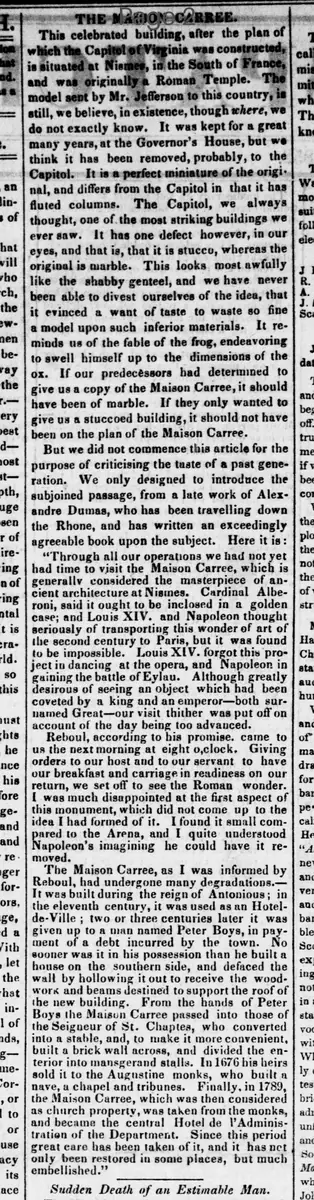
Article on the Maison Carree, a Roman temple in Nismes, France, that inspired the Virginia State Capitol's design. Critiques the Capitol's stucco construction versus the original marble. Includes Alexandre Dumas' excerpt from his Rhone travel book, detailing a visit, initial disappointment, and the building's historical degradations and restorations from antiquity to 1789.
Clipping
OCR Quality
Full Text
But we did not commence this article for the purpose of criticising the taste of a past generation. We only designed to introduce the subjoined passage, from a late work of Alexandre Dumas, who has been travelling down the Rhone, and has written an exceedingly agreeable book upon the subject. Here it is:
"Through all our operations we had not yet had time to visit the Maison Carree, which is generally considered the masterpiece of ancient architecture at Nismes. Cardinal Alberoni, said it ought to be inclosed in a golden case; and Louis XIV. and Napoleon thought seriously of transporting this wonder of art of the second century to Paris, but it was found to be impossible. Louis XIV. forgot this project in dancing at the opera, and Napoleon in gaining the battle of Eylau. Although greatly desirous of seeing an object which had been coveted by a king and an emperor—both surnamed Great—our visit thither was put off on account of the day being too advanced.
Reboul, according to his promise, came to us the next morning at eight o'clock. Giving orders to our host and to our servant to have our breakfast and carriage in readiness on our return, we set off to see the Roman wonder.
I was much disappointed at the first aspect of this monument, which did not come up to the idea I had formed of it. I found it small compared to the Arena, and I quite understood Napoleon's imagining he could have it removed.
The Maison Carree, as I was informed by Reboul, had undergone many degradations.—It was built during the reign of Antoninus; in the eleventh century, it was used as an Hotel de Ville: two or three centuries later it was given up to a man named Peter Boys, in payment of a debt incurred by the town. No sooner was it in his possession than he built a house on the southern side, and defaced the wall by hollowing it out to receive the wood-work and beams destined to support the roof of the new building. From the hands of Peter Boys the Maison Carree passed into those of the Seigneur of St. Chapelle, who converted it into a stable, and, to make it more convenient, built a brick wall across, and divided the interior into manger and stalls. In 1676 his heirs sold it to the Augustine monks, who built a nave, a chapel and tribunes. Finally, in 1789, the Maison Carree, which was then considered as church property, was taken from the monks, and became the central Hotel de l'Administration of the Department. Since this period great care has been taken of it, and it has not only been restored in some places, but much embellished."
What sub-type of article is it?
What themes does it cover?
What keywords are associated?
What entities or persons were involved?
Where did it happen?
Story Details
Key Persons
Location
Nismes, South Of France
Event Date
Second Century
Story Details
The Maison Carree, a Roman temple built in the reign of Antoninus, inspired the Virginia Capitol but was critiqued for the latter's inferior materials. Alexandre Dumas recounts his visit, initial disappointment, and the building's history of degradations from town hall to stable and church, culminating in restoration after 1789.