Thank you for visiting SNEWPapers!
Sign up free
Literary
October 5, 1836
Morning Star
Limerick, York County, Maine
What is this article about?
An essay on sympathy as a divine gift that brings joy, connects people, harmonizes with nature, inspires philanthropy like Howard's, and is central to Christianity, urging its cultivation to foster brotherhood and divine fellowship.
Clipping
OCR Quality
98%
Excellent
Full Text
For the Morning Star.
SYMPATHY.
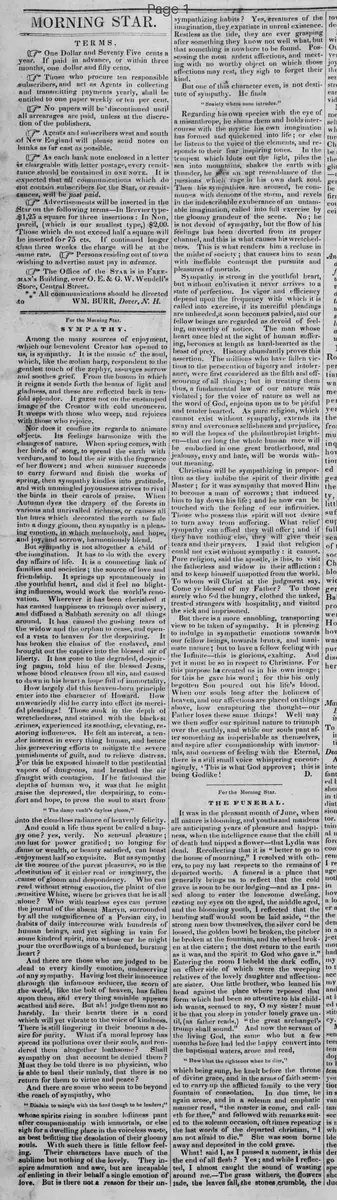
Among the many sources of enjoyment, which our benevolent Creator has opened to us, is sympathy. It is the music of the soul, which, like the aeolian harp, respondent to the gentlest touch of the zephyr, assuages sorrow and soothes grief. From the bosom in which it reigns it sends forth the beams of light and gladness, and these are reflected back in tenfold splendor. It gazes not on the enstamped image of the Creator with cold unconcern. It weeps with those who weep, and rejoices with those who rejoice.
Nor does it confine its regards to animate objects. Its feelings harmonize with the changes of nature. When spring comes, with her birds of song, to spread the earth with verdure, and to load the air with the fragrance of her flowers: and when summer succeeds to carry forward and finish the works of spring, then sympathy kindles into gratitude, and with unmingled joyousness strives to rival the birds in their carols of praise. When Autumn dyes the drapery of the forests in various and unrivalled richness, or causes all the hues which decorated the earth to fade into a dingy gloom, then sympathy is a pleasing emotion, in which melancholy, and hope, and joy, and sorrow, harmoniously blend.
But sympathy is not altogether a child of the imagination. It has to do with the every day affairs of life. It is a connecting link of families and societies; the source of love and friendship. It springs up spontaneously in the youthful heart, and did it feel no blighting influences, would work the world's renovation. Wherever it has been cherished it has caused happiness to triumph over misery, and diffused a Sabbath serenity on all things around. It has caused the gushing tears of the widow and the orphan to cease, and opened a vista to heaven for the despairing. It has broken the chains of the enslaved, and brought out the captive into the blessed air of liberty. It has gone to the degraded, despairing pagan, told him of the blessed Jesus, whose blood cleanses from all sin, and caused to dawn in his heart a hope full of immortality.
How largely did this heaven-born principle enter into the character of Howard. How unweariedly did he carry into effect its merciful pleadings! Those sunk in the depth of wretchedness, and stained with the blackest crimes, experienced its soothing, elevating, restoring influences. He felt an interest, a tender interest in every thing human, and hence his persevering efforts to mitigate the severe punishments of guilt, and to relieve distress. For this he exposed himself to the pestilential vapors of dungeons, and breathed the air fraught with contagion. If he fathomed the depths of human wo, it was that he might raise the depressed, the despairing, to comfort and hope, to press the soul to start from
"The damp vault's dayless gloom,"
into the cloudless radiance of heavenly felicity.
And could a life thus spent be called a happy one? yes, verily. No sensual pleasure; no lust for power gratified; no longing for fame or wealth, or beauty satisfied, can boast enjoyment half so exquisite. But as sympathy is the source of the purest pleasures, so is the destitution of it either real or imaginary, the cause of gloom and despondency. Who can read without strong emotion, the plaint of the sensitive White, where he grieves that he is all alone? Who with tearless eyes can peruse the journal of the absent Martyn, surrounded by all the magnificence of a Persian city, in habits of daily intercourse with hundreds of human beings, and yet sighing in vain for some kindred spirit, into whose ear he might pour the overflowings of a burdened, bursting heart?
And there are those who are judged to be dead to every kindly emotion, undeserving of any sympathy. Having lost their innocence through the infamous seducer, the scorn of the world, like the bolt of heaven, has fallen upon them, and every thing amiable appears scathed and sere. But ah! judge them not so harshly. In their hearts there is a cord which will yet vibrate to the voice of kindness. There is still lingering in their bosoms a desire for purity. What if a moral leprosy has spread its pollutions over their souls, and rendered them altogether loathsome? Shall sympathy on that account be denied them? Must they be told there is no physician, who is able to heal their malady, that there is no return for them to virtue and peace?
And there are some who seem to be beyond the reach of sympathy, who
"Disdain to mingle with the herd though to be leaders;"
whose spirits rising in sombre loftiness pant after companionship with immortals, or else sigh for a dwelling place in the voiceless waste, as best befitting the desolation of their gloomy souls. With such there is little fellow feeling.
Their characters have much of the sublime but nothing of the lovely. They inspire admiration and awe, but are incapable of enlisting in their behalf a single emotion of love. But is there not a reason for their unsympathizing habits? Yes, creatures of the imagination, they expatiate in unreal existence. Restless as the tide, they are ever grasping after something they know not well what, but that something is nowhere to be found. Possessing the most ardent affections, and meeting with no worthy object on which those affections may rest, they sigh to forget their kind.
But one of this character even, is not destitute of sympathy. He finds
"Society where none intrudes."
Regarding his own species with the eye of a misanthrope, he shuns them and holds intercourse with the mystic his own imagination has formed and quickened into life; or else he listens to the voice of the elements, and responds to their fear inspiring tones. In the tempest which blots out the light, piles the sea into mountains, shakes the earth with thunder, he sees an apt resemblance of the passions which rage in his own dark soul. Then his sympathies are aroused, he communes with demons of the storm, and revels in the indescribable exuberance of an untamable imagination, called into full exercise by the gloomy grandeur of the scene. No; he is not devoid of sympathy, but the flow of his feelings has been diverted from its proper channel, and this is what causes his wretchedness. This is what renders him a recluse in the midst of society; that causes him to scan with ineffable contempt the pursuits and pleasures of mortals.
Sympathy is strong in the youthful heart, but without cultivation it never arrives to a state of perfection. Its vigor and efficiency depend upon the frequency with which it is called into exercise, if its merciful pleadings are unheeded, it soon becomes palsied, and our fellow beings are regarded as devoid of feeling, unworthy of notice. The man whose heart once bled at the sight of human suffering, becomes at length as hard-hearted as the beast of prey. History abundantly proves this assertion. The millions who have fallen victims to the persecution of bigotry and intolerance, were first considered as the filth and offscouring of all things; but in treating them thus, a fundamental law of our nature was violated: for the voice of nature as well as the word of God, enjoins upon us to be pitiful and tender hearted. As pure religion, which cannot exist without sympathy, extends its sway and overcomes selfishness and prejudice, so will the hopes of the philanthropist brighten—that ere long the whole human race will be embodied in one great brotherhood, and jealousy, envy and hate, will be words without meaning.
Christians will be sympathizing in proportion as they imbibe the spirit of their divine Master; for it was sympathy that moved Him to become a man of sorrows; that induced him to lay down his life: and he now can be touched with the feeling of our infirmities. Those who possess this spirit will not desire to turn away from suffering. What relief sympathy can afford they will offer; and if they have nothing else, they will give their tears and their prayers. I said that religion could not exist without sympathy: it cannot. Pure religion, said the apostle, is this, to visit the fatherless and widow in their affliction: and to keep himself unspotted from the world. To whom will Christ at the judgment say, Come ye blessed of my Father? To those surely who fed the hungry, clothed the naked, treated strangers with hospitality, and visited the sick and imprisoned.
But there is a more ennobling, transporting view to be taken of sympathy. It is pleasing to indulge in sympathetic emotions towards our fellow beings, towards brutes, and inanimate nature; but to have a fellow feeling with the Infinite—this is glorious, exalting. And yet it must be so in respect to Christians. For this purpose he created us in his own image; for this he gave his word: for this his only begotten Son poured out his life's blood. When our souls long after the holiness of heaven, and our affections are placed on things above, how enrapturing the thought—our Father loves these same things! Well may we then suffer our spiritual nature to triumph over the earthly, and while our souls pant after something as imperishable as themselves, and aspire after companionship with immortals, and oneness of feeling with the Eternal, there is a still small voice whispering encouragingly, This is what God approves; this is being Godlike!
D.
SYMPATHY.
Among the many sources of enjoyment, which our benevolent Creator has opened to us, is sympathy. It is the music of the soul, which, like the aeolian harp, respondent to the gentlest touch of the zephyr, assuages sorrow and soothes grief. From the bosom in which it reigns it sends forth the beams of light and gladness, and these are reflected back in tenfold splendor. It gazes not on the enstamped image of the Creator with cold unconcern. It weeps with those who weep, and rejoices with those who rejoice.
Nor does it confine its regards to animate objects. Its feelings harmonize with the changes of nature. When spring comes, with her birds of song, to spread the earth with verdure, and to load the air with the fragrance of her flowers: and when summer succeeds to carry forward and finish the works of spring, then sympathy kindles into gratitude, and with unmingled joyousness strives to rival the birds in their carols of praise. When Autumn dyes the drapery of the forests in various and unrivalled richness, or causes all the hues which decorated the earth to fade into a dingy gloom, then sympathy is a pleasing emotion, in which melancholy, and hope, and joy, and sorrow, harmoniously blend.
But sympathy is not altogether a child of the imagination. It has to do with the every day affairs of life. It is a connecting link of families and societies; the source of love and friendship. It springs up spontaneously in the youthful heart, and did it feel no blighting influences, would work the world's renovation. Wherever it has been cherished it has caused happiness to triumph over misery, and diffused a Sabbath serenity on all things around. It has caused the gushing tears of the widow and the orphan to cease, and opened a vista to heaven for the despairing. It has broken the chains of the enslaved, and brought out the captive into the blessed air of liberty. It has gone to the degraded, despairing pagan, told him of the blessed Jesus, whose blood cleanses from all sin, and caused to dawn in his heart a hope full of immortality.
How largely did this heaven-born principle enter into the character of Howard. How unweariedly did he carry into effect its merciful pleadings! Those sunk in the depth of wretchedness, and stained with the blackest crimes, experienced its soothing, elevating, restoring influences. He felt an interest, a tender interest in every thing human, and hence his persevering efforts to mitigate the severe punishments of guilt, and to relieve distress. For this he exposed himself to the pestilential vapors of dungeons, and breathed the air fraught with contagion. If he fathomed the depths of human wo, it was that he might raise the depressed, the despairing, to comfort and hope, to press the soul to start from
"The damp vault's dayless gloom,"
into the cloudless radiance of heavenly felicity.
And could a life thus spent be called a happy one? yes, verily. No sensual pleasure; no lust for power gratified; no longing for fame or wealth, or beauty satisfied, can boast enjoyment half so exquisite. But as sympathy is the source of the purest pleasures, so is the destitution of it either real or imaginary, the cause of gloom and despondency. Who can read without strong emotion, the plaint of the sensitive White, where he grieves that he is all alone? Who with tearless eyes can peruse the journal of the absent Martyn, surrounded by all the magnificence of a Persian city, in habits of daily intercourse with hundreds of human beings, and yet sighing in vain for some kindred spirit, into whose ear he might pour the overflowings of a burdened, bursting heart?
And there are those who are judged to be dead to every kindly emotion, undeserving of any sympathy. Having lost their innocence through the infamous seducer, the scorn of the world, like the bolt of heaven, has fallen upon them, and every thing amiable appears scathed and sere. But ah! judge them not so harshly. In their hearts there is a cord which will yet vibrate to the voice of kindness. There is still lingering in their bosoms a desire for purity. What if a moral leprosy has spread its pollutions over their souls, and rendered them altogether loathsome? Shall sympathy on that account be denied them? Must they be told there is no physician, who is able to heal their malady, that there is no return for them to virtue and peace?
And there are some who seem to be beyond the reach of sympathy, who
"Disdain to mingle with the herd though to be leaders;"
whose spirits rising in sombre loftiness pant after companionship with immortals, or else sigh for a dwelling place in the voiceless waste, as best befitting the desolation of their gloomy souls. With such there is little fellow feeling.
Their characters have much of the sublime but nothing of the lovely. They inspire admiration and awe, but are incapable of enlisting in their behalf a single emotion of love. But is there not a reason for their unsympathizing habits? Yes, creatures of the imagination, they expatiate in unreal existence. Restless as the tide, they are ever grasping after something they know not well what, but that something is nowhere to be found. Possessing the most ardent affections, and meeting with no worthy object on which those affections may rest, they sigh to forget their kind.
But one of this character even, is not destitute of sympathy. He finds
"Society where none intrudes."
Regarding his own species with the eye of a misanthrope, he shuns them and holds intercourse with the mystic his own imagination has formed and quickened into life; or else he listens to the voice of the elements, and responds to their fear inspiring tones. In the tempest which blots out the light, piles the sea into mountains, shakes the earth with thunder, he sees an apt resemblance of the passions which rage in his own dark soul. Then his sympathies are aroused, he communes with demons of the storm, and revels in the indescribable exuberance of an untamable imagination, called into full exercise by the gloomy grandeur of the scene. No; he is not devoid of sympathy, but the flow of his feelings has been diverted from its proper channel, and this is what causes his wretchedness. This is what renders him a recluse in the midst of society; that causes him to scan with ineffable contempt the pursuits and pleasures of mortals.
Sympathy is strong in the youthful heart, but without cultivation it never arrives to a state of perfection. Its vigor and efficiency depend upon the frequency with which it is called into exercise, if its merciful pleadings are unheeded, it soon becomes palsied, and our fellow beings are regarded as devoid of feeling, unworthy of notice. The man whose heart once bled at the sight of human suffering, becomes at length as hard-hearted as the beast of prey. History abundantly proves this assertion. The millions who have fallen victims to the persecution of bigotry and intolerance, were first considered as the filth and offscouring of all things; but in treating them thus, a fundamental law of our nature was violated: for the voice of nature as well as the word of God, enjoins upon us to be pitiful and tender hearted. As pure religion, which cannot exist without sympathy, extends its sway and overcomes selfishness and prejudice, so will the hopes of the philanthropist brighten—that ere long the whole human race will be embodied in one great brotherhood, and jealousy, envy and hate, will be words without meaning.
Christians will be sympathizing in proportion as they imbibe the spirit of their divine Master; for it was sympathy that moved Him to become a man of sorrows; that induced him to lay down his life: and he now can be touched with the feeling of our infirmities. Those who possess this spirit will not desire to turn away from suffering. What relief sympathy can afford they will offer; and if they have nothing else, they will give their tears and their prayers. I said that religion could not exist without sympathy: it cannot. Pure religion, said the apostle, is this, to visit the fatherless and widow in their affliction: and to keep himself unspotted from the world. To whom will Christ at the judgment say, Come ye blessed of my Father? To those surely who fed the hungry, clothed the naked, treated strangers with hospitality, and visited the sick and imprisoned.
But there is a more ennobling, transporting view to be taken of sympathy. It is pleasing to indulge in sympathetic emotions towards our fellow beings, towards brutes, and inanimate nature; but to have a fellow feeling with the Infinite—this is glorious, exalting. And yet it must be so in respect to Christians. For this purpose he created us in his own image; for this he gave his word: for this his only begotten Son poured out his life's blood. When our souls long after the holiness of heaven, and our affections are placed on things above, how enrapturing the thought—our Father loves these same things! Well may we then suffer our spiritual nature to triumph over the earthly, and while our souls pant after something as imperishable as themselves, and aspire after companionship with immortals, and oneness of feeling with the Eternal, there is a still small voice whispering encouragingly, This is what God approves; this is being Godlike!
D.
What sub-type of article is it?
Essay
What themes does it cover?
Moral Virtue
Religious
Liberty Freedom
What keywords are associated?
Sympathy
Benevolence
Philanthropy
Howard
Religion
Christianity
Nature
Liberty
Friendship
Moral Virtue
What entities or persons were involved?
D.
Literary Details
Title
Sympathy.
Author
D.
Key Lines
It Weeps With Those Who Weep, And Rejoices With Those Who Rejoice.
"The Damp Vault's Dayless Gloom,"
"Disdain To Mingle With The Herd Though To Be Leaders;"
"Society Where None Intrudes."
Pure Religion, Said The Apostle, Is This, To Visit The Fatherless And Widow In Their Affliction: And To Keep Himself Unspotted From The World.