Thank you for visiting SNEWPapers!
Sign up free
Story
June 5, 1930
The Milwaukee Leader
Milwaukee, Milwaukee County, Wisconsin
What is this article about?
Dr. William Brady's column critiques hospital standardization, closed staffs, and lengthy nurse training, advocating shorter programs to cut sickness costs. Includes Q&A on health concepts, diet, piles treatment, and a book on intestines.
Clipping
OCR Quality
98%
Excellent
Full Text
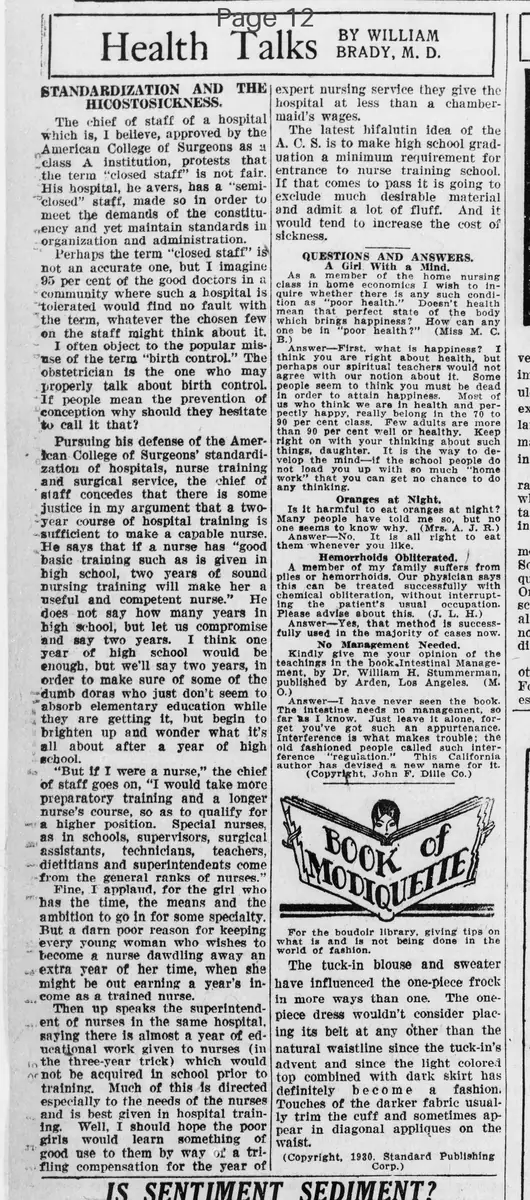
BY WILLIAM BRADY, M.D.
STANDARDIZATION AND THE HIGH COST OF SICKNESS.
The chief of staff of a hospital which is, I believe, approved by the American College of Surgeons as a class A institution, protests that the term "closed staff" is not fair. His hospital, he avers, has a "semi-closed" staff, made so in order to meet the demands of the constituency and yet maintain standards in organization and administration. Perhaps the term "closed staff" is not an accurate one, but I imagine 95 per cent of the good doctors in a community where such a hospital is tolerated would find no fault with the term, whatever the chosen few on the staff might think about it.
I often object to the popular misuse of the term "birth control." The obstetrician is the one who may properly talk about birth control. If people mean the prevention of conception why should they hesitate to call it that?
Pursuing his defense of the American College of Surgeons' standardization of hospitals, nurse training and surgical service, the chief of staff concedes that there is some justice in my argument that a two-year course of hospital training is sufficient to make a capable nurse. He says that if a nurse has "good basic training such as is given in high school, two years of sound nursing training will make her a useful and competent nurse."
He does not say how many years in high school, but let us compromise and say two years. I think one year of high school would be enough, but we'll say two years, in order to make sure of some of the dumb doras who just don't seem to absorb elementary education while they are getting it, but begin to brighten up and wonder what it's all about after a year of high school.
"But if I were a nurse," the chief of staff goes on, "I would take more preparatory training and a longer nurse's course, so as to qualify for a higher position. Special nurses, as in schools, supervisors, surgical assistants, technicians, teachers, dietitians and superintendents come from the general ranks of nurses."
Fine, I applaud, for the girl who has the time, the means and the ambition to go in for some specialty. But a darn poor reason for keeping every young woman who wishes to become a nurse dawdling away an extra year of her time, when she might be out earning a year's income as a trained nurse.
Then up speaks the superintendent of nurses in the same hospital, saying there is almost a year of educational work given to nurses (in the three-year trick) which would not be acquired in school prior to training. Much of this is directed especially to the needs of the nurses and is best given in hospital training.
Well, I should hope the poor girls would learn something of good use to them by way of a trifling compensation for the year of expert nursing service they give the hospital at less than a chambermaid's wages.
The latest hifalutin idea of the A. C. S. is to make high school graduation a minimum requirement for entrance to nurse training school. If that comes to pass it is going to exclude much desirable material and admit a lot of fluff. And it would tend to increase the cost of sickness.
QUESTIONS AND ANSWERS.
A Girl With a Mind.
As a member of the home nursing class in home economics I wish to inquire whether there is any such condition as "poor health." Doesn't health mean that perfect state of the body which brings happiness? How can anyone be in "poor health?" (Miss M. C. B.)
Answer—First, what is happiness? I think you are right about health, but perhaps our spiritual teachers would not agree with our notion about it. Some people seem to think you must be dead in order to attain happiness. Most of us who think we are in health and perfectly happy, really belong in the 70 to 90 per cent class. Few adults are more than 90 per cent well or healthy. Keep right on with your thinking about such things, daughter. It is the way to develop the mind—if the school people do not load you up with so much home work that you can get no chance to do any thinking.
Oranges at Night,
Is it harmful to eat oranges at night? Many people have told me so, but no one seems to know why. (Mrs. A. J. R.)
Answer—No. It is all right to eat them whenever you like.
Hemorrhoids Obliterated.
A member of my family suffers from piles or hemorrhoids. Our physician says this can be treated successfully with chemical obliteration, without interrupting the patient's usual occupation. Please advise about this. (J. L. H.)
Answer—Yes, that method is successfully used in the majority of cases now.
No Management Needed.
Kindly give me your opinion of the teachings in the book Intestinal Management, by Dr. William H. Stummerman, published by Arden, Los Angeles. (M. O.)
Answer—I have never seen the book. The intestine needs no management, so far as I know. Just leave it alone, forget you've got such an appurtenance. Interference is what makes trouble: the old fashioned people called such interference "regulation." This California author has devised a new name for it.
(Copyright, John F. Dille Co.)
STANDARDIZATION AND THE HIGH COST OF SICKNESS.
The chief of staff of a hospital which is, I believe, approved by the American College of Surgeons as a class A institution, protests that the term "closed staff" is not fair. His hospital, he avers, has a "semi-closed" staff, made so in order to meet the demands of the constituency and yet maintain standards in organization and administration. Perhaps the term "closed staff" is not an accurate one, but I imagine 95 per cent of the good doctors in a community where such a hospital is tolerated would find no fault with the term, whatever the chosen few on the staff might think about it.
I often object to the popular misuse of the term "birth control." The obstetrician is the one who may properly talk about birth control. If people mean the prevention of conception why should they hesitate to call it that?
Pursuing his defense of the American College of Surgeons' standardization of hospitals, nurse training and surgical service, the chief of staff concedes that there is some justice in my argument that a two-year course of hospital training is sufficient to make a capable nurse. He says that if a nurse has "good basic training such as is given in high school, two years of sound nursing training will make her a useful and competent nurse."
He does not say how many years in high school, but let us compromise and say two years. I think one year of high school would be enough, but we'll say two years, in order to make sure of some of the dumb doras who just don't seem to absorb elementary education while they are getting it, but begin to brighten up and wonder what it's all about after a year of high school.
"But if I were a nurse," the chief of staff goes on, "I would take more preparatory training and a longer nurse's course, so as to qualify for a higher position. Special nurses, as in schools, supervisors, surgical assistants, technicians, teachers, dietitians and superintendents come from the general ranks of nurses."
Fine, I applaud, for the girl who has the time, the means and the ambition to go in for some specialty. But a darn poor reason for keeping every young woman who wishes to become a nurse dawdling away an extra year of her time, when she might be out earning a year's income as a trained nurse.
Then up speaks the superintendent of nurses in the same hospital, saying there is almost a year of educational work given to nurses (in the three-year trick) which would not be acquired in school prior to training. Much of this is directed especially to the needs of the nurses and is best given in hospital training.
Well, I should hope the poor girls would learn something of good use to them by way of a trifling compensation for the year of expert nursing service they give the hospital at less than a chambermaid's wages.
The latest hifalutin idea of the A. C. S. is to make high school graduation a minimum requirement for entrance to nurse training school. If that comes to pass it is going to exclude much desirable material and admit a lot of fluff. And it would tend to increase the cost of sickness.
QUESTIONS AND ANSWERS.
A Girl With a Mind.
As a member of the home nursing class in home economics I wish to inquire whether there is any such condition as "poor health." Doesn't health mean that perfect state of the body which brings happiness? How can anyone be in "poor health?" (Miss M. C. B.)
Answer—First, what is happiness? I think you are right about health, but perhaps our spiritual teachers would not agree with our notion about it. Some people seem to think you must be dead in order to attain happiness. Most of us who think we are in health and perfectly happy, really belong in the 70 to 90 per cent class. Few adults are more than 90 per cent well or healthy. Keep right on with your thinking about such things, daughter. It is the way to develop the mind—if the school people do not load you up with so much home work that you can get no chance to do any thinking.
Oranges at Night,
Is it harmful to eat oranges at night? Many people have told me so, but no one seems to know why. (Mrs. A. J. R.)
Answer—No. It is all right to eat them whenever you like.
Hemorrhoids Obliterated.
A member of my family suffers from piles or hemorrhoids. Our physician says this can be treated successfully with chemical obliteration, without interrupting the patient's usual occupation. Please advise about this. (J. L. H.)
Answer—Yes, that method is successfully used in the majority of cases now.
No Management Needed.
Kindly give me your opinion of the teachings in the book Intestinal Management, by Dr. William H. Stummerman, published by Arden, Los Angeles. (M. O.)
Answer—I have never seen the book. The intestine needs no management, so far as I know. Just leave it alone, forget you've got such an appurtenance. Interference is what makes trouble: the old fashioned people called such interference "regulation." This California author has devised a new name for it.
(Copyright, John F. Dille Co.)
What sub-type of article is it?
Curiosity
Medical Curiosity
What themes does it cover?
Justice
Moral Virtue
Social Manners
What keywords are associated?
Hospital Standardization
Nurse Training
Closed Staff
Birth Control
Health Questions
Hemorrhoids
Intestinal Management
What entities or persons were involved?
William Brady
Chief Of Staff
Superintendent Of Nurses
Story Details
Key Persons
William Brady
Chief Of Staff
Superintendent Of Nurses
Story Details
Dr. Brady critiques hospital 'closed staff' policies and argues for a two-year nurse training course instead of three to reduce costs and make nursing accessible, opposing high school graduation requirements. He responds to questions on 'poor health,' eating oranges at night, hemorrhoid treatment, and intestinal management.