Thank you for visiting SNEWPapers!
Sign up free
Letter to Editor
September 11, 1824
Concord Register
Concord, Merrimack County, New Hampshire
What is this article about?
A plain man writes to the editor of the Concord Register, satirically critiquing the paper's illogical attack on a legislative caucus that unanimously recommended John Quincy Adams for President. He defends the caucus, notes denials of alleged pledges from electors, and mocks the editor's reasoning as inverted logic favoring rival candidate Crawford.
Clipping
OCR Quality
98%
Excellent
Full Text
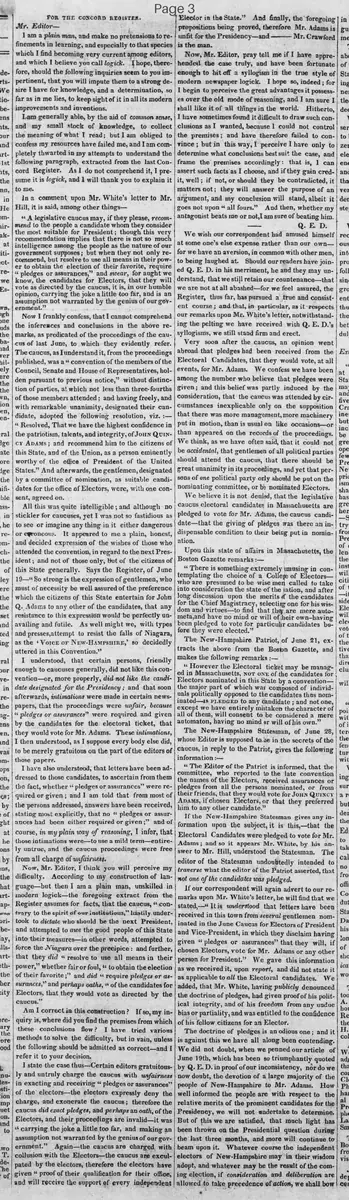
FOR THE CONCORD REGISTER.
Mr. Editor-
I am a plain man, and make no pretensions to refinements in learning, and especially to that species which I find becoming very current among editors, and which I believe you call logick. I hope, therefore, should the following inquiries seem to you impertinent, that you will impute them to a strong desire I have for knowledge, and a determination, so far as in me lies, to keep sight of it in all its modern improvements and inventions.
I am generally able, by the aid of common sense, and my small stock of knowledge, to collect the meaning of what I read; but I am obliged to confess my resources have failed me, and I am completely thwarted in my attempts to understand the following paragraph, extracted from the last Concord Register. As I do not comprehend it, I presume it is logick, and I will thank you to explain it to me.
In a comment upon Mr. White's letter to Mr. Hill, it is said, among other things—
"A legislative caucus may, if they please, recommend to the people a candidate whom they consider the most suitable for President; though this very recommendation implies that there is not so much intelligence among the people as the nature of our government supposes; but when they not only recommend, but resolve to use all means in their power to obtain the election of their favorite, require "pledges or assurances," and swear, for aught we know, the candidates for Electors, that they will vote as directed by the caucus, it is, in our humble opinion, carrying the joke a little too far, and is an assumption not warranted by the genius of our government."
Now I frankly confess that I cannot comprehend the inferences and conclusions in the above remarks, as predicated of the proceedings of the caucus of last June, to which they evidently refer.
The caucus, as I understand it, from the proceedings published, was a "convention of the members of the Council, Senate and House of Representatives, holden pursuant to previous notice," without distinction of parties, at which not less than three-fourths of those members attended; and having freely, and with remarkable unanimity, designated their candidate, adopted the following resolution, viz. :-
"Resolved, That we have the highest confidence in the patriotism, talents, and integrity, of JOHN QUINCY ADAMS: and recommend him to the citizens of this State, and of the Union, as a person eminently worthy of the office of President of the United States." And afterwards, the gentlemen, designated by a committee of nomination, as suitable candidates for the office of Electors, were, with one consent, agreed on.
All this was quite intelligible; and although no stickler for caucuses, yet I was not so fastidious as to see or imagine anything in it either dangerous or erroneous. It appeared to me a plain, honest, and decided expression of the wishes of those who attended the convention, in regard to the next President; and not of those only, but of the citizens of this State generally. Says the Register, of June 19 "So strong is the expression of gentlemen, who must of necessity be well assured of the preference which the citizens of this State entertain for John Q. Adams to any other of the candidates, that any resistance to this expression would be perfectly unavailing and futile. As well might we, with types and presses, attempt to resist the falls of Niagara, as the 'Voice of New-Hampshire,' so decidedly uttered in this Convention."
I understood, that certain persons, friendly enough to caucuses generally, did not like this convention—or, more properly, did not like the candidate designated for the Presidency: and that soon afterwards, intimations were made in certain newspapers, that the proceedings were unfair, because "pledges or assurances" were required and given by the candidates for the electoral ticket, that they would vote for Mr. Adams. These intimations, I then understood, as I suppose every body else did, to be merely gratuitous on the part of the editors of those papers.
I have also understood, that letters have been addressed to those candidates, to ascertain from them the fact, whether "pledges or assurances" were required or given; and I am told that from most of the persons addressed, answers have been received, stating most explicitly, that no "pledges or assurances had been either required or given;" and of course, in my plain way of reasoning, I infer, that those intimations were-to use a mild term-entirely untrue, and the caucus proceedings were free from all charge of unfairness.
Now, Mr. Editor, I think you will perceive my difficulty. According to my construction of language-but then I am a plain man, unskilled in modern logick-the foregoing extract from the Register assumes for facts, that the caucus, "contrary to the spirit of our institutions," hastily undertook to dictate who should be the next President, and attempted to awe the good people of this State into their measures—in other words, attempted to force the Niagara over the precipice: and further, that they did "resolve to use all means in their power," whether fair or foul, "to obtain the election of their favorite;" and did "require pledges or assurances," and perhaps oaths, "of the candidates for Electors, that they would vote as directed by the caucus."
Am I correct in this construction? If so, my inquiry is, where did you find the premises from which these conclusions flow? I have tried various methods to solve the difficulty, but in vain, unless the following should be admitted as correct-and I refer it to your decision.
I state the case thus-Certain editors gratuitously and untruly charge the caucus with unfairness in exacting and receiving "pledges or assurances" of the electors-the electors expressly deny the charge, and exonerate the caucus; therefore the caucus did exact pledges, and perhaps an oath, of the Electors, and their proceedings are invalid-it was "carrying the joke a little too far, and making an assumption not warranted by the genius of our government." Again-the caucus are charged with collusion with the Electors-the caucus are exculpated by the electors, therefore the electors have given "proof of their qualification for their office, and will receive the support of every independent Elector in the State." And finally, the foregoing propositions being proved, therefore Mr. Adams is unfit for the Presidency-and —a.- Mr. Crawford is the man.
Now, Mr. Editor, pray tell me if I have apprehended the case truly, and have been fortunate enough to hit off a syllogism in the true style of modern newspaper logick. I hope so, indeed; for I begin to perceive the great advantages it possesses over the old mode of reasoning, and I am sure I shall like it of all things in the world. Hitherto, I have sometimes found it difficult to draw such conclusions as I wanted, because I could not control the premises; and have therefore failed to convince; but in this way, I perceive I have only to determine what conclusions best suit the case, and frame the premises accordingly: that is, I can assert such facts as I choose, and if they gain credit, well; if not, or should they be contradicted, it matters not; they will answer the purpose of an argument, and my conclusion will stand, albeit it goes not upon "all fours." And then, whether my antagonist beats me or not, I am sure of beating him.
Q. E. D.
Mr. Editor-
I am a plain man, and make no pretensions to refinements in learning, and especially to that species which I find becoming very current among editors, and which I believe you call logick. I hope, therefore, should the following inquiries seem to you impertinent, that you will impute them to a strong desire I have for knowledge, and a determination, so far as in me lies, to keep sight of it in all its modern improvements and inventions.
I am generally able, by the aid of common sense, and my small stock of knowledge, to collect the meaning of what I read; but I am obliged to confess my resources have failed me, and I am completely thwarted in my attempts to understand the following paragraph, extracted from the last Concord Register. As I do not comprehend it, I presume it is logick, and I will thank you to explain it to me.
In a comment upon Mr. White's letter to Mr. Hill, it is said, among other things—
"A legislative caucus may, if they please, recommend to the people a candidate whom they consider the most suitable for President; though this very recommendation implies that there is not so much intelligence among the people as the nature of our government supposes; but when they not only recommend, but resolve to use all means in their power to obtain the election of their favorite, require "pledges or assurances," and swear, for aught we know, the candidates for Electors, that they will vote as directed by the caucus, it is, in our humble opinion, carrying the joke a little too far, and is an assumption not warranted by the genius of our government."
Now I frankly confess that I cannot comprehend the inferences and conclusions in the above remarks, as predicated of the proceedings of the caucus of last June, to which they evidently refer.
The caucus, as I understand it, from the proceedings published, was a "convention of the members of the Council, Senate and House of Representatives, holden pursuant to previous notice," without distinction of parties, at which not less than three-fourths of those members attended; and having freely, and with remarkable unanimity, designated their candidate, adopted the following resolution, viz. :-
"Resolved, That we have the highest confidence in the patriotism, talents, and integrity, of JOHN QUINCY ADAMS: and recommend him to the citizens of this State, and of the Union, as a person eminently worthy of the office of President of the United States." And afterwards, the gentlemen, designated by a committee of nomination, as suitable candidates for the office of Electors, were, with one consent, agreed on.
All this was quite intelligible; and although no stickler for caucuses, yet I was not so fastidious as to see or imagine anything in it either dangerous or erroneous. It appeared to me a plain, honest, and decided expression of the wishes of those who attended the convention, in regard to the next President; and not of those only, but of the citizens of this State generally. Says the Register, of June 19 "So strong is the expression of gentlemen, who must of necessity be well assured of the preference which the citizens of this State entertain for John Q. Adams to any other of the candidates, that any resistance to this expression would be perfectly unavailing and futile. As well might we, with types and presses, attempt to resist the falls of Niagara, as the 'Voice of New-Hampshire,' so decidedly uttered in this Convention."
I understood, that certain persons, friendly enough to caucuses generally, did not like this convention—or, more properly, did not like the candidate designated for the Presidency: and that soon afterwards, intimations were made in certain newspapers, that the proceedings were unfair, because "pledges or assurances" were required and given by the candidates for the electoral ticket, that they would vote for Mr. Adams. These intimations, I then understood, as I suppose every body else did, to be merely gratuitous on the part of the editors of those papers.
I have also understood, that letters have been addressed to those candidates, to ascertain from them the fact, whether "pledges or assurances" were required or given; and I am told that from most of the persons addressed, answers have been received, stating most explicitly, that no "pledges or assurances had been either required or given;" and of course, in my plain way of reasoning, I infer, that those intimations were-to use a mild term-entirely untrue, and the caucus proceedings were free from all charge of unfairness.
Now, Mr. Editor, I think you will perceive my difficulty. According to my construction of language-but then I am a plain man, unskilled in modern logick-the foregoing extract from the Register assumes for facts, that the caucus, "contrary to the spirit of our institutions," hastily undertook to dictate who should be the next President, and attempted to awe the good people of this State into their measures—in other words, attempted to force the Niagara over the precipice: and further, that they did "resolve to use all means in their power," whether fair or foul, "to obtain the election of their favorite;" and did "require pledges or assurances," and perhaps oaths, "of the candidates for Electors, that they would vote as directed by the caucus."
Am I correct in this construction? If so, my inquiry is, where did you find the premises from which these conclusions flow? I have tried various methods to solve the difficulty, but in vain, unless the following should be admitted as correct-and I refer it to your decision.
I state the case thus-Certain editors gratuitously and untruly charge the caucus with unfairness in exacting and receiving "pledges or assurances" of the electors-the electors expressly deny the charge, and exonerate the caucus; therefore the caucus did exact pledges, and perhaps an oath, of the Electors, and their proceedings are invalid-it was "carrying the joke a little too far, and making an assumption not warranted by the genius of our government." Again-the caucus are charged with collusion with the Electors-the caucus are exculpated by the electors, therefore the electors have given "proof of their qualification for their office, and will receive the support of every independent Elector in the State." And finally, the foregoing propositions being proved, therefore Mr. Adams is unfit for the Presidency-and —a.- Mr. Crawford is the man.
Now, Mr. Editor, pray tell me if I have apprehended the case truly, and have been fortunate enough to hit off a syllogism in the true style of modern newspaper logick. I hope so, indeed; for I begin to perceive the great advantages it possesses over the old mode of reasoning, and I am sure I shall like it of all things in the world. Hitherto, I have sometimes found it difficult to draw such conclusions as I wanted, because I could not control the premises; and have therefore failed to convince; but in this way, I perceive I have only to determine what conclusions best suit the case, and frame the premises accordingly: that is, I can assert such facts as I choose, and if they gain credit, well; if not, or should they be contradicted, it matters not; they will answer the purpose of an argument, and my conclusion will stand, albeit it goes not upon "all fours." And then, whether my antagonist beats me or not, I am sure of beating him.
Q. E. D.
What sub-type of article is it?
Satirical
Persuasive
Political
What themes does it cover?
Politics
What keywords are associated?
Caucus
John Quincy Adams
Presidential Election
Electors
Pledges
New Hampshire
Logic
Crawford
What entities or persons were involved?
Q. E. D.
Mr. Editor
Letter to Editor Details
Author
Q. E. D.
Recipient
Mr. Editor
Main Argument
the legislative caucus's recommendation of john quincy adams was fair and unanimous, with no pledges required from electors; the editor's criticism relies on false premises and inverted logic to undermine adams and promote crawford.
Notable Details
Quotes Caucus Resolution Praising Adams's Patriotism, Talents, And Integrity
References Register's Own Praise Of The Caucus As The 'Voice Of New Hampshire'
Electors Denied Giving Or Receiving Pledges Or Assurances
Constructs A Syllogism To Mock The Editor's Reasoning Style