Thank you for visiting SNEWPapers!
Sign up free
Domestic News
June 2, 1790
Gazette Of The United States
New York, New York County, New York
What is this article about?
On May 11, in the U.S. House of Representatives, members debated increasing tonnage duties on foreign ships to promote American shipbuilding and trade. Speakers including Fitzsimons, Livermore, Bloodworth, White, and Page presented regional arguments for and against, emphasizing economic benefits and potential burdens on agriculture.
Clipping
OCR Quality
95%
Excellent
Full Text
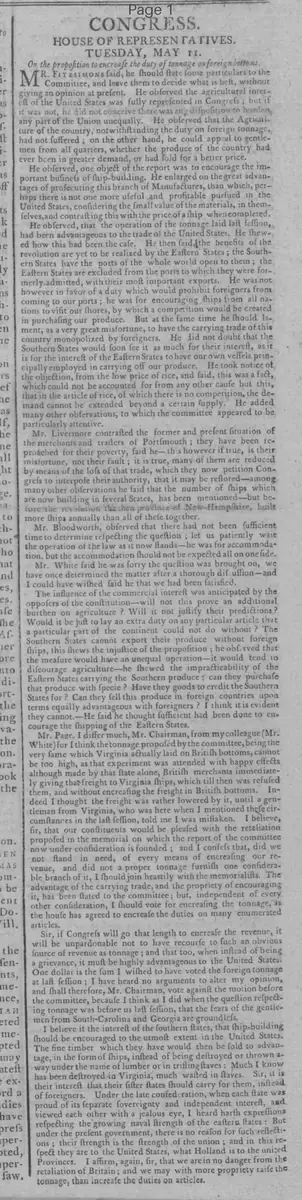
CONGRESS.
HOUSE OF REPRESENTATIVES.
TUESDAY, MAY 11.
On the proposition to increase the duty of tonnage on foreign bottoms.
Mr. Fitzsimons said, he should state some particulars to the Committee, and leave them to decide what is best, without giving an opinion at present. He observed the agricultural interest of the United States was fully represented in Congress; but if it was not, he did not conceive there was any disposition to burden any part of the Union unequally. He observed that the Agriculture of the country, notwithstanding the duty on foreign tonnage, had not suffered; on the other hand, he could appeal to gentlemen from all quarters, whether the produce of the country had been in greater demand, or had sold for a better price.
He observed, one object of the report was to encourage the important business of ship-building. He enlarged on the great advantages of prosecuting this branch of Manufactures, than which, perhaps there is not one more useful and profitable pursued in the United States, considering the small value of the materials, in themselves, and contrasting this with the price of a ship when completed.
He observed, that the operation of the tonnage laid last session, had been advantageous to the trade of the United States. He showed how this had been the case. He then said, the benefits of the revolution are yet to be realized by the Eastern States: the Southern States have the ports of the whole world open to them; the Eastern States are excluded from the ports to which they were formerly admitted, with their most important exports. He was not however in favor of a duty which would prohibit foreigners from coming to our ports; he was for encouraging ships from all nations to visit our shores, by which a competition would be created in purchasing our produce. But at the same time he should lament, as a very great misfortune, to have the carrying trade of this country monopolized by foreigners. He did not doubt that the Southern States would soon see it as much for their interest, as it is for the interest of the Eastern States to have our own vessels principally employed in carrying off our produce. He took notice of the objection, from the low price of rice, and said, this was a fact, which could not be accounted for from any other cause but this, that in the article of rice, of which there is no competition, the demand cannot be extended beyond a certain supply. He added many other observations, to which the committee appeared to be particularly attentive.
Mr. Livermore contrasted the former and present situation of the merchants and traders of Portsmouth: they have been reproached for their poverty, said he— this however if true, is their misfortune, not their fault; it is true, many of them are reduced by means of the loss of that trade, which they now petition Congress to interpose their authority, that it may be restored—among many other observations he said that the number of ships which are now building in several States, has been mentioned—but before the revolution that one province of New-Hampshire, built more ships annually than all of these together.
Mr. Bloodworth, observed that there had not been sufficient time to determine respecting the question; let us patiently wait the operation of the law as it now stands—he was for accommodation. but the accommodation should not be expected all on one side.
Mr. White said he was sorry the question was brought on, we have once determined the matter after a thorough discussion—and I could have wished said he that we had been satisfied.
The influence of the commercial interest was anticipated by the opposers of the constitution—will not this prove an additional burthen on agriculture? Will it not justify their predictions?
Would it be just to lay an extra duty on any particular article that a particular part of the continent could not do without? The Southern States cannot export their produce without foreign ships, this shows the injustice of the proposition; he observed that the measure would have an unequal operation—it would tend to discourage agriculture—he showed the impracticability of the Eastern States carrying the Southern produce; can they purchase that produce with specie? Have they goods to credit the Southern States for? Can they sell this produce in foreign countries upon terms equally advantageous with foreigners? I think it is evident they cannot.—He said he thought sufficient had been done to encourage the shipping of the Eastern States.
Mr. Page. I differ much, Mr. Chairman, from my colleague (Mr. White) for I think the tonnage proposed by the committee, being the very same which Virginia actually laid on British bottoms, cannot be too high, as that experiment was attended with happy effects although made by that state alone, British merchants immediately giving that freight to Virginia ships, which till then was refused them, and without increasing the freight in British bottoms. Indeed I thought the freight was rather lowered by it, until a gentleman from Virginia, who was here when I mentioned these circumstances in the last session, told me I was mistaken. I believe, sir, that our constituents would be pleased with the retaliation proposed in the memorial on which the report of the committee now under consideration is founded; and I confess that, did we not stand in need, of every means of increasing our revenue, and did not a proper tonnage furnish one considerable branch of it, I should join heartily with the memorialists. The advantage of the carrying trade, and the propriety of encouraging it, has been stated to the committee; but, independent of every other consideration, I should vote for increasing the tonnage, as the house has agreed to increase the duties on many enumerated articles.
Sir, if Congress will go that length to increase the revenue, it will be unpardonable not to have recourse to such an obvious source of revenue as tonnage; and that too, when instead of being a grievance, it must be highly advantageous to the United States.
One dollar is the sum I wished to have voted the foreign tonnage at last session; I have heard no arguments to alter my opinion, and shall therefore, Mr. Chairman, vote against the motion before the committee, because I think as I did when the question respecting tonnage was before us last session, that the fears of the gentlemen from South-Carolina and Georgia are groundless,
I believe it the interest of the southern states, that ship-building should be encouraged to the utmost extent in the United States.
The fine timber which they have would then be sold to advantage, in the form of ships, instead of being destroyed or thrown away under the name of lumber or in trifling staves: Much I know has been destroyed in Virginia, much wasted in staves. Sir, it is their interest that their sister states should carry for them, instead of foreigners. Under the late confederation, when each state was proud of its separate sovereignty and independent interest, and viewed each other with a jealous eye, I heard harsh expressions respecting the growing naval strength of the eastern states: But under the present government, there is no reason for such reflections; their strength is the strength of the union; and in this respect they are to the United States, what Holland is to the united Provinces. I affirm, again, sir, that we are in no danger from the retaliation of Britain; and we may with more propriety raise the tonnage, than increase the duties on articles.
HOUSE OF REPRESENTATIVES.
TUESDAY, MAY 11.
On the proposition to increase the duty of tonnage on foreign bottoms.
Mr. Fitzsimons said, he should state some particulars to the Committee, and leave them to decide what is best, without giving an opinion at present. He observed the agricultural interest of the United States was fully represented in Congress; but if it was not, he did not conceive there was any disposition to burden any part of the Union unequally. He observed that the Agriculture of the country, notwithstanding the duty on foreign tonnage, had not suffered; on the other hand, he could appeal to gentlemen from all quarters, whether the produce of the country had been in greater demand, or had sold for a better price.
He observed, one object of the report was to encourage the important business of ship-building. He enlarged on the great advantages of prosecuting this branch of Manufactures, than which, perhaps there is not one more useful and profitable pursued in the United States, considering the small value of the materials, in themselves, and contrasting this with the price of a ship when completed.
He observed, that the operation of the tonnage laid last session, had been advantageous to the trade of the United States. He showed how this had been the case. He then said, the benefits of the revolution are yet to be realized by the Eastern States: the Southern States have the ports of the whole world open to them; the Eastern States are excluded from the ports to which they were formerly admitted, with their most important exports. He was not however in favor of a duty which would prohibit foreigners from coming to our ports; he was for encouraging ships from all nations to visit our shores, by which a competition would be created in purchasing our produce. But at the same time he should lament, as a very great misfortune, to have the carrying trade of this country monopolized by foreigners. He did not doubt that the Southern States would soon see it as much for their interest, as it is for the interest of the Eastern States to have our own vessels principally employed in carrying off our produce. He took notice of the objection, from the low price of rice, and said, this was a fact, which could not be accounted for from any other cause but this, that in the article of rice, of which there is no competition, the demand cannot be extended beyond a certain supply. He added many other observations, to which the committee appeared to be particularly attentive.
Mr. Livermore contrasted the former and present situation of the merchants and traders of Portsmouth: they have been reproached for their poverty, said he— this however if true, is their misfortune, not their fault; it is true, many of them are reduced by means of the loss of that trade, which they now petition Congress to interpose their authority, that it may be restored—among many other observations he said that the number of ships which are now building in several States, has been mentioned—but before the revolution that one province of New-Hampshire, built more ships annually than all of these together.
Mr. Bloodworth, observed that there had not been sufficient time to determine respecting the question; let us patiently wait the operation of the law as it now stands—he was for accommodation. but the accommodation should not be expected all on one side.
Mr. White said he was sorry the question was brought on, we have once determined the matter after a thorough discussion—and I could have wished said he that we had been satisfied.
The influence of the commercial interest was anticipated by the opposers of the constitution—will not this prove an additional burthen on agriculture? Will it not justify their predictions?
Would it be just to lay an extra duty on any particular article that a particular part of the continent could not do without? The Southern States cannot export their produce without foreign ships, this shows the injustice of the proposition; he observed that the measure would have an unequal operation—it would tend to discourage agriculture—he showed the impracticability of the Eastern States carrying the Southern produce; can they purchase that produce with specie? Have they goods to credit the Southern States for? Can they sell this produce in foreign countries upon terms equally advantageous with foreigners? I think it is evident they cannot.—He said he thought sufficient had been done to encourage the shipping of the Eastern States.
Mr. Page. I differ much, Mr. Chairman, from my colleague (Mr. White) for I think the tonnage proposed by the committee, being the very same which Virginia actually laid on British bottoms, cannot be too high, as that experiment was attended with happy effects although made by that state alone, British merchants immediately giving that freight to Virginia ships, which till then was refused them, and without increasing the freight in British bottoms. Indeed I thought the freight was rather lowered by it, until a gentleman from Virginia, who was here when I mentioned these circumstances in the last session, told me I was mistaken. I believe, sir, that our constituents would be pleased with the retaliation proposed in the memorial on which the report of the committee now under consideration is founded; and I confess that, did we not stand in need, of every means of increasing our revenue, and did not a proper tonnage furnish one considerable branch of it, I should join heartily with the memorialists. The advantage of the carrying trade, and the propriety of encouraging it, has been stated to the committee; but, independent of every other consideration, I should vote for increasing the tonnage, as the house has agreed to increase the duties on many enumerated articles.
Sir, if Congress will go that length to increase the revenue, it will be unpardonable not to have recourse to such an obvious source of revenue as tonnage; and that too, when instead of being a grievance, it must be highly advantageous to the United States.
One dollar is the sum I wished to have voted the foreign tonnage at last session; I have heard no arguments to alter my opinion, and shall therefore, Mr. Chairman, vote against the motion before the committee, because I think as I did when the question respecting tonnage was before us last session, that the fears of the gentlemen from South-Carolina and Georgia are groundless,
I believe it the interest of the southern states, that ship-building should be encouraged to the utmost extent in the United States.
The fine timber which they have would then be sold to advantage, in the form of ships, instead of being destroyed or thrown away under the name of lumber or in trifling staves: Much I know has been destroyed in Virginia, much wasted in staves. Sir, it is their interest that their sister states should carry for them, instead of foreigners. Under the late confederation, when each state was proud of its separate sovereignty and independent interest, and viewed each other with a jealous eye, I heard harsh expressions respecting the growing naval strength of the eastern states: But under the present government, there is no reason for such reflections; their strength is the strength of the union; and in this respect they are to the United States, what Holland is to the united Provinces. I affirm, again, sir, that we are in no danger from the retaliation of Britain; and we may with more propriety raise the tonnage, than increase the duties on articles.
What sub-type of article is it?
Politics
Economic
What keywords are associated?
Congress Debate
Tonnage Duty
Foreign Ships
Ship Building
American Trade
Eastern States
Southern States
Agriculture Impact
What entities or persons were involved?
Mr. Fitzsimons
Mr. Livermore
Mr. Bloodworth
Mr. White
Mr. Page
Domestic News Details
Event Date
Tuesday, May 11
Key Persons
Mr. Fitzsimons
Mr. Livermore
Mr. Bloodworth
Mr. White
Mr. Page
Event Details
Debate in the House of Representatives on increasing the duty of tonnage on foreign vessels, with speakers arguing for encouragement of ship-building, protection of domestic trade, and addressing regional interests between Eastern and Southern states.