Thank you for visiting SNEWPapers!
Sign up free
Story
April 5, 1844
Vermont Watchman And State Journal
Montpelier, Washington County, Vermont
What is this article about?
In Philadelphia, a poor boy named Henry begs for charity to aid his sick mother and infant brother. He encounters George Washington, who provides money for a doctor and leaves a $100 promissory note from his own funds, leading to the family's recovery and future prosperity.
Clipping
OCR Quality
98%
Excellent
Full Text
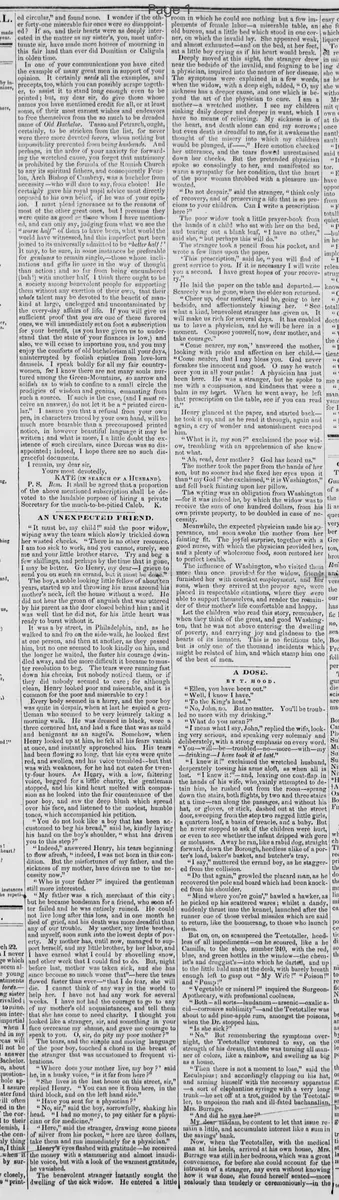
AN UNEXPECTED FRIEND.
"It must be, my child!" said the poor widow, wiping away the tears which slowly trickled down her wasted cheeks. "There is no other resource. I am too sick to work, and you cannot, surely, see me and your little brother starve. Try and beg a few shillings, and perhaps by the time that is gone, I may be better. Go Henry, my dear—I grieve to send you on such an errand, but it must be done."
The boy, a noble looking little fellow of about ten years, started up and throwing his arms around his mother's neck, left the house without a word. He did not hear the groan of anguish that was uttered by his parent as the door closed behind him; and it was well that he did not, for his little heart was ready to burst without it.
It was a by street, in Philadelphia, and, as he walked to and fro on the side-walk, he looked first at one person, and then at another, as they passed him, but no one seemed to look kindly on him, and the longer he waited, the faster his courage dwindled away, and the more difficult it became to muster resolution to beg. The tears were running fast down his cheeks, but nobody noticed them, or if they did nobody seemed to care; for although clean, Henry looked poor and miserable, and it is common for the poor and miserable to cry!
Every body seemed in a hurry, and the poor boy was quite in despair, when at last he espied a gentleman who seemed to be very leisurely taking a morning walk. He was dressed in black, wore a three cornered hat, and had a face that was as mild and benignant as an angel's. Somehow, when Henry looked up at him, he felt all his fears vanish at once, and instantly approached him. His tears had been flowing so long, that his eyes were quite red, and swollen, and his voice trembled—but that was with weakness, for he had not eaten for twenty-four hours. As Henry, with a low, faltering voice, begged for a little charity, the gentleman stopped, and his kind heart melted with compassion as he looked into the fair countenance of the poor boy, and saw the deep blush which spread over his face, and listened to the modest, humble tones, which accompanied his petition.
"You do not look like a boy that has been accustomed to beg his bread," said he, kindly laying his hand on the boy's shoulder, "what has driven you to this step?"
"Indeed," answered Henry, his tears beginning to flow afresh, "indeed, I was not born in this condition. But the misfortunes of my father, and the sickness of my mother, have driven me to the necessity now."
"Who is your father?" inquired the gentleman still more interested.
"My father was a rich merchant of this city; but he became bondsman for a friend, who soon after failed and he was entirely ruined. He could not live long after this loss, and in one month he died of grief, and his death was more dreadful than any of our trouble. My mother, my little brother, and myself, soon sunk into the lowest depths of poverty. My mother has, until now, managed to support herself, and my little brother, by her labor, and I have earned what I could by shovelling snow, and other work that I could find to do. But, night before last, mother was taken sick, and she has since become so much worse that"—here the tears flowed faster than ever—”that I do fear, she will die. I cannot think of any way in the world to help her. I have not had any work for several weeks. I have not had the courage to go to any of my mother's old acquaintances, and tell them that she has come to need charity. I thought you looked like a stranger, sir, and something in your face overcame my shame, and gave me courage to speak to you. O, sir, do pity my poor mother?"
The tears, and the simple and moving language of the poor boy, touched a chord in the breast of the stranger that was accustomed to frequent vibrations.
"Where does your mother live, my boy?" said he, in a husky voice, "is it far from here?"
"She lives in the last house on this street, sir," replied Henry. "You can see it from here, in the third block, and on the left hand side."
"Have you sent for a physician?"
"No, sir," said the boy, sorrowfully, shaking his head. "I had no money, to pay either for a physician or for medicine."
"Here," said the stranger, drawing some pieces of silver from his pocket, "here are three dollars, take them and run immediately for a physician."
Henry's eyes flashed with gratitude—he received the money with a stammering and almost inaudible voice, but with a look of the warmest gratitude, he vanished.
The benevolent stranger instantly sought the dwelling of the sick widow. He entered a little room in which he could see nothing but a few implements of female labor—a miserable table, an old bureau, and a little bed which stood in one corner, on which the invalid lay. She appeared weak, and almost exhausted—and on the bed, at her feet, sat a little boy crying as if his heart would break.
Deeply moved at this sight, the stranger drew near the bedside of the invalid, and feigning to be a physician, inquired into the nature of her disease. The symptoms were explained in a few words, when the widow, with a deep sigh, added, "O, my sickness has a deeper cause, and one which is beyond the art of the physician to cure. I am a mother—a wretched mother. I see my children sinking daily deeper and deeper in want, which I have no means of relieving. My sickness is of the heart, and death alone can end my sorrows; but even death is dreadful to me, for it awakens the thought of the misery into which my children would be plunged, if." Here emotion checked her utterance, and the tears flowed unrestrained down her cheeks. But the pretended physician spoke so consolingly to her, and manifested so warm a sympathy for her condition, that the heart of the poor woman throbbed with a pleasure unwonted.
"Do not despair." said the stranger, "think only of recovery, and of preserving a life that is so precious to your children. Can I write a prescription here?"
The poor widow took a little prayer-book from the hands of a child who sat with her on the bed, and tearing out a blank leaf, "I have no other," said she, "but perhaps this will do."
The stranger took a pencil from his pocket, and wrote a few lines upon the paper.
"This prescription," said he, "you will find of great service to you. If it is necessary I will write you a second. I have great hopes of your recovery."
He laid the paper on the table and departed.—
Scarcely was he gone, when the elder son returned.
"Cheer up, dear mother," said he, going to her bedside, and affectionately kissing her. "See what a kind, benevolent stranger has given us. It will make us rich for several days. It has enabled us to have a physician, and he will be here in a moment. Compose yourself, now, dear mother, and take courage."
"Come nearer, my son,' answered the mother, looking with pride and affection on her child.—"Come nearer, that I may bless you. God never forsakes the innocent and good. O may he watch over you in all your paths! A physician has just been here. He was a stranger, but he spoke to me with a compassion, and kindness that were a balm in my heart. When he went away, he left that prescription on the table, see if you can read it."
Henry glanced at the paper, and started back—he took it up, and as he read it through, again and again, a cry of wonder and astonishment escaped him.
"What is it, my son?" exclaimed the poor widow, trembling with an apprehension of she knew not what.
"Ah, read, dear mother? God has heard us."
The mother took the paper from the hands of her son, but no sooner had she fixed her eyes upon it than "my God!" she exclaimed, "it is Washington," and fell back fainting upon her pillow.
The writing was an obligation from Washington—for it was indeed he—by which the widow was to receive the sum of one hundred dollars, from his own private property, to be doubled in case of necessity.
Meanwhile, the expected physician made his appearance, and soon awoke the mother from her fainting fit. The joyful surprise, together with a good nurse, with which the physician provided her, and a plenty of wholesome food, soon restored her to perfect health.
The influence of Washington, who visited them more than once, provided for the widow, friends furnished her with constant employment, and her sons, when they arrived at the proper age, were placed in respectable situations, where they were able to support themselves, and render the remainder of their mother's life comfortable and happy.
Let the children who read this story, remember, when they think of the great, and good Washington, that he was not above entering the dwelling of poverty, and carrying joy and gladness to the hearts of its inmates. This is no fictitious tale, but is only one of the thousand incidents which might be related of him, and which stamp him one of the best of men.
"It must be, my child!" said the poor widow, wiping away the tears which slowly trickled down her wasted cheeks. "There is no other resource. I am too sick to work, and you cannot, surely, see me and your little brother starve. Try and beg a few shillings, and perhaps by the time that is gone, I may be better. Go Henry, my dear—I grieve to send you on such an errand, but it must be done."
The boy, a noble looking little fellow of about ten years, started up and throwing his arms around his mother's neck, left the house without a word. He did not hear the groan of anguish that was uttered by his parent as the door closed behind him; and it was well that he did not, for his little heart was ready to burst without it.
It was a by street, in Philadelphia, and, as he walked to and fro on the side-walk, he looked first at one person, and then at another, as they passed him, but no one seemed to look kindly on him, and the longer he waited, the faster his courage dwindled away, and the more difficult it became to muster resolution to beg. The tears were running fast down his cheeks, but nobody noticed them, or if they did nobody seemed to care; for although clean, Henry looked poor and miserable, and it is common for the poor and miserable to cry!
Every body seemed in a hurry, and the poor boy was quite in despair, when at last he espied a gentleman who seemed to be very leisurely taking a morning walk. He was dressed in black, wore a three cornered hat, and had a face that was as mild and benignant as an angel's. Somehow, when Henry looked up at him, he felt all his fears vanish at once, and instantly approached him. His tears had been flowing so long, that his eyes were quite red, and swollen, and his voice trembled—but that was with weakness, for he had not eaten for twenty-four hours. As Henry, with a low, faltering voice, begged for a little charity, the gentleman stopped, and his kind heart melted with compassion as he looked into the fair countenance of the poor boy, and saw the deep blush which spread over his face, and listened to the modest, humble tones, which accompanied his petition.
"You do not look like a boy that has been accustomed to beg his bread," said he, kindly laying his hand on the boy's shoulder, "what has driven you to this step?"
"Indeed," answered Henry, his tears beginning to flow afresh, "indeed, I was not born in this condition. But the misfortunes of my father, and the sickness of my mother, have driven me to the necessity now."
"Who is your father?" inquired the gentleman still more interested.
"My father was a rich merchant of this city; but he became bondsman for a friend, who soon after failed and he was entirely ruined. He could not live long after this loss, and in one month he died of grief, and his death was more dreadful than any of our trouble. My mother, my little brother, and myself, soon sunk into the lowest depths of poverty. My mother has, until now, managed to support herself, and my little brother, by her labor, and I have earned what I could by shovelling snow, and other work that I could find to do. But, night before last, mother was taken sick, and she has since become so much worse that"—here the tears flowed faster than ever—”that I do fear, she will die. I cannot think of any way in the world to help her. I have not had any work for several weeks. I have not had the courage to go to any of my mother's old acquaintances, and tell them that she has come to need charity. I thought you looked like a stranger, sir, and something in your face overcame my shame, and gave me courage to speak to you. O, sir, do pity my poor mother?"
The tears, and the simple and moving language of the poor boy, touched a chord in the breast of the stranger that was accustomed to frequent vibrations.
"Where does your mother live, my boy?" said he, in a husky voice, "is it far from here?"
"She lives in the last house on this street, sir," replied Henry. "You can see it from here, in the third block, and on the left hand side."
"Have you sent for a physician?"
"No, sir," said the boy, sorrowfully, shaking his head. "I had no money, to pay either for a physician or for medicine."
"Here," said the stranger, drawing some pieces of silver from his pocket, "here are three dollars, take them and run immediately for a physician."
Henry's eyes flashed with gratitude—he received the money with a stammering and almost inaudible voice, but with a look of the warmest gratitude, he vanished.
The benevolent stranger instantly sought the dwelling of the sick widow. He entered a little room in which he could see nothing but a few implements of female labor—a miserable table, an old bureau, and a little bed which stood in one corner, on which the invalid lay. She appeared weak, and almost exhausted—and on the bed, at her feet, sat a little boy crying as if his heart would break.
Deeply moved at this sight, the stranger drew near the bedside of the invalid, and feigning to be a physician, inquired into the nature of her disease. The symptoms were explained in a few words, when the widow, with a deep sigh, added, "O, my sickness has a deeper cause, and one which is beyond the art of the physician to cure. I am a mother—a wretched mother. I see my children sinking daily deeper and deeper in want, which I have no means of relieving. My sickness is of the heart, and death alone can end my sorrows; but even death is dreadful to me, for it awakens the thought of the misery into which my children would be plunged, if." Here emotion checked her utterance, and the tears flowed unrestrained down her cheeks. But the pretended physician spoke so consolingly to her, and manifested so warm a sympathy for her condition, that the heart of the poor woman throbbed with a pleasure unwonted.
"Do not despair." said the stranger, "think only of recovery, and of preserving a life that is so precious to your children. Can I write a prescription here?"
The poor widow took a little prayer-book from the hands of a child who sat with her on the bed, and tearing out a blank leaf, "I have no other," said she, "but perhaps this will do."
The stranger took a pencil from his pocket, and wrote a few lines upon the paper.
"This prescription," said he, "you will find of great service to you. If it is necessary I will write you a second. I have great hopes of your recovery."
He laid the paper on the table and departed.—
Scarcely was he gone, when the elder son returned.
"Cheer up, dear mother," said he, going to her bedside, and affectionately kissing her. "See what a kind, benevolent stranger has given us. It will make us rich for several days. It has enabled us to have a physician, and he will be here in a moment. Compose yourself, now, dear mother, and take courage."
"Come nearer, my son,' answered the mother, looking with pride and affection on her child.—"Come nearer, that I may bless you. God never forsakes the innocent and good. O may he watch over you in all your paths! A physician has just been here. He was a stranger, but he spoke to me with a compassion, and kindness that were a balm in my heart. When he went away, he left that prescription on the table, see if you can read it."
Henry glanced at the paper, and started back—he took it up, and as he read it through, again and again, a cry of wonder and astonishment escaped him.
"What is it, my son?" exclaimed the poor widow, trembling with an apprehension of she knew not what.
"Ah, read, dear mother? God has heard us."
The mother took the paper from the hands of her son, but no sooner had she fixed her eyes upon it than "my God!" she exclaimed, "it is Washington," and fell back fainting upon her pillow.
The writing was an obligation from Washington—for it was indeed he—by which the widow was to receive the sum of one hundred dollars, from his own private property, to be doubled in case of necessity.
Meanwhile, the expected physician made his appearance, and soon awoke the mother from her fainting fit. The joyful surprise, together with a good nurse, with which the physician provided her, and a plenty of wholesome food, soon restored her to perfect health.
The influence of Washington, who visited them more than once, provided for the widow, friends furnished her with constant employment, and her sons, when they arrived at the proper age, were placed in respectable situations, where they were able to support themselves, and render the remainder of their mother's life comfortable and happy.
Let the children who read this story, remember, when they think of the great, and good Washington, that he was not above entering the dwelling of poverty, and carrying joy and gladness to the hearts of its inmates. This is no fictitious tale, but is only one of the thousand incidents which might be related of him, and which stamp him one of the best of men.
What sub-type of article is it?
Heroic Act
Historical Event
Biography
What themes does it cover?
Bravery Heroism
Moral Virtue
Family
What keywords are associated?
Washington Benevolence
Family Poverty
Charity Aid
Historical Anecdote
Philanthropy
Recovery From Hardship
What entities or persons were involved?
Henry
Poor Widow
Little Brother
George Washington
Deceased Father
Where did it happen?
By Street In Philadelphia
Story Details
Key Persons
Henry
Poor Widow
Little Brother
George Washington
Deceased Father
Location
By Street In Philadelphia
Story Details
A destitute boy begs in Philadelphia for his sick mother and meets George Washington, who gives money for a doctor, poses as a physician, leaves a $100 promissory note, and ensures the family's recovery and future well-being through his influence.