Thank you for visiting SNEWPapers!
Sign up free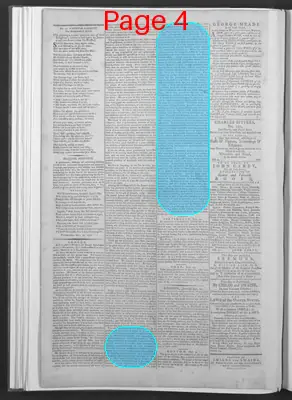
Editorial
December 1, 1791
National Gazette
Philadelphia, Philadelphia County, Pennsylvania
What is this article about?
This editorial extols the transformative role of newspapers in Britain, enhancing commerce through rapid information dissemination and serving as a powerful censor via public opinion, which enforces moral behavior more effectively than law. It acknowledges potential abuses but highlights remedies and overall benefits.
Clipping
OCR Quality
98%
Excellent
Full Text
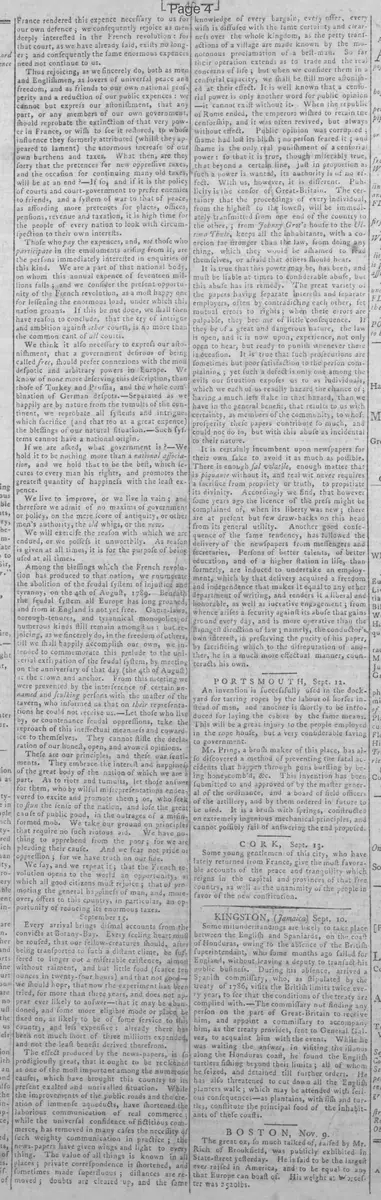
The effect produced by the news-papers, is so prodigiously great, that it ought to be reckoned as one of the most important among the numerous causes, which have brought this country to its present exalted and unrivalled situation. While the improvements of the public roads and the creation of immense aqueducts, have shortened the laborious communication of real commerce; while the universal confidence of fictitious commerce, has removed in many cases the necessity of such weighty communication in practice; the news-papers have given wings and light to every thing. The value of all things is known in all places; private correspondence is shortened, and sometimes made superfluous; distances are removed; doubts are cleared up, and the same knowledge of every bargain, every offer, every wish is diffused with the same certainty and clearness over the whole kingdom, as the petty transactions of a village are made known by the monotonous proclamation of a bell-man. So far their operation extends as to trade and the real concerns of life; but when we consider them in a censorial capacity, we shall be still more astonished at their effect. It is well known that a censorial power is only another word for public opinion—it cannot exist without it. When the republic of Rome ended, the emperors wished to retain the censorship, and it was often revived, but always without effect. Public opinion was corrupted; shame had lost its blush; no person feared it; and shame is the only real punishment of a censorial power: so that it is true, though miserably true, that beyond a certain line, just in proportion as such a power is wanted, its authority is of no effect. With us, however, it is different. Publicity is the censor of Great-Britain. The certainty that the proceedings of every individual, from the highest to the lowest, will be immediately transmitted from one end of the country to the other, from John o' Groat's house to the Ultima Thule, keeps all the inhabitants, with a coercion far stronger than the law, from doing any thing, which they would be ashamed to read themselves, or afraid that others should hear.
It is true that this power may be, has been, and must be liable at times to considerable abuse, but this abuse has its remedy. The great variety of the papers having separate interests and separate employers, often by contradicting each other, set mutual errors to rights; when these errors are palpable, they become of little consequence. If they be of a great and dangerous nature, the law is open, and it is now upon experience, not only open to hear, but ready to punish whenever there is occasion. It is true that such prosecutions are sometimes but poor satisfaction to the person complaining; yet such a defect is only one among the evils our situation exposes us to as individuals, which we each of us readily hazard the chance of; having a much less stake in that hazard, than we have in the general benefit, that results to us with certainty, as members of the community, to whose prosperity these papers contribute so much, and could not do so, but with this abuse as incidental to their nature.
It is certainly incumbent upon newspapers for their own sake to avoid it as much as possible. There is enough sal volatile, enough matter that is piquant without it, and real wit never requires a sacrifice from propriety or truth, to propitiate its divinity. Accordingly we find, that however some years ago the licence of the press might be complained of, when its liberty was new; there are at present but few draw-backs on this head from its general utility. Another good consequence of the same tendency, has followed the delivery of the newspapers from messengers and secretaries. Persons of better talents, of better education, and of a higher station in life, than formerly, are induced to undertake an employment, which by that delivery acquired a freedom and independence that makes it equal to any other department of writing, and renders it a liberal and honorable, as well as lucrative engagement; from whence arises a security against its abuse that gains ground every day, and is more operative than the strongest direction of law; namely, the conductor's own interest, in preserving the purity of his paper, by sacrificing which to the disreputation of another, he in a much more effectual manner, counteracts his own.
It is true that this power may be, has been, and must be liable at times to considerable abuse, but this abuse has its remedy. The great variety of the papers having separate interests and separate employers, often by contradicting each other, set mutual errors to rights; when these errors are palpable, they become of little consequence. If they be of a great and dangerous nature, the law is open, and it is now upon experience, not only open to hear, but ready to punish whenever there is occasion. It is true that such prosecutions are sometimes but poor satisfaction to the person complaining; yet such a defect is only one among the evils our situation exposes us to as individuals, which we each of us readily hazard the chance of; having a much less stake in that hazard, than we have in the general benefit, that results to us with certainty, as members of the community, to whose prosperity these papers contribute so much, and could not do so, but with this abuse as incidental to their nature.
It is certainly incumbent upon newspapers for their own sake to avoid it as much as possible. There is enough sal volatile, enough matter that is piquant without it, and real wit never requires a sacrifice from propriety or truth, to propitiate its divinity. Accordingly we find, that however some years ago the licence of the press might be complained of, when its liberty was new; there are at present but few draw-backs on this head from its general utility. Another good consequence of the same tendency, has followed the delivery of the newspapers from messengers and secretaries. Persons of better talents, of better education, and of a higher station in life, than formerly, are induced to undertake an employment, which by that delivery acquired a freedom and independence that makes it equal to any other department of writing, and renders it a liberal and honorable, as well as lucrative engagement; from whence arises a security against its abuse that gains ground every day, and is more operative than the strongest direction of law; namely, the conductor's own interest, in preserving the purity of his paper, by sacrificing which to the disreputation of another, he in a much more effectual manner, counteracts his own.
What sub-type of article is it?
Press Freedom
Moral Or Religious
What keywords are associated?
Newspapers
Public Opinion
Press Liberty
Censorial Power
British Commerce
Moral Coercion
What entities or persons were involved?
Newspapers
Public Opinion
Great Britain
Republic Of Rome
Editorial Details
Primary Topic
Role And Effects Of Newspapers In Society
Stance / Tone
Strongly Positive And Laudatory
Key Figures
Newspapers
Public Opinion
Great Britain
Republic Of Rome
Key Arguments
Newspapers Facilitate Commerce By Rapidly Disseminating Information Across The Kingdom.
Newspapers Embody Public Opinion As A Censorial Power Stronger Than Law.
Publicity Enforces Moral Behavior Through Shame.
Abuses Of The Press Are Remedied By Variety Among Papers And Legal Recourse.
Improved Contributors Enhance The Press's Quality And Reduce Abuse.