Thank you for visiting SNEWPapers!
Sign up free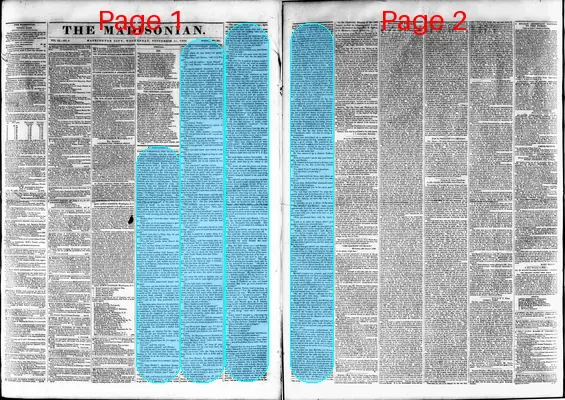
Literary
September 11, 1839
The Madisonian
Washington, District Of Columbia
What is this article about?
Humorous tale of Irish fisherman Barney O'Reirdon from Kinsale who, mistaking Bengal for Fingal, follows an American brig across the ocean with his hooker loaded with scalpeens. He trades provisions, evades ships, and cleverly pilots an American vessel home, turning folly into fortune.
Merged-components note: These three components contain sequential parts of the same short story 'Barney O'Reirdon's Trip to Fingal,' split across page boundaries but continuing the narrative without interruption in topic or flow.
Clippings
1 of 2
OCR Quality
80%
Good
Full Text
MISCELLANEOUS.
BARNEY O'REIRDON'S TRIP TO FINGAL.
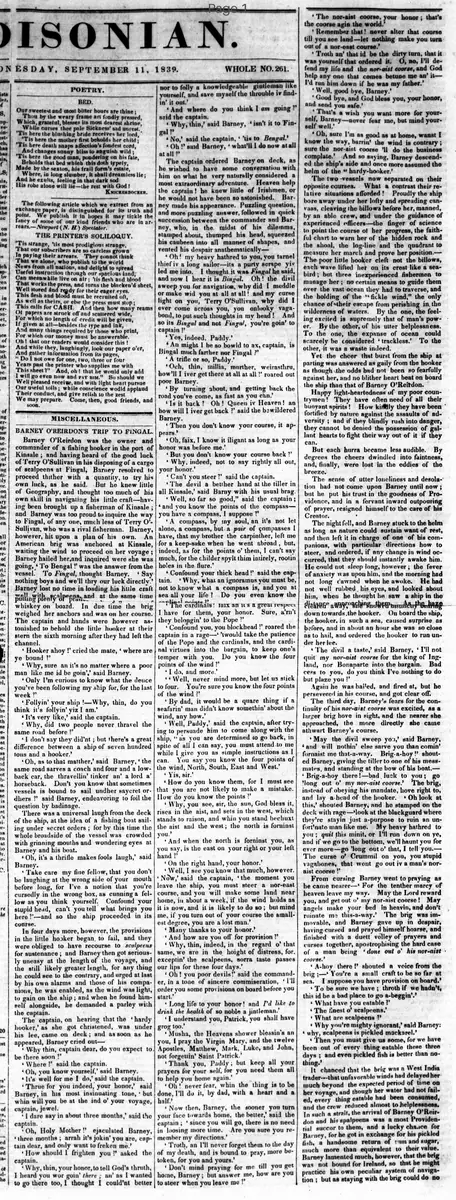
Barney O'Reirdon was the owner and commander of a fishing hooker in the port of Kinsale; and having heard of the good luck of Terry O'Sullivan in his disposing of a cargo of scalpeens at Fingal, Barney resolved to proceed thither with a quantity, to try his own luck, as he said. But he knew little of Geography, and thought too much of his own skill in navigating his little craft—having been brought up a fisherman of Kinsale; and Barney was too proud to inquire the way to Fingal, of any one, much less of Terry O'Sullivan, who was a rival fisherman. Barney, however, hit upon a plan of his own. An American brig was anchored at Kinsale, waiting the wind to proceed on her voyage; Barney hailed her, and inquired were she was going, "To Bengal!' was the answer from the vessel. "To Fingal, thought Barney. "Say nothing boys and we'll thry our luck directly.' Barney lost no time in loading his little craft well with scalpeens, and at the same time putting plenty of whiskey on board. In due time the brig weighed her anchors and was on her course. The captain and hands were however astonished to behold the little hooker at their stern the sixth morning after they had left the channel.
"Hooker ahoy!' cried the mate, 'where are ye bound?"
"Why, sure an it's no matter where a poor man like me id be goin'' said Barney.
"Only I'm curious to know what the deuce you've been following my ship for, for the last week?"
"Follyin' your ship!—Why, thin, do you think it's follyin' yiz I am."
"It's very like,' said the captain.
"Why, did two people never thravel the same road before?"
"I don't say they didn't; but there's a great difference between a ship of seven hundred tons and a hooker.'"
"Oh, as to that matther,' said Barney, 'the same road sarves a coach and four and a low-back car, the thravellin' tinker an' a lord a' horseback. Don't you know that sometimes vessels is bound to sail undher saycret orders?' said Barney, endeavoring to foil the question by badinage.
There was a universal laugh from the deck of the ship, at the idea of a fishing boat sailing under secret orders; for by this time the whole broadside of the vessel was crowded with grinning mouths and wondering eyes at Barney and his boat.
"Oh, it's a thrille makes fools laugh,' said Barney.
"Take care my fine fellow, that you don't be laughing at the wrong side of your mouth before long, for I've a notion that you're cursedly in the wrong box, as cunning a fellow as you think yourself. Confound your stupid head, can't you tell what brings you here?'-and so the ship proceeded in its course.
In four days more, however, the provisions in the little hooker began to fail, and they were obliged to have recourse to scalpeens for sustenance; and Barney then got seriously uneasy at the length of the voyage, and the still likely greater length, for any thing he could see to the contrary, and urged at last by his own alarms and those of his companions, he was enabled, as the wind was light, to gain on the ship; and when he found himself alongside, he demanded a parley with the captain.
The captain, on hearing that the 'hardy hooker,' as she got christened, was under his lee, came on deck; and as soon as he appeared, Barney cried out—
"Why thin, captain dear, do you expect to be there soon?"
"Where?' said the captain.
"Oh, you know yourself,' said Barney.
"It's well for me I do,' said the captain.
"Thrue for you indeed, your honor,' said Barney, in his most insinuating tone, 'but whin will you be at the ind o' your voyage, captain, jewel."
"I dare say in about three months,' said the captain.
"Oh, Holy Mother!' ejaculated Barney, 'three months; arrah it's jokin' you are, captain dear, and only want to freken me.'
"How should I frighten you? asked the captain.
"Why, thin, your honor, to tell God's thruth, I heard you wor goin' there; an' as I wanted to go there too, I thought I couldn't better nor to folly a knowledgeable gintleman like yourself, and save myself the throuble iv findin' it out.
"And where do you think I am going?' said the captain.
"Why, thin,' said Barney, 'isn't it to Fingal?"
"No,' said the captain, ''tis to Bengal.'
"Oh!' said Barney, 'what'll I do now at all at all?
The captain ordered Barney on deck, as he wished to have some conversation with him on what he very naturally considered a most extraordinary adventure. Heaven help the captain! he knew little of Irishmen, or he would not have been so astonished. Barney made his appearance. Puzzling question, and more puzzling answer, followed in quick succession between the commander and Barney, who, in the midst of his dilemma, stamped about, thumped his head, squeezed his caubeen into all manner of shapes, and vented his despair anathematically—
"Oh! my heavy hathred to you, you tarnel thief iv a long sailor—it's a purty scrape yiv led me into. I thought it was Fingal he said, and now I hear it is Bengal. Oh! the divil sweep you for navigation, why did I meddle or make wid you at all at all! and my curse light on you, Terry O'Sullivan, why did I ever come across you, you onlucky vagabond, to put such thoughts in my head! And so its Bengal and not Fingal, you're goin' to captain?"
"Yes, indeed, Paddy.
"An might I be so bowld to ax, captain, is Bengal much farther nor Fingal?"
"A trifle or so, Paddy."
"Och, thin, millia murther, weirasthru, how'll I iver get there at all at all?' roared out poor Barney.
"By turning about, and getting back the road you've come, as fast as you can.
"Is it back? Oh! Queen iv Heaven! an how will I iver get back?' said the bewildered Barney.
"Then you don't know your course, it appears.'
"Oh, faix, I know it iligant as long as your honor was before me.'
"But you don't know your course back?'
"Why, indeed, not to say rightly all out, your honor."
"Can't you steer?' said the captain.
"The devil a betther hand at the tiller in all Kinsale,' said Barney with his usual brag.
"Well, so far so good," said the captain; and you know the points of the compass—you have a compass, I suppose?'
"A compass, by my soul, an it's not let alone, a compass, but a pair of compasses I have, that my brother the carpenter, let me for a keep-sake when he went abroad, but, indeed, as for the points o' them, I can't say much, or the childer spylt thim intirely, rootin holes in the flure.'
"Confound your thick head!' said the captain. 'Why, what an ignoramus you must be. not to know what a compass is, and you at sea all your life? .Do you even know the cardinals! ax an a great respect I have for them, your honor. Sure, a'rn't they belongin' to the Pope?'
"Confound you, you blockhead!' roared the captain in a rage—'twould take the patience of the Pope and the cardinals, and the cardinal virtues into the bargain, to keep one's temper with you. Do you know the four points of the wind?'
"I do, and more.'
"Well, never mind more, but let us stick to four. You're sure you know the four points of the wind?'
"By dad, it would be a quare thing if a seafarin' man didn't know somethin' about the wind, any how."
"Well, Paddy,' said the captain, after trying to persuade him to come along with the ship, "as you are determined to go back, in spite of all I can say, you must attend to me while I give you as simple instructions as I can. You say you know the four points of the wind, North, South, East and West."
"Yis, sir."
"How do you know them, or I must see that you are not likely to make a mistake. How do you know the points?'
"Why, you see, sir, the sun, God bless it, rises in the aist, and sets in the west, which stands to raison, and whin you stand bechuxt the aist and the west; the north is forninst you.'
"And when the north is forninst you, as you say, is the east on your right or your left hand?"
"On the right hand, your honor."
"Well, I see you know that much, however. Now.' said the captain, the moment you leave the ship, you must steer a nor-east course, and you will make some land near home, in about a week, if the wind holds as it is now. and it is likely to do so : but mind me, if you turn out of your course the smallest degree, you are a lost man.'
"Many thanks to your honor.'
"And how are you off for provision?'
"Why, thin, indeed, in the regard o' that same, we are in the hoight of distress, for. exceptin' the scalpeens, sorra taste passes our lips for these four days.'
"Oh! you poor devils!' said the commander, in a tone of sincere commiseration, 'I'll order you some provisions on board before you start.'
"Long life to your honor! and I'd like to drink the health of so noble a jintleman."
"I understand you, Patrick, you shall have grog too.'
"Musha, the Heavens shower biessin's an you, I pray the Virgin Mary, and the twelve Apostles, Matthew, Mark, Luke, and John, not forgettin' Saint Patrick."
"Thank you, Paddy; but keep all your prayers for yourself, for you need them all to help you home again.'
"Oh! never fear, whin the thing is to be done, I'll do it, by dad, with a heart and a half.?"
"Now then, Barney, the sooner you turn your face towards home, the better,' said the captain; 'since you will go, there is no need in loosing more time. Are you sure you remember my directions.'
"Troth, an I'll never forget them to the day of my death, and is bound to pray, more be token, for you and yours."
"Don't mind praying for me till you get home, Barney; but answer me, how are you to steer when you leave me?"
"The nor-aist coorse, your honor; that's the coorse agin the world."
"Remember that! never alter that course till you see land—let nothing make you turn out of a nor-east course.'
"Troth an' that id be the dirty turn, that it was yourself that ordered it. O, no, I'll depend my life and the nor-aist coorse, and God help any one that comes betune me an' it I'd run him down if he was my father."
"Well, good bye, Barney."
"Good bye, and God bless you, your honor, and send you safe.'
"That's a wish you want more for yourself, Barney—never fear me, but mind yourself well."
"Oh, sure I'm as good as at home, wanst I know the way, barrin' the wind is contrary; sure the nor-aist coorse 'll do the business complate.' And so saying, Barney descended the ship's side and once more assumed the helm of the "hardy-hooker.'
The two vessels now separated on their opposite courses. What a contrast their relative situations afforded! Proudly the ship bore away under her lofty and spreading canvass, cleaving the billows before her, manned, by an able crew, and under the guidance of experienced officers—the finger of science to point the course of her progress, the faithful chart to warn her of the hidden rock and the shoal, the log-line and the quadrant to measure her march and prove her position.— The poor little hooker cleft not the billows, each wave lifted her on its crest like a sea-bird; but three inexperienced fishermen to manage her; no certain means to guide them over the vast ocean they had to traverse, and the holding of the "fickle wind," the only chance of their escape from perishing in, the wilderness of waters. By the one, the feeling excited is supremely that of man's power. By the other, of his utter helplessness. To the one, the expanse of ocean could scarcely be considered 'trackless.' To the other, it was a waste indeed.
Yet the cheer that burst from the ship at parting was answered as gaily from the hooker as though the odds had not been so fearfully against her, and no blither heart beat on board the ship than that of Barney O'Reirdon. Happy light-heartedness of my poor countrymen! They have often need of all their buoyant spirits! How kindly they have been fortified by nature against the assaults of adversity; and if they blindly rush into danger, they cannot be denied the possession of gallant hearts to fight their way out of it if they can.
But each hurra became less audible. By degrees the cheers dwindled into faintness, and, finally, were lost in the eddies of the breeze.
The sense of utter loneliness and desolation had not come upon Barney until now; but he put his trust in the goodness of Providence, and in a fervent inward outpouring of prayer, resigned himself to the care of his Creator.
The night fell, and Barney stuck to the helm as long as nature could sustain want of rest, and then let it in charge of one of his companions, with particular directions how to steer, and ordered, if any change in wind occurred, that they should instantly awake him. He could not sleep long, however; the fever of anxiety was upon him, and the morning had not long dawned when he awoke. He had not well rubbed his eyes, and looked about him, when he thought he saw a ship in the distance approaching under easy sail. On board the ship, the hooker, in such a sea, caused surprise as before, and in about an hour she was so close as to hail, and ordered the hooker to run under her lee.
"The divil a taste,' said Barney, 'I'll not quit my nor-aist coorse for the king of England. nor Bonaparte into the bargain. Bad cess to you, do you think I've nothing to do but plaze you?'
Again he was hailed, and fired at. but he persevered in his course, and got clear off.
The third day, Barney's fears for the continuity of his nor-aist coorse was excited, as a larger brig hove in sight, and the nearer she approached, the more directly she came athwart Barney's course.
"May the divil sweep you,' said Barney, 'and will nothin' else sarve you than comin' fornaist me that-a-way. Brig-a-hoy!' shouted Barney, giving the tiller to one of his mess-mates, and standing at the bow of his boat.— "Brig-a-hoy there!—bad luck to you; go 'long out o' my nor-aist coorse.' The brig instead of obeying his mandate, hove right to, and lay a-head of the hooker. "Oh look at this,' shouted Barney, and he stamped on the deck with rage—'n look at the blackguard where they're stayin just a-purpose to ruin an unfortunate man like me. My heavy hathred to you; quil this minit. or I'll run down on ye, and if we go to the bottom, we'll haunt you for ever more—go 'long out o' that, I tell you.— The curse o' Crummie on you, you stupid vagabones, that wont go out iv a man's nor-aist coorse!'
From cursing Barney went to praying as he came nearer—'For the tandher marcy o' heaven leave my way. May the Lord reward you, and get out o' my nor-aist coorse! May angels make your bed in heavin, and don't ruinate me this-a-way.' 'The brig was immovable, and Barney gave up in despair, having cursed and prayed himself hoarse, and finished with a duett volley of prayers and curses together, apostrophising the hard case of a man being done out o' his nor-aist coorse.
"A-hoy there!' shouted a voice from the brig;—'You're a small craft to be so far at sea. I suppose you have provision on board.'
"To be sure we have; throth if we hadn't, this id be a bad place to go a-beggin'.'"
"What have you eatable?'
"The finest o'scalpeens."
"What are scalpeens?'
"Why you're mighty ignorant,' said Barney: 'why, scalpeens is pickled mackarel.'"
"Then you must give us some, for we have been out of every thing eatable these three days; and even pickled fish is better than nothing.'"
It chanced that the brig was a West India trader—that unfavorable winds had delayed her voyage, and though her water had not failed much beyond the expected period of time on her voyage, every thing eatable had been consumed, and the crew reduced almost to helplessness. In such a strait, the arrival of Barney O'Reirdon and his scalpeens was a most Providential succor to them, and a lucky chance for Barney, for he got in exchange for his pickled fish, a handsome return of rum and sugar, much more than equivalent to their value. Barney lamented much, however, that the brig was not bound for Ireland, so that he might practice his own peculiar system of navigation; but as staying with the brig could do no good, he got himself put once more, and ploughed away towards home. Good luck to Barney in more ways than one. In the disposal of his cargo was great good; in the first place, he had found the most profitable market he could have had; and secondly it enabled him to cover his retreat from the difficulty which still was before him, of not getting to Fingal after all his danger, and consequently, being open to discovery and disgrace. All these beneficial results were not thrown away upon one of Barney's readiness to avail himself of every point in his favor; and, accordingly, when they left the brig, Barney said to his companions, 'why, thin boys, 'pon my conscience but I'm as proud as a horse wid a wouden leg this minit, that we met them poor unfort'nate craythurs this blessed day, and was enabled to extend our charity to them. Sure an' it's lost they'd be only for our coming acrass them, and we, thro' the blessing o'God enabled to do an act o' marcy, that is feeding the bungry; and sure every good work we do here is before us in heaven--and that's a comfort any how. To be sure, now that the scalpeens is sowld, there's no use in goin'to Fingal, and we may as well jist go home. To the divil now wid Terry O'Sullivan, what does he know what's an illigant place? What knowledge has he of iligance? I'll go bail he never was half as far a navigatin' as we-he wint the short cut I go bail, and never dared for to vinture the round as I did.' Nothing particular occurred for the two succeeding days, during which time Barney most religiously pursued his nor east-course, but the third day produced a new and important event. A sail was discovered on the horizon, and in the direction Barney was steering, and a couple of hours made him tolerably certain that the vessel in sight was an American; or though it is needless to say he was not very conversant in such matters, yet from the frequency of his seeing Americans trading to Ireland, his eye had become sufficiently accustomed to their lofty and tapering spars, and peculiar smartness of rig, to satisfy him that the ship before him was of Transatlantic build: nor was he wrong in his conjecture. Barney now determined on a manoeuvre, classing him among the first tactitians at securing a good retreat. He calculated the American vessel was bound to Ireland, and as she lay almost as directly in the way of his nor-east course as the West India brig, he bore up to and spoke her. He was answered by a shrewd Yankee captain. 'Faix an it's glad I am to see your honor agin,' said Barney. The Yankee had never been to Ireland, and told Barney so, but that a pilot was wanted for Cove. 'You know Cove?' said the American. 'Is it the Cove o' Cork why?' 'Yes.' 'I was bred and born there, and pilots as many ships into Cove as any other two men out of it.' Barney thus sheltered his falsehood under the idiom of his language. 'But what brought you so far out to sea?' asked the captain. 'We wor lyin' out lookin' for ships that wanted pilots, and there kem one of the terriblest gales of wind aff the land, an' blew us to say out intirely, an' that's the way iv it, your honor.' 'I calculate we got a share of the same gale,' said the American. 'Oh,' directly!' said Barney; 'faith you're right enough, 'twas the nor-west coorse we wor an sure enough; but no matter now that we've met with you-sure we'll have a job home any how.' 'Well, get aboard, then,' said the American. 'I will in a minit, yer honor, whin I just spake a word to my comrade here.' 'Why sure it's not goin' to turn pilot you are?' said Jemmy, in his simplicity of heart. 'Whisht, you maudhaun!' said Barney, 'or I'll cut the tongue out o' you. Now, mind me, Pother; you don't understan' navigashin' and the various branches of knowledge, and so all you have to do is to follow the ship when I get into her, and I'll show you the way home.' Barney then got aboard the American vessel, and begged of the captain, that as he had been out at sea so long, and had gone through 'a power o' hardships intirely,' that he would be permitted to go below and turn in to take a sleep, for in throth, it's myself and sleep that's strayngers for some time,' said Barney; 'an' if your honor 'll be plazed, I'll be thankful if you won't let them disturb me until I'm wanted—for sure, till you see the land, there's no use or me in life, an' throth I want a sleep sorely.' Barney's request was granted. and it will not be wondered at, that after so much fatigue of mind and body, he slept profoundly for four and twenty hours. He then was called, for land was in sight; and when he came on deck, the captain rallied him upon the potency of his somniferous qualities, and calculated he had never met any one who could sleep four and twenty hours on a stretch before. 'Oh, sir,' said Barney, rubbing his eyes, which were still a little hazy, 'whiniver I go to sleep, I pay attention to it.' The land was soon neared, and Barney put in charge of the ship, when he ascertained the first landmark he was acquainted with; but as soon as the Head of Kinsale hove in sight, Barney gave a "who," and cut a caper that astonished the Yankees, and was quite inexplicable to them, though we flatter ourselves, it is not to those who do Barney the favor of reading his adventures. 'Oh! there you are, darling ould head! an' where's the head like you! troth it's little I thought I'd ever set eyes on your good-lookin' features agin.' In such half-muttered exclamations did Barney apostrophise each well known point of his native shore, and when opposite, the harbor of Kinsale, he spoke the hooker, that was somewhat astern, and ordered Jemmy and Peter to put in there, and tell Molly immediately that he was come back, and would be with her as soon as he could, after piloting the ship into Cove. The hooker put into Kinsale, and Barney sailed the ship into Cove. It was the first ship he ever had acted the pilot for, and his old luck attended him; no accident befel his charge, and, what was still more extraordinary, he made the American believe he was actually the most skilful pilot on the station. So Barney pocketed his pilot's fee, and swore the Yankee was a gentleman, for which the republican did not thank him, wished him good bye, and then pushed his way home with what Barney swore was the easiest made money he ever had in his life. So Barney got himself paid for piloting the ship that showed him the way home.
BARNEY O'REIRDON'S TRIP TO FINGAL.
Barney O'Reirdon was the owner and commander of a fishing hooker in the port of Kinsale; and having heard of the good luck of Terry O'Sullivan in his disposing of a cargo of scalpeens at Fingal, Barney resolved to proceed thither with a quantity, to try his own luck, as he said. But he knew little of Geography, and thought too much of his own skill in navigating his little craft—having been brought up a fisherman of Kinsale; and Barney was too proud to inquire the way to Fingal, of any one, much less of Terry O'Sullivan, who was a rival fisherman. Barney, however, hit upon a plan of his own. An American brig was anchored at Kinsale, waiting the wind to proceed on her voyage; Barney hailed her, and inquired were she was going, "To Bengal!' was the answer from the vessel. "To Fingal, thought Barney. "Say nothing boys and we'll thry our luck directly.' Barney lost no time in loading his little craft well with scalpeens, and at the same time putting plenty of whiskey on board. In due time the brig weighed her anchors and was on her course. The captain and hands were however astonished to behold the little hooker at their stern the sixth morning after they had left the channel.
"Hooker ahoy!' cried the mate, 'where are ye bound?"
"Why, sure an it's no matter where a poor man like me id be goin'' said Barney.
"Only I'm curious to know what the deuce you've been following my ship for, for the last week?"
"Follyin' your ship!—Why, thin, do you think it's follyin' yiz I am."
"It's very like,' said the captain.
"Why, did two people never thravel the same road before?"
"I don't say they didn't; but there's a great difference between a ship of seven hundred tons and a hooker.'"
"Oh, as to that matther,' said Barney, 'the same road sarves a coach and four and a low-back car, the thravellin' tinker an' a lord a' horseback. Don't you know that sometimes vessels is bound to sail undher saycret orders?' said Barney, endeavoring to foil the question by badinage.
There was a universal laugh from the deck of the ship, at the idea of a fishing boat sailing under secret orders; for by this time the whole broadside of the vessel was crowded with grinning mouths and wondering eyes at Barney and his boat.
"Oh, it's a thrille makes fools laugh,' said Barney.
"Take care my fine fellow, that you don't be laughing at the wrong side of your mouth before long, for I've a notion that you're cursedly in the wrong box, as cunning a fellow as you think yourself. Confound your stupid head, can't you tell what brings you here?'-and so the ship proceeded in its course.
In four days more, however, the provisions in the little hooker began to fail, and they were obliged to have recourse to scalpeens for sustenance; and Barney then got seriously uneasy at the length of the voyage, and the still likely greater length, for any thing he could see to the contrary, and urged at last by his own alarms and those of his companions, he was enabled, as the wind was light, to gain on the ship; and when he found himself alongside, he demanded a parley with the captain.
The captain, on hearing that the 'hardy hooker,' as she got christened, was under his lee, came on deck; and as soon as he appeared, Barney cried out—
"Why thin, captain dear, do you expect to be there soon?"
"Where?' said the captain.
"Oh, you know yourself,' said Barney.
"It's well for me I do,' said the captain.
"Thrue for you indeed, your honor,' said Barney, in his most insinuating tone, 'but whin will you be at the ind o' your voyage, captain, jewel."
"I dare say in about three months,' said the captain.
"Oh, Holy Mother!' ejaculated Barney, 'three months; arrah it's jokin' you are, captain dear, and only want to freken me.'
"How should I frighten you? asked the captain.
"Why, thin, your honor, to tell God's thruth, I heard you wor goin' there; an' as I wanted to go there too, I thought I couldn't better nor to folly a knowledgeable gintleman like yourself, and save myself the throuble iv findin' it out.
"And where do you think I am going?' said the captain.
"Why, thin,' said Barney, 'isn't it to Fingal?"
"No,' said the captain, ''tis to Bengal.'
"Oh!' said Barney, 'what'll I do now at all at all?
The captain ordered Barney on deck, as he wished to have some conversation with him on what he very naturally considered a most extraordinary adventure. Heaven help the captain! he knew little of Irishmen, or he would not have been so astonished. Barney made his appearance. Puzzling question, and more puzzling answer, followed in quick succession between the commander and Barney, who, in the midst of his dilemma, stamped about, thumped his head, squeezed his caubeen into all manner of shapes, and vented his despair anathematically—
"Oh! my heavy hathred to you, you tarnel thief iv a long sailor—it's a purty scrape yiv led me into. I thought it was Fingal he said, and now I hear it is Bengal. Oh! the divil sweep you for navigation, why did I meddle or make wid you at all at all! and my curse light on you, Terry O'Sullivan, why did I ever come across you, you onlucky vagabond, to put such thoughts in my head! And so its Bengal and not Fingal, you're goin' to captain?"
"Yes, indeed, Paddy.
"An might I be so bowld to ax, captain, is Bengal much farther nor Fingal?"
"A trifle or so, Paddy."
"Och, thin, millia murther, weirasthru, how'll I iver get there at all at all?' roared out poor Barney.
"By turning about, and getting back the road you've come, as fast as you can.
"Is it back? Oh! Queen iv Heaven! an how will I iver get back?' said the bewildered Barney.
"Then you don't know your course, it appears.'
"Oh, faix, I know it iligant as long as your honor was before me.'
"But you don't know your course back?'
"Why, indeed, not to say rightly all out, your honor."
"Can't you steer?' said the captain.
"The devil a betther hand at the tiller in all Kinsale,' said Barney with his usual brag.
"Well, so far so good," said the captain; and you know the points of the compass—you have a compass, I suppose?'
"A compass, by my soul, an it's not let alone, a compass, but a pair of compasses I have, that my brother the carpenter, let me for a keep-sake when he went abroad, but, indeed, as for the points o' them, I can't say much, or the childer spylt thim intirely, rootin holes in the flure.'
"Confound your thick head!' said the captain. 'Why, what an ignoramus you must be. not to know what a compass is, and you at sea all your life? .Do you even know the cardinals! ax an a great respect I have for them, your honor. Sure, a'rn't they belongin' to the Pope?'
"Confound you, you blockhead!' roared the captain in a rage—'twould take the patience of the Pope and the cardinals, and the cardinal virtues into the bargain, to keep one's temper with you. Do you know the four points of the wind?'
"I do, and more.'
"Well, never mind more, but let us stick to four. You're sure you know the four points of the wind?'
"By dad, it would be a quare thing if a seafarin' man didn't know somethin' about the wind, any how."
"Well, Paddy,' said the captain, after trying to persuade him to come along with the ship, "as you are determined to go back, in spite of all I can say, you must attend to me while I give you as simple instructions as I can. You say you know the four points of the wind, North, South, East and West."
"Yis, sir."
"How do you know them, or I must see that you are not likely to make a mistake. How do you know the points?'
"Why, you see, sir, the sun, God bless it, rises in the aist, and sets in the west, which stands to raison, and whin you stand bechuxt the aist and the west; the north is forninst you.'
"And when the north is forninst you, as you say, is the east on your right or your left hand?"
"On the right hand, your honor."
"Well, I see you know that much, however. Now.' said the captain, the moment you leave the ship, you must steer a nor-east course, and you will make some land near home, in about a week, if the wind holds as it is now. and it is likely to do so : but mind me, if you turn out of your course the smallest degree, you are a lost man.'
"Many thanks to your honor.'
"And how are you off for provision?'
"Why, thin, indeed, in the regard o' that same, we are in the hoight of distress, for. exceptin' the scalpeens, sorra taste passes our lips for these four days.'
"Oh! you poor devils!' said the commander, in a tone of sincere commiseration, 'I'll order you some provisions on board before you start.'
"Long life to your honor! and I'd like to drink the health of so noble a jintleman."
"I understand you, Patrick, you shall have grog too.'
"Musha, the Heavens shower biessin's an you, I pray the Virgin Mary, and the twelve Apostles, Matthew, Mark, Luke, and John, not forgettin' Saint Patrick."
"Thank you, Paddy; but keep all your prayers for yourself, for you need them all to help you home again.'
"Oh! never fear, whin the thing is to be done, I'll do it, by dad, with a heart and a half.?"
"Now then, Barney, the sooner you turn your face towards home, the better,' said the captain; 'since you will go, there is no need in loosing more time. Are you sure you remember my directions.'
"Troth, an I'll never forget them to the day of my death, and is bound to pray, more be token, for you and yours."
"Don't mind praying for me till you get home, Barney; but answer me, how are you to steer when you leave me?"
"The nor-aist coorse, your honor; that's the coorse agin the world."
"Remember that! never alter that course till you see land—let nothing make you turn out of a nor-east course.'
"Troth an' that id be the dirty turn, that it was yourself that ordered it. O, no, I'll depend my life and the nor-aist coorse, and God help any one that comes betune me an' it I'd run him down if he was my father."
"Well, good bye, Barney."
"Good bye, and God bless you, your honor, and send you safe.'
"That's a wish you want more for yourself, Barney—never fear me, but mind yourself well."
"Oh, sure I'm as good as at home, wanst I know the way, barrin' the wind is contrary; sure the nor-aist coorse 'll do the business complate.' And so saying, Barney descended the ship's side and once more assumed the helm of the "hardy-hooker.'
The two vessels now separated on their opposite courses. What a contrast their relative situations afforded! Proudly the ship bore away under her lofty and spreading canvass, cleaving the billows before her, manned, by an able crew, and under the guidance of experienced officers—the finger of science to point the course of her progress, the faithful chart to warn her of the hidden rock and the shoal, the log-line and the quadrant to measure her march and prove her position.— The poor little hooker cleft not the billows, each wave lifted her on its crest like a sea-bird; but three inexperienced fishermen to manage her; no certain means to guide them over the vast ocean they had to traverse, and the holding of the "fickle wind," the only chance of their escape from perishing in, the wilderness of waters. By the one, the feeling excited is supremely that of man's power. By the other, of his utter helplessness. To the one, the expanse of ocean could scarcely be considered 'trackless.' To the other, it was a waste indeed.
Yet the cheer that burst from the ship at parting was answered as gaily from the hooker as though the odds had not been so fearfully against her, and no blither heart beat on board the ship than that of Barney O'Reirdon. Happy light-heartedness of my poor countrymen! They have often need of all their buoyant spirits! How kindly they have been fortified by nature against the assaults of adversity; and if they blindly rush into danger, they cannot be denied the possession of gallant hearts to fight their way out of it if they can.
But each hurra became less audible. By degrees the cheers dwindled into faintness, and, finally, were lost in the eddies of the breeze.
The sense of utter loneliness and desolation had not come upon Barney until now; but he put his trust in the goodness of Providence, and in a fervent inward outpouring of prayer, resigned himself to the care of his Creator.
The night fell, and Barney stuck to the helm as long as nature could sustain want of rest, and then let it in charge of one of his companions, with particular directions how to steer, and ordered, if any change in wind occurred, that they should instantly awake him. He could not sleep long, however; the fever of anxiety was upon him, and the morning had not long dawned when he awoke. He had not well rubbed his eyes, and looked about him, when he thought he saw a ship in the distance approaching under easy sail. On board the ship, the hooker, in such a sea, caused surprise as before, and in about an hour she was so close as to hail, and ordered the hooker to run under her lee.
"The divil a taste,' said Barney, 'I'll not quit my nor-aist coorse for the king of England. nor Bonaparte into the bargain. Bad cess to you, do you think I've nothing to do but plaze you?'
Again he was hailed, and fired at. but he persevered in his course, and got clear off.
The third day, Barney's fears for the continuity of his nor-aist coorse was excited, as a larger brig hove in sight, and the nearer she approached, the more directly she came athwart Barney's course.
"May the divil sweep you,' said Barney, 'and will nothin' else sarve you than comin' fornaist me that-a-way. Brig-a-hoy!' shouted Barney, giving the tiller to one of his mess-mates, and standing at the bow of his boat.— "Brig-a-hoy there!—bad luck to you; go 'long out o' my nor-aist coorse.' The brig instead of obeying his mandate, hove right to, and lay a-head of the hooker. "Oh look at this,' shouted Barney, and he stamped on the deck with rage—'n look at the blackguard where they're stayin just a-purpose to ruin an unfortunate man like me. My heavy hathred to you; quil this minit. or I'll run down on ye, and if we go to the bottom, we'll haunt you for ever more—go 'long out o' that, I tell you.— The curse o' Crummie on you, you stupid vagabones, that wont go out iv a man's nor-aist coorse!'
From cursing Barney went to praying as he came nearer—'For the tandher marcy o' heaven leave my way. May the Lord reward you, and get out o' my nor-aist coorse! May angels make your bed in heavin, and don't ruinate me this-a-way.' 'The brig was immovable, and Barney gave up in despair, having cursed and prayed himself hoarse, and finished with a duett volley of prayers and curses together, apostrophising the hard case of a man being done out o' his nor-aist coorse.
"A-hoy there!' shouted a voice from the brig;—'You're a small craft to be so far at sea. I suppose you have provision on board.'
"To be sure we have; throth if we hadn't, this id be a bad place to go a-beggin'.'"
"What have you eatable?'
"The finest o'scalpeens."
"What are scalpeens?'
"Why you're mighty ignorant,' said Barney: 'why, scalpeens is pickled mackarel.'"
"Then you must give us some, for we have been out of every thing eatable these three days; and even pickled fish is better than nothing.'"
It chanced that the brig was a West India trader—that unfavorable winds had delayed her voyage, and though her water had not failed much beyond the expected period of time on her voyage, every thing eatable had been consumed, and the crew reduced almost to helplessness. In such a strait, the arrival of Barney O'Reirdon and his scalpeens was a most Providential succor to them, and a lucky chance for Barney, for he got in exchange for his pickled fish, a handsome return of rum and sugar, much more than equivalent to their value. Barney lamented much, however, that the brig was not bound for Ireland, so that he might practice his own peculiar system of navigation; but as staying with the brig could do no good, he got himself put once more, and ploughed away towards home. Good luck to Barney in more ways than one. In the disposal of his cargo was great good; in the first place, he had found the most profitable market he could have had; and secondly it enabled him to cover his retreat from the difficulty which still was before him, of not getting to Fingal after all his danger, and consequently, being open to discovery and disgrace. All these beneficial results were not thrown away upon one of Barney's readiness to avail himself of every point in his favor; and, accordingly, when they left the brig, Barney said to his companions, 'why, thin boys, 'pon my conscience but I'm as proud as a horse wid a wouden leg this minit, that we met them poor unfort'nate craythurs this blessed day, and was enabled to extend our charity to them. Sure an' it's lost they'd be only for our coming acrass them, and we, thro' the blessing o'God enabled to do an act o' marcy, that is feeding the bungry; and sure every good work we do here is before us in heaven--and that's a comfort any how. To be sure, now that the scalpeens is sowld, there's no use in goin'to Fingal, and we may as well jist go home. To the divil now wid Terry O'Sullivan, what does he know what's an illigant place? What knowledge has he of iligance? I'll go bail he never was half as far a navigatin' as we-he wint the short cut I go bail, and never dared for to vinture the round as I did.' Nothing particular occurred for the two succeeding days, during which time Barney most religiously pursued his nor east-course, but the third day produced a new and important event. A sail was discovered on the horizon, and in the direction Barney was steering, and a couple of hours made him tolerably certain that the vessel in sight was an American; or though it is needless to say he was not very conversant in such matters, yet from the frequency of his seeing Americans trading to Ireland, his eye had become sufficiently accustomed to their lofty and tapering spars, and peculiar smartness of rig, to satisfy him that the ship before him was of Transatlantic build: nor was he wrong in his conjecture. Barney now determined on a manoeuvre, classing him among the first tactitians at securing a good retreat. He calculated the American vessel was bound to Ireland, and as she lay almost as directly in the way of his nor-east course as the West India brig, he bore up to and spoke her. He was answered by a shrewd Yankee captain. 'Faix an it's glad I am to see your honor agin,' said Barney. The Yankee had never been to Ireland, and told Barney so, but that a pilot was wanted for Cove. 'You know Cove?' said the American. 'Is it the Cove o' Cork why?' 'Yes.' 'I was bred and born there, and pilots as many ships into Cove as any other two men out of it.' Barney thus sheltered his falsehood under the idiom of his language. 'But what brought you so far out to sea?' asked the captain. 'We wor lyin' out lookin' for ships that wanted pilots, and there kem one of the terriblest gales of wind aff the land, an' blew us to say out intirely, an' that's the way iv it, your honor.' 'I calculate we got a share of the same gale,' said the American. 'Oh,' directly!' said Barney; 'faith you're right enough, 'twas the nor-west coorse we wor an sure enough; but no matter now that we've met with you-sure we'll have a job home any how.' 'Well, get aboard, then,' said the American. 'I will in a minit, yer honor, whin I just spake a word to my comrade here.' 'Why sure it's not goin' to turn pilot you are?' said Jemmy, in his simplicity of heart. 'Whisht, you maudhaun!' said Barney, 'or I'll cut the tongue out o' you. Now, mind me, Pother; you don't understan' navigashin' and the various branches of knowledge, and so all you have to do is to follow the ship when I get into her, and I'll show you the way home.' Barney then got aboard the American vessel, and begged of the captain, that as he had been out at sea so long, and had gone through 'a power o' hardships intirely,' that he would be permitted to go below and turn in to take a sleep, for in throth, it's myself and sleep that's strayngers for some time,' said Barney; 'an' if your honor 'll be plazed, I'll be thankful if you won't let them disturb me until I'm wanted—for sure, till you see the land, there's no use or me in life, an' throth I want a sleep sorely.' Barney's request was granted. and it will not be wondered at, that after so much fatigue of mind and body, he slept profoundly for four and twenty hours. He then was called, for land was in sight; and when he came on deck, the captain rallied him upon the potency of his somniferous qualities, and calculated he had never met any one who could sleep four and twenty hours on a stretch before. 'Oh, sir,' said Barney, rubbing his eyes, which were still a little hazy, 'whiniver I go to sleep, I pay attention to it.' The land was soon neared, and Barney put in charge of the ship, when he ascertained the first landmark he was acquainted with; but as soon as the Head of Kinsale hove in sight, Barney gave a "who," and cut a caper that astonished the Yankees, and was quite inexplicable to them, though we flatter ourselves, it is not to those who do Barney the favor of reading his adventures. 'Oh! there you are, darling ould head! an' where's the head like you! troth it's little I thought I'd ever set eyes on your good-lookin' features agin.' In such half-muttered exclamations did Barney apostrophise each well known point of his native shore, and when opposite, the harbor of Kinsale, he spoke the hooker, that was somewhat astern, and ordered Jemmy and Peter to put in there, and tell Molly immediately that he was come back, and would be with her as soon as he could, after piloting the ship into Cove. The hooker put into Kinsale, and Barney sailed the ship into Cove. It was the first ship he ever had acted the pilot for, and his old luck attended him; no accident befel his charge, and, what was still more extraordinary, he made the American believe he was actually the most skilful pilot on the station. So Barney pocketed his pilot's fee, and swore the Yankee was a gentleman, for which the republican did not thank him, wished him good bye, and then pushed his way home with what Barney swore was the easiest made money he ever had in his life. So Barney got himself paid for piloting the ship that showed him the way home.
What sub-type of article is it?
Prose Fiction
Satire
What themes does it cover?
Social Manners
Commerce Trade
What keywords are associated?
Irish Fisherman
Sea Misadventure
Dialect Humor
Scalpeens Trade
Nor East Course
Literary Details
Title
Barney O'reirdon's Trip To Fingal.
Key Lines
"To Fingal, Thought Barney. "Say Nothing Boys And We'll Thry Our Luck Directly.'
"Why, Thin, Your Honor, To Tell God's Thruth, I Heard You Wor Goin' There ; An' As I Wanted To Go There Too, I Thought I Couldn't Better Nor To Folly A Knowledgeable Gintleman Like Yourself".
"Och, Thin, Millia Murther, Weirasthru, How'll I Iver Get There At All At All ?' Roared Out Poor Barney.
"The Nor Aist Coorse, Your Honor; That's The Coorse Agin The World."
"Happy Light Heartedness Of My Poor Countrymen! They Have Often Need Of All Their Buoyant Spirits!"