Thank you for visiting SNEWPapers!
Sign up free
Editorial
December 1, 1790
Gazette Of The United States
New York, New York County, New York
What is this article about?
Editorial praises General du Portail's wartime observations on the vital importance of a strong Union and effective general government for the United States, warning against states' tendencies to undermine Congress's authority, especially amid recent anti-federal sentiments.
Clipping
OCR Quality
98%
Excellent
Full Text
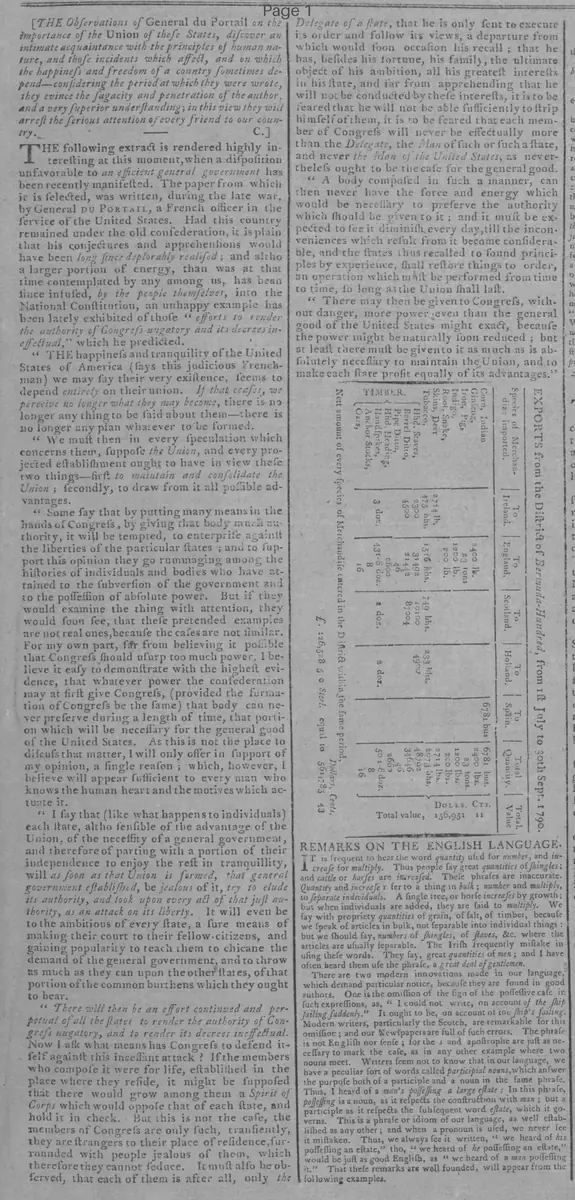
THE Observations of General du Portail on the importance of the Union of these States, discover an intimate acquaintance with the principles of human nature, and those incidents which affect, and on which the happiness and freedom of a country sometimes depend—considering the period at which they were wrote, they evince the Sagacity and penetration of the author, and a very superior understanding; in this view they will arrest the serious attention of every friend to our country.
[C.]
THE following extract is rendered highly interesting at this moment, when a disposition unfavorable to an efficient general government has been recently manifested. The paper from which it is selected, was written, during the late war, by General Du Portail, a French officer in the service of the United States. Had this country remained under the old confederation, it is plain that his conjectures and apprehensions would have been long since deplorably realized; and although a larger portion of energy, than was at that time contemplated by any among us, has been since infused, by the people themselves, into the National Constitution, an unhappy example has been lately exhibited of those "efforts to render the authority of Congress nugatory and its decrees ineffectual," which he predicted.
"THE happiness and tranquility of the United States of America (says this judicious Frenchman) we may say their very existence, seems to depend entirely on their union. If that ceases, we perceive no longer what they may become, there is no longer any thing to be said about them—there is no longer any plan whatever to be formed.
"We must then in every speculation which concerns them, suppose the Union, and every projected establishment ought to have in view these two things—first to maintain and consolidate the Union; secondly, to draw from it all possible advantages.
"Some say that by putting many means in the hands of Congress, by giving that body much authority, it will be tempted, to enterprise against the liberties of the particular states; and to support this opinion they go rummaging among the histories of individuals and bodies who have attained to the subversion of the government and to the possession of absolute power. But if they would examine the thing with attention, they would soon see, that these pretended examples are not real ones, because the cases are not similar.
For my own part, far from believing it possible that Congress should usurp too much power, I believe it easy to demonstrate with the highest evidence, that whatever power the confederation may at first give Congress, (provided the formation of Congress be the same) that body can never preserve during a length of time, that portion which will be necessary for the general good of the United States. As this is not the place to discuss that matter, I will only offer in support of my opinion, a single reason; which, however, I believe will appear sufficient to every man who knows the human heart and the motives which actuate it.
"I say that (like what happens to individuals) each state, although sensible of the advantage of the Union, of the necessity of a general government, and therefore of parting with a portion of their independence to enjoy the rest in tranquillity, will as soon as that Union is formed, that general government established, be jealous of it, try to elude its authority, and look upon every act of that just authority, as an attack on its liberty. It will even be to the ambitious of every state, a sure means of making their court to their fellow-citizens, and gaining popularity to teach them to chicane the demand of the general government, and to throw as much as they can upon the other states, of that portion of the common burdens which they ought to bear.
"There will then be an effort continued and perpetual of all the states to render the authority of Congress nugatory, and to render its decrees ineffectual. Now I ask what means has Congress to defend itself against this incessant attack? If the members who compose it were for life, established in the place where they reside, it might be supposed that there would grow among them a Spirit of Corps which would oppose that of each state, and hold it in check. But this is not the case, the members of Congress are only such, transiently, they are strangers to their place of residence, surrounded with people jealous of them, which therefore they cannot seduce. It must also be observed, that each of them is after all, only the Delegate of a state, that he is only sent to execute its orders and follow its views, a departure from which would soon occasion his recall; that he has, besides his fortune, his family, the ultimate object of his ambition, all his greatest interests in his state, and far from apprehending that he will not be conducted by these interests, it is to be feared that he will not be able sufficiently to strip himself of them, it is to be feared that each member of Congress will never be effectually more than the Delegate, the Man of such or such a state, and never the man of the United States, as nevertheless ought to be the case for the general good.
"A body composed in such a manner, can then never have the force and energy which would be necessary to preserve the authority which should be given to it; and it must be expected to see it diminish every day, till the inconveniences which result from it become considerable, and the states thus recalled to sound principles by experience, shall restore things to order, an operation which must be performed from time to time, so long as the Union shall last.
"There may then be given to Congress, without danger, more power even than the general good of the United States might exact, because the power might be naturally soon reduced; but at least there must be given to it as much as is absolutely necessary to maintain the Union, and to make each state profit equally of its advantages."
[C.]
THE following extract is rendered highly interesting at this moment, when a disposition unfavorable to an efficient general government has been recently manifested. The paper from which it is selected, was written, during the late war, by General Du Portail, a French officer in the service of the United States. Had this country remained under the old confederation, it is plain that his conjectures and apprehensions would have been long since deplorably realized; and although a larger portion of energy, than was at that time contemplated by any among us, has been since infused, by the people themselves, into the National Constitution, an unhappy example has been lately exhibited of those "efforts to render the authority of Congress nugatory and its decrees ineffectual," which he predicted.
"THE happiness and tranquility of the United States of America (says this judicious Frenchman) we may say their very existence, seems to depend entirely on their union. If that ceases, we perceive no longer what they may become, there is no longer any thing to be said about them—there is no longer any plan whatever to be formed.
"We must then in every speculation which concerns them, suppose the Union, and every projected establishment ought to have in view these two things—first to maintain and consolidate the Union; secondly, to draw from it all possible advantages.
"Some say that by putting many means in the hands of Congress, by giving that body much authority, it will be tempted, to enterprise against the liberties of the particular states; and to support this opinion they go rummaging among the histories of individuals and bodies who have attained to the subversion of the government and to the possession of absolute power. But if they would examine the thing with attention, they would soon see, that these pretended examples are not real ones, because the cases are not similar.
For my own part, far from believing it possible that Congress should usurp too much power, I believe it easy to demonstrate with the highest evidence, that whatever power the confederation may at first give Congress, (provided the formation of Congress be the same) that body can never preserve during a length of time, that portion which will be necessary for the general good of the United States. As this is not the place to discuss that matter, I will only offer in support of my opinion, a single reason; which, however, I believe will appear sufficient to every man who knows the human heart and the motives which actuate it.
"I say that (like what happens to individuals) each state, although sensible of the advantage of the Union, of the necessity of a general government, and therefore of parting with a portion of their independence to enjoy the rest in tranquillity, will as soon as that Union is formed, that general government established, be jealous of it, try to elude its authority, and look upon every act of that just authority, as an attack on its liberty. It will even be to the ambitious of every state, a sure means of making their court to their fellow-citizens, and gaining popularity to teach them to chicane the demand of the general government, and to throw as much as they can upon the other states, of that portion of the common burdens which they ought to bear.
"There will then be an effort continued and perpetual of all the states to render the authority of Congress nugatory, and to render its decrees ineffectual. Now I ask what means has Congress to defend itself against this incessant attack? If the members who compose it were for life, established in the place where they reside, it might be supposed that there would grow among them a Spirit of Corps which would oppose that of each state, and hold it in check. But this is not the case, the members of Congress are only such, transiently, they are strangers to their place of residence, surrounded with people jealous of them, which therefore they cannot seduce. It must also be observed, that each of them is after all, only the Delegate of a state, that he is only sent to execute its orders and follow its views, a departure from which would soon occasion his recall; that he has, besides his fortune, his family, the ultimate object of his ambition, all his greatest interests in his state, and far from apprehending that he will not be conducted by these interests, it is to be feared that he will not be able sufficiently to strip himself of them, it is to be feared that each member of Congress will never be effectually more than the Delegate, the Man of such or such a state, and never the man of the United States, as nevertheless ought to be the case for the general good.
"A body composed in such a manner, can then never have the force and energy which would be necessary to preserve the authority which should be given to it; and it must be expected to see it diminish every day, till the inconveniences which result from it become considerable, and the states thus recalled to sound principles by experience, shall restore things to order, an operation which must be performed from time to time, so long as the Union shall last.
"There may then be given to Congress, without danger, more power even than the general good of the United States might exact, because the power might be naturally soon reduced; but at least there must be given to it as much as is absolutely necessary to maintain the Union, and to make each state profit equally of its advantages."
What sub-type of article is it?
Constitutional
What keywords are associated?
Union Importance
General Government
Congress Authority
State Jealousy
Federal Power
Confederation Weaknesses
What entities or persons were involved?
General Du Portail
Congress
United States
Particular States
Editorial Details
Primary Topic
Importance Of Union And Strong General Government
Stance / Tone
Supportive Of Efficient Federal Authority Against State Jealousy
Key Figures
General Du Portail
Congress
United States
Particular States
Key Arguments
Union Is Essential For The Existence, Happiness, And Tranquility Of The United States
Every Establishment Should Aim To Maintain And Consolidate The Union And Draw Advantages From It
Fears Of Congress Usurping Power Are Unfounded As Cases Are Not Similar
States Will Be Jealous Of General Government And Try To Elude Its Authority
Ambition In States Will Lead To Undermining Congress For Popularity
Congress Lacks Means To Defend Against States' Attacks Due To Transient Members And State Loyalties
Congress's Power Will Diminish Over Time Without Periodic Restoration
Give Congress Sufficient Power To Maintain Union Without Danger Of Excess