Thank you for visiting SNEWPapers!
Sign up free
Story
May 13, 1840
Vermont Telegraph
Brandon, Rutland County, Vermont
What is this article about?
The Amistad case appeal was argued in New Haven's Circuit Court, with defense moving to dismiss on grounds US lacks interest in Spanish property claims over the Africans; prosecutors invoked US-Spain treaty obligations; key debates on slavery, appeals, and executive duties.
Clipping
OCR Quality
95%
Excellent
Full Text
From the N. Y. Spectator.
THE AMISTAD CASE.
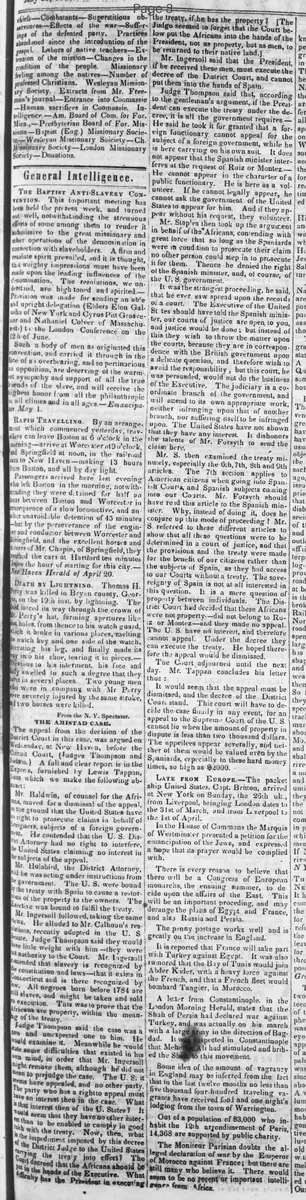
The appeal from the decision of the District Court in this case, was argued on Wednesday, at New Haven, before the Circuit Court, (Judges Thompson and Judson.) A full and clear report is in the Express, furnished by Lewis Tappan, from which we make the following abstract:
Mr. Baldwin, of counsel for the Africans, moved for a dismissal of the appeal, on the ground that the United States have no right to prosecute claims in behalf of foreigners, subjects of a foreign government. He contended that the U. S. District Attorney had no right to interfere, the United States claiming no interest in the subjects of the appeal.
Mr. Holabird, the District Attorney, said he was acting under instructions from the government. The U. S. were bound by the treaty with Spain to cause a restoration of the property to the owners. The Executive was bound to fulfil the treaty.
Mr. Ingersoll followed, taking the same views. He alluded to Mr. Calhoun's resolutions, recently adopted in the U. S. Senate. Judge Thompson said they would have little weight with him—they were not authority to the Court. Mr. Ingersoll contended that slavery is recognized by the constitution and laws—that it exists in Connecticut and is there recognized by law. All negroes born before 1784 are still slaves, and might be taken and sold on execution. This was to prove that the Africans are property, within the meaning of the treaty.
Judge Thompson said the case was a new and unexpected one to him. He would examine it. Meanwhile he would state some difficulties that existed in his own mind, in order that Mr. Ingersoll might remove them, although he did not mean to prejudge the case. The U. S. it seems have appealed, and no other party. The party who has a right to appeal must have an interest then in the case. What is that interest then of the U. States? It would seem that they have no other interest than to be enabled to comply in good faith with the treaty. Now then is carrying the impediment decreed by the District Court into the hands of the Executive by the United States should be difficulty has the President in executing
the treaty, if he has the property? [The Judge seemed to forget that the Court below put the Africans into the hands of the President, not as property, but as men, to be returned to their native land.]
Mr. Ingersoll said that the President, if he received these men, must execute the decree of the District Court, and cannot put them into the hands of Spain.
Judge Thompson said that, according to the gentleman's argument, if the President can execute the treaty under the decree, it is all the government requires. He said he took it for granted that a foreign functionary cannot appeal for the subject of a foreign government, while he is here carrying on his own suit. It does not appear that the Spanish minister interferes at the request of Ruiz or Montez. He cannot appear in the character of a public functionary. He is here as a volunteer. If he cannot legally appear, he cannot ask the government of the United States to appear for him. And if they appear without his request, they volunteer.
Mr. Staples then took up the argument in behalf of the Africans, contending with great force that so long as the Spaniards were in condition to prosecute their claim no other person could step in to prosecute it for them. Thence he denied the right of the Spanish minister, and, of course, of the U. S. government.
It was the strangest proceeding, he said, that he ever saw spread upon the records of a court. The Executive of the United States should have told the Spanish minister, our courts of justice are open to you, and justice would be done; but instead of this they wish to throw the matter upon the courts, because they are in correspondence with the British government upon a delicate question, and therefore wish to avoid the responsibility, but this court, he was persuaded, would not do the business of the Executive. The judiciary is a co-ordinate branch of the government, and will attend to its own appropriate work, neither infringing upon that of another branch, nor suffering itself to be infringed upon. The United States have not shown that they have any interest. It dishonors the talents of Mr. Forsyth to send the claim here.
Mr. S. then examined the treaty minutely, especially the 6th, 7th, 8th and 9th articles.
The 7th section applies to American citizens when going into Spanish Courts, and Spanish subjects coming into our Courts. Mr. Forsyth should have read this article to the Spanish minister. Why, instead of doing it, does he conjure up this mode of proceeding? Mr. S. referred to these different articles to show that all these questions were to be determined in a court of justice, and that the provisions and the treaty were made for the benefit of our citizens rather than the subjects of Spain, as they had access to our Courts without a treaty. The sovereignty of Spain is not at all interested in this question. It is a mere question of property between individuals. The District Court had decided that these Africans were not property—did not belong to Ruiz or Montez—and they made no appeal. The U. S. have no interest, and therefore cannot appeal. Under the decree they can execute the treaty. He hoped therefore this appeal would be dismissed.
The Court adjourned until the next day. Mr. Tappan concludes his letter thus:
It would seem that the appeal must be dismissed, and the decree of the District Court stand. This court will have to decide the case finally in any event, for an appeal to the Supreme Court of the U. S. cannot lie when the amount of property in dispute is less than two thousand dollars. The appellees appear severally, and neither of them would be valued even by the Spaniards, especially in these hard money times, so high as 2000.
THE AMISTAD CASE.
The appeal from the decision of the District Court in this case, was argued on Wednesday, at New Haven, before the Circuit Court, (Judges Thompson and Judson.) A full and clear report is in the Express, furnished by Lewis Tappan, from which we make the following abstract:
Mr. Baldwin, of counsel for the Africans, moved for a dismissal of the appeal, on the ground that the United States have no right to prosecute claims in behalf of foreigners, subjects of a foreign government. He contended that the U. S. District Attorney had no right to interfere, the United States claiming no interest in the subjects of the appeal.
Mr. Holabird, the District Attorney, said he was acting under instructions from the government. The U. S. were bound by the treaty with Spain to cause a restoration of the property to the owners. The Executive was bound to fulfil the treaty.
Mr. Ingersoll followed, taking the same views. He alluded to Mr. Calhoun's resolutions, recently adopted in the U. S. Senate. Judge Thompson said they would have little weight with him—they were not authority to the Court. Mr. Ingersoll contended that slavery is recognized by the constitution and laws—that it exists in Connecticut and is there recognized by law. All negroes born before 1784 are still slaves, and might be taken and sold on execution. This was to prove that the Africans are property, within the meaning of the treaty.
Judge Thompson said the case was a new and unexpected one to him. He would examine it. Meanwhile he would state some difficulties that existed in his own mind, in order that Mr. Ingersoll might remove them, although he did not mean to prejudge the case. The U. S. it seems have appealed, and no other party. The party who has a right to appeal must have an interest then in the case. What is that interest then of the U. States? It would seem that they have no other interest than to be enabled to comply in good faith with the treaty. Now then is carrying the impediment decreed by the District Court into the hands of the Executive by the United States should be difficulty has the President in executing
the treaty, if he has the property? [The Judge seemed to forget that the Court below put the Africans into the hands of the President, not as property, but as men, to be returned to their native land.]
Mr. Ingersoll said that the President, if he received these men, must execute the decree of the District Court, and cannot put them into the hands of Spain.
Judge Thompson said that, according to the gentleman's argument, if the President can execute the treaty under the decree, it is all the government requires. He said he took it for granted that a foreign functionary cannot appeal for the subject of a foreign government, while he is here carrying on his own suit. It does not appear that the Spanish minister interferes at the request of Ruiz or Montez. He cannot appear in the character of a public functionary. He is here as a volunteer. If he cannot legally appear, he cannot ask the government of the United States to appear for him. And if they appear without his request, they volunteer.
Mr. Staples then took up the argument in behalf of the Africans, contending with great force that so long as the Spaniards were in condition to prosecute their claim no other person could step in to prosecute it for them. Thence he denied the right of the Spanish minister, and, of course, of the U. S. government.
It was the strangest proceeding, he said, that he ever saw spread upon the records of a court. The Executive of the United States should have told the Spanish minister, our courts of justice are open to you, and justice would be done; but instead of this they wish to throw the matter upon the courts, because they are in correspondence with the British government upon a delicate question, and therefore wish to avoid the responsibility, but this court, he was persuaded, would not do the business of the Executive. The judiciary is a co-ordinate branch of the government, and will attend to its own appropriate work, neither infringing upon that of another branch, nor suffering itself to be infringed upon. The United States have not shown that they have any interest. It dishonors the talents of Mr. Forsyth to send the claim here.
Mr. S. then examined the treaty minutely, especially the 6th, 7th, 8th and 9th articles.
The 7th section applies to American citizens when going into Spanish Courts, and Spanish subjects coming into our Courts. Mr. Forsyth should have read this article to the Spanish minister. Why, instead of doing it, does he conjure up this mode of proceeding? Mr. S. referred to these different articles to show that all these questions were to be determined in a court of justice, and that the provisions and the treaty were made for the benefit of our citizens rather than the subjects of Spain, as they had access to our Courts without a treaty. The sovereignty of Spain is not at all interested in this question. It is a mere question of property between individuals. The District Court had decided that these Africans were not property—did not belong to Ruiz or Montez—and they made no appeal. The U. S. have no interest, and therefore cannot appeal. Under the decree they can execute the treaty. He hoped therefore this appeal would be dismissed.
The Court adjourned until the next day. Mr. Tappan concludes his letter thus:
It would seem that the appeal must be dismissed, and the decree of the District Court stand. This court will have to decide the case finally in any event, for an appeal to the Supreme Court of the U. S. cannot lie when the amount of property in dispute is less than two thousand dollars. The appellees appear severally, and neither of them would be valued even by the Spaniards, especially in these hard money times, so high as 2000.
What sub-type of article is it?
Historical Event
Crime Story
What themes does it cover?
Justice
Crime Punishment
What keywords are associated?
Amistad Case
Appeal
Circuit Court
Slavery
Spanish Treaty
Africans
District Court
New Haven
What entities or persons were involved?
Mr. Baldwin
Mr. Holabird
Mr. Ingersoll
Judge Thompson
Judge Judson
Mr. Staples
Lewis Tappan
Ruiz
Montez
Mr. Forsyth
Mr. Calhoun
Where did it happen?
New Haven
Story Details
Key Persons
Mr. Baldwin
Mr. Holabird
Mr. Ingersoll
Judge Thompson
Judge Judson
Mr. Staples
Lewis Tappan
Ruiz
Montez
Mr. Forsyth
Mr. Calhoun
Location
New Haven
Story Details
Appeal in the Amistad case argued before Circuit Court in New Haven; counsel for Africans moved to dismiss, claiming US has no interest or right to prosecute for Spanish subjects; prosecutors argued treaty obligations require restoration of property; discussions on slavery recognition, appeal rights, and treaty articles; court to decide dismissal.