Thank you for visiting SNEWPapers!
Sign up free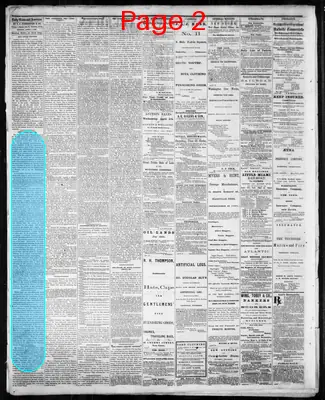
Editorial
April 1, 1866
Daily Union And American
Nashville, Davidson County, Tennessee
What is this article about?
Editorial criticizes the New York Evening Post's defense of the Civil Rights Bill against President Johnson's veto, arguing it relies on unconstitutional 'higher law' principles, undermines state sovereignty, and equates freedmen with citizens without basis. Supports Johnson's view on state control over rights and suffrage.
Clipping

OCR Quality
95%
Excellent
Full Text
ABOUT CIVIL RIGHTS.
The ablest and most influential paper in the country which has defended the misnamed civil rights bill against the veto of the President, is the New York Evening Post. We had expected from this journal a candid statement of all the reasons which could be urged in favor of this measure, for its editors are well-informed, and, we have thought, were least abased with partizanship of all the conductors of the Republican press. With this impression we have carefully read its article, and are constrained to say it is weak and impotent, and that to make even a plausible showing in answer to the many grave objections to the bill, it has been compelled to grovel in the mire, and make common cause with the Radical press of Chicago, not to say the Washington Chronicle. As an evidence that this usually fair and always able paper is sorely pressed for tenable ground, we give the following extract: We will not take up the time of those who read this article in discussing the question whether either of these provisions gives the Federal Government power to protect its citizens in the exercise of their civil rights, inasmuch as we derive the power from a higher principle than any express provision of the Constitution. In plain language it says that, finding no warrant in the Constitution for such a measure, it derives it from a law higher than that instrument. Upon this postulate it founds a specious argument that the right of the Government to endow all citizens with equality of rights, results from the nature and office of all governments, and the pivot of this argument is that freedmen, or the emancipated slaves of the South, are citizens in the view of the Constitution. Without entering into an elaborate refutation of positions so flagrantly erroneous as these, it is sufficient to say that the doctrine of law higher than the Constitution, and deducible only from theories of government held by a party, is inadmissible, and that it has already been the source of woes unnumbered in this country, and that its avowal at the present time augurs evil. Further it is not true that it is the duty of the Federal Government to confer equality of rights upon all its inhabitants. Under our system of combined Federal and State powers, the rights referred to in this bill are under the exclusive control of the jurisdiction of the latter. Still further, the constitutional amendment declaring slavery abolished, and perfecting the already proclaimed emancipation of the slaves of the South, did not erect them into citizens. It simply placed them upon the plane of freedmen, differing in no respect from that held by slaves set free by private manumission. We have instanced these points in the Post's article to express our dissent, and demonstrate the extreme shifts to which the advocates of this monstrous measure are driven. With the President, we have no fear that the authority of each State will not provide, if necessary by statute, and administer through their courts ample protection to all the rights of the freedmen in the enjoyment of life, liberty and property. This bill is nothing more nor less than a covert and insidious scheme to transfer State authority to the control of Federal jurisdiction, and extinguish the liberty of the white citizen in the meshes of this unnecessary contrivance for the protection of the negro. Eight years ago, when Minnesota made application for admission as a State, and it was objected that the Constitution she presented gave the right of suffrage to aliens President Johnson then foreshadowed his present policy, and announced some of his ideas about republican government. In his speech on that occasion, favoring the admission of Minnesota, he said: "This Government has no power under the Constitution of the United States to fix the qualification of voters in any sovereign State of the Confederacy, I want to enter my protest against the doctrine being indulged in or cultivated to any other extent, that this Government has power to go inside a sovereign State and prescribe the qualifications of her voters at the ballot box. It is for the State and not for the Government to do that. If the doctrine be once conceded, that the Federal Government has the power to fix the qualifications of voters in a State, the idea of State sovereignty is utopian. There is no such thing as State sovereignty if this Government can fix the qualification of voters." As shown by his recent veto the President has not changed his opinions. MR. Sumner is resorting to the Scrap Book argument again, to prove he is wiser, more humane, patriotic, and knows more of the South than the President, or "any other man." "School-marms" and Radical agents are writing dreadful letters to him about outrages committed upon negroes, and all good white people where they eat hominy and bacon. Is it not time such charlatan attempts to keep the country in its present condition were rebuked in a manner that would relieve us of the imposition? The fact will be heard with surprise by the large number who have heretofore considered that the expansion of the Russian empire was necessarily limited by the lack of coal, that the coal resources of Russia are shown to be considerably greater than even those of the United States.
The ablest and most influential paper in the country which has defended the misnamed civil rights bill against the veto of the President, is the New York Evening Post. We had expected from this journal a candid statement of all the reasons which could be urged in favor of this measure, for its editors are well-informed, and, we have thought, were least abased with partizanship of all the conductors of the Republican press. With this impression we have carefully read its article, and are constrained to say it is weak and impotent, and that to make even a plausible showing in answer to the many grave objections to the bill, it has been compelled to grovel in the mire, and make common cause with the Radical press of Chicago, not to say the Washington Chronicle. As an evidence that this usually fair and always able paper is sorely pressed for tenable ground, we give the following extract: We will not take up the time of those who read this article in discussing the question whether either of these provisions gives the Federal Government power to protect its citizens in the exercise of their civil rights, inasmuch as we derive the power from a higher principle than any express provision of the Constitution. In plain language it says that, finding no warrant in the Constitution for such a measure, it derives it from a law higher than that instrument. Upon this postulate it founds a specious argument that the right of the Government to endow all citizens with equality of rights, results from the nature and office of all governments, and the pivot of this argument is that freedmen, or the emancipated slaves of the South, are citizens in the view of the Constitution. Without entering into an elaborate refutation of positions so flagrantly erroneous as these, it is sufficient to say that the doctrine of law higher than the Constitution, and deducible only from theories of government held by a party, is inadmissible, and that it has already been the source of woes unnumbered in this country, and that its avowal at the present time augurs evil. Further it is not true that it is the duty of the Federal Government to confer equality of rights upon all its inhabitants. Under our system of combined Federal and State powers, the rights referred to in this bill are under the exclusive control of the jurisdiction of the latter. Still further, the constitutional amendment declaring slavery abolished, and perfecting the already proclaimed emancipation of the slaves of the South, did not erect them into citizens. It simply placed them upon the plane of freedmen, differing in no respect from that held by slaves set free by private manumission. We have instanced these points in the Post's article to express our dissent, and demonstrate the extreme shifts to which the advocates of this monstrous measure are driven. With the President, we have no fear that the authority of each State will not provide, if necessary by statute, and administer through their courts ample protection to all the rights of the freedmen in the enjoyment of life, liberty and property. This bill is nothing more nor less than a covert and insidious scheme to transfer State authority to the control of Federal jurisdiction, and extinguish the liberty of the white citizen in the meshes of this unnecessary contrivance for the protection of the negro. Eight years ago, when Minnesota made application for admission as a State, and it was objected that the Constitution she presented gave the right of suffrage to aliens President Johnson then foreshadowed his present policy, and announced some of his ideas about republican government. In his speech on that occasion, favoring the admission of Minnesota, he said: "This Government has no power under the Constitution of the United States to fix the qualification of voters in any sovereign State of the Confederacy, I want to enter my protest against the doctrine being indulged in or cultivated to any other extent, that this Government has power to go inside a sovereign State and prescribe the qualifications of her voters at the ballot box. It is for the State and not for the Government to do that. If the doctrine be once conceded, that the Federal Government has the power to fix the qualifications of voters in a State, the idea of State sovereignty is utopian. There is no such thing as State sovereignty if this Government can fix the qualification of voters." As shown by his recent veto the President has not changed his opinions. MR. Sumner is resorting to the Scrap Book argument again, to prove he is wiser, more humane, patriotic, and knows more of the South than the President, or "any other man." "School-marms" and Radical agents are writing dreadful letters to him about outrages committed upon negroes, and all good white people where they eat hominy and bacon. Is it not time such charlatan attempts to keep the country in its present condition were rebuked in a manner that would relieve us of the imposition? The fact will be heard with surprise by the large number who have heretofore considered that the expansion of the Russian empire was necessarily limited by the lack of coal, that the coal resources of Russia are shown to be considerably greater than even those of the United States.
What sub-type of article is it?
Constitutional
Partisan Politics
Slavery Abolition
What keywords are associated?
Civil Rights Bill
President Veto
State Sovereignty
Federal Overreach
Freedmen Rights
Higher Law Doctrine
Partisan Press
What entities or persons were involved?
New York Evening Post
President Johnson
Mr. Sumner
Radical Press
Freedmen
Republicans
Editorial Details
Primary Topic
Opposition To The Civil Rights Bill And Federal Overreach On State Rights
Stance / Tone
Strongly Critical Of The Bill And Its Supporters, Supportive Of President Johnson's Veto And State Sovereignty
Key Figures
New York Evening Post
President Johnson
Mr. Sumner
Radical Press
Freedmen
Republicans
Key Arguments
The Civil Rights Bill Lacks Constitutional Warrant And Relies On Invalid 'Higher Law' Principles.
Federal Government Has No Duty To Confer Equality Of Rights; These Are Under State Control.
Emancipation Did Not Make Freedmen Citizens, Only Freed Them Like Private Manumission.
The Bill Is A Scheme To Transfer State Authority To Federal Jurisdiction, Harming White Citizens.
President Johnson's Consistent View: Federal Government Cannot Prescribe Voter Qualifications In States.
Criticism Of Sumner's Tactics And Radical Agents' Reports As Charlatanry.