Thank you for visiting SNEWPapers!
Sign up free
Editorial
August 22, 1951
The Daily Alaska Empire
Juneau, Juneau County, Alaska
What is this article about?
The editorial contrasts sensational stories of government corruption with lesser-known positive examples of officials like Secretary Charles F. Brannan and Raymond M. Foley taking action to prevent acceptance of favors and gifts, arguing that most public servants are honest and vigilant.
Clipping
OCR Quality
95%
Excellent
Full Text
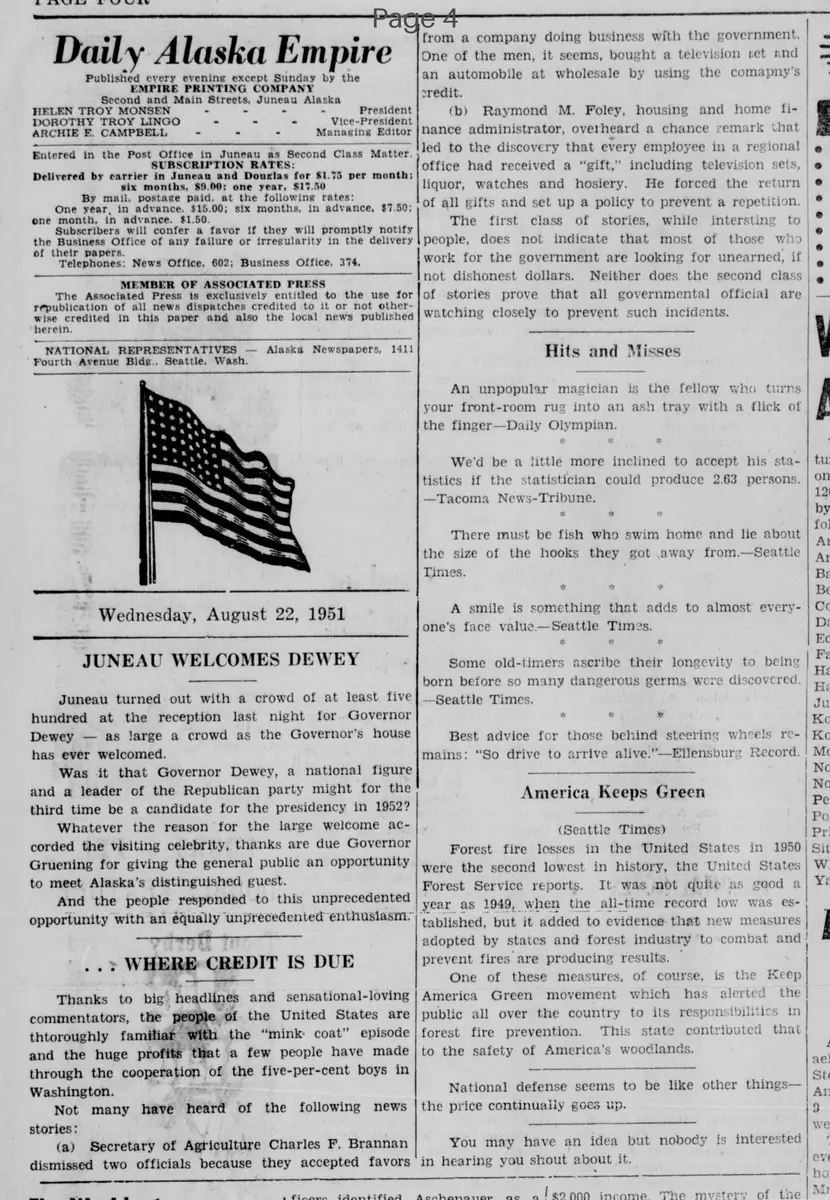
... WHERE CREDIT IS DUE
Thanks to big headlines and sensational-loving
commentators, the people of the United States are
thoroughly familiar with the "mink coat" episode
and the huge profits that a few people have made
through the cooperation of the five-per-cent boys in
Washington.
Not
many have heard of the following news
stories:
(a)
Secretary of Agriculture Charles F. Brannan
dismissed two officials because they accepted favors
from a company doing business with the government.
One of the men, it seems, bought a television set and
an automobile at wholesale by using the company's
credit.
(b) Raymond M. Foley, housing and home fi-
nance administrator, overheard a chance remark that
led to the discovery that every employee in a regional
office had received a "gift," including television sets,
liquor, watches and hosiery. He forced the return
of all gifts and set up a policy to prevent a repetition.
The first class of stories, while interesting to
people, does not indicate that most of those who
work for the government are looking for unearned, if
not dishonest dollars. Neither does the second class
of stories prove that all governmental officials are
watching closely to prevent such incidents.
Thanks to big headlines and sensational-loving
commentators, the people of the United States are
thoroughly familiar with the "mink coat" episode
and the huge profits that a few people have made
through the cooperation of the five-per-cent boys in
Washington.
Not
many have heard of the following news
stories:
(a)
Secretary of Agriculture Charles F. Brannan
dismissed two officials because they accepted favors
from a company doing business with the government.
One of the men, it seems, bought a television set and
an automobile at wholesale by using the company's
credit.
(b) Raymond M. Foley, housing and home fi-
nance administrator, overheard a chance remark that
led to the discovery that every employee in a regional
office had received a "gift," including television sets,
liquor, watches and hosiery. He forced the return
of all gifts and set up a policy to prevent a repetition.
The first class of stories, while interesting to
people, does not indicate that most of those who
work for the government are looking for unearned, if
not dishonest dollars. Neither does the second class
of stories prove that all governmental officials are
watching closely to prevent such incidents.
What sub-type of article is it?
Moral Or Religious
What keywords are associated?
Government Integrity
Corruption Prevention
Public Service Ethics
Sensationalism
Official Accountability
What entities or persons were involved?
Charles F. Brannan
Raymond M. Foley
Editorial Details
Primary Topic
Defending Government Integrity Against Sensationalism
Stance / Tone
Supportive Of Honest Public Service
Key Figures
Charles F. Brannan
Raymond M. Foley
Key Arguments
Sensational Stories Highlight Rare Corruption But Ignore Widespread Honesty.
Brannan Dismissed Officials For Accepting Favors From A Government Contractor.
Foley Discovered And Returned Illicit Gifts To Regional Office Employees, Establishing Preventive Policy.
Most Government Workers Seek Earned Income, Not Dishonest Gains.
Not All Officials Are Vigilant, But Positive Examples Exist.