Thank you for visiting SNEWPapers!
Sign up free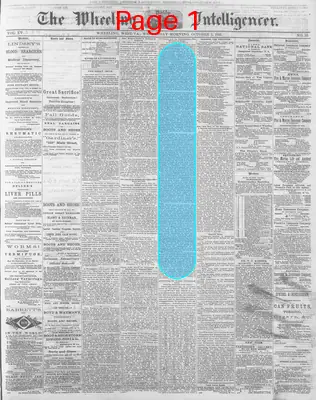
Editorial
October 3, 1866
The Wheeling Daily Intelligencer
Wheeling, Ohio County, West Virginia
What is this article about?
Editorial urges Southern states to ratify Congress's constitutional amendment for reconstruction, highlighting Northern support strengthened by Southern riots, failed conservative fusion, and Maine election. Emphasizes security for national debt, repudiation of rebel debts, and exclusion of rebels from office as binding terms preferable to Johnson's plan.
Clipping

OCR Quality
98%
Excellent
Full Text
Recent events, North and South, have wonderfully contributed to strengthen the Republican party on the platform adopted by Congress for the reconstruction and restoration of the lately rebellious States. The Memphis riots, the New Orleans massacre, and other scenes of a similar character in different places South, have made a deep impression on the Northern public mind prejudicial to the confidence policy of restoration. The Philadelphia August Convention has signally failed in its efforts to organize a new national party, from a fusion of the conservative Republicans with the treacherous Northern democracy. The Maine election has shown that the new distributions of Executive patronage undertaken at Washington comes too late; and if any doubts still remained that the plan of Congress as against the President's plan of restoration will sweep the North, from New York to San Francisco, those doubts have been removed by the unfortunate incidents by the way of Mr. Johnson's late unfortunate pilgrimage to the tomb of a Western trading politician.
Thus the issue between the President and Congress has taken a shape which has strengthened the republican party on the policy of Congress, beyond the largest expectations entertained by its leaders six weeks ago, and has correspondingly weakened the chosen policy of the administration. From Pennsylvania westward "the Boys in Blue" replace in 1866 the scenes and gatherings of the "Wide Awakes" of 1860. The enthusiasm, the numbers and the spirit of the republican mass meetings, and the still increasing popularity of this constitutional amendment before the States, too clearly mark the drift of public opinion to leave a doubt as to the general results of the coming elections. This amendment of the Constitution passed by Congress will be ratified by the North, and the Congress interested will be endorsed in a re-election substantially on this broad and acceptable platform of "securities for the future."
Representation in Congress on the basis of suffrage, as each State may choose for itself; the inviolable obligations of the national debt, the irrepealable repudiation of all rebel debts and all claims for emancipated slaves; and the exclusion from federal offices hereafter of certain classes of active rebels, until absolved by a two-thirds vote of each house of Congress, are the conditions of Southern restoration which will surely be exacted by the North in the approaching elections. And why should the South hesitate in accepting these terms, when in substance they are nothing more than the putting of the President's terms into the form of a binding contract or treaty of peace, with a government stamp upon it which cannot be called in question? Why hesitate, when nothing is to be gained, but when much that may be now secured by the South will be put in jeopardy by delay? Why did the Executive require of the lately insurgent States the ratification of the constitutional amendment abolishing slavery as an indispensable condition of restoration? Because, if admitted to their former relations in the government in advance, these States, it was feared, might refuse the ratification, and might at any time, each State for itself, under the constitution as it was, revive the institution of slavery. The masses of the Northern States entertain the same idea in regard to the national debt, all rebel debts, and all claims for liberated slaves. Hence the resistless pressure of this paramount idea of a bond in advance, which cannot be hereafter set aside or repealed by a Southern balance of power in Congress?
The North says to the South, after fighting for four terrible years as no people ever fought before to destroy their government, after sacrificing as you have done in this war a quarter of a million of able-bodied white men, and black slaves as property to the value of twenty-five hundred millions of dollars, and other property and crops and capital to the extent of five or six thousand millions, all gone beyond redemption, we must have a bond in advance before we can trust our debts and obligations to the chances of a Southern balance of power in Congress. We must have our conditions of security in advance; for we cannot place into your hands the power to reject them. This is a practical view of the matter, which every man of business will readily comprehend, and herein lies the secret of the astonishing popular strength of this restoration plan of Congress in the North. No man who has a fifty-dollar government bond salted down would trust its redemption to the chances of the casting vote in Congress of a Southerner who has lost his thousands in Confederate scrip.
We must repeat, then, to the Southern States our earnest admonition that the terms of this constitutional amendment are the best they can obtain; that their true policy is to get back into Congress as fast as possible on the credentials of this amendment, which will bring them in; and that if they permit this golden opportunity to slip away they will run the hazard of sweeping penalties against treason and traitors, and of universal negro suffrage by compulsion. This constitutional amendment, in a word, as the ultimatum of the North, is the only way of safety to the South.
Thus the issue between the President and Congress has taken a shape which has strengthened the republican party on the policy of Congress, beyond the largest expectations entertained by its leaders six weeks ago, and has correspondingly weakened the chosen policy of the administration. From Pennsylvania westward "the Boys in Blue" replace in 1866 the scenes and gatherings of the "Wide Awakes" of 1860. The enthusiasm, the numbers and the spirit of the republican mass meetings, and the still increasing popularity of this constitutional amendment before the States, too clearly mark the drift of public opinion to leave a doubt as to the general results of the coming elections. This amendment of the Constitution passed by Congress will be ratified by the North, and the Congress interested will be endorsed in a re-election substantially on this broad and acceptable platform of "securities for the future."
Representation in Congress on the basis of suffrage, as each State may choose for itself; the inviolable obligations of the national debt, the irrepealable repudiation of all rebel debts and all claims for emancipated slaves; and the exclusion from federal offices hereafter of certain classes of active rebels, until absolved by a two-thirds vote of each house of Congress, are the conditions of Southern restoration which will surely be exacted by the North in the approaching elections. And why should the South hesitate in accepting these terms, when in substance they are nothing more than the putting of the President's terms into the form of a binding contract or treaty of peace, with a government stamp upon it which cannot be called in question? Why hesitate, when nothing is to be gained, but when much that may be now secured by the South will be put in jeopardy by delay? Why did the Executive require of the lately insurgent States the ratification of the constitutional amendment abolishing slavery as an indispensable condition of restoration? Because, if admitted to their former relations in the government in advance, these States, it was feared, might refuse the ratification, and might at any time, each State for itself, under the constitution as it was, revive the institution of slavery. The masses of the Northern States entertain the same idea in regard to the national debt, all rebel debts, and all claims for liberated slaves. Hence the resistless pressure of this paramount idea of a bond in advance, which cannot be hereafter set aside or repealed by a Southern balance of power in Congress?
The North says to the South, after fighting for four terrible years as no people ever fought before to destroy their government, after sacrificing as you have done in this war a quarter of a million of able-bodied white men, and black slaves as property to the value of twenty-five hundred millions of dollars, and other property and crops and capital to the extent of five or six thousand millions, all gone beyond redemption, we must have a bond in advance before we can trust our debts and obligations to the chances of a Southern balance of power in Congress. We must have our conditions of security in advance; for we cannot place into your hands the power to reject them. This is a practical view of the matter, which every man of business will readily comprehend, and herein lies the secret of the astonishing popular strength of this restoration plan of Congress in the North. No man who has a fifty-dollar government bond salted down would trust its redemption to the chances of the casting vote in Congress of a Southerner who has lost his thousands in Confederate scrip.
We must repeat, then, to the Southern States our earnest admonition that the terms of this constitutional amendment are the best they can obtain; that their true policy is to get back into Congress as fast as possible on the credentials of this amendment, which will bring them in; and that if they permit this golden opportunity to slip away they will run the hazard of sweeping penalties against treason and traitors, and of universal negro suffrage by compulsion. This constitutional amendment, in a word, as the ultimatum of the North, is the only way of safety to the South.
What sub-type of article is it?
Constitutional
Partisan Politics
Economic Policy
What keywords are associated?
Reconstruction
Constitutional Amendment
Republican Party
Southern Restoration
National Debt
Rebel Debts
Memphis Riots
New Orleans Massacre
What entities or persons were involved?
Republican Party
Congress
President Johnson
Southern States
Northern Public
Editorial Details
Primary Topic
Support For Congress's Constitutional Amendment On Reconstruction
Stance / Tone
Strongly Supportive Of Republican Congressional Policy And Advisory To The South
Key Figures
Republican Party
Congress
President Johnson
Southern States
Northern Public
Key Arguments
Southern Riots Have Prejudiced Northern Opinion Against Johnson's Restoration Policy
Failed Philadelphia Convention And Maine Election Strengthen Congress's Plan
Constitutional Amendment Provides Securities For National Debt And Repudiation Of Rebel Debts
Amendment Excludes Active Rebels From Federal Offices Until Absolved
South Should Accept Amendment As Binding Contract To Avoid Harsher Terms Like Universal Negro Suffrage
Northern Sacrifices Demand Advance Guarantees Against Southern Power In Congress