Thank you for visiting SNEWPapers!
Sign up free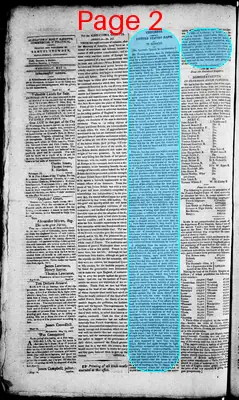
Alexandria Daily Gazette, Commercial & Political
Alexandria, Virginia
What is this article about?
In the U.S. Senate, Mr. Lloyd continues his speech supporting the renewal of the United States Bank's charter. He relays concerns from Philadelphia delegations of mechanics, manufacturers, and merchants about severe economic distress, business stagnation, and credit collapse if the charter is not renewed, emphasizing non-partisan urgency.
Clipping
OCR Quality
Full Text
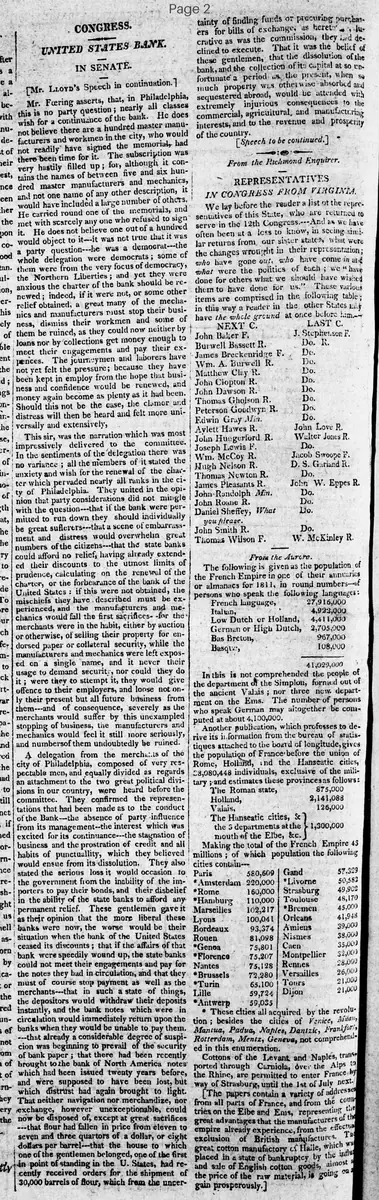
UNITED STATES BANK.
IN SENATE.
[Mr. Lloyd's Speech in continuation.]
this is no party question; nearly all classes wish for a continuance of the bank. Mr. Farrag asserts, that, in Philadelphia, not one master manufacturer or workman would object to it--it was not a party question---he was a democrat---the whole delegation were democrats; some of them were from the very focus of democracy, the Northern Liberties; and yet they were anxious the charter of the bank should be renewed; indeed, if it were not, or some other relief obtained, a great many of the mechanics and manufacturers must stop their business, dismiss their workmen and some of them be ruined, as they could now neither by loans nor by collections get money enough to meet their engagements and pay their expenses. The journeymen and laborers have not yet felt the pressure; because they have been kept in employ from the hope that business and confidence would be renewed, and money again become as plenty as it had been. Should this not be the case, the clamor and distress will then be heard and felt more universally and extensively.
This sir, was the narration which was most impressively delivered to the committee. In the sentiments of the delegation there was no variance ; all the members of it stated the anxiety and wish for the renewal of the charter which pervaded nearly all ranks in the city of Philadelphia. They united in the opinion that party considerations did not mingle with the question---that if the bank were permitted to run down they should individually be great sufferers---that a scene of embarrassment and distress would overwhelm great numbers of the citizens---that the state banks could afford no relief, having already extended their discounts to the utmost limits of prudence, calculating on the renewal of the charter, or the forbearance of the bank of the United States : if this were not obtained, the mischiefs they have described must be experienced, and the manufacturers and mechanics would fall the first sacrifices--for the merchants were in the habit, either by auction or otherwise, of selling their property for endorsed paper or collateral security, while the manufacturers and mechanics were left exposed on a single name, and it never their usage to demand security, nor could they do it ; were they to attempt it, they would give offence to their employers, and loose not only their present but all future business from them---and of consequence, severely as the merchants would suffer by this unexampled stopping of business, the manufacturers and mechanics would feel it still more seriously, and numbers of them undoubtedly be ruined.
A delegation from the merchants of the city of Philadelphia, composed of very respectable men, and equally divided as regards an attachment to the two great political divisions in our country, were heard before the committee. They confirmed the representations that had been made as to the conduct of the Bank--the absence of party influence from its management--the interest which was excited for its continuance---the stagnation of business and the prostration of credit and all habits of punctuality, which they believed would ensue from its dissolution. They also stated the serious loss it would occasion to the government from the inability of the importers to pay their bonds, and their disbelief in the ability of the state banks to afford any permanent relief. These gentlemen gave it as their opinion that the more liberal these banks were now, the worse would be their situation when the bank of the United States ceased its discounts; that if the affairs of that bank were speedily wound up, the state banks could not meet their engagements and pay for the notes they had in circulation, and that they must of course stop payment as well as the merchants---that in such a state of things, the depositors would withdraw their deposits instantly, and the bank notes which were in circulation would immediately return upon the banks when they would be unable to pay them. ---that already a considerable degree of suspicion was beginning to prevail of the security of bank paper ; that there had been recently brought to the bank of North America notes which had been issued twenty years before, and were supposed to have been lost, but which distrust had again brought to light. That neither navigation nor merchandize, nor exchange, however unexceptionable, could now be disposed of, except at great sacrifices ---that flour had fallen in price from eleven to seven and three quarters of a dollar, or eight dollars per barrel---that the house to which one of the gentlemen belonged, one of the first in point of standing in the U. States, had recently received orders for, the shipment of 30,000 barrels of flour, which from the uncertainty of finding funds or procuring purchasers for bills of exchange: as heretofore lucrative as was the commission; they had declined to execute. That it was the belief of these gentlemen, that the dissolution of the bank, and the collection of its capital at so unfortunate a period as the present, when so much property was otherwise-absorbed and sequestered abroad, would be attended with extremely injurious consequences to the commercial, agricultural, and manufacturing interests, and to the revenue and prosperity of the country.
[Speech to be continued.]
What sub-type of article is it?
What keywords are associated?
What entities or persons were involved?
Where did it happen?
Domestic News Details
Primary Location
Philadelphia
Key Persons
Outcome
potential economic distress, business closures, ruin for mechanics and manufacturers, loss to government revenue, and collapse of state banks if the bank's charter is not renewed.
Event Details
Mr. Lloyd's speech in the Senate details testimonies from Philadelphia delegations of democrats, mechanics, manufacturers, and merchants urging renewal of the United States Bank's charter to avert widespread economic stagnation, credit prostration, and distress across commercial, agricultural, and manufacturing sectors.