Thank you for visiting SNEWPapers!
Sign up free
Story
August 5, 1825
Rhode Island American
Providence, Providence County, Rhode Island
What is this article about?
An essay speculating on observed climate changes, noting milder winters with cultivation but increasingly intense summer heat in northern regions, contrary to expectations. It critiques philosophical ignorance of atmospheric influences and urges more research on this vital topic affecting agriculture, commerce, and health.
Clipping
OCR Quality
95%
Excellent
Full Text
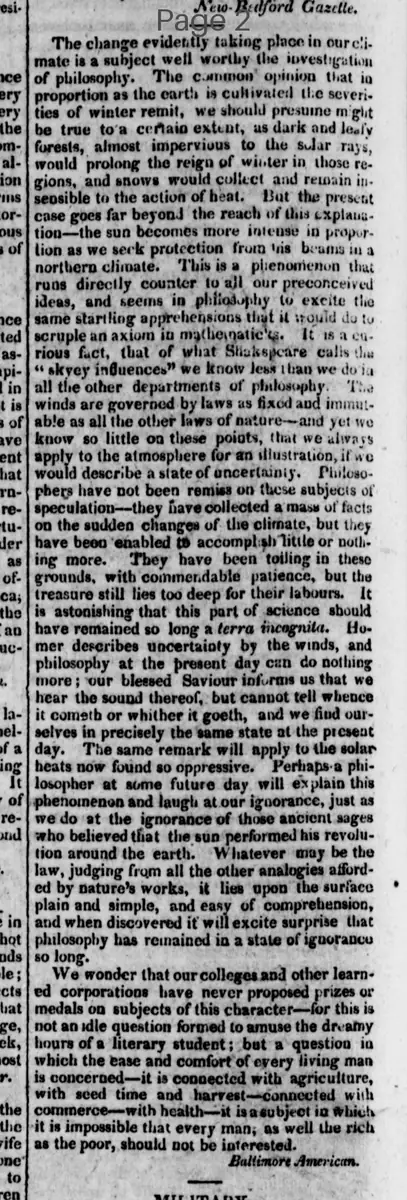
The change evidently taking place in our climate is a subject well worthy the investigation of philosophy. The common opinion that in proportion as the earth is cultivated the severities of winter remit, we should presume might be true to a certain extent, as dark and leafy forests, almost impervious to the solar rays, would prolong the reign of winter in those regions, and snows would collect and remain insensible to the action of heat. But the present case goes far beyond the reach of this explanation—the sun becomes more intense in proportion as we seek protection from its beams in a northern climate. This is a phenomenon that runs directly counter to all our preconceived ideas, and seems in philosophy to excite the same startling apprehensions that it would do to scruple an axiom in mathematics. It is a curious fact, that of what Shakspeare calls the "skvey influences" we know less than we do in all the other departments of philosophy. The winds are governed by laws as fixed and immutable as all the other laws of nature—and yet we know so little on these points, that we always apply to the atmosphere for an illustration, if we would describe a state of uncertainty. Philosophers have not been remiss on these subjects of speculation—they have collected a mass of facts on the sudden changes of the climate, but they have been enabled to accomplish little or nothing more. They have been toiling in these grounds, with commendable patience, but the treasure still lies too deep for their labours. It is astonishing that this part of science should have remained so long a terra incognita. Homer describes uncertainty by the winds, and philosophy at the present day can do nothing more; our blessed Saviour informs us that we hear the sound thereof, but cannot tell whence it cometh or whither it goeth, and we find ourselves in precisely the same state at the present day. The same remark will apply to the solar heats now found so oppressive. Perhaps a philosopher at some future day will explain this phenomenon and laugh at our ignorance, just as we do at the ignorance of those ancient sages who believed that the sun performed his revolution around the earth. Whatever may be the law, judging from all the other analogies afforded by nature's works, it lies upon the surface plain and simple, and easy of comprehension, and when discovered it will excite surprise that philosophy has remained in a state of ignorance so long.
We wonder that our colleges and other learned corporations have never proposed prizes or medals on subjects of this character—or this is not an idle question formed to amuse the dreamy hours of a literary student: but a question in which the ease and comfort of every living man is concerned—it is connected with agriculture, with seed time and harvest—connected with commerce—with health—it is a subject in which it is impossible that every man; as well the rich as the poor, should not be interested.
Baltimore American.
We wonder that our colleges and other learned corporations have never proposed prizes or medals on subjects of this character—or this is not an idle question formed to amuse the dreamy hours of a literary student: but a question in which the ease and comfort of every living man is concerned—it is connected with agriculture, with seed time and harvest—connected with commerce—with health—it is a subject in which it is impossible that every man; as well the rich as the poor, should not be interested.
Baltimore American.
What sub-type of article is it?
Curiosity
What themes does it cover?
Nature
What keywords are associated?
Climate Change
Philosophical Speculation
Atmospheric Uncertainty
Solar Heat
Northern Climate
Where did it happen?
Baltimore
Story Details
Location
Baltimore
Story Details
Speculation on climate change where cultivation reduces winter severity but increases summer heat intensity in northern areas, defying expectations; philosophical discussion on ignorance of atmospheric laws and call for further investigation into this phenomenon affecting daily life.