Thank you for visiting SNEWPapers!
Sign up free
Literary
July 6, 1847
Richmond Palladium
Richmond, Wayne County, Indiana
What is this article about?
Moral tale of Mr. Marble, a wealthy eccentric who marries a poor orphan, retires early to aid the needy, loses his family, adopts beggar boy Conrad, educates him on charity and mending 'holes in sleeves' as metaphor for diligence, leading to Conrad's success as estate manager.
Clipping
OCR Quality
95%
Excellent
Full Text
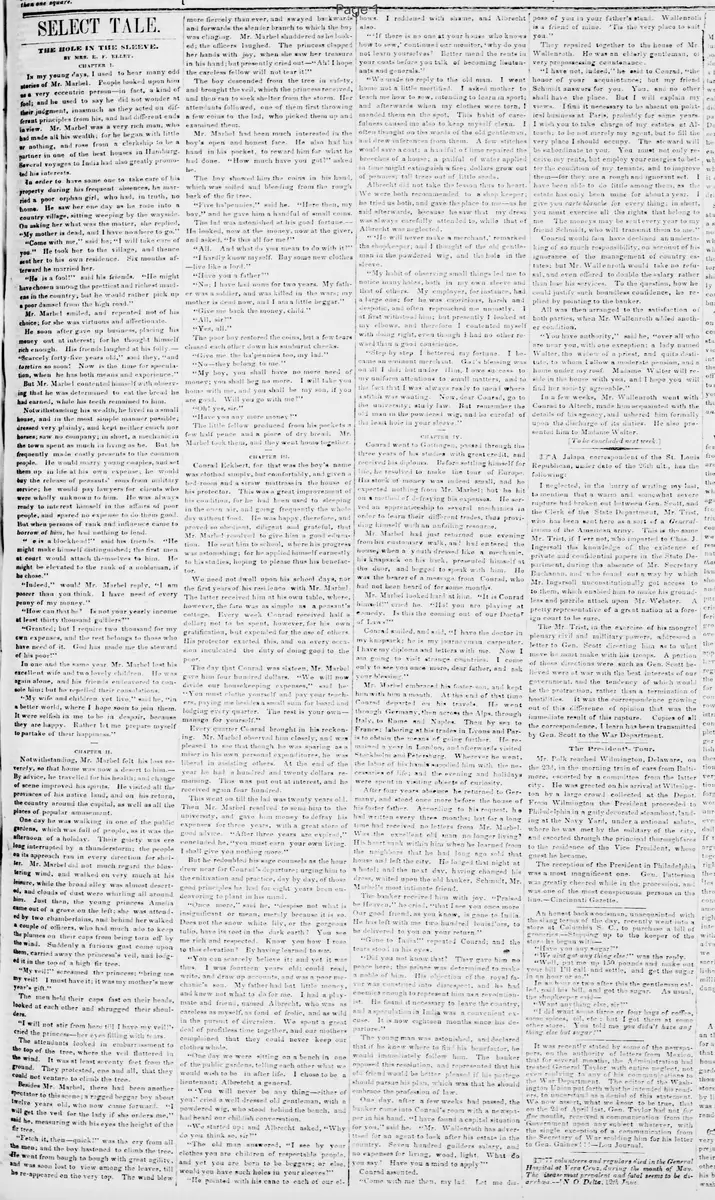
SELECT TALE.
THE HOLE IN THE SLEEVE.
BY MRS. E. F. ELLET.
CHAPTER I.
In my young days, I used to hear many odd stories of Mr. Marble. People looked upon him as a very eccentric person—in fact, a kind of envy. Mr. Marble was a very rich man, who had different principles from his [friends], and had different ends in view. In their judgment, inasmuch as they acted on different rules; and he used to say he did not wonder at it [that he] had made all his wealth; for he began with little or nothing, and rose from a clerkship to be a partner in one of the best houses in Hamburg. Several voyages to India had also greatly promoted his interests.
In order to have someone to take care of his property during his frequent absences, he married a poor orphan girl, who had, in truth, no home. He saw her one day as he rode into a country village, sitting weeping by the wayside. On asking her what was the matter, she replied, "My mother is dead, and I have nowhere to go."
"Come with me," said he; "I will take care of you." He took her to the village, and thence sent her to his own residence. Six months afterward he married her.
"He is a fool!" said his friends. "He might have chosen among the prettiest and richest maidens in the country; but he would rather pick up [a] poor damsel from the high road."
Mr. Marble smiled, and repented not of his choice; for she was virtuous and affectionate. He soon after gave up business, placing his money out at interest; for he thought himself rich enough. His friends laughed at his folly.—"Scarcely forty-five years old," said they, "and to retire so soon! Now is the time for speculation, when he has both means and experience."
But Mr. Marble contented himself with observing that he was determined to eat the bread he had earned, while his teeth remained to him. Notwithstanding his wealth, he lived in a small house, and in the most simple manner possible; dressed very plainly, and kept neither coach nor horses; saw no company; in short, a mechanic in the town spent as much in living as he. But he frequently made costly presents to the common people. He would marry young couples, and set them up in life at his own expense; he would buy the release of peasants' sons from military service: he would pay lawyers for clients who were wholly unknown to him. He was always ready to interest himself in the affairs of poor people, and spared no expense to do them good. But when persons of rank and influence came to borrow of him, he had nothing to lend.
"He is a blockhead!" said his friends. "He might make himself distinguished; the first men at court would attach themselves to him. He might be elevated to the rank of a nobleman, if he chose."
"Indeed," would Mr. Marble reply, "I am poorer than you think. I have need of every penny of my money."
"How can that be? Is not your yearly income at least thirty thousand guilders?"
"Granted; but I require two thousand for my own expenses, and the rest belongs to those who have need of it. God has made me the steward of his poor!"
In one and the same year Mr. Marble lost his excellent wife and two lovely children. He was again alone, and his friends endeavored to console him; but he repelled their consolations. "My wife and children yet live," said he, "in a better world, where I hope soon to join them. It were selfish in me to be in despair, because they are happy. Rather let me prepare myself to partake of their happiness."
CHAPTER II.
Notwithstanding, Mr. Marble felt his loss severely, so that home was now a desert to him. By advice, he travelled for his health; and change of scene improved his spirits. He visited all the provinces of his native land, and on his return, the country around the capital, as well as all the places of popular amusement.
One day he was walking in one of the public gardens, which was full of people, as it was the afternoon of a holiday. Their gaiety was ere long interrupted by a thunderstorm; the people on its approach ran in every direction for shelter. Mr. Marble did not much regard the blustering wind, and walked on very much at his leisure, while the broad alley was almost deserted, and clouds of dust were whirling all around him. Just then, the young princess Amelia came out of a grove on the left; she was attended by two chamberlains, and behind her walked a couple of officers, who had much ado to keep the plumes on their caps from being torn off by the wind. Suddenly a furious gust came upon them, carried away the princess's veil, and lodged it in the top of a high fir tree.
"My veil!" screamed the princess; "bring me my veil! I must have it; it was my mother's new year's gift."
The men held their caps fast on their heads, looked at each other and shrugged their shoulders.
"I will not stir from here till I have my veil!" cried the princess—her eyes filling with tears. The attendants looked in embarrassment to the top of the tree, where the veil fluttered in the wind. It was at least seventy feet from the ground. They protested, one and all, that they could not venture to climb the tree.
Besides Mr. Marble, there had been another spectator to this scene; a ragged beggar boy about twelve years old, who now came forward. "I will get the veil for the lady if she orders me," said he, measuring with his eyes the height of the fir tree.
"Fetch it, then—quick!" was the cry from all the men; and the boy hastened to climb the tree. He went from bough to bough with great agility, and was soon lost to view among the leaves, till he re-appeared on the very top. The wind blew more fiercely than ever, and swayed backwards and forwards the slender branch to which the boy was clinging. Mr. Marble shuddered as he looked; the officers laughed. The princess clapped her hands with joy, when she saw her treasure in his hand; but presently cried out—"Ah! I hope the careless fellow will not tear it!"
The boy descended from the tree in safety, and brought the veil, which the princess received, and then ran to seek shelter from the storm. Her attendants followed, one of them first throwing a few coins to the lad, who picked them up and examined them.
Mr. Marble had been much interested in the boy's open and honest face. He also had his hand in his pocket, to reward him for what he had done. "How much have you got?" asked he.
The boy showed him the coins in his hand, which was soiled and bleeding from the rough bark of the fir tree.
"Five ha'pennies," said he. "Here then, my boy," and he gave him a handful of small coins.
The lad was astonished at his good fortune.—He looked, now at the money, now at the giver, and asked. "Is this all for me?"
"All. And what do you mean to do with it?"
"I hardly know myself. Buy some new clothes—live like a lord."
"Have you a father?"
"No; I have had none for two years. My father was a soldier, and was killed in the wars; my mother is dead now, and I am a little beggar."
"Give me back the money, child."
"All, sir?"
"Yes, all."
The poor boy restored the coins, but a few tears chased each other down his sunburnt cheeks.
"Give me the ha'pennies too, my lad."
"No—they belong to me."
"My boy, you shall have no more need of money; you shall beg no more. I will take you home with me, and you shall be my son, if you are good. Will you go with me?"
"Oh! yes, sir."
"Have you any more money?"
The little fellow produced from his pockets a few half pence and a piece of dry bread. Mr. Marble took them, and they went home together.
CHAPTER III.
Conrad Eckbert, for that was the boy's name, was clothed simply, but comfortably, and given a bed-room and a straw mattress in the house of his protector. This was a great improvement of his condition, for he had been used to sleeping in the open air, and going frequently the whole day without food. He was happy, therefore, and proved so obedient, diligent and grateful, that Mr. Marble resolved to give him a good education. He sent him to school, where his progress was astonishing; for he applied himself earnestly to his studies, hoping to please thus his benefactor.
We need not dwell upon his school days, nor the first years of his residence with Mr. Marble. The latter received him at his own table, where, however, the fare was as simple as a peasant's cottage. Every week Conrad received half a dollar; not to be spent, however, for his own gratification, but expended for the use of others. His protector exacted this, and on every occasion inculcated the duty of doing good to the poor.
The day that Conrad was sixteen, Mr. Marble gave him four hundred dollars. "We will now divide our housekeeping expenses," said he: "You must clothe yourself and pay your teachers, paying me besides a small sum for board and lodging every quarter. The rest is your own—manage for yourself."
Every quarter Conrad brought in his reckoning. Mr. Marble observed him closely, and was pleased to see that though he was sparing as a miser in his own personal expenditures, he was liberal in assisting others. At the end of the year he had a hundred and twenty dollars remaining. This was put out at interest, and he received again four hundred.
This went on till the lad was twenty years old. Then Mr. Marble resolved to send him to the university, and gave him money to defray his expenses for three years, with a great store of good advice. "After three years are expired," concluded he, "you must earn your own living. I shall give you nothing more."
But he redoubled his sage counsels as the hour drew near for Conrad's departure: urging him to the cultivation and practice, day by day, of those good principles he had for eight years been endeavoring to plant in his mind.
"Once more," said he, "despise not what is insignificant or mean, merely because it is so. Does not the snow white lily, or the gorgeous tulip, have its root in the dark earth? You see me rich and respected. Know you how I rose to this elevation? By having learned to sew.
"You can scarcely believe it; and yet it was thus. I was fourteen years old: could read, write, and draw up accounts, and was a poor mechanic's son. My father had but little money, and knew not what to do for me. I had a playmate and friend, named Albrecht, who was as careless as myself, as fond of frolic, and as wild in the pursuit of diversion. We spent a great deal of profitless time together, and our mothers complained that they could never keep our clothes whole.
"One day we were sitting on a bench in one of the public gardens, telling each other what we would wish to be in after life. I chose to be a lieutenant; Albrecht a general.
"'You will never be anything—either of you,' cried a well dressed old gentleman, with a powdered wig, who stood behind the bench, and had heard our childish conversation.
"We started up: and Albrecht asked, 'Why do you think so, sir?'
"The old man answered, 'I see by your clothes you are children of respectable people, and yet you are born to be beggars; or else, would you have such holes in your sleeves?'
"He pointed with his cane to each of our elbows. I reddened with shame, and Albrecht also.
"'If there is no one at your house who knows how to sew,' continued our monitor, 'why do you not learn yourselves? Better mend the rents in your coats before you talk of becoming lieutenants and generals.'
"We made no reply to the old man. I went home not a little mortified. I asked mother to teach me how to sew, intending to learn in sport; and afterwards when my clothes were torn, I mended them on the spot. This habit of carefulness caused me also to keep myself clean. I often thought on the words of the old gentleman, and drew inferences from them. A few stitches would save a coat; a handful of lime repaired the breaches of a house; a pailful of water applied in time might extinguish a fire; dollars grow out of pennies; tall trees out of little seeds.
"Albrecht did not take the lesson thus to heart. We were both recommended to a shopkeeper; he tried us both, and gave the place to me—as he said afterwards, because he saw that my dress was always carefully attended to, while that of Albrecht was neglected.
"'He will never make a merchant,' remarked the shopkeeper: and I thought of the old gentleman in the powdered wig, and the hole in the sleeve.
"My habit of observing small things led me to notice many holes, both in my own sleeve and that of others. My employer, for instance, had a large one; for he was capricious, harsh and despotic, and often reproached me unjustly. I at first withstood him; but presently I looked at my elbows, and therefore I contented myself with doing right, even though I had no other reward than a good conscience.
"Step by step I bettered my fortune. I became an eminent merchant. God's blessing was on all I did; but under Him, I owe success to my uniform attentions to small matters, and to the fact that I was always ready to mend where a stitch was wanting. Now, dear Conrad, go to the university; study law. But remember the old man in the powdered wig, and be careful of the least hole in your sleeve."
CHAPTER IV.
Conrad went to Göttingen, passed through the three years of his studies with greater credit, and received his diploma. Before settling himself for life, he resolved to make the tour of Europe. His stock of money was indeed small, and he expected nothing from Mr. Marble; but he hit on a method of defraying his expenses. He served an apprenticeship to several mechanics in order to learn their different trades, thus providing himself with an unfailing resource.
Mr. Marble had just returned one evening from his customary walk, and had entered the house, when a youth dressed like a mechanic, his knapsack on his back, presented himself at the door, and begged to speak with him. He was the bearer of a message from Conrad, who had not been heard of for some months.
Mr. Marble looked hard at him. "It is Conrad himself!" cried he. "Ha! you are playing at comedy. Is this the coming out of our Doctor of Laws?"
Conrad smiled, and said, "I have the doctor in my knapsack; he is my journeyman carpenter. I have my diploma and letters with me. Now I am going to visit strange countries. I come only to see you once more, dear father, and ask your blessing."
Mr. Marble embraced his foster-son, and kept him with him a month. At the end of that time Conrad departed on his travels. He went through Germany, then across the Alps, through Italy, to Rome and Naples. Then by sea to France: laboring at his trades in Lyons and Paris to obtain the means of going further. He remained a year in London, and afterwards visited Stockholm and Petersburg. Wherever he went, the labor of his hands supplied him with the necessaries of life: and the evening and holidays were spent in visiting objects of curiosity.
After four years absence he returned to Germany, and stood once more before the house of his foster father. According to his request, he had written every three months: but for a long time had received no letters from Mr. Marble. Was the excellent old man no longer living? His heart sunk within him when he learned from the neighbors that he had long ago sold that house and left the city. He lodged that night at a hotel: and the next day, having changed his dress, waited upon the old banker, Schmidt, Mr. Marble's most intimate friend.
The banker received him with joy. "Praised be Heaven," he cried, "that I see you once more! Our good friend, as you know, is gone to India. He has left with me two hundred louis d'ors, to be delivered to you on your return."
"Gone to India!" repeated Conrad; and the tears stood in his eyes.
"Did you not know that? They gave him no peace here; the prince was determined to make a noble of him. His objection of the royal favor was construed into disrespect, and he had enemies enough to represent him as a revolutionist. He found it necessary to leave the country, and a speculation in India was a convenient excuse. It is now eighteen months since his departure."
The young man was astonished, and declared that if he knew where to find his benefactor, he would immediately follow him. The banker opposed this resolution, and represented that his old friend would be better pleased if his protégé should pursue his plan, which was that he should embrace the profession of law.
One day, after a few weeks had passed, the banker came into Conrad's room with a newspaper in his hand. "I have found a capital situation for you," said he. "Mr. Wallenroth has advertised for an agent to look after his estate in the country. Seven hundred guilders salary, and no expenses for living, wood, light. What do you say? Have you a mind to apply?"
Conrad assented.
"Come with me then, my lad. Let me dispose of you in your father's stead. Wallenroth is a friend of mine. 'Tis the very place to suit you."
They repaired together to the house of Mr. Wallenroth. He was an elderly gentleman, of very prepossessing countenance.
"I have not, indeed," he said to Conrad, "the honor of your acquaintance; but my friend Schmidt answers for you. You, and no other, shall have the place. But I will explain my views. I find it necessary to be absent on political business at Paris, probably for some years. I wish you to take charge of my estates at Alteach; to be not merely my agent, but to fill the very place I should occupy. The steward will be subordinate to you. You must not only receive my rents, but employ your energies to better the condition of my tenants, and to improve them—for they are a rough and ignorant set. I have been able to do little among them, as the estate has only been mine for about a year. I give you carte blanche for every thing; in short, you must exercise all the rights that belong to me. The moneys may be sent every year to my friend Schmidt, who will transmit them to me."
Conrad would fain have declined an undertaking of so much responsibility, on account of his ignorance of the management of country estates; but Mr. Wallenroth would take no refusal, and even offered to double the salary rather than lose his services. To the question, how he could justify such boundless confidence, he replied by pointing to the banker.
All was then arranged to the satisfaction of both parties, when Mr. Wallenroth added another condition.
"You have authority," said he, "over all who are near you, with one exception; a lady named Walter, the widow of a priest, and quite destitute, to whom I allow a moderate pension, and a home under my roof. Madame Walter will reside in the house with you, and I hope you will find her society agreeable."
In a few weeks, Mr. Wallenroth went with Conrad to Alteach, made him acquainted with the details of his agency, and ushered him formally upon the discharge of its duties. He also presented him to Madame Walter.
[To be continued next week.]
THE HOLE IN THE SLEEVE.
BY MRS. E. F. ELLET.
CHAPTER I.
In my young days, I used to hear many odd stories of Mr. Marble. People looked upon him as a very eccentric person—in fact, a kind of envy. Mr. Marble was a very rich man, who had different principles from his [friends], and had different ends in view. In their judgment, inasmuch as they acted on different rules; and he used to say he did not wonder at it [that he] had made all his wealth; for he began with little or nothing, and rose from a clerkship to be a partner in one of the best houses in Hamburg. Several voyages to India had also greatly promoted his interests.
In order to have someone to take care of his property during his frequent absences, he married a poor orphan girl, who had, in truth, no home. He saw her one day as he rode into a country village, sitting weeping by the wayside. On asking her what was the matter, she replied, "My mother is dead, and I have nowhere to go."
"Come with me," said he; "I will take care of you." He took her to the village, and thence sent her to his own residence. Six months afterward he married her.
"He is a fool!" said his friends. "He might have chosen among the prettiest and richest maidens in the country; but he would rather pick up [a] poor damsel from the high road."
Mr. Marble smiled, and repented not of his choice; for she was virtuous and affectionate. He soon after gave up business, placing his money out at interest; for he thought himself rich enough. His friends laughed at his folly.—"Scarcely forty-five years old," said they, "and to retire so soon! Now is the time for speculation, when he has both means and experience."
But Mr. Marble contented himself with observing that he was determined to eat the bread he had earned, while his teeth remained to him. Notwithstanding his wealth, he lived in a small house, and in the most simple manner possible; dressed very plainly, and kept neither coach nor horses; saw no company; in short, a mechanic in the town spent as much in living as he. But he frequently made costly presents to the common people. He would marry young couples, and set them up in life at his own expense; he would buy the release of peasants' sons from military service: he would pay lawyers for clients who were wholly unknown to him. He was always ready to interest himself in the affairs of poor people, and spared no expense to do them good. But when persons of rank and influence came to borrow of him, he had nothing to lend.
"He is a blockhead!" said his friends. "He might make himself distinguished; the first men at court would attach themselves to him. He might be elevated to the rank of a nobleman, if he chose."
"Indeed," would Mr. Marble reply, "I am poorer than you think. I have need of every penny of my money."
"How can that be? Is not your yearly income at least thirty thousand guilders?"
"Granted; but I require two thousand for my own expenses, and the rest belongs to those who have need of it. God has made me the steward of his poor!"
In one and the same year Mr. Marble lost his excellent wife and two lovely children. He was again alone, and his friends endeavored to console him; but he repelled their consolations. "My wife and children yet live," said he, "in a better world, where I hope soon to join them. It were selfish in me to be in despair, because they are happy. Rather let me prepare myself to partake of their happiness."
CHAPTER II.
Notwithstanding, Mr. Marble felt his loss severely, so that home was now a desert to him. By advice, he travelled for his health; and change of scene improved his spirits. He visited all the provinces of his native land, and on his return, the country around the capital, as well as all the places of popular amusement.
One day he was walking in one of the public gardens, which was full of people, as it was the afternoon of a holiday. Their gaiety was ere long interrupted by a thunderstorm; the people on its approach ran in every direction for shelter. Mr. Marble did not much regard the blustering wind, and walked on very much at his leisure, while the broad alley was almost deserted, and clouds of dust were whirling all around him. Just then, the young princess Amelia came out of a grove on the left; she was attended by two chamberlains, and behind her walked a couple of officers, who had much ado to keep the plumes on their caps from being torn off by the wind. Suddenly a furious gust came upon them, carried away the princess's veil, and lodged it in the top of a high fir tree.
"My veil!" screamed the princess; "bring me my veil! I must have it; it was my mother's new year's gift."
The men held their caps fast on their heads, looked at each other and shrugged their shoulders.
"I will not stir from here till I have my veil!" cried the princess—her eyes filling with tears. The attendants looked in embarrassment to the top of the tree, where the veil fluttered in the wind. It was at least seventy feet from the ground. They protested, one and all, that they could not venture to climb the tree.
Besides Mr. Marble, there had been another spectator to this scene; a ragged beggar boy about twelve years old, who now came forward. "I will get the veil for the lady if she orders me," said he, measuring with his eyes the height of the fir tree.
"Fetch it, then—quick!" was the cry from all the men; and the boy hastened to climb the tree. He went from bough to bough with great agility, and was soon lost to view among the leaves, till he re-appeared on the very top. The wind blew more fiercely than ever, and swayed backwards and forwards the slender branch to which the boy was clinging. Mr. Marble shuddered as he looked; the officers laughed. The princess clapped her hands with joy, when she saw her treasure in his hand; but presently cried out—"Ah! I hope the careless fellow will not tear it!"
The boy descended from the tree in safety, and brought the veil, which the princess received, and then ran to seek shelter from the storm. Her attendants followed, one of them first throwing a few coins to the lad, who picked them up and examined them.
Mr. Marble had been much interested in the boy's open and honest face. He also had his hand in his pocket, to reward him for what he had done. "How much have you got?" asked he.
The boy showed him the coins in his hand, which was soiled and bleeding from the rough bark of the fir tree.
"Five ha'pennies," said he. "Here then, my boy," and he gave him a handful of small coins.
The lad was astonished at his good fortune.—He looked, now at the money, now at the giver, and asked. "Is this all for me?"
"All. And what do you mean to do with it?"
"I hardly know myself. Buy some new clothes—live like a lord."
"Have you a father?"
"No; I have had none for two years. My father was a soldier, and was killed in the wars; my mother is dead now, and I am a little beggar."
"Give me back the money, child."
"All, sir?"
"Yes, all."
The poor boy restored the coins, but a few tears chased each other down his sunburnt cheeks.
"Give me the ha'pennies too, my lad."
"No—they belong to me."
"My boy, you shall have no more need of money; you shall beg no more. I will take you home with me, and you shall be my son, if you are good. Will you go with me?"
"Oh! yes, sir."
"Have you any more money?"
The little fellow produced from his pockets a few half pence and a piece of dry bread. Mr. Marble took them, and they went home together.
CHAPTER III.
Conrad Eckbert, for that was the boy's name, was clothed simply, but comfortably, and given a bed-room and a straw mattress in the house of his protector. This was a great improvement of his condition, for he had been used to sleeping in the open air, and going frequently the whole day without food. He was happy, therefore, and proved so obedient, diligent and grateful, that Mr. Marble resolved to give him a good education. He sent him to school, where his progress was astonishing; for he applied himself earnestly to his studies, hoping to please thus his benefactor.
We need not dwell upon his school days, nor the first years of his residence with Mr. Marble. The latter received him at his own table, where, however, the fare was as simple as a peasant's cottage. Every week Conrad received half a dollar; not to be spent, however, for his own gratification, but expended for the use of others. His protector exacted this, and on every occasion inculcated the duty of doing good to the poor.
The day that Conrad was sixteen, Mr. Marble gave him four hundred dollars. "We will now divide our housekeeping expenses," said he: "You must clothe yourself and pay your teachers, paying me besides a small sum for board and lodging every quarter. The rest is your own—manage for yourself."
Every quarter Conrad brought in his reckoning. Mr. Marble observed him closely, and was pleased to see that though he was sparing as a miser in his own personal expenditures, he was liberal in assisting others. At the end of the year he had a hundred and twenty dollars remaining. This was put out at interest, and he received again four hundred.
This went on till the lad was twenty years old. Then Mr. Marble resolved to send him to the university, and gave him money to defray his expenses for three years, with a great store of good advice. "After three years are expired," concluded he, "you must earn your own living. I shall give you nothing more."
But he redoubled his sage counsels as the hour drew near for Conrad's departure: urging him to the cultivation and practice, day by day, of those good principles he had for eight years been endeavoring to plant in his mind.
"Once more," said he, "despise not what is insignificant or mean, merely because it is so. Does not the snow white lily, or the gorgeous tulip, have its root in the dark earth? You see me rich and respected. Know you how I rose to this elevation? By having learned to sew.
"You can scarcely believe it; and yet it was thus. I was fourteen years old: could read, write, and draw up accounts, and was a poor mechanic's son. My father had but little money, and knew not what to do for me. I had a playmate and friend, named Albrecht, who was as careless as myself, as fond of frolic, and as wild in the pursuit of diversion. We spent a great deal of profitless time together, and our mothers complained that they could never keep our clothes whole.
"One day we were sitting on a bench in one of the public gardens, telling each other what we would wish to be in after life. I chose to be a lieutenant; Albrecht a general.
"'You will never be anything—either of you,' cried a well dressed old gentleman, with a powdered wig, who stood behind the bench, and had heard our childish conversation.
"We started up: and Albrecht asked, 'Why do you think so, sir?'
"The old man answered, 'I see by your clothes you are children of respectable people, and yet you are born to be beggars; or else, would you have such holes in your sleeves?'
"He pointed with his cane to each of our elbows. I reddened with shame, and Albrecht also.
"'If there is no one at your house who knows how to sew,' continued our monitor, 'why do you not learn yourselves? Better mend the rents in your coats before you talk of becoming lieutenants and generals.'
"We made no reply to the old man. I went home not a little mortified. I asked mother to teach me how to sew, intending to learn in sport; and afterwards when my clothes were torn, I mended them on the spot. This habit of carefulness caused me also to keep myself clean. I often thought on the words of the old gentleman, and drew inferences from them. A few stitches would save a coat; a handful of lime repaired the breaches of a house; a pailful of water applied in time might extinguish a fire; dollars grow out of pennies; tall trees out of little seeds.
"Albrecht did not take the lesson thus to heart. We were both recommended to a shopkeeper; he tried us both, and gave the place to me—as he said afterwards, because he saw that my dress was always carefully attended to, while that of Albrecht was neglected.
"'He will never make a merchant,' remarked the shopkeeper: and I thought of the old gentleman in the powdered wig, and the hole in the sleeve.
"My habit of observing small things led me to notice many holes, both in my own sleeve and that of others. My employer, for instance, had a large one; for he was capricious, harsh and despotic, and often reproached me unjustly. I at first withstood him; but presently I looked at my elbows, and therefore I contented myself with doing right, even though I had no other reward than a good conscience.
"Step by step I bettered my fortune. I became an eminent merchant. God's blessing was on all I did; but under Him, I owe success to my uniform attentions to small matters, and to the fact that I was always ready to mend where a stitch was wanting. Now, dear Conrad, go to the university; study law. But remember the old man in the powdered wig, and be careful of the least hole in your sleeve."
CHAPTER IV.
Conrad went to Göttingen, passed through the three years of his studies with greater credit, and received his diploma. Before settling himself for life, he resolved to make the tour of Europe. His stock of money was indeed small, and he expected nothing from Mr. Marble; but he hit on a method of defraying his expenses. He served an apprenticeship to several mechanics in order to learn their different trades, thus providing himself with an unfailing resource.
Mr. Marble had just returned one evening from his customary walk, and had entered the house, when a youth dressed like a mechanic, his knapsack on his back, presented himself at the door, and begged to speak with him. He was the bearer of a message from Conrad, who had not been heard of for some months.
Mr. Marble looked hard at him. "It is Conrad himself!" cried he. "Ha! you are playing at comedy. Is this the coming out of our Doctor of Laws?"
Conrad smiled, and said, "I have the doctor in my knapsack; he is my journeyman carpenter. I have my diploma and letters with me. Now I am going to visit strange countries. I come only to see you once more, dear father, and ask your blessing."
Mr. Marble embraced his foster-son, and kept him with him a month. At the end of that time Conrad departed on his travels. He went through Germany, then across the Alps, through Italy, to Rome and Naples. Then by sea to France: laboring at his trades in Lyons and Paris to obtain the means of going further. He remained a year in London, and afterwards visited Stockholm and Petersburg. Wherever he went, the labor of his hands supplied him with the necessaries of life: and the evening and holidays were spent in visiting objects of curiosity.
After four years absence he returned to Germany, and stood once more before the house of his foster father. According to his request, he had written every three months: but for a long time had received no letters from Mr. Marble. Was the excellent old man no longer living? His heart sunk within him when he learned from the neighbors that he had long ago sold that house and left the city. He lodged that night at a hotel: and the next day, having changed his dress, waited upon the old banker, Schmidt, Mr. Marble's most intimate friend.
The banker received him with joy. "Praised be Heaven," he cried, "that I see you once more! Our good friend, as you know, is gone to India. He has left with me two hundred louis d'ors, to be delivered to you on your return."
"Gone to India!" repeated Conrad; and the tears stood in his eyes.
"Did you not know that? They gave him no peace here; the prince was determined to make a noble of him. His objection of the royal favor was construed into disrespect, and he had enemies enough to represent him as a revolutionist. He found it necessary to leave the country, and a speculation in India was a convenient excuse. It is now eighteen months since his departure."
The young man was astonished, and declared that if he knew where to find his benefactor, he would immediately follow him. The banker opposed this resolution, and represented that his old friend would be better pleased if his protégé should pursue his plan, which was that he should embrace the profession of law.
One day, after a few weeks had passed, the banker came into Conrad's room with a newspaper in his hand. "I have found a capital situation for you," said he. "Mr. Wallenroth has advertised for an agent to look after his estate in the country. Seven hundred guilders salary, and no expenses for living, wood, light. What do you say? Have you a mind to apply?"
Conrad assented.
"Come with me then, my lad. Let me dispose of you in your father's stead. Wallenroth is a friend of mine. 'Tis the very place to suit you."
They repaired together to the house of Mr. Wallenroth. He was an elderly gentleman, of very prepossessing countenance.
"I have not, indeed," he said to Conrad, "the honor of your acquaintance; but my friend Schmidt answers for you. You, and no other, shall have the place. But I will explain my views. I find it necessary to be absent on political business at Paris, probably for some years. I wish you to take charge of my estates at Alteach; to be not merely my agent, but to fill the very place I should occupy. The steward will be subordinate to you. You must not only receive my rents, but employ your energies to better the condition of my tenants, and to improve them—for they are a rough and ignorant set. I have been able to do little among them, as the estate has only been mine for about a year. I give you carte blanche for every thing; in short, you must exercise all the rights that belong to me. The moneys may be sent every year to my friend Schmidt, who will transmit them to me."
Conrad would fain have declined an undertaking of so much responsibility, on account of his ignorance of the management of country estates; but Mr. Wallenroth would take no refusal, and even offered to double the salary rather than lose his services. To the question, how he could justify such boundless confidence, he replied by pointing to the banker.
All was then arranged to the satisfaction of both parties, when Mr. Wallenroth added another condition.
"You have authority," said he, "over all who are near you, with one exception; a lady named Walter, the widow of a priest, and quite destitute, to whom I allow a moderate pension, and a home under my roof. Madame Walter will reside in the house with you, and I hope you will find her society agreeable."
In a few weeks, Mr. Wallenroth went with Conrad to Alteach, made him acquainted with the details of his agency, and ushered him formally upon the discharge of its duties. He also presented him to Madame Walter.
[To be continued next week.]
What sub-type of article is it?
Prose Fiction
What themes does it cover?
Moral Virtue
What keywords are associated?
Moral Tale
Charity
Diligence
Self Improvement
Philanthropy
Orphan Adoption
Small Details
What entities or persons were involved?
By Mrs. E. F. Ellet.
Literary Details
Title
The Hole In The Sleeve
Author
By Mrs. E. F. Ellet.
Key Lines
"God Has Made Me The Steward Of His Poor!"
"Better Mend The Rents In Your Coats Before You Talk Of Becoming Lieutenants And Generals."
"A Few Stitches Would Save A Coat; A Handful Of Lime Repaired The Breaches Of A House; A Pailful Of Water Applied In Time Might Extinguish A Fire; Dollars Grow Out Of Pennies; Tall Trees Out Of Little Seeds."
"Remember The Old Man In The Powdered Wig, And Be Careful Of The Least Hole In Your Sleeve."