Thank you for visiting SNEWPapers!
Sign up free
The Wilmington Morning Star
Wilmington, New Hanover County, North Carolina
What is this article about?
Raymond Clapper argues that U.S.-UK disputes over North African political control underscore the urgency for a United Nations council to manage such issues, prevent Allied bickering, and support the war effort, recommending Sumner Welles' immediate visit.
Clipping
OCR Quality
Full Text
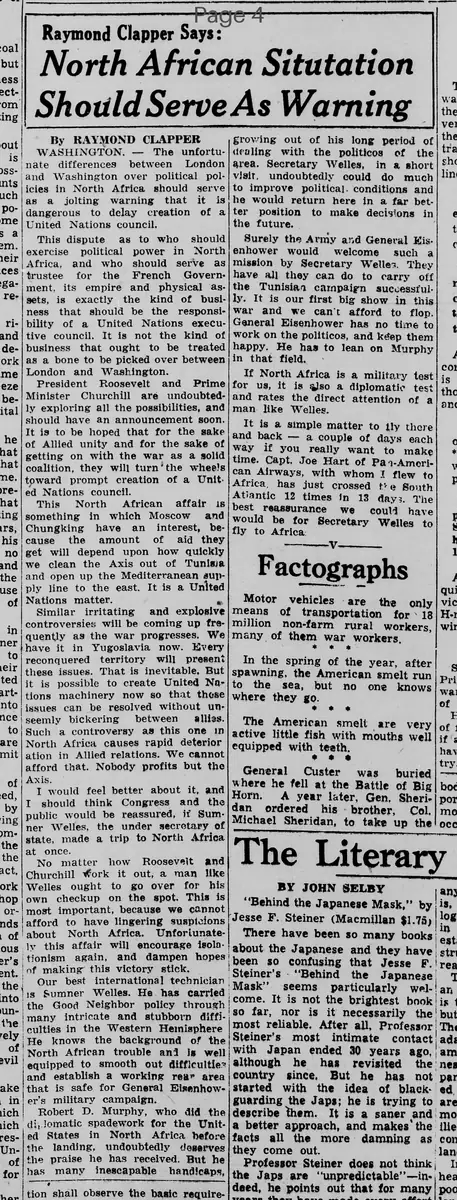
North African Situation Should Serve As Warning
By RAYMOND CLAPPER
WASHINGTON. - The unfortunate differences between London and Washington over political policies in North Africa should serve as a jolting warning that it is dangerous to delay creation of a United Nations council. This dispute as to who should exercise political power in North Africa, and who should serve as trustee for the French Government, its empire and physical assets, is exactly the kind of business that should be the responsibility of a United Nations executive council. It is not the kind of business that ought to be treated as a bone to be picked over between London and Washington. President Roosevelt and Prime Minister Churchill are undoubtedly exploring all the possibilities, and should have an announcement soon. It is to be hoped that for the sake of Allied unity and for the sake of getting on with the war as a solid coalition, they will turn the wheels toward prompt creation of a United Nations council. This North African affair is something in which Moscow and Chungking have an interest, because the amount of aid they get will depend upon how quickly we clean the Axis out of Tunisia and open up the Mediterranean supply line to the east. It is a United Nations matter. Similar irritating and explosive controversies will be coming up frequently as the war progresses. We have it in Yugoslavia now. Every reconquered territory will present these issues. That is inevitable. But it is possible to create United Nations machinery now so that these issues can be resolved without unseemly bickering between allies. Such a controversy as this one in North Africa causes rapid deterioration in Allied relations. We cannot afford that. Nobody profits but the Axis. I would feel better about it, and I should think Congress and the public would be reassured, if Sumner Welles, the under secretary of state, made a trip to North Africa at once. No matter how Roosevelt and Churchill work it out, a man like Welles ought to go over for his own checkup on the spot. This is most important, because we cannot afford to have lingering suspicions about North Africa. Unfortunately this affair will encourage isolationism again, and dampen hopes of making this victory stick. Our best international technician is Sumner Welles. He has carried the Good Neighbor policy through many intricate and stubborn difficulties in the Western Hemisphere. He knows the background of the North African trouble and is well equipped to smooth out difficulties and establish a working rear area that is safe for General Eisenhower's military campaign. Robert D. Murphy, who did the diplomatic spadework for the United States in North Africa before the landing, undoubtedly deserves the praise he has received. But he has many inescapable handicaps, growing out of his long period of dealing with the politicos of the area. Secretary Welles, in a short visit, undoubtedly could do much to improve political conditions and he would return here in a far better position to make decisions in the future. Surely the Army and General Eisenhower would welcome such a mission by Secretary Welles. They have all they can do to carry off the Tunisian campaign successfully. It is our first big show in this war and we can't afford to flop. General Eisenhower has no time to work on the politicos, and keep them happy. He has to lean on Murphy in that field. If North Africa is a military test for us, it is also a diplomatic test and rates the direct attention of a man like Welles. It is a simple matter to fly there and back - a couple of days each way if you really want to make time. Capt. Joe Hart of Pan American Airways, with whom I flew to Africa, has just crossed the South Atlantic 12 times in 13 days. The best reassurance we could have would be for Secretary Welles to fly to Africa.
What sub-type of article is it?
What keywords are associated?
What entities or persons were involved?
Where did it happen?
Foreign News Details
Primary Location
North Africa
Key Persons
Outcome
dispute over political power and trusteeship in north africa; advocacy for united nations council to resolve such issues and maintain allied unity.
Event Details
The differences between London and Washington over political policies in North Africa highlight the need for a United Nations executive council to handle such matters. President Roosevelt and Prime Minister Churchill are expected to announce progress. The issue affects aid to Moscow and Chungking by impacting the Mediterranean supply line after clearing Axis from Tunisia. Similar controversies expected in reconquered territories like Yugoslavia. Suggests Sumner Welles visit North Africa to improve political conditions and support General Eisenhower's campaign, as Robert D. Murphy faces handicaps.