Thank you for visiting SNEWPapers!
Sign up free
Story
October 21, 1952
Atlanta Daily World
Atlanta, Fulton County, Georgia
What is this article about?
The 1950 Housing Act improved GI Bill loan provisions for WWII and Korean War veterans, raising guarantees, extending terms, aiding widows, enforcing construction standards, and regulating fees to protect home-buying veterans.
Clipping
OCR Quality
95%
Excellent
Full Text
ATLANTA DAILY WORLD
The Veterans
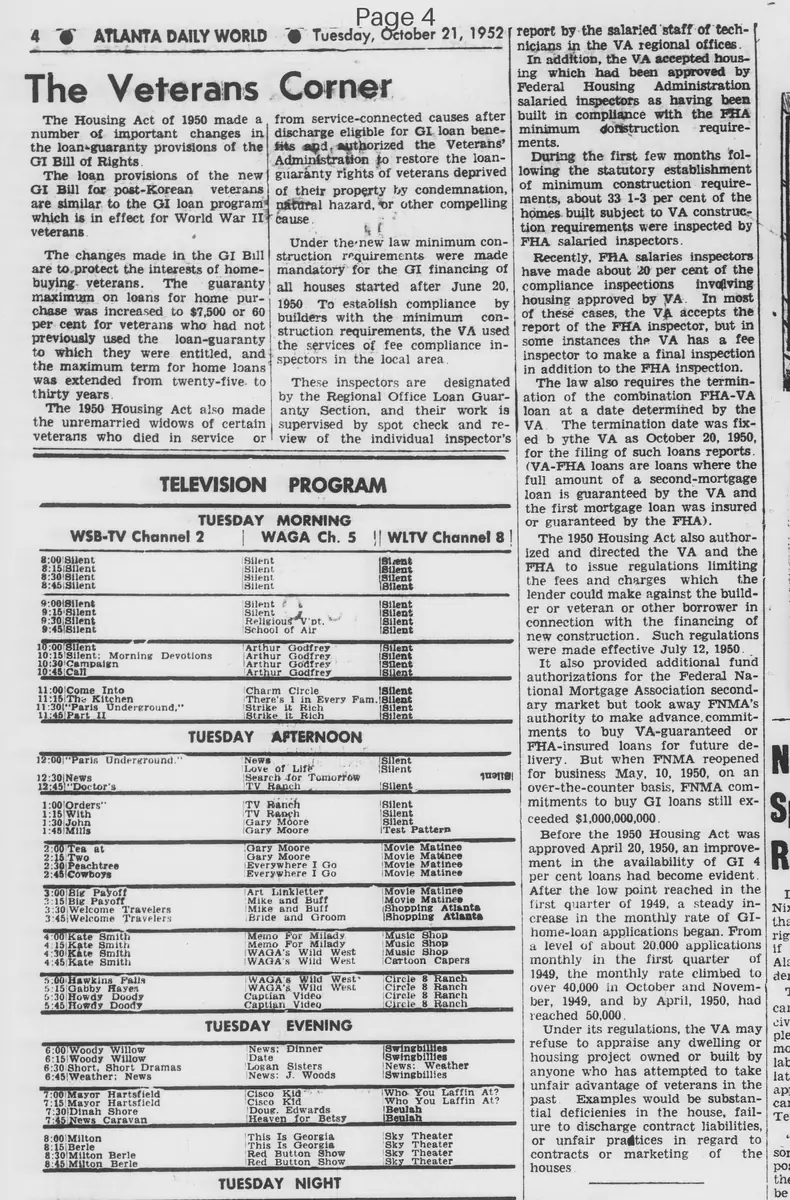
The Housing Act of 1950 made a number of important changes in the loan-guaranty provisions of the GI Bill of Rights.
The loan provisions of the new GI Bill for post-Korean veterans are similar to the GI loan program which is in effect for World War II veterans.
The changes made in the GI Bill are to protect the interests of home buying veterans. The guaranty maximum on loans for home purchase was increased to $7,500 or 60 per cent for veterans who had not previously used the loan-guaranty to which they were entitled, and the maximum term for home loans was extended from twenty-five to thirty years.
The 1950 Housing Act also made the unremarried widows of certain veterans who died in service
Tuesday, October 21, 1952
Corner
from service-connected causes after discharge eligible for GI loan benefits and, authorized the Veterans' Administration to restore the loan-guaranty rights of veterans deprived of their property by condemnation, natural hazard, or other compelling cause.
Under the new law minimum construction requirements were made mandatory for the GI financing of all houses started after June 20, 1950. To establish compliance by builders with the minimum construction requirements, the VA used the services of fee compliance inspectors in the local area.
These inspectors are designated by the Regional Office Loan Guaranty Section, and their work is supervised by spot check and review of the individual inspector's
Report by the salaried technicians in the VA regional offices.
In addition, the VA accepted housing which had been approved by Federal Housing Administration salaried inspectors as having been built in compliance with the FHA minimum construction requirements.
During the first few months following the statutory establishment of minimum construction requirements, about 33 1-3 per cent of the homes built subject to VA construction requirements were inspected by FHA salaried inspectors.
Recently, FHA salaried inspectors have made about 20 per cent of the compliance inspections involving housing approved by VA.
In most of these cases, the VA accepts the report of the FHA inspector, but in some instances the VA has a fee inspector to make a final inspection in addition to the FHA inspection.
The law also requires the termination of the combination FHA-VA loan at a date determined by the VA. The termination date was fixed by the VA as October 20, 1950, for the filing of such loans reports.
(VA-FHA loans are loans where the full amount of a second-mortgage loan is guaranteed by the VA and the first mortgage loan was insured or guaranteed by the FHA).
The 1950 Housing Act also authorized and directed the VA and the FHA to issue regulations limiting the fees and charges which the lender could make against the builder or veteran or other borrower in connection with the financing of new construction. Such regulations were made effective July 12, 1950.
It also provided additional fund authorizations for the Federal National Mortgage Association secondary market but took away FNMA's authority to make advance commitments to buy VA-guaranteed or FHA-insured loans for future delivery. But when FNMA reopened for business May 10, 1950, on an over-the-counter basis, FNMA commitments to buy GI loans still exceeded $1,000,000,000.
Before the 1950 Housing Act was approved April 20, 1950, an improvement in the availability of GI 4 per cent loans had become evident.
After the low point reached in the first quarter of 1949, a steady increase in the monthly rate of GI-home-loan applications began. From a level of about 20,000 applications monthly in the first quarter of 1949, the monthly rate climbed to over 40,000 in October and November 1949, and by April, 1950, had reached 50,000.
Under its regulations, the VA may refuse to appraise any dwelling or housing project owned or built by anyone who has attempted to take unfair advantage of veterans in the past.
Examples would be substantial deficiencies in the house, failure to discharge contract liabilities, or unfair practices in regard to contracts or marketing of the houses.
The Veterans
The Housing Act of 1950 made a number of important changes in the loan-guaranty provisions of the GI Bill of Rights.
The loan provisions of the new GI Bill for post-Korean veterans are similar to the GI loan program which is in effect for World War II veterans.
The changes made in the GI Bill are to protect the interests of home buying veterans. The guaranty maximum on loans for home purchase was increased to $7,500 or 60 per cent for veterans who had not previously used the loan-guaranty to which they were entitled, and the maximum term for home loans was extended from twenty-five to thirty years.
The 1950 Housing Act also made the unremarried widows of certain veterans who died in service
Tuesday, October 21, 1952
Corner
from service-connected causes after discharge eligible for GI loan benefits and, authorized the Veterans' Administration to restore the loan-guaranty rights of veterans deprived of their property by condemnation, natural hazard, or other compelling cause.
Under the new law minimum construction requirements were made mandatory for the GI financing of all houses started after June 20, 1950. To establish compliance by builders with the minimum construction requirements, the VA used the services of fee compliance inspectors in the local area.
These inspectors are designated by the Regional Office Loan Guaranty Section, and their work is supervised by spot check and review of the individual inspector's
Report by the salaried technicians in the VA regional offices.
In addition, the VA accepted housing which had been approved by Federal Housing Administration salaried inspectors as having been built in compliance with the FHA minimum construction requirements.
During the first few months following the statutory establishment of minimum construction requirements, about 33 1-3 per cent of the homes built subject to VA construction requirements were inspected by FHA salaried inspectors.
Recently, FHA salaried inspectors have made about 20 per cent of the compliance inspections involving housing approved by VA.
In most of these cases, the VA accepts the report of the FHA inspector, but in some instances the VA has a fee inspector to make a final inspection in addition to the FHA inspection.
The law also requires the termination of the combination FHA-VA loan at a date determined by the VA. The termination date was fixed by the VA as October 20, 1950, for the filing of such loans reports.
(VA-FHA loans are loans where the full amount of a second-mortgage loan is guaranteed by the VA and the first mortgage loan was insured or guaranteed by the FHA).
The 1950 Housing Act also authorized and directed the VA and the FHA to issue regulations limiting the fees and charges which the lender could make against the builder or veteran or other borrower in connection with the financing of new construction. Such regulations were made effective July 12, 1950.
It also provided additional fund authorizations for the Federal National Mortgage Association secondary market but took away FNMA's authority to make advance commitments to buy VA-guaranteed or FHA-insured loans for future delivery. But when FNMA reopened for business May 10, 1950, on an over-the-counter basis, FNMA commitments to buy GI loans still exceeded $1,000,000,000.
Before the 1950 Housing Act was approved April 20, 1950, an improvement in the availability of GI 4 per cent loans had become evident.
After the low point reached in the first quarter of 1949, a steady increase in the monthly rate of GI-home-loan applications began. From a level of about 20,000 applications monthly in the first quarter of 1949, the monthly rate climbed to over 40,000 in October and November 1949, and by April, 1950, had reached 50,000.
Under its regulations, the VA may refuse to appraise any dwelling or housing project owned or built by anyone who has attempted to take unfair advantage of veterans in the past.
Examples would be substantial deficiencies in the house, failure to discharge contract liabilities, or unfair practices in regard to contracts or marketing of the houses.
What sub-type of article is it?
Historical Event
What themes does it cover?
Justice
Recovery
What keywords are associated?
Gi Bill
Housing Act 1950
Veterans Loans
Fha Va
Construction Requirements
What entities or persons were involved?
Veterans
Unremarried Widows
Story Details
Key Persons
Veterans
Unremarried Widows
Event Date
1950
Story Details
The 1950 Housing Act amended the GI Bill to increase loan guarantees to $7,500 or 60%, extend home loan terms to 30 years, make unremarried widows eligible, restore rights lost due to condemnation or hazards, mandate minimum construction standards, limit fees, and adjust FHA-VA loan terminations.