Thank you for visiting SNEWPapers!
Sign up free
Literary
October 5, 1922
Emmons County Record
Linton, Williamsport, Emmons County, North Dakota
What is this article about?
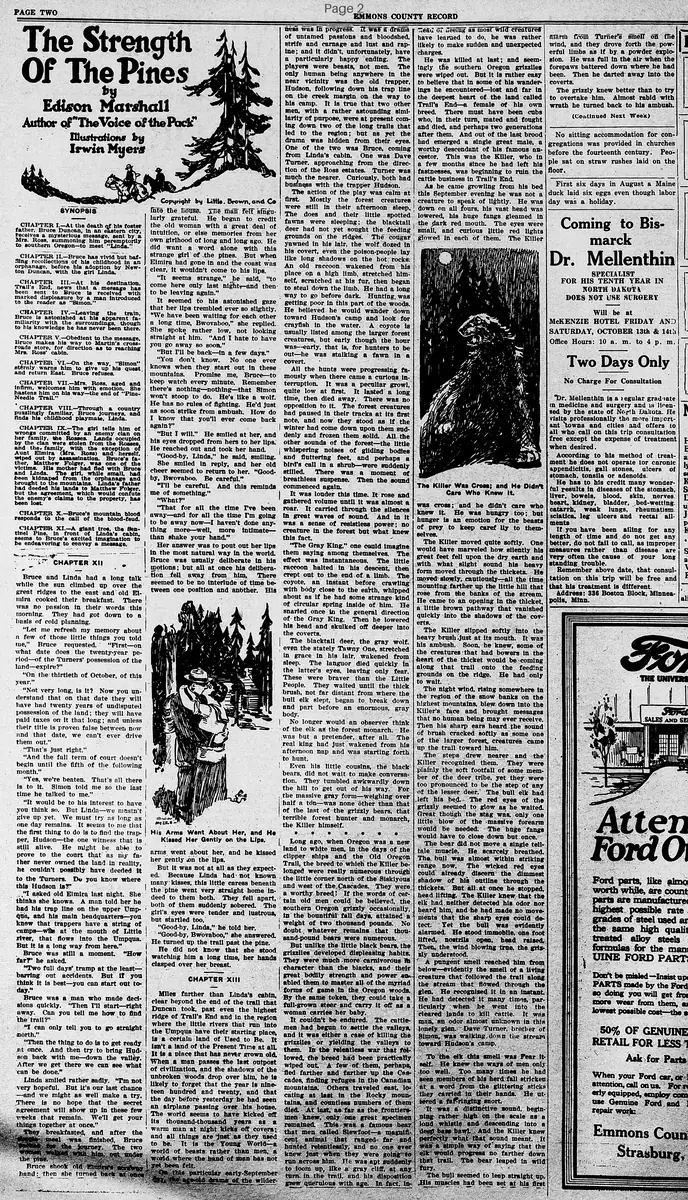
Chapters XII and XIII of 'The Strength of the Pines' by Edison Marshall. Bruce and Linda discuss their plan to find trapper Hudson to challenge the Turners' land claim before the deadline. They share an emotional farewell kiss. Chapter XIII depicts the Oregon wilderness, focusing on a grizzly bear's hunt interrupted by approaching men, including Bruce and Dave Turner, seeking Hudson.
Merged-components note: Merged illustrations into the serialized story 'The Strength of the Pines' based on spatial overlap and sequential reading order.
Clipping
OCR Quality
75%
Good
Full Text
The Strength of the Pines
by
Edison Marshall
Author of "The Voice of the Pack"
Illustrations by
Irwin Myers
SYNOPSIS
CHAPTER I.—At the death of his foster father, Bruce Duncan, in an eastern city, receives a mysterious message, sent by a Mrs. Ross, summoning him peremptorily to southern Oregon—to meet "Linda."
CHAPTER II.—Bruce has vivid but baffling recollections of his childhood in an orphanage, before his adoption by Newton Duncan, with the girl Linda.
CHAPTER III.—At his destination, Trail's End, news that a message has been sent to Bruce is received with marked displeasure by a man introduced to the reader as "Simon."
CHAPTER IV.—Leaving the train, Bruce is astonished at his apparent familiarity with the surroundings, though to his knowledge he has never been there.
CHAPTER V.—Obedient to the message, Bruce makes his way to Martin's cross-roads store, for direction as to reaching Mrs. Ross' cabin.
CHAPTER VI.—On the Way. "Simon" sternly warns him to give up his quest and return East. Bruce refuses.
CHAPTER VII.—Mrs. Ross. Aged and infirm, welcomes him with emotion. She hastens him on his way—the end of "Pine-Needle Trail."
CHAPTER VIII.—Through a country puzzlingly familiar, Bruce journeys, and finds his childhood playmate, Linda.
CHAPTER IX.—The girl tells him of wrongs committed by an enemy clan on her family, the Rosses. Lands occupied by the clan were stolen from the Rosses, and the family, with the exception of Aunt Elmira (Mrs. Ross) and herself, wiped out by assassination. Bruce's father, Matthew Folger, was one of the victims. His mother had fled with Bruce and Linda. The girl, while small, had been kidnapped from the orphanage and brought to the mountains. Linda's father had deeded his lands to Matthew Folger, but the agreement which would confute the enemy's claims to the property has been lost.
CHAPTER X.—Bruce's mountain blood responds to the call of the blood-feud.
CHAPTER XI.—A giant tree, the Sentinel Pine, in front of Linda's cabin, seems to Bruce's excited imagination to be endeavoring to convey a message.
CHAPTER XII
Bruce and Linda had a long talk while the sun climbed up over the great ridges to the east and old Elmira cooked their breakfast. There was no passion in their words this morning. They had got down to a basis of cold planning.
"Let me refresh my memory about a few of those little things you told me," Bruce requested. "First—on what date does the twenty-year period of the Turners' possession of the land expire?"
"On the thirtieth of October, of this year."
"Not very long, is it? Now you understand that on that date they will have had twenty years of undisputed possession of the land; they will have paid taxes on it that long; and unless their title is proven false between now and that date, we can't ever drive them out."
"That's just right."
"And the fall term of court doesn't begin until the fifth of the following month."
"Yes, we're beaten. That's all there is to it. Simon told me so the last time he talked to me."
"It would be to his interest to have you think so. But Linda—we mustn't give up yet. We must try as long as one day remains. It seems to me that the first thing to do is to find the trapper, Hudson—the one witness that is still alive. He might be able to prove to the court that as my father never owned the land in reality, he couldn't possibly have deeded it to the Turners. Do you know where this Hudson is?"
"I asked old Elmira last night. She thinks she knows. A man told her he had his trap line on the upper Umpqua, and his main headquarters—you know that trappers have a string of camps—was at the mouth of Little River, that flows into the Umpqua. But it is a long way from here."
Bruce was still a moment. "How far?" he asked.
"Two full days' tramp at the least—barring out accidents. But if you think it is best—you can start out to-day."
Bruce was a man who made decisions quickly. "Then I'll start right away. Can you tell me how to find the trail?"
"I can only tell you to go straight north."
"Then the thing to do is to get ready at once. And then try to bring Hudson back with me down the valley. After we get there we can see what can be done."
Linda smiled rather sadly. "I'm not very hopeful. But it's our last chance—and we might as well make a try. There is no hope that the secret agreement will show up in these few weeks that remain. We'll get your things together at once."
They breakfasted, and after the meal was finished, Bruce to the journey. The two women were sad under the pine.
Bruce shook old Elmira's hand; then she turned back into the house. The man felt singly grateful. He began to credit the old woman with a great deal of intuition, or else memories from her own girlhood of long and long ago. He did want a word alone with this strange girl of the pines. But when Elmira had gone in and the coast was clear, it wouldn't come to his lips.
"It seems strange," he said, "to come here only last night—and then to be leaving again."
It seemed to his astonished gaze that her lips trembled ever so slightly.
"We have been waiting for each other a long time, Braveheart," she replied.
She spoke rather low, not looking straight at him. "And I hate to have you go away so soon."
"But I'll be back—in a few days."
"You don't know. No one ever knows when they start out in these mountains. Promise me, Bruce—to keep watch every minute. Remember there's nothing—nothing that Simon won't stoop to do. He's like a wolf. He has no rules of fighting. He'd just as soon strike from ambush. How do I know that you'll ever come back again?"
"But I will." He smiled at her, and his eyes dropped from hers to her lips. He reached out and took her hand.
"Good-by, Linda," he said, smiling.
She smiled in reply, and her old cheer seemed to return to her. "Good-by, Braveheart. Be careful."
"I'll be careful. And this reminds me of something."
"What?"
"That for all the time I've been away—and for all the time I'm going to be away now—I haven't done anything more—well, more intimate—than shake your hand."
Her answer was to pout out her lips in the most natural way in the world.
Bruce was usually deliberate in his motions; but all at once his deliberation fell away from him. There seemed to be no interlude of time between one position and another. His arms went about her, and he kissed her gently on the lips.
But it was not at all as they expected. Because Linda had not known many kisses, this little caress beneath the pine went very straight home indeed to them both. They fell apart, both of them suddenly sobered. The girl's eyes were tender and lustrous but startled too.
"Good-by, Linda," he told her.
"Good-by, Braveheart," she answered.
He turned up the trail past the pine. He did not know that she stood watching him a long time, her hands clasped over her breast.
CHAPTER XIII
Miles farther than Linda's cabin clear beyond the end of the trail that Duncan took, past even the highest ridge of Trail's End and in the region where the little rivers that run into the Umpqua have their starting place is a certain land of Used to Be. It isn't a land of the Present Time at all. It is a place that has never grown old. When a man passes the last outpost of civilization, and the shadows of the unbroken woods drop over him, he is likely to forget that the year is nineteen hundred and twenty, and that the day before yesterday he had seen an airplane passing over his house. The world seems to have kicked off its thousand-thousand years as a warm man at night kicks off covers; and all things are just as they used to be. It is the Young World—a world of beasts rather than men, a world where the hand of man has not yet been felt.
On this particular early-September evening old ramrod of the wilderness was in progress. It was a drama of untamed passions and bloodshed strife and carnage and lust and rapine; and it didn't, unfortunately, have a particularly happy ending.
The players were beasts, not men. The only human being anywhere in the near vicinity was the old trapper, Hudson, following down his trap line on the creek margin on the way to his camp. It is true that two other men, with a rather astounding similarity of purpose, were at present coming down—two of the long trails that led to the region; but as yet the drama was hidden from their eyes.
One of the two was Bruce, coming from Linda's cabin. One was Dave Turner, approaching from the direction of the Ross estates. Turner was much the nearer. Curiously, both had business with the trapper Hudson.
The action of the play was calm at first. Mostly the forest creatures were still in their afternoon sleep. The does and their little spotted fawns were sleeping; the blacktail deer had not yet sought the feeding grounds on the ridges. The cougar yawned in his lair, the wolf dozed in his covert, even the poison-people lay like long shadows on the hot rocks.
An old raccoon wakened from his place on a high limb, stretched himself, scratched at his fur, then began to steal down the limb. He had a long way to go before dark. Hunting was getting poor in this part of the woods. He believed he would wander down toward Hudson's camp and look for crayfish in the water. A coyote is usually listed among the larger forest creatures, but early though the hour was—early, that is, for hunters to be out—he was stalking a fawn in a covert.
All the hunts were progressing famously when there came a curious interruption. It was a peculiar growl, quite low at first. It lasted a long time, then died away. There was no opposition to it. The forest creatures had paused in their tracks at its first note, and now they stood as if the winter had come down upon them suddenly and frozen them solid. All the other sounds of the forest—the little whispering noises of gliding bodies and fluttering feet, and perhaps a bird's call in a shrub—were suddenly stilled. There was a moment of breathless suspense. Then the sound commenced again.
It was louder this time. It rose and gathered volume until it was almost a roar. It carried through the silences in great waves of sound. And in it was a sense of resistless power; no creature in the forest but what knew this fact.
"The Gray King," one could imagine them saying among themselves. The effect was instantaneous. The little raccoon halted in his descent, then crept out to the end of a limb. The coyote, an instant before crawling with body close to the earth, whipped about as if he had some strange kind of circular spring inside of him. He snarled once in the general direction of the Gray King. Then he lowered his head and skulked off deeper into the coverts.
The blacktail deer, the gray wolf, even the stately Tawny One, stretched in grace in his lair, wakened from sleep. The languor died quickly in the latter's eyes, leaving only fear. These were braver than the Little People. They waited until the thick brush, not far distant from where the bull elk slept, began to break down and part before an enormous, gray body.
No longer would an observer think of the elk as the forest monarch. He was but a pretender, after all. The real king had just wakened from his afternoon nap and was starting forth to hunt.
Even his little cousins, the black bears, did not wait to make conversation. They tumbled awkwardly down the hill to get out of his way. For the massive gray form—weighing over half a ton—was none other than that of the last of the grizzly bears, that terrible forest hunter and monarch, the Killer himself.
Long ago, when Oregon was a new land to white men in the days of the clipper ships and the Old Oregon Trail, the breed to which the Killer belonged were really numerous through the little corner north of the Siskiyous and west of the Cascades. They were a worthy breed! If the words of certain old men could be believed, the southern Oregon grizzly occasionally, in the bountiful fall days, attained a weight of two thousand pounds. No doubt whatever remains that thousand-pound bears were numerous.
But unlike the little black bears the grizzlies developed displeasing habits. They were much more carnivorous in character than the blacks, and their great bodily strength and power enabled them to master all of the myriad forms of game in the Oregon woods. By the same token they could take a full-grown steer and carry it off as a woman carries her baby.
It couldn't be endured. The cattle men had begun to settle the valleys, and it was either a case of killing the grizzlies or yielding the valleys to them. In the relentless war that followed, the breed had been practically wiped out. A few of them, perhaps, fled farther and farther up the Cascades, finding refuges in the Canadian mountains. Others traveled east, locating at last in the Rocky mountains, and countless numbers of them died. At last as far as the frontier men knew only one great specimen remained. This was a famous bear that men called Slewtusk—a magnificent animal that ranged far and hunted relentlessly—and no one ever knew just when they were going to run across him. He was apt suddenly to loom up, like a gray cliff, at any turn in the trail and his disposition grew querulous with age. In fact, instead of retreating as most wild creatures have learned to do, he was rather likely to make sudden and unexpected charges.
He was killed at last; and seemingly the Southern Oregon grizzlies were wiped out. But it is rather easy to believe that in some of his wanderings he encountered—lost and far in the deepest heart of the land called Trail's End—a female of his own breed. There must have been cubs who, in their turn, mated and fought and died, and perhaps two generations after them. And out of the last brood had emerged a single great male, a worthy descendant of his famous ancestor. This was the Killer, who in a few months since he had left his fastnesses, was beginning to ruin the cattle business in Trail's End.
As he came growling from his bed this September evening he was not a creature to speak of lightly. He was down on all fours, his vast head was lowered, his huge fangs gleamed in the dark red mouth. The eyes were small, and curious little red lights glowed in each of them. The Killer was cross; and he didn't care who knew it. He was hungry too; but hunger is an emotion for the beasts of prey to keep carefully to themselves.
The Killer moved quite softly. One would have marveled how silently his great feet fell upon the dry earth and with what slight sound his heavy form moved through the thickets. He moved slowly, cautiously—all the time mounting farther up the little hill that rose from the banks of the stream.
He came to an opening in the thicket, a little brown pathway that vanished quickly into the shadows of the coverts.
The Killer slipped softly into the heavy brush just at its mouth. It was his ambush. Soon, he knew, some of the creatures that had bowers in the heart of the thicket would be coming along that trail onto the feeding grounds on the ridge. He had only to wait.
The night wind, rising somewhere in the region of the snow banks on the highest mountains, blew down into the Killer's face and brought messages that no human being may ever receive.
Then his sharp ears heard the sound of brush cracked softly as some one of the larger forest creatures came up the trail toward him.
The steps drew nearer and the Killer recognized them. They were plainly the soft footfall of some member of the deer tribe, yet they were too pronounced to be the step of any of the lesser deer. The bull elk had left his bed. The red eyes of the grizzly seemed to glow as he waited. Great though the stag was, only one little blow of the massive forearm would be needed! The huge fangs would have to close down but once.
The bear did not move a single tell-tale muscle. He scarcely breathed. The bull was almost within striking range now. The wicked red eyes could already discern the dimmest shadow of his outline through the thickets. But all at once he stopped, head lifting. The Killer knew that the elk had neither detected his odor nor heard him, and he had made no movements that the sharp eyes could detect. Yet the bull was evidently alarmed. He stood immobile, one foot lifted, nostrils open, head raised.
Then the wind blowing true, the grizzly understood.
A pungent smell reached him from below—evidently the smell of a living creature that followed the trail along the stream that flowed through the glen. He recognized it in an instant. He had detected it many times particularly when he went into the cleared lands to kill cattle. It was man—an odor almost unknown in this lonely glen. Dave Turner, brother of Simon, was walking down the stream toward Hudson's camp.
To the elk this smell was fear itself. He knew the ways of men only too well. Too many times he had seen members of his herd fall—stricken at a word from the glittering sticks they carried in their hands. He uttered a far-ringing snort. It was a distinctive sound, beginning rather high on the scale as a loud whistle and descending into a deep bass bawl. And the Killer knew perfectly what that sound meant. It was a simple way of saying that the elk would progress no farther down that trail. The bear leaped in wild fury.
The bull seemed to leap straight up. His muscles had been set at his first alarm from Turner's smell on the wind, and they drove forth the powerful limbs as if by a powder explosion. He was full in the air when the forepaws battered down where he had been. Then he darted away into the coverts.
The grizzly knew better than to try to overtake him. Almost rabid with wrath he turned back to his ambush.
(Continued Next Week)
by
Edison Marshall
Author of "The Voice of the Pack"
Illustrations by
Irwin Myers
SYNOPSIS
CHAPTER I.—At the death of his foster father, Bruce Duncan, in an eastern city, receives a mysterious message, sent by a Mrs. Ross, summoning him peremptorily to southern Oregon—to meet "Linda."
CHAPTER II.—Bruce has vivid but baffling recollections of his childhood in an orphanage, before his adoption by Newton Duncan, with the girl Linda.
CHAPTER III.—At his destination, Trail's End, news that a message has been sent to Bruce is received with marked displeasure by a man introduced to the reader as "Simon."
CHAPTER IV.—Leaving the train, Bruce is astonished at his apparent familiarity with the surroundings, though to his knowledge he has never been there.
CHAPTER V.—Obedient to the message, Bruce makes his way to Martin's cross-roads store, for direction as to reaching Mrs. Ross' cabin.
CHAPTER VI.—On the Way. "Simon" sternly warns him to give up his quest and return East. Bruce refuses.
CHAPTER VII.—Mrs. Ross. Aged and infirm, welcomes him with emotion. She hastens him on his way—the end of "Pine-Needle Trail."
CHAPTER VIII.—Through a country puzzlingly familiar, Bruce journeys, and finds his childhood playmate, Linda.
CHAPTER IX.—The girl tells him of wrongs committed by an enemy clan on her family, the Rosses. Lands occupied by the clan were stolen from the Rosses, and the family, with the exception of Aunt Elmira (Mrs. Ross) and herself, wiped out by assassination. Bruce's father, Matthew Folger, was one of the victims. His mother had fled with Bruce and Linda. The girl, while small, had been kidnapped from the orphanage and brought to the mountains. Linda's father had deeded his lands to Matthew Folger, but the agreement which would confute the enemy's claims to the property has been lost.
CHAPTER X.—Bruce's mountain blood responds to the call of the blood-feud.
CHAPTER XI.—A giant tree, the Sentinel Pine, in front of Linda's cabin, seems to Bruce's excited imagination to be endeavoring to convey a message.
CHAPTER XII
Bruce and Linda had a long talk while the sun climbed up over the great ridges to the east and old Elmira cooked their breakfast. There was no passion in their words this morning. They had got down to a basis of cold planning.
"Let me refresh my memory about a few of those little things you told me," Bruce requested. "First—on what date does the twenty-year period of the Turners' possession of the land expire?"
"On the thirtieth of October, of this year."
"Not very long, is it? Now you understand that on that date they will have had twenty years of undisputed possession of the land; they will have paid taxes on it that long; and unless their title is proven false between now and that date, we can't ever drive them out."
"That's just right."
"And the fall term of court doesn't begin until the fifth of the following month."
"Yes, we're beaten. That's all there is to it. Simon told me so the last time he talked to me."
"It would be to his interest to have you think so. But Linda—we mustn't give up yet. We must try as long as one day remains. It seems to me that the first thing to do is to find the trapper, Hudson—the one witness that is still alive. He might be able to prove to the court that as my father never owned the land in reality, he couldn't possibly have deeded it to the Turners. Do you know where this Hudson is?"
"I asked old Elmira last night. She thinks she knows. A man told her he had his trap line on the upper Umpqua, and his main headquarters—you know that trappers have a string of camps—was at the mouth of Little River, that flows into the Umpqua. But it is a long way from here."
Bruce was still a moment. "How far?" he asked.
"Two full days' tramp at the least—barring out accidents. But if you think it is best—you can start out to-day."
Bruce was a man who made decisions quickly. "Then I'll start right away. Can you tell me how to find the trail?"
"I can only tell you to go straight north."
"Then the thing to do is to get ready at once. And then try to bring Hudson back with me down the valley. After we get there we can see what can be done."
Linda smiled rather sadly. "I'm not very hopeful. But it's our last chance—and we might as well make a try. There is no hope that the secret agreement will show up in these few weeks that remain. We'll get your things together at once."
They breakfasted, and after the meal was finished, Bruce to the journey. The two women were sad under the pine.
Bruce shook old Elmira's hand; then she turned back into the house. The man felt singly grateful. He began to credit the old woman with a great deal of intuition, or else memories from her own girlhood of long and long ago. He did want a word alone with this strange girl of the pines. But when Elmira had gone in and the coast was clear, it wouldn't come to his lips.
"It seems strange," he said, "to come here only last night—and then to be leaving again."
It seemed to his astonished gaze that her lips trembled ever so slightly.
"We have been waiting for each other a long time, Braveheart," she replied.
She spoke rather low, not looking straight at him. "And I hate to have you go away so soon."
"But I'll be back—in a few days."
"You don't know. No one ever knows when they start out in these mountains. Promise me, Bruce—to keep watch every minute. Remember there's nothing—nothing that Simon won't stoop to do. He's like a wolf. He has no rules of fighting. He'd just as soon strike from ambush. How do I know that you'll ever come back again?"
"But I will." He smiled at her, and his eyes dropped from hers to her lips. He reached out and took her hand.
"Good-by, Linda," he said, smiling.
She smiled in reply, and her old cheer seemed to return to her. "Good-by, Braveheart. Be careful."
"I'll be careful. And this reminds me of something."
"What?"
"That for all the time I've been away—and for all the time I'm going to be away now—I haven't done anything more—well, more intimate—than shake your hand."
Her answer was to pout out her lips in the most natural way in the world.
Bruce was usually deliberate in his motions; but all at once his deliberation fell away from him. There seemed to be no interlude of time between one position and another. His arms went about her, and he kissed her gently on the lips.
But it was not at all as they expected. Because Linda had not known many kisses, this little caress beneath the pine went very straight home indeed to them both. They fell apart, both of them suddenly sobered. The girl's eyes were tender and lustrous but startled too.
"Good-by, Linda," he told her.
"Good-by, Braveheart," she answered.
He turned up the trail past the pine. He did not know that she stood watching him a long time, her hands clasped over her breast.
CHAPTER XIII
Miles farther than Linda's cabin clear beyond the end of the trail that Duncan took, past even the highest ridge of Trail's End and in the region where the little rivers that run into the Umpqua have their starting place is a certain land of Used to Be. It isn't a land of the Present Time at all. It is a place that has never grown old. When a man passes the last outpost of civilization, and the shadows of the unbroken woods drop over him, he is likely to forget that the year is nineteen hundred and twenty, and that the day before yesterday he had seen an airplane passing over his house. The world seems to have kicked off its thousand-thousand years as a warm man at night kicks off covers; and all things are just as they used to be. It is the Young World—a world of beasts rather than men, a world where the hand of man has not yet been felt.
On this particular early-September evening old ramrod of the wilderness was in progress. It was a drama of untamed passions and bloodshed strife and carnage and lust and rapine; and it didn't, unfortunately, have a particularly happy ending.
The players were beasts, not men. The only human being anywhere in the near vicinity was the old trapper, Hudson, following down his trap line on the creek margin on the way to his camp. It is true that two other men, with a rather astounding similarity of purpose, were at present coming down—two of the long trails that led to the region; but as yet the drama was hidden from their eyes.
One of the two was Bruce, coming from Linda's cabin. One was Dave Turner, approaching from the direction of the Ross estates. Turner was much the nearer. Curiously, both had business with the trapper Hudson.
The action of the play was calm at first. Mostly the forest creatures were still in their afternoon sleep. The does and their little spotted fawns were sleeping; the blacktail deer had not yet sought the feeding grounds on the ridges. The cougar yawned in his lair, the wolf dozed in his covert, even the poison-people lay like long shadows on the hot rocks.
An old raccoon wakened from his place on a high limb, stretched himself, scratched at his fur, then began to steal down the limb. He had a long way to go before dark. Hunting was getting poor in this part of the woods. He believed he would wander down toward Hudson's camp and look for crayfish in the water. A coyote is usually listed among the larger forest creatures, but early though the hour was—early, that is, for hunters to be out—he was stalking a fawn in a covert.
All the hunts were progressing famously when there came a curious interruption. It was a peculiar growl, quite low at first. It lasted a long time, then died away. There was no opposition to it. The forest creatures had paused in their tracks at its first note, and now they stood as if the winter had come down upon them suddenly and frozen them solid. All the other sounds of the forest—the little whispering noises of gliding bodies and fluttering feet, and perhaps a bird's call in a shrub—were suddenly stilled. There was a moment of breathless suspense. Then the sound commenced again.
It was louder this time. It rose and gathered volume until it was almost a roar. It carried through the silences in great waves of sound. And in it was a sense of resistless power; no creature in the forest but what knew this fact.
"The Gray King," one could imagine them saying among themselves. The effect was instantaneous. The little raccoon halted in his descent, then crept out to the end of a limb. The coyote, an instant before crawling with body close to the earth, whipped about as if he had some strange kind of circular spring inside of him. He snarled once in the general direction of the Gray King. Then he lowered his head and skulked off deeper into the coverts.
The blacktail deer, the gray wolf, even the stately Tawny One, stretched in grace in his lair, wakened from sleep. The languor died quickly in the latter's eyes, leaving only fear. These were braver than the Little People. They waited until the thick brush, not far distant from where the bull elk slept, began to break down and part before an enormous, gray body.
No longer would an observer think of the elk as the forest monarch. He was but a pretender, after all. The real king had just wakened from his afternoon nap and was starting forth to hunt.
Even his little cousins, the black bears, did not wait to make conversation. They tumbled awkwardly down the hill to get out of his way. For the massive gray form—weighing over half a ton—was none other than that of the last of the grizzly bears, that terrible forest hunter and monarch, the Killer himself.
Long ago, when Oregon was a new land to white men in the days of the clipper ships and the Old Oregon Trail, the breed to which the Killer belonged were really numerous through the little corner north of the Siskiyous and west of the Cascades. They were a worthy breed! If the words of certain old men could be believed, the southern Oregon grizzly occasionally, in the bountiful fall days, attained a weight of two thousand pounds. No doubt whatever remains that thousand-pound bears were numerous.
But unlike the little black bears the grizzlies developed displeasing habits. They were much more carnivorous in character than the blacks, and their great bodily strength and power enabled them to master all of the myriad forms of game in the Oregon woods. By the same token they could take a full-grown steer and carry it off as a woman carries her baby.
It couldn't be endured. The cattle men had begun to settle the valleys, and it was either a case of killing the grizzlies or yielding the valleys to them. In the relentless war that followed, the breed had been practically wiped out. A few of them, perhaps, fled farther and farther up the Cascades, finding refuges in the Canadian mountains. Others traveled east, locating at last in the Rocky mountains, and countless numbers of them died. At last as far as the frontier men knew only one great specimen remained. This was a famous bear that men called Slewtusk—a magnificent animal that ranged far and hunted relentlessly—and no one ever knew just when they were going to run across him. He was apt suddenly to loom up, like a gray cliff, at any turn in the trail and his disposition grew querulous with age. In fact, instead of retreating as most wild creatures have learned to do, he was rather likely to make sudden and unexpected charges.
He was killed at last; and seemingly the Southern Oregon grizzlies were wiped out. But it is rather easy to believe that in some of his wanderings he encountered—lost and far in the deepest heart of the land called Trail's End—a female of his own breed. There must have been cubs who, in their turn, mated and fought and died, and perhaps two generations after them. And out of the last brood had emerged a single great male, a worthy descendant of his famous ancestor. This was the Killer, who in a few months since he had left his fastnesses, was beginning to ruin the cattle business in Trail's End.
As he came growling from his bed this September evening he was not a creature to speak of lightly. He was down on all fours, his vast head was lowered, his huge fangs gleamed in the dark red mouth. The eyes were small, and curious little red lights glowed in each of them. The Killer was cross; and he didn't care who knew it. He was hungry too; but hunger is an emotion for the beasts of prey to keep carefully to themselves.
The Killer moved quite softly. One would have marveled how silently his great feet fell upon the dry earth and with what slight sound his heavy form moved through the thickets. He moved slowly, cautiously—all the time mounting farther up the little hill that rose from the banks of the stream.
He came to an opening in the thicket, a little brown pathway that vanished quickly into the shadows of the coverts.
The Killer slipped softly into the heavy brush just at its mouth. It was his ambush. Soon, he knew, some of the creatures that had bowers in the heart of the thicket would be coming along that trail onto the feeding grounds on the ridge. He had only to wait.
The night wind, rising somewhere in the region of the snow banks on the highest mountains, blew down into the Killer's face and brought messages that no human being may ever receive.
Then his sharp ears heard the sound of brush cracked softly as some one of the larger forest creatures came up the trail toward him.
The steps drew nearer and the Killer recognized them. They were plainly the soft footfall of some member of the deer tribe, yet they were too pronounced to be the step of any of the lesser deer. The bull elk had left his bed. The red eyes of the grizzly seemed to glow as he waited. Great though the stag was, only one little blow of the massive forearm would be needed! The huge fangs would have to close down but once.
The bear did not move a single tell-tale muscle. He scarcely breathed. The bull was almost within striking range now. The wicked red eyes could already discern the dimmest shadow of his outline through the thickets. But all at once he stopped, head lifting. The Killer knew that the elk had neither detected his odor nor heard him, and he had made no movements that the sharp eyes could detect. Yet the bull was evidently alarmed. He stood immobile, one foot lifted, nostrils open, head raised.
Then the wind blowing true, the grizzly understood.
A pungent smell reached him from below—evidently the smell of a living creature that followed the trail along the stream that flowed through the glen. He recognized it in an instant. He had detected it many times particularly when he went into the cleared lands to kill cattle. It was man—an odor almost unknown in this lonely glen. Dave Turner, brother of Simon, was walking down the stream toward Hudson's camp.
To the elk this smell was fear itself. He knew the ways of men only too well. Too many times he had seen members of his herd fall—stricken at a word from the glittering sticks they carried in their hands. He uttered a far-ringing snort. It was a distinctive sound, beginning rather high on the scale as a loud whistle and descending into a deep bass bawl. And the Killer knew perfectly what that sound meant. It was a simple way of saying that the elk would progress no farther down that trail. The bear leaped in wild fury.
The bull seemed to leap straight up. His muscles had been set at his first alarm from Turner's smell on the wind, and they drove forth the powerful limbs as if by a powder explosion. He was full in the air when the forepaws battered down where he had been. Then he darted away into the coverts.
The grizzly knew better than to try to overtake him. Almost rabid with wrath he turned back to his ambush.
(Continued Next Week)
What sub-type of article is it?
Prose Fiction
Journey Narrative
What themes does it cover?
Political
Nature
War Peace
What keywords are associated?
Oregon Wilderness
Blood Feud
Land Dispute
Grizzly Bear
Trap Line
Sentinel Pine
Umpqua River
Trail's End
What entities or persons were involved?
By Edison Marshall
Literary Details
Title
The Strength Of The Pines
Author
By Edison Marshall
Key Lines
"We Have Been Waiting For Each Other A Long Time, Braveheart," She Replied.
"Good By, Linda," He Told Her.
"Good By, Braveheart," She Answered.
It Is The Young World—A World Of Beasts Rather Than Men, A World Where The Hand Of Man Has Not Yet Been Felt.
For The Massive Gray Form—Weighing Over Half A Ton—Was None Other Than That Of The Last Of The Grizzly Bears, That Terrible Forest Hunter And Monarch, The Killer Himself.
The Killer Was Cross; And He Didn't Care Who Knew It. He Was Hungry Too; But Hunger Is An Emotion For The Beasts Of Prey To Keep Carefully To Themselves.