Thank you for visiting SNEWPapers!
Sign up free
Editorial
April 29, 1803
Alexandria Advertiser And Commercial Intelligencer
Alexandria, Virginia
What is this article about?
Federalist Charles H. W. Wharton criticizes Jefferson's appointment of foreigner Albert Gallatin to high office, arguing it insults native Americans, promotes undesirable immigrants, and rewards a suspected rebel from the Western Insurrection. He advocates caution in elevating foreigners without proven loyalty.
Clipping
OCR Quality
98%
Excellent
Full Text
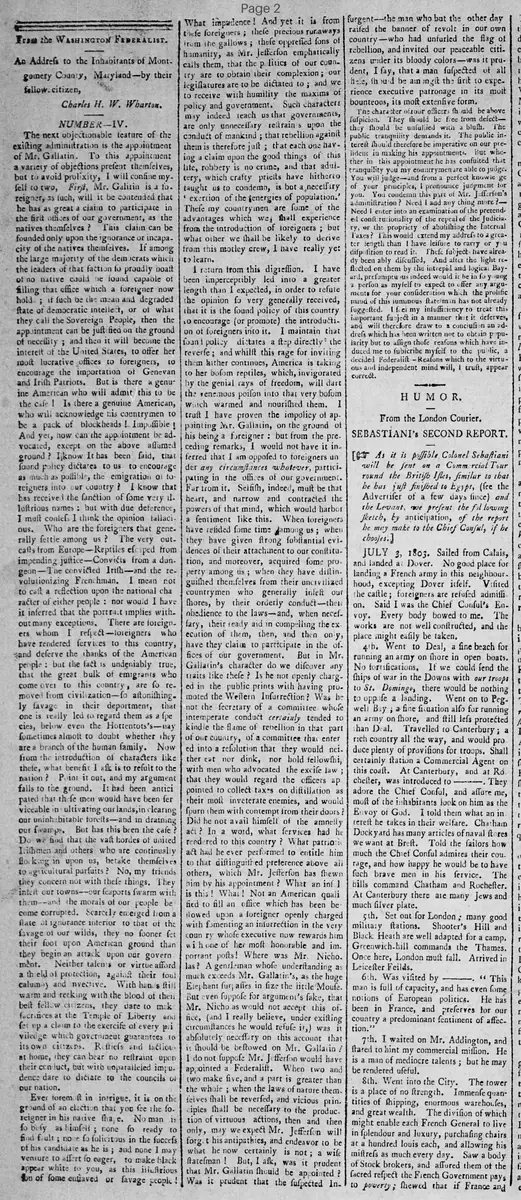
From the Washington Federalist.
An Address to the Inhabitants of Montgomery County, Maryland--by their fellow citizen,
Charles H. W. Wharton.
NUMBER IV.
The next objectionable feature of the existing administration is the appointment of Mr. Gallatin. To this appointment a variety of objections present themselves, but to avoid prolixity, I will confine myself to two. First, Mr. Gallatin is a foreigner, as such, will it be contended that he has as great a claim to participate in the first offices of our government, as the natives themselves? This claim can be founded only upon the ignorance or incapacity of the natives themselves. If among the large majority of the democrats which the leaders of that faction so proudly boast of no native could be found capable of filling that office which a foreigner now holds; if such be the mean and degraded state of democratic intellect, or of what they call the Sovereign People, then the appointment can be justified on the ground of necessity; and then it will become the interest of the United States, to offer her most lucrative offices to foreigners, to encourage the importation of Genevan and Irish Patriots. But is there a genuine American who will admit this to be the case! Is there a genuine American, who will acknowledge his countrymen to be a pack of blockheads! Impossible! And yet, how can the appointment be advocated, except on the above assumed ground? I know it has been said, that sound policy dictates to us to encourage as much as possible, the emigration of foreigners into our country? I know that has received the sanction of some very illustrious names: but with due deference, I must confess I think the opinion fallacious. Who are the foreigners that generally settle among us? The very outcasts from Europe--Reptiles escaped from impending justice--Convicts from a dungeon--The convicted Irish--and the revolutionizing Frenchman. I mean not to cast a reflection upon the national character of either people: nor would I have it inferred that the portrait implies without many exceptions. There are foreigners whom I respect--foreigners who have rendered services to this country, and deserve the thanks of the American people: but the fact is undeniably true, that the great bulk of emigrants who come over to this country, are so removed from civilization--so astonishingly savage in their deportment, that one is really led to regard them as a species, below even the Hottentots--nay sometimes almost to doubt whether they are a branch of the human family. Now from the introduction of characters like these, what benefit I ask is to result to the nation? Point it out, and my argument falls to the ground. It had been anticipated that these men would have been serviceable in cultivating our lands, in clearing our uninhabitable forests--and in draining our swamps. But has this been the case? Do we find that the vast hordes of uniced Irishmen and others who are continually flocking in upon us, betake themselves to agricultural pursuits? No, my friends they concern not with these things. They infest our towns--our seaports swarm with them--and the morals of our people become corrupted. Scarcely emerged from a state of ignorance inferior to that of the Savage of our wilds, they no sooner set their foot upon American ground than they begin an attack upon our government. Neither talents nor virtue afford a shield of protection, against their foul calumny and invective. With hands still warm and reeking with the blood of their best fellow citizens, they dare to make Sacrifices at the Temple of Liberty and Set up a claim to the exercise of every privilege which government guarantees to its own citizens. Refugees and faction at home, they can bear no restraint upon their conduct, but with unparalleled impudence dare to dictate to the councils of our nation.
Ever foremost in intrigue, it is on the ground of an election that you see the foreigner in his native shape. No man is so busy as himself; none so ready to find fault; none so solicitous in the success of his candidate as he is; and none I may venture to assert so eager, to make black appear white to you, as this illustrious son of some enslaved or savage people!
What impudence! And yet it is from these foreigners; these precious runaways from the gallows; these oppressed ones of humanity, as Mr. Jefferson emphatically calls them, that the politics of our country are to obtain their complexion; our legislatures are to be dictated to; and we to receive with humility the maxims of policy and government. Such characters may indeed teach us that governments, are only unnecessary restraints upon the conduct of mankind; that rebellion against them is therefore just; that each one having a claim upon the good things of this life, robbery is no crime, and that adultery, which crafty priests have hitherto taught us to condemn, is but a necessary exertion of the energies of population.' These my countrymen are some of the advantages which we shall experience from the introduction of foreigners: but what other we shall be likely to derive from this motley crew, I have really yet to learn.
I return from this digression. I have been imperceptibly led into a greater length than I expected, in order to refute the opinion so very generally received, that it is the sound policy of this country to encourage (or promote) the introduction of foreigners into it. I maintain that sound policy dictates a step directly the reverse; and whilst this rage for inviting them hither continues, America is taking to her bosom reptiles, which, invigorated by the genial rays of freedom, will dart the venomous poison into that very bosom which warmed and nourished them. I trust I have proven the impolicy of appointing Mr. Gallatin, on the ground of his being a foreigner: but from the preceding remarks, I would not have it inferred that I am opposed to foreigners under any circumstances whatever, participating in the offices of our government. Far from it. Selfish, indeed, must be that heart. and narrow and contracted the powers of that mind, which would harbor a sentiment like this. When foreigners have resided some time among us; when they have given strong substantial evidences of their attachment to our constitution, and moreover, acquired some property among us; when they have distinguished themselves from their uncivilized countrymen who generally infest our shores, by their orderly conduct--their obedience to the laws--and, when necessary, their ready aid in compelling the execution of them, then, and then only, have they claim to participate in the offices of our government. But in Mr. Gallatin's character do we discover any traits like these? Is he not openly charged in the public prints with having promoted the Western Insurrection? Was he not the secretary of a committee whose intemperate conduct certainly tended to kindle the flame of rebellion in that part of our country, of a committee that entered into a resolution that they would neither eat nor drink, nor hold fellowship, with men who advocated the excise law; that they would regard the officers appointed to collect taxes on distillation as their most inveterate enemies, and would spurn them with contempt from their doors? Did he not avail himself of the amnesty act? In a word, what services had he rendered to this country? What patriotic act had he ever performed to entitle him to that distinguished preference above all others, which Mr. Jefferson has shown him by his appointment? What an insult is this! What! Not an American qualified to fill an office which has been bestowed upon a foreigner openly charged with fomenting an insurrection in the very country whose executive now rewards him with one of her most honorable and important posts! Where was Mr. Nicholas? A gentleman whose understanding as much exceeds Mr. Gallatin's, as the huge Elephant surpasses in size the little Mouse. But even suppose for argument's sake, that Mr. Nicholas would not accept this office, (and I really believe, under existing circumstances he would refuse it,) was it absolutely necessary on this account that it should be bestowed on Mr. Gallatin! I do not suppose Mr. Jefferson would have appointed a Federalist. When two and two make five, and a part is greater than the whole; when the laws of nature themselves shall be reversed; and vicious principles shall be necessary to the production of virtuous actions, then and then only, may we expect Mr. Jefferson will forget his antipathies, and endeavor to be what he now certainly is not; a wise statesman! But, I ask, was it prudent that Mr. Gallatin should be appointed? Was it prudent: that urgent--the man who but the other day raised the banner of revolt in our own country--who had unfurled the flag of rebellion, and invited our peaceable citizens under its bloody colors--was it prudent, I say, that a man suspected of all these, should be amongst the first to experience executive patronage in its most bounteous, its most extensive form.
The character of our officers should be above suspicion. They should be free from defect--they should be unsullied with a blush. The public tranquility demands it. The public interest should therefore be imperative on our president in making his appointments. But whether in this appointment he has consulted that tranquility you my countrymen are able to judge. You will judge--and from a perfect knowledge of your principles, I pronounce judgment for you. You condemn this part of Mr. Jefferson's administration? Need I add any thing more?-- Need I enter into an examination of the pretended constitutionality of the repeal of the Judiciary, or the propriety of abolishing the Internal Taxes? This would extend my address to a greater length than I have leisure to carry or you disposition to read it. These subjects have already been ably discussed, And after the light reflected on them by the intrepid and logical Bayard, presumptuous indeed would it be in so young a person as myself to expect to offer any arguments for your consideration which the prolific mind of this luminous statesman has not already suggested. I feel my insufficiency to treat this important subject in a manner that it deserves, and will therefore draw to a conclusion an address which has been written not to obtain popularity but to assign those reasons which have induced me to subscribe myself to the public, a decided Federalist--Reasons which to the virtuous and independent mind will, I trust, appear correct.
An Address to the Inhabitants of Montgomery County, Maryland--by their fellow citizen,
Charles H. W. Wharton.
NUMBER IV.
The next objectionable feature of the existing administration is the appointment of Mr. Gallatin. To this appointment a variety of objections present themselves, but to avoid prolixity, I will confine myself to two. First, Mr. Gallatin is a foreigner, as such, will it be contended that he has as great a claim to participate in the first offices of our government, as the natives themselves? This claim can be founded only upon the ignorance or incapacity of the natives themselves. If among the large majority of the democrats which the leaders of that faction so proudly boast of no native could be found capable of filling that office which a foreigner now holds; if such be the mean and degraded state of democratic intellect, or of what they call the Sovereign People, then the appointment can be justified on the ground of necessity; and then it will become the interest of the United States, to offer her most lucrative offices to foreigners, to encourage the importation of Genevan and Irish Patriots. But is there a genuine American who will admit this to be the case! Is there a genuine American, who will acknowledge his countrymen to be a pack of blockheads! Impossible! And yet, how can the appointment be advocated, except on the above assumed ground? I know it has been said, that sound policy dictates to us to encourage as much as possible, the emigration of foreigners into our country? I know that has received the sanction of some very illustrious names: but with due deference, I must confess I think the opinion fallacious. Who are the foreigners that generally settle among us? The very outcasts from Europe--Reptiles escaped from impending justice--Convicts from a dungeon--The convicted Irish--and the revolutionizing Frenchman. I mean not to cast a reflection upon the national character of either people: nor would I have it inferred that the portrait implies without many exceptions. There are foreigners whom I respect--foreigners who have rendered services to this country, and deserve the thanks of the American people: but the fact is undeniably true, that the great bulk of emigrants who come over to this country, are so removed from civilization--so astonishingly savage in their deportment, that one is really led to regard them as a species, below even the Hottentots--nay sometimes almost to doubt whether they are a branch of the human family. Now from the introduction of characters like these, what benefit I ask is to result to the nation? Point it out, and my argument falls to the ground. It had been anticipated that these men would have been serviceable in cultivating our lands, in clearing our uninhabitable forests--and in draining our swamps. But has this been the case? Do we find that the vast hordes of uniced Irishmen and others who are continually flocking in upon us, betake themselves to agricultural pursuits? No, my friends they concern not with these things. They infest our towns--our seaports swarm with them--and the morals of our people become corrupted. Scarcely emerged from a state of ignorance inferior to that of the Savage of our wilds, they no sooner set their foot upon American ground than they begin an attack upon our government. Neither talents nor virtue afford a shield of protection, against their foul calumny and invective. With hands still warm and reeking with the blood of their best fellow citizens, they dare to make Sacrifices at the Temple of Liberty and Set up a claim to the exercise of every privilege which government guarantees to its own citizens. Refugees and faction at home, they can bear no restraint upon their conduct, but with unparalleled impudence dare to dictate to the councils of our nation.
Ever foremost in intrigue, it is on the ground of an election that you see the foreigner in his native shape. No man is so busy as himself; none so ready to find fault; none so solicitous in the success of his candidate as he is; and none I may venture to assert so eager, to make black appear white to you, as this illustrious son of some enslaved or savage people!
What impudence! And yet it is from these foreigners; these precious runaways from the gallows; these oppressed ones of humanity, as Mr. Jefferson emphatically calls them, that the politics of our country are to obtain their complexion; our legislatures are to be dictated to; and we to receive with humility the maxims of policy and government. Such characters may indeed teach us that governments, are only unnecessary restraints upon the conduct of mankind; that rebellion against them is therefore just; that each one having a claim upon the good things of this life, robbery is no crime, and that adultery, which crafty priests have hitherto taught us to condemn, is but a necessary exertion of the energies of population.' These my countrymen are some of the advantages which we shall experience from the introduction of foreigners: but what other we shall be likely to derive from this motley crew, I have really yet to learn.
I return from this digression. I have been imperceptibly led into a greater length than I expected, in order to refute the opinion so very generally received, that it is the sound policy of this country to encourage (or promote) the introduction of foreigners into it. I maintain that sound policy dictates a step directly the reverse; and whilst this rage for inviting them hither continues, America is taking to her bosom reptiles, which, invigorated by the genial rays of freedom, will dart the venomous poison into that very bosom which warmed and nourished them. I trust I have proven the impolicy of appointing Mr. Gallatin, on the ground of his being a foreigner: but from the preceding remarks, I would not have it inferred that I am opposed to foreigners under any circumstances whatever, participating in the offices of our government. Far from it. Selfish, indeed, must be that heart. and narrow and contracted the powers of that mind, which would harbor a sentiment like this. When foreigners have resided some time among us; when they have given strong substantial evidences of their attachment to our constitution, and moreover, acquired some property among us; when they have distinguished themselves from their uncivilized countrymen who generally infest our shores, by their orderly conduct--their obedience to the laws--and, when necessary, their ready aid in compelling the execution of them, then, and then only, have they claim to participate in the offices of our government. But in Mr. Gallatin's character do we discover any traits like these? Is he not openly charged in the public prints with having promoted the Western Insurrection? Was he not the secretary of a committee whose intemperate conduct certainly tended to kindle the flame of rebellion in that part of our country, of a committee that entered into a resolution that they would neither eat nor drink, nor hold fellowship, with men who advocated the excise law; that they would regard the officers appointed to collect taxes on distillation as their most inveterate enemies, and would spurn them with contempt from their doors? Did he not avail himself of the amnesty act? In a word, what services had he rendered to this country? What patriotic act had he ever performed to entitle him to that distinguished preference above all others, which Mr. Jefferson has shown him by his appointment? What an insult is this! What! Not an American qualified to fill an office which has been bestowed upon a foreigner openly charged with fomenting an insurrection in the very country whose executive now rewards him with one of her most honorable and important posts! Where was Mr. Nicholas? A gentleman whose understanding as much exceeds Mr. Gallatin's, as the huge Elephant surpasses in size the little Mouse. But even suppose for argument's sake, that Mr. Nicholas would not accept this office, (and I really believe, under existing circumstances he would refuse it,) was it absolutely necessary on this account that it should be bestowed on Mr. Gallatin! I do not suppose Mr. Jefferson would have appointed a Federalist. When two and two make five, and a part is greater than the whole; when the laws of nature themselves shall be reversed; and vicious principles shall be necessary to the production of virtuous actions, then and then only, may we expect Mr. Jefferson will forget his antipathies, and endeavor to be what he now certainly is not; a wise statesman! But, I ask, was it prudent that Mr. Gallatin should be appointed? Was it prudent: that urgent--the man who but the other day raised the banner of revolt in our own country--who had unfurled the flag of rebellion, and invited our peaceable citizens under its bloody colors--was it prudent, I say, that a man suspected of all these, should be amongst the first to experience executive patronage in its most bounteous, its most extensive form.
The character of our officers should be above suspicion. They should be free from defect--they should be unsullied with a blush. The public tranquility demands it. The public interest should therefore be imperative on our president in making his appointments. But whether in this appointment he has consulted that tranquility you my countrymen are able to judge. You will judge--and from a perfect knowledge of your principles, I pronounce judgment for you. You condemn this part of Mr. Jefferson's administration? Need I add any thing more?-- Need I enter into an examination of the pretended constitutionality of the repeal of the Judiciary, or the propriety of abolishing the Internal Taxes? This would extend my address to a greater length than I have leisure to carry or you disposition to read it. These subjects have already been ably discussed, And after the light reflected on them by the intrepid and logical Bayard, presumptuous indeed would it be in so young a person as myself to expect to offer any arguments for your consideration which the prolific mind of this luminous statesman has not already suggested. I feel my insufficiency to treat this important subject in a manner that it deserves, and will therefore draw to a conclusion an address which has been written not to obtain popularity but to assign those reasons which have induced me to subscribe myself to the public, a decided Federalist--Reasons which to the virtuous and independent mind will, I trust, appear correct.
What sub-type of article is it?
Partisan Politics
Immigration
What keywords are associated?
Gallatin Appointment
Foreigners In Government
Western Insurrection
Immigration Policy
Federalist Critique
Jefferson Administration
What entities or persons were involved?
Mr. Gallatin
Mr. Jefferson
Charles H. W. Wharton
Mr. Nicholas
Bayard
Editorial Details
Primary Topic
Criticism Of Albert Gallatin's Appointment To Jefferson's Administration
Stance / Tone
Strongly Anti Jefferson And Anti Gallatin Federalist Critique
Key Figures
Mr. Gallatin
Mr. Jefferson
Charles H. W. Wharton
Mr. Nicholas
Bayard
Key Arguments
Gallatin As Foreigner Has No Superior Claim To Native Americans For High Office
Encouraging Immigration Brings Undesirable Outcasts Who Corrupt Society And Politics
Gallatin Suspected Of Promoting Western Insurrection And Opposing Excise Laws
Appointment Insults Qualified Americans Like Mr. Nicholas
Officers Must Be Above Suspicion For Public Tranquility