Thank you for visiting SNEWPapers!
Sign up free
Editorial
August 22, 1827
Literary Cadet And Rhode Island Statesman
Providence, Providence County, Rhode Island
What is this article about?
Satirical piece mocking Andrew Jackson's reaction to Henry Clay's acquittal from corruption charges. Imagines a barbecue and ball at the Hermitage where Jackson and allies drink ironic toasts, with Jackson confessing to spreading falsehoods in a humorous speech.
Merged-components note: Satirical political piece mocking Andrew Jackson; better classified as editorial due to partisan opinion content.
Clipping
OCR Quality
95%
Excellent
Full Text
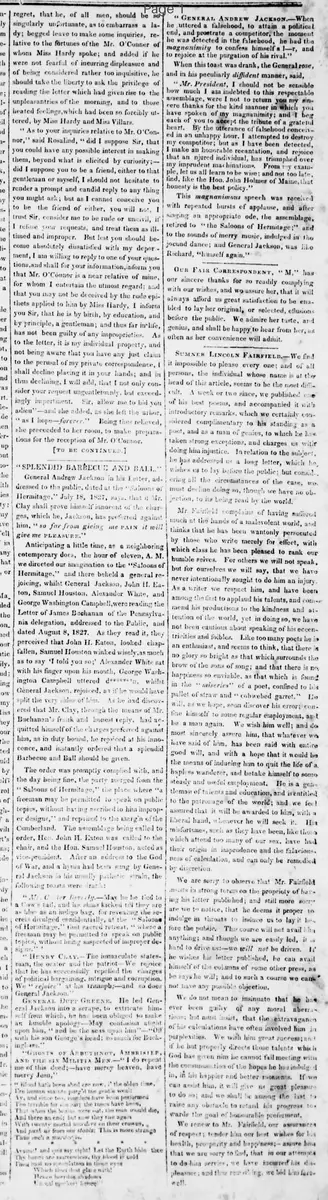
"SPLENDID BARBECUE AND BALL."
General Andrew Jackson in his letter, addressed to the public, dated at the "saloons of Hermitage," July 18, 1827, says, that in case Mr. Clay shall prove himself innocent of the charges, which he, Jackson, has preferred against him, "so far from giving me pain it will give me PLEASURE."
Anticipating a little time, as a neighboring cotemporary does, the hour of eleven, A. M. we directed our imagination to the "Saloons of Hermitage," and there beheld a general rejoicing, whilst General Jackson, John H. Eaton, Samuel Houston, Alexander White, and George Washington Campbell, were reading the Letter of James Buchanan of the Pennsylvania delegation, addressed to the Public, and dated August 8, 1827. As they read it, they perceived that John H. Eaton, looked chapfallen, Samuel Houston winked wisely, as much as to say 'I told you so;' Alexander White sat with his finger upon his mouth, George Washington Campbell uttered damnation, whilst General Jackson, rejoiced, as if he would have split the very sides of him. As he had discovered that Mr. Clay, through the means of Mr. Buchanan's frank and honest reply, had acquitted himself of the charges preferred against him, as in duty bound, he rejoiced at his innocence, and instantly ordered that a splendid Barbecue and Ball should be given.
The order was promptly complied with, and the day being fine, the party merged from the "Saloons of Hermitage," the place where "a freeman may be permitted to speak on public topics, without having ascribed to him improper designs," and repaired to the margin of the Cumberland. The assemblage being called to order, Hon. John H. Eaton was called to the chair, and the Hon. Samuel Houston, acted as vice-president. After an address to the God of War, and a hymn had been sung by General Jackson in his usually pathetic strain, the following toasts were drank:
"Mr. C. ter Beredly.—May he be tied to a Cow's tail, and his shins kicked till they are as blue as an indigo bag, for revealing the secrets divulged confidentially, at the "Saloons of Hermitage," that sacred retreat, "where a freeman may be permitted to speak on public topics, without being suspected of improper designs."
"HENRY CLAY.—The immaculate statesman, the orator and the patriot—We rejoice that he has successfully repelled the charges of political bargaining, intrigue and corruption. We "rejoice" at his triumph;—and so does General Jackson.
"General Duff Green.—He led General Jackson into a scrape, to extricate himself from which, he has been obliged to make an humble apology—May confusion alight upon him, "and be the seas upon him"—Of with his son George's head; so much for Buckingham."
"Ghosts of Arbuthnot, Ambristow, AND THE SIN MILITIA MEN.—"I do repent me of this deed;—have mercy heaven, have mercy Jesu,'"
"Blood hath been shed ere now, i' the olden time.
Ere human statute purged the gentle weal:
Ay, and since too, murders have been performed
Too terrible for the ear: the times have been,
That, when the brains were out, the man would die.
And there an end; but now they rise again
With twenty mortal murders on their crowns,
And push us from our stools: This is more strange
Than such a murder is.
Avaunt! and quit my sight! Let the Earth hide thee
Thy bones are marrowless, thy blood is cold
Thou hast no speculation in those eyes
Which thou dost glare with!
Hence, horrible shadows!
"General Andrew Jackson.—When he uttered a falsehood, to attain a political end, and prostrate a competitor, the moment he was detected in the falsehood, he had the magnanimity to confess himself a liar, and to rejoice at the purgation of his rival."
When this toast was drank, the General rose, and in his peculiarly diffident manner, said, "Mr. President, I should not be sensible how much I am indebted to this respectable assemblage, were I not to return you my sincere thanks for the kind manner in which you have spoken of my magnanimity; and I beg each of you to accept the tribute of a grateful heart. By the utterance of falsehood conceived in an unhappy hour, I attempted to destroy my competitor; but as I have been detected, I make an honorable recantation, and rejoice that an injured individual, has triumphed over my imprudent machinations. From my example, let us all learn to be wise; and not too late, find, like the Hon. John Holmes of Maine, that honesty is the best policy."
This magnanimous speech was received with repeated bursts of applause, and after singing an appropriate ode, the assemblage, retired to "the Saloons of Hermitage;" and to the sounds of merry music, indulged in the jocund dance; and General Jackson, was like Richard, "himself again."
General Andrew Jackson in his letter, addressed to the public, dated at the "saloons of Hermitage," July 18, 1827, says, that in case Mr. Clay shall prove himself innocent of the charges, which he, Jackson, has preferred against him, "so far from giving me pain it will give me PLEASURE."
Anticipating a little time, as a neighboring cotemporary does, the hour of eleven, A. M. we directed our imagination to the "Saloons of Hermitage," and there beheld a general rejoicing, whilst General Jackson, John H. Eaton, Samuel Houston, Alexander White, and George Washington Campbell, were reading the Letter of James Buchanan of the Pennsylvania delegation, addressed to the Public, and dated August 8, 1827. As they read it, they perceived that John H. Eaton, looked chapfallen, Samuel Houston winked wisely, as much as to say 'I told you so;' Alexander White sat with his finger upon his mouth, George Washington Campbell uttered damnation, whilst General Jackson, rejoiced, as if he would have split the very sides of him. As he had discovered that Mr. Clay, through the means of Mr. Buchanan's frank and honest reply, had acquitted himself of the charges preferred against him, as in duty bound, he rejoiced at his innocence, and instantly ordered that a splendid Barbecue and Ball should be given.
The order was promptly complied with, and the day being fine, the party merged from the "Saloons of Hermitage," the place where "a freeman may be permitted to speak on public topics, without having ascribed to him improper designs," and repaired to the margin of the Cumberland. The assemblage being called to order, Hon. John H. Eaton was called to the chair, and the Hon. Samuel Houston, acted as vice-president. After an address to the God of War, and a hymn had been sung by General Jackson in his usually pathetic strain, the following toasts were drank:
"Mr. C. ter Beredly.—May he be tied to a Cow's tail, and his shins kicked till they are as blue as an indigo bag, for revealing the secrets divulged confidentially, at the "Saloons of Hermitage," that sacred retreat, "where a freeman may be permitted to speak on public topics, without being suspected of improper designs."
"HENRY CLAY.—The immaculate statesman, the orator and the patriot—We rejoice that he has successfully repelled the charges of political bargaining, intrigue and corruption. We "rejoice" at his triumph;—and so does General Jackson.
"General Duff Green.—He led General Jackson into a scrape, to extricate himself from which, he has been obliged to make an humble apology—May confusion alight upon him, "and be the seas upon him"—Of with his son George's head; so much for Buckingham."
"Ghosts of Arbuthnot, Ambristow, AND THE SIN MILITIA MEN.—"I do repent me of this deed;—have mercy heaven, have mercy Jesu,'"
"Blood hath been shed ere now, i' the olden time.
Ere human statute purged the gentle weal:
Ay, and since too, murders have been performed
Too terrible for the ear: the times have been,
That, when the brains were out, the man would die.
And there an end; but now they rise again
With twenty mortal murders on their crowns,
And push us from our stools: This is more strange
Than such a murder is.
Avaunt! and quit my sight! Let the Earth hide thee
Thy bones are marrowless, thy blood is cold
Thou hast no speculation in those eyes
Which thou dost glare with!
Hence, horrible shadows!
"General Andrew Jackson.—When he uttered a falsehood, to attain a political end, and prostrate a competitor, the moment he was detected in the falsehood, he had the magnanimity to confess himself a liar, and to rejoice at the purgation of his rival."
When this toast was drank, the General rose, and in his peculiarly diffident manner, said, "Mr. President, I should not be sensible how much I am indebted to this respectable assemblage, were I not to return you my sincere thanks for the kind manner in which you have spoken of my magnanimity; and I beg each of you to accept the tribute of a grateful heart. By the utterance of falsehood conceived in an unhappy hour, I attempted to destroy my competitor; but as I have been detected, I make an honorable recantation, and rejoice that an injured individual, has triumphed over my imprudent machinations. From my example, let us all learn to be wise; and not too late, find, like the Hon. John Holmes of Maine, that honesty is the best policy."
This magnanimous speech was received with repeated bursts of applause, and after singing an appropriate ode, the assemblage, retired to "the Saloons of Hermitage;" and to the sounds of merry music, indulged in the jocund dance; and General Jackson, was like Richard, "himself again."
What sub-type of article is it?
Satire
Partisan Politics
What keywords are associated?
Andrew Jackson
Henry Clay
Political Satire
Bargain And Corruption
Hermitage
Barbecue And Ball
What entities or persons were involved?
Andrew Jackson
Henry Clay
John H. Eaton
Samuel Houston
James Buchanan
Duff Green
Arbuthnot
Ambristow
Editorial Details
Primary Topic
Satirical Mockery Of Andrew Jackson's Accusations Against Henry Clay
Stance / Tone
Mocking And Ironic
Key Figures
Andrew Jackson
Henry Clay
John H. Eaton
Samuel Houston
James Buchanan
Duff Green
Arbuthnot
Ambristow
Key Arguments
Jackson Supposedly Rejoices At Clay's Innocence After Failed Accusations Of Corruption
Ironic Toasts Mocking Political Intrigue And Past Actions
Jackson's Fictional Speech Admitting To Falsehoods For Political Gain