Thank you for visiting SNEWPapers!
Sign up free
The Charleston Daily News
Charleston, Charleston County, South Carolina
What is this article about?
On Sunday night, the 24th instant, freedman Peter Johnson was shot and killed on Bermuda plantation in Christ Church Parish by James Davenport, the colored foreman, due to an old grudge. Davenport confessed and fled. An inquest confirmed the cause of death.
Clipping
OCR Quality
Full Text
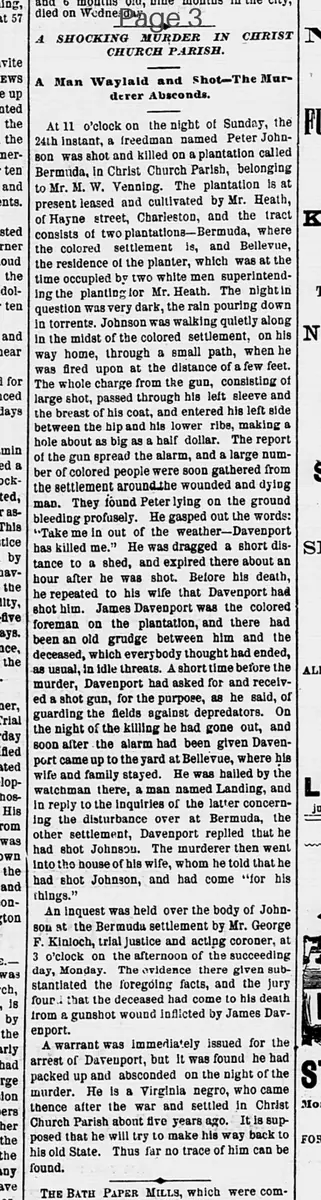
A Man Waylaid and Shot - The Murderer Absconds.
At 11 o'clock on the night of Sunday, the 24th instant, a freedman named Peter Johnson was shot and killed on a plantation called Bermuda, in Christ Church Parish, belonging to Mr. M. W. Venning. The plantation is at present leased and cultivated by Mr. Heath, of Hayne street, Charleston, and the tract consists of two plantations - Bermuda, where the colored settlement is, and Bellevue, the residence of the planter, which was at the time occupied by two white men superintending the planting for Mr. Heath. The night in question was very dark, the rain pouring down in torrents. Johnson was walking quietly along in the midst of the colored settlement, on his way home, through a small path, when he was fired upon at the distance of a few feet. The whole charge from the gun, consisting of large shot, passed through his left sleeve and the breast of his coat, and entered his left side between the hip and his lower ribs, making a hole about as big as a half dollar. The report of the gun spread the alarm, and a large number of colored people were soon gathered from the settlement around the wounded and dying man. They found Peter lying on the ground bleeding profusely. He gasped out the words: "Take me in out of the weather - Davenport has killed me." He was dragged a short distance to a shed, and expired there about an hour after he was shot. Before his death, he repeated to his wife that Davenport had shot him. James Davenport was the colored foreman on the plantation, and there had been an old grudge between him and the deceased, which everybody thought had ended, as usual, in idle threats. A short time before the murder, Davenport had asked for and received a shot gun, for the purpose, as he said, of guarding the fields against depredators. On the night of the killing he had gone out, and soon after the alarm had been given Davenport came up to the yard at Bellevue, where his wife and family stayed. He was hailed by the watchman there, a man named Landing, and in reply to the inquiries of the latter concerning the disturbance over at Bermuda, the other settlement, Davenport replied that he had shot Johnson. The murderer then went into the house of his wife, whom he told that he had shot Johnson, and had come "for his things."
An Inquest was held over the body of Johnson at the Bermuda settlement by Mr. George F. Kinloch, trial Justice and acting coroner, at 3 o'clock on the afternoon of the succeeding day, Monday. The evidence there given substantiated the foregoing facts, and the jury found that the deceased had come to his death from a gunshot wound inflicted by James Davenport.
A warrant was immediately issued for the arrest of Davenport, but it was found he had packed up and absconded on the night of the murder. He is a Virginia negro, who came thence after the war and settled in Christ Church Parish about five years ago. It is supposed that he will try to make his way back to his old State. Thus far no trace of him can be found.
What sub-type of article is it?
What themes does it cover?
What keywords are associated?
What entities or persons were involved?
Where did it happen?
Story Details
Key Persons
Location
Christ Church Parish, Bermuda Plantation
Event Date
Sunday, The 24th Instant
Story Details
Freedman Peter Johnson was waylaid and shot dead by plantation foreman James Davenport on a dark, rainy night while walking home through the colored settlement on Bermuda plantation. Johnson identified Davenport before dying. Davenport, armed with a shotgun for guarding fields, confessed to shooting Johnson and absconded after packing his things. An inquest by George F. Kinloch found Davenport responsible.