Thank you for visiting SNEWPapers!
Sign up free
Literary
June 3, 1833
The National Republican And Cincinnati Daily Mercantile Advertiser
Cincinnati, Hamilton County, Ohio
What is this article about?
This chapter from the Western Monthly Magazine details the early history of Ohio, covering European explorations from Marquette in 1673 to La Salle's expeditions, French and English territorial claims in the mid-18th century, the Ohio Company, conflicts leading to the French and Indian War, and post-Revolution land cessions by Virginia and Connecticut to the U.S. government. It also describes initial settlements in Kentucky and interactions with Ohio Indians, including Captain Bullitt's 1773 diplomatic visit to Chillicothe.
Clipping
OCR Quality
98%
Excellent
Full Text
From the Western Monthly Magazine.
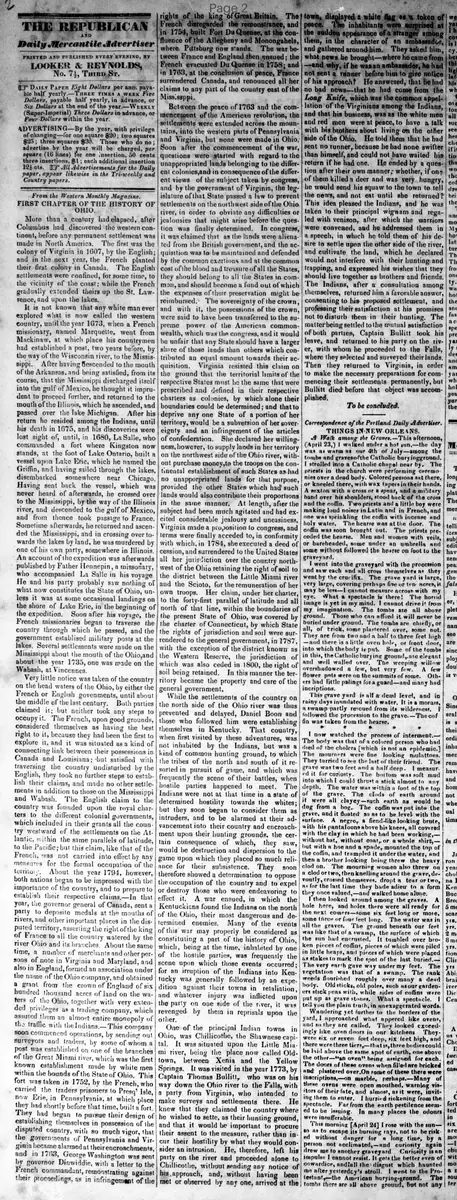
FIRST CHAPTER OF THE HISTORY OF OHIO.
More than a century had elapsed, after Columbus had discovered the western continent, before any permanent settlement was made in North America. The first was the colony of Virginia in 1607, by the English; and in the next year, the French planted their first colony in Canada. The English settlements were confined, for some time, to the vicinity of the coast; while the French gradually extended theirs up the St. Lawrence, and upon the lakes.
It is not known that any white man ever explored what is now called the western country, until the year 1673, when a French missionary, named Marquette, went from Mackinaw, at which place his countrymen had established a post, two years before, by the way of the Wisconsin river, to the Mississippi. After having descended to the mouth of the Arkansas, and being satisfied, from its course, that the Mississippi discharged itself into the gulf of Mexico, he thought it imprudent to proceed further, and returned to the mouth of the Illinois, which he ascended, and passed over the lake Michigan. After his return he resided among the Indians, until his death in 1675, and his discoveries were lost sight of, until, in 1680, LaSalle, who commanded a fort where Kingston now stands, at the foot of Lake Ontario, built a vessel upon Lake Erie, which he named the Griffin, and having sailed through the lakes, disembarked somewhere near Chicago.
Having sent back the vessel, which was never heard of afterwards, he crossed over to the Mississippi, by the way of the Illinois river, and descended to the gulf of Mexico, and from thence took passage to France.
Sometime afterwards, he returned and ascended the Mississippi, and in crossing over towards the lakes by land, he was murdered by one of his own party, somewhere in Illinois.
An account of the expedition was afterwards published by Father Hennepin, a missionary, who accompanied La Salle in his voyage.
He and his party probably saw nothing of what now constitutes the State of Ohio, unless it was at some occasional landings on the shore of Lake Erie, in the beginning of the expedition. Soon after his voyage, the French missionaries began to traverse the country through which he passed, and the government established military posts at the lakes. Several settlements were made on the Mississippi about the mouth of the Ohio, and about the year 1735, one was made on the Wabash, at Vincennes.
Very little notice was taken of the country on the head waters of the Ohio, by either the French or English governments, until about the middle of the last century. Both parties claimed it; but neither took any steps to occupy it. The French, upon good grounds, considered themselves as having the best right to it, because they had been the first to explore it, and it was situated as a kind of connecting link between their possessions in Canada and Louisiana; but satisfied with traversing the country undisturbed by the English, they took no further steps to establish their claims, and made no other settlements in addition to those on the Mississippi and Wabash. The English claim to the country was founded upon the royal charters to the different colonial governments, which included in their grants all the country westward of the settlements on the Atlantic, within the same parallels of latitude, to the Pacific; but this claim, like that of the French, was not carried into effect by any measures for the formal occupation of the territory. About the year 1744, however, both nations began to be impressed with the importance of the country, and to prepare to establish their respective claims. In that year, the governor general of Canada, sent a party to deposite medals at the mouths of rivers, and other important places in the disputed territory, asserting the right of the king of France to all the country watered by the river Ohio and its branches. About the same time, a number of merchants and other persons of note in Virginia and Maryland, and also in England, formed an association under the name of the Ohio company, and obtained a grant from the crown of England of six hundred thousand acres of land on the waters of the Ohio, together with very extended privileges as a trading company, which assured them an almost entire monopoly of the traffic with the Indians. This company soon commenced operations, by sending out surveyors and traders, by some of whom a post was established on one of the branches of the Great Miami river, which was the first known establishment made by white men within the bounds of the State of Ohio. This fort was taken in 1752, by the French, who carried the traders prisoners to Presq' Isle, now Erie, in Pennsylvania, at which place they had shortly before that time, built a fort.
They had began to pursue their design of establishing themselves in possession of the disputed country, with so much vigor, that the governments of Pennsylvania and Virginia became alarmed at their encroachments, and in 1753, George Washington was sent by governor Dinwiddie, with a letter to the French commandant, remonstrating against their proceedings, as in infringement of the rights of the English colonies.
French disregarded the remonstrance, and in 1754, built Fort Du Quesne, at the confluence of the Allegheny and Monongahela, where Pittsburgh now stands. The war between France and England then ensued; the French evacuated Du Quesne in 1758; and in 1763, at the conclusion of peace, France surrendered Canada, and renounced all her claims to any part of the country east of the Mississippi.
Between the peace of 1763 and the commencement of the American revolution, the settlements were extended across the mountains, into the western parts of Pennsylvania and Virginia, but none were made in Ohio.
Soon after the commencement of the war, questions were started with regard to the unappropriated lands belonging to the different colonies, and in consequence of the different views of the subject taken by congress and by the government of Virginia, the legislature of that State passed a law to prevent settlements on the northwest side of the Ohio river, in order to obviate any difficulties or jealousies that might arise before the question was finally determined. In congress, it was claimed that as the lands were alienated from the British government, and the acquisition was to be maintained and defended by the common exertions and at the common cost of the blood and treasure of all the States, they should belong to all the States in common, and should become a fund out of which the expenses of their preservation might be reimbursed. The sovereignty of the crown, and with it, the possessions of the crown, were said to have been transferred to the supreme power of the American commonwealth, which was the congress, and it would be unfair that any State should have a larger share of those lands than others which contributed an equal amount towards their acquisition. Virginia resisted this claim on the ground that the territorial limits of the respective States must be the same that were prescribed and defined in their respective charters as colonies, by which alone their boundaries could be determined; and that to deprive any one State of a portion of her territory, would be a subversion of her sovereignty and an infringement of the articles of confederation. She declared her willingness, however, to supply lands in her territory on the northwest side of the Ohio river, without purchase money, to the troops in the continental establishment of such States as had no unappropriated lands for that purpose, provided the other States which had such lands would also contribute their proportions in the same manner. At length, after the subject had been much agitated and had excited considerable jealousy and uneasiness, Virginia made a proposition to congress, and terms were finally acceded to, in conformity with which, in 1784, she executed a deed of cession, and surrendered to the United States all her jurisdiction over the country northwest of the Ohio retaining the right of soil to the district between the Little Miami river and the Scioto, for the remuneration of her own troops. Her claim, under her charter, to the forty-first parallel of latitude and all north of that line, within the boundaries of the present State of Ohio, was covered by the charter of Connecticut, by which State the rights of jurisdiction and soil were surrendered to the general government, in 1786, with the exception of the district known as the Western Reserve, the jurisdiction of which was also ceded in 1800, the right of soil being retained. In this manner the territory became the property and care of the general government.
While the settlements of the country on the north side of the Ohio river was thus prevented and delayed, Daniel Boone and those who followed him were establishing themselves in Kentucky. That country, when first visited by these adventurers, was not inhabited by the Indians, but was a kind of common hunting ground, to which the tribes of the north and south of it resorted in pursuit of game, and which was frequently the scene of their battles, when hostile parties happened to meet. The Indians were not at that time in a state of determined hostility towards the whites; but they soon began to consider them as intruders, and to be alarmed at their advancement into their country and encroachment upon their hunting grounds, the certain consequence of which, they saw, would be destruction and dispersion to the game upon which they placed so much reliance for their subsistence. They therefore showed a determination to oppose the occupation of the country and to expel or destroy those who were endeavoring to effect it. A war ensued, in which the Kentuckians found the Indians on the north of the Ohio, their most dangerous and determined enemies. Many of the events of this war may properly be considered as constituting a part of the history of Ohio, which, being at the time, inhabited by one of the hostile parties, was frequently the scene upon which those events occurred: for an irruption of the Indians into Kentucky was generally followed by an expedition against their towns in retaliation, and whatever injury was inflicted upon the party on one side of the river, it was revenged by them in reprisals upon the other.
One of the principal Indian towns in Ohio, was Chillicothe, the Shawanese capital. It was situated upon the Little Miami river, being the place now called Old-town, between Xenia and the Yellow Springs. It was visited in the year 1773, by Captain Thomas Bullitt, who was on his way down the Ohio river to the Falls, with a party from Virginia, who intended to make surveys and settlements there. He knew that they claimed the country where he wished to settle, as their hunting ground, and that it would be important to procure their assent to the measure, rather than incur their hostility by what they would consider an intrusion. He, therefore, left his party on the river and proceeded alone to Chillicothe, without sending any notice of his approach, and, without having been met or observed by any one, arrived at the town, displayed a white flag as a token of peace. The inhabitants were surprised at the sudden appearance of a stranger among them, in the character of an ambassador, and gathered around him. They asked him, what news he brought—where he came from—and why, if he was an ambassador, he had not sent a runner before him to give notice of his approach? He answered, that he had no bad news—that he had come from the Long Knife, which was the common appellation of the Virginians among the Indians, and that his business, was as the white men and red men were at peace, to have a talk with his brothers about living on the other side of the Ohio. He told them that he had sent no runner, because he had none swifter than himself, and could not have waited his return if he had one. He ended by a question after their own manner; whether, if one of them killed a deer and was very hungry, he would send his squaw to the town to tell the news, and not eat until she returned?
This idea pleased the Indians, and he was taken to their principal wigwam and regaled with venison, after which the warriors were convened, and he addressed them in a speech, in which he told them of his desire to settle upon the other side of the river, and cultivate the land, which he declared would not interfere with their hunting and trapping, and expressed his wishes that they should live together as brothers and friends.
The Indians, after a consultation among themselves, returned him a favorable answer, consenting to his proposed settlement, and professing their satisfaction at his promises not to disturb them in their hunting. The matter being settled to the mutual satisfaction of both parties, Captain Bullitt took his leave, and returned to his party on the river, with whom he proceeded to the Falls, where they selected and surveyed their lands.
Then they returned to Virginia, in order to make the necessary preparations for commencing their settlements permanently, but Bullitt died before that object was accomplished.
To be continued.
FIRST CHAPTER OF THE HISTORY OF OHIO.
More than a century had elapsed, after Columbus had discovered the western continent, before any permanent settlement was made in North America. The first was the colony of Virginia in 1607, by the English; and in the next year, the French planted their first colony in Canada. The English settlements were confined, for some time, to the vicinity of the coast; while the French gradually extended theirs up the St. Lawrence, and upon the lakes.
It is not known that any white man ever explored what is now called the western country, until the year 1673, when a French missionary, named Marquette, went from Mackinaw, at which place his countrymen had established a post, two years before, by the way of the Wisconsin river, to the Mississippi. After having descended to the mouth of the Arkansas, and being satisfied, from its course, that the Mississippi discharged itself into the gulf of Mexico, he thought it imprudent to proceed further, and returned to the mouth of the Illinois, which he ascended, and passed over the lake Michigan. After his return he resided among the Indians, until his death in 1675, and his discoveries were lost sight of, until, in 1680, LaSalle, who commanded a fort where Kingston now stands, at the foot of Lake Ontario, built a vessel upon Lake Erie, which he named the Griffin, and having sailed through the lakes, disembarked somewhere near Chicago.
Having sent back the vessel, which was never heard of afterwards, he crossed over to the Mississippi, by the way of the Illinois river, and descended to the gulf of Mexico, and from thence took passage to France.
Sometime afterwards, he returned and ascended the Mississippi, and in crossing over towards the lakes by land, he was murdered by one of his own party, somewhere in Illinois.
An account of the expedition was afterwards published by Father Hennepin, a missionary, who accompanied La Salle in his voyage.
He and his party probably saw nothing of what now constitutes the State of Ohio, unless it was at some occasional landings on the shore of Lake Erie, in the beginning of the expedition. Soon after his voyage, the French missionaries began to traverse the country through which he passed, and the government established military posts at the lakes. Several settlements were made on the Mississippi about the mouth of the Ohio, and about the year 1735, one was made on the Wabash, at Vincennes.
Very little notice was taken of the country on the head waters of the Ohio, by either the French or English governments, until about the middle of the last century. Both parties claimed it; but neither took any steps to occupy it. The French, upon good grounds, considered themselves as having the best right to it, because they had been the first to explore it, and it was situated as a kind of connecting link between their possessions in Canada and Louisiana; but satisfied with traversing the country undisturbed by the English, they took no further steps to establish their claims, and made no other settlements in addition to those on the Mississippi and Wabash. The English claim to the country was founded upon the royal charters to the different colonial governments, which included in their grants all the country westward of the settlements on the Atlantic, within the same parallels of latitude, to the Pacific; but this claim, like that of the French, was not carried into effect by any measures for the formal occupation of the territory. About the year 1744, however, both nations began to be impressed with the importance of the country, and to prepare to establish their respective claims. In that year, the governor general of Canada, sent a party to deposite medals at the mouths of rivers, and other important places in the disputed territory, asserting the right of the king of France to all the country watered by the river Ohio and its branches. About the same time, a number of merchants and other persons of note in Virginia and Maryland, and also in England, formed an association under the name of the Ohio company, and obtained a grant from the crown of England of six hundred thousand acres of land on the waters of the Ohio, together with very extended privileges as a trading company, which assured them an almost entire monopoly of the traffic with the Indians. This company soon commenced operations, by sending out surveyors and traders, by some of whom a post was established on one of the branches of the Great Miami river, which was the first known establishment made by white men within the bounds of the State of Ohio. This fort was taken in 1752, by the French, who carried the traders prisoners to Presq' Isle, now Erie, in Pennsylvania, at which place they had shortly before that time, built a fort.
They had began to pursue their design of establishing themselves in possession of the disputed country, with so much vigor, that the governments of Pennsylvania and Virginia became alarmed at their encroachments, and in 1753, George Washington was sent by governor Dinwiddie, with a letter to the French commandant, remonstrating against their proceedings, as in infringement of the rights of the English colonies.
French disregarded the remonstrance, and in 1754, built Fort Du Quesne, at the confluence of the Allegheny and Monongahela, where Pittsburgh now stands. The war between France and England then ensued; the French evacuated Du Quesne in 1758; and in 1763, at the conclusion of peace, France surrendered Canada, and renounced all her claims to any part of the country east of the Mississippi.
Between the peace of 1763 and the commencement of the American revolution, the settlements were extended across the mountains, into the western parts of Pennsylvania and Virginia, but none were made in Ohio.
Soon after the commencement of the war, questions were started with regard to the unappropriated lands belonging to the different colonies, and in consequence of the different views of the subject taken by congress and by the government of Virginia, the legislature of that State passed a law to prevent settlements on the northwest side of the Ohio river, in order to obviate any difficulties or jealousies that might arise before the question was finally determined. In congress, it was claimed that as the lands were alienated from the British government, and the acquisition was to be maintained and defended by the common exertions and at the common cost of the blood and treasure of all the States, they should belong to all the States in common, and should become a fund out of which the expenses of their preservation might be reimbursed. The sovereignty of the crown, and with it, the possessions of the crown, were said to have been transferred to the supreme power of the American commonwealth, which was the congress, and it would be unfair that any State should have a larger share of those lands than others which contributed an equal amount towards their acquisition. Virginia resisted this claim on the ground that the territorial limits of the respective States must be the same that were prescribed and defined in their respective charters as colonies, by which alone their boundaries could be determined; and that to deprive any one State of a portion of her territory, would be a subversion of her sovereignty and an infringement of the articles of confederation. She declared her willingness, however, to supply lands in her territory on the northwest side of the Ohio river, without purchase money, to the troops in the continental establishment of such States as had no unappropriated lands for that purpose, provided the other States which had such lands would also contribute their proportions in the same manner. At length, after the subject had been much agitated and had excited considerable jealousy and uneasiness, Virginia made a proposition to congress, and terms were finally acceded to, in conformity with which, in 1784, she executed a deed of cession, and surrendered to the United States all her jurisdiction over the country northwest of the Ohio retaining the right of soil to the district between the Little Miami river and the Scioto, for the remuneration of her own troops. Her claim, under her charter, to the forty-first parallel of latitude and all north of that line, within the boundaries of the present State of Ohio, was covered by the charter of Connecticut, by which State the rights of jurisdiction and soil were surrendered to the general government, in 1786, with the exception of the district known as the Western Reserve, the jurisdiction of which was also ceded in 1800, the right of soil being retained. In this manner the territory became the property and care of the general government.
While the settlements of the country on the north side of the Ohio river was thus prevented and delayed, Daniel Boone and those who followed him were establishing themselves in Kentucky. That country, when first visited by these adventurers, was not inhabited by the Indians, but was a kind of common hunting ground, to which the tribes of the north and south of it resorted in pursuit of game, and which was frequently the scene of their battles, when hostile parties happened to meet. The Indians were not at that time in a state of determined hostility towards the whites; but they soon began to consider them as intruders, and to be alarmed at their advancement into their country and encroachment upon their hunting grounds, the certain consequence of which, they saw, would be destruction and dispersion to the game upon which they placed so much reliance for their subsistence. They therefore showed a determination to oppose the occupation of the country and to expel or destroy those who were endeavoring to effect it. A war ensued, in which the Kentuckians found the Indians on the north of the Ohio, their most dangerous and determined enemies. Many of the events of this war may properly be considered as constituting a part of the history of Ohio, which, being at the time, inhabited by one of the hostile parties, was frequently the scene upon which those events occurred: for an irruption of the Indians into Kentucky was generally followed by an expedition against their towns in retaliation, and whatever injury was inflicted upon the party on one side of the river, it was revenged by them in reprisals upon the other.
One of the principal Indian towns in Ohio, was Chillicothe, the Shawanese capital. It was situated upon the Little Miami river, being the place now called Old-town, between Xenia and the Yellow Springs. It was visited in the year 1773, by Captain Thomas Bullitt, who was on his way down the Ohio river to the Falls, with a party from Virginia, who intended to make surveys and settlements there. He knew that they claimed the country where he wished to settle, as their hunting ground, and that it would be important to procure their assent to the measure, rather than incur their hostility by what they would consider an intrusion. He, therefore, left his party on the river and proceeded alone to Chillicothe, without sending any notice of his approach, and, without having been met or observed by any one, arrived at the town, displayed a white flag as a token of peace. The inhabitants were surprised at the sudden appearance of a stranger among them, in the character of an ambassador, and gathered around him. They asked him, what news he brought—where he came from—and why, if he was an ambassador, he had not sent a runner before him to give notice of his approach? He answered, that he had no bad news—that he had come from the Long Knife, which was the common appellation of the Virginians among the Indians, and that his business, was as the white men and red men were at peace, to have a talk with his brothers about living on the other side of the Ohio. He told them that he had sent no runner, because he had none swifter than himself, and could not have waited his return if he had one. He ended by a question after their own manner; whether, if one of them killed a deer and was very hungry, he would send his squaw to the town to tell the news, and not eat until she returned?
This idea pleased the Indians, and he was taken to their principal wigwam and regaled with venison, after which the warriors were convened, and he addressed them in a speech, in which he told them of his desire to settle upon the other side of the river, and cultivate the land, which he declared would not interfere with their hunting and trapping, and expressed his wishes that they should live together as brothers and friends.
The Indians, after a consultation among themselves, returned him a favorable answer, consenting to his proposed settlement, and professing their satisfaction at his promises not to disturb them in their hunting. The matter being settled to the mutual satisfaction of both parties, Captain Bullitt took his leave, and returned to his party on the river, with whom he proceeded to the Falls, where they selected and surveyed their lands.
Then they returned to Virginia, in order to make the necessary preparations for commencing their settlements permanently, but Bullitt died before that object was accomplished.
To be continued.
What sub-type of article is it?
Essay
What themes does it cover?
Political
War Peace
What keywords are associated?
Ohio History
French Exploration
English Claims
Ohio Company
Indian Diplomacy
Land Cession
Kentucky Settlement
What entities or persons were involved?
From The Western Monthly Magazine.
Literary Details
Title
First Chapter Of The History Of Ohio.
Author
From The Western Monthly Magazine.
Form / Style
Historical Narrative In Prose