Thank you for visiting SNEWPapers!
Sign up free
The Minnesota Pioneer
Saint Paul, Ramsey County, Minnesota
What is this article about?
Winnebago chiefs, including Dekora and Winnishik, confer with Governor Ramsey and agent Gen. Fletcher in Saint Paul on March 14, complaining of poverty, hunting restrictions by Sioux and Chippewas, and unfulfilled annuities. Officials advise self-reliance, farming, and remaining in their territory.
Clipping
OCR Quality
Full Text
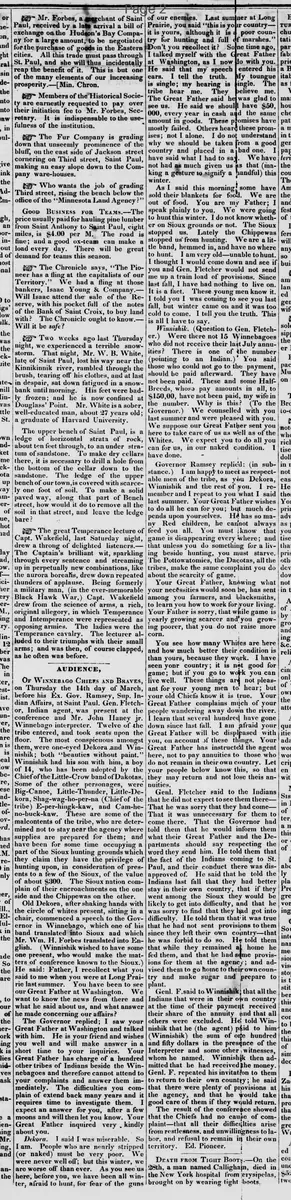
Of Winnebago Chiefs And Braves, on Thursday the 14th day of March before his Ex. Gov. Ramsey, Sup. Indian Affairs, at Saint Paul. Gen. Fletcher, Indian agent, was present at the conference and Mr. John Haney jr. Winnebago interpreter. Twelve of the tribe entered, and took seats upon the floor. The most conspicuous amongst them, were one-eyed Dekora and Winnishik: both "beauties without paint." Winnishik had his son with him, a boy of 14. who has been adopted by the Chief of the Little-Crow band of Dakotas. Some of the other personages, were Big-Canoe. Little-Thunder, Little-Dekora, Shag-wag-ho-per-na (Chief of the tribe) E-per-hingk-kaw, and Cam-he-no-buck-kaw. These are some of the malcontents of the tribe, who are determined not to stay near the agency where supplies are prepared for them; and have been for some time occupying a part of the Sioux hunting grounds which they claim they have the privilege of hunting upon, in consideration of presents to a few of the Sioux, of the value of about $300. The Sioux nation complain of their encroachments on the one side and the Chippewas on the other.
Old Dekora. after shaking hands with the circle of whites present, sitting in a chair, commenced a speech to the Governor in Winnebago, which one of his band translated into Sioux and which Mr. Wm. H. Forbes translated into English. (Winnishik wished to have some one present, who would make the matters of conference known to the Sioux. He said: Father, I recollect what you said to me when you were at Long Prairie last summer. You have been to see our Great Father at Washington. We want to know the news from there and what he said about us, and what answer he made concerning our affairs?
The Governor replied; I saw your Great Father at Washington and talked with him. He is your friend and wishes you well and will make answer in a short time to your inquiries. Your Great Father has charge of a hundred other tribes of Indians beside the Winnebagoes and therefore cannot attend to your complaints and answer them immediately. The difficulties you complain of extend back many years and it requires time to investigate them. I expect an answer for you, after a few moons and will then let you know. Your Great Father inquired very kindly about you.
Dekora. I said I was miserable. So I am. People who are nearly stripped (or naked) must be very poor. We were never well off; but this winter, we are worse off than ever. As you see us here, before you, we have been all winter, afraid to hunt, for fear of the guns of our enemies. Last summer at Long Prairie, you said 'this is your country it is yours, although it is a poor country for hunting and full of marshes." Don't you recollect it? Some time ago. I talked myself with the Great Father at Washington, as I now do with you. He said that my speech entered his ears. I tell the truth. My tongue is single; my hearing is single. The tribe hear me. They believe me. The Great Father said he was glad to see us. He said we should have $50,000, every year in cash and the same amount in goods. These promises have mostly failed. Others heard these promises; not I alone. I do not understand why we should be taken from a good country and placed in a bad one. I have said what I had to say.
We have not had as much given us as that (making a gesture to signify a handful) this winter. As I said this morning. some have sold their blankets for food. We are out of food. You are my Father; I speak plainly to you. We were going to hunt this winter. I do not know whether on Sioux grounds or not. The Sioux stopped us. Lately the Chippewas stopped us from hunting. We are a little band, hemmed in, and have no where to hunt. I am very old-unable to hunt. I thought I would come down and see if you and Gen. Fletcher would not send me up a train load of provisions. Since last fall. I have had nothing to live on. It is a fact. These young men know it. I told you I was coming to see you last fall, but winter came on and it was too cold to come. I tell you the truth. This is all I have to say.
Winnishik. (Question to Gen. Fletcher.) Were there not 15 Winnebagoes who did not receive their last July annuities? There is one of the number (pointing to an Indian.)' You said those who could not go to the payment, should be paid afterward. They have not been paid. These and some Half-Breeds, whose pay amounts in all, to $150,00, have not been paid, my wife in the number. Why is this? (To the Governor.) We counselled with you last summer and were pleased with you. We suppose our Great Father sent you here to take care of us as well as of the Whites. We expect you to do all you can for us, in our naked condition. I have done.
Governor Ramsey replied: (in substance.) I am happy to meet as respectable men of the tribe, as you Dekora, Winnishik and the rest of you. I remember and I repeat to you what I said last summer. Your Great Father wishes to do all he can for you; but much depends upon yourselves. He has so many Red children, he cannot always feed you all. You must know that game is disappearing every where; and that unless you do something for a living beside hunting, you must starve. The Pottowatomies, the Dacotas, all the tribes, make the same complaint you do about the scarcity of game.
Your Great Father, knowing what your necessities would soon be, has sent among you farmers, and blacksmiths, to learn you how to work for your living. Your Father is sorry, that while game is yearly growing scarcer and you growing poorer, that you do not raise more corn.
You see how many Whites are here and how much better their condition is than yours, because they work. I have seen your country; it is not good for game; but if you go to work you can live well. These things are not pleasant for your young men to hear; but your old Chiefs know it is true. Your Great Father complains much of your people wandering away down the river. I learn that several hundred have gone down since last fall. I am afraid your Great Father will be displeased with you, on account of these things. Your Great Father has instructed the agent here, not to pay annuities to those who do not remain in their own country. Let your people below know this, so that they may return and not lose their annuities.
Genl. Fletcher said to the Indians that he did not expect to see them there- That he was sorry that they had come- That it was unnecessary for them to come there. That the Governor had told them that he would inform them what their Great Father and the Departments should say respecting the word they send him. He told them that the fact of the Indians coming to St. Paul, and their conduct there was disapproved of. He said that he told the Indians last fall that they had better stay in their own country, that if they went among the Sioux they would be likely to get into difficulty, and that he was sorry to find that they had got into difficulty. He told them that it was true that he had not sent provisions to them since they left their own country-that he was forbid to do so. He told them that while they remained at home he fed them, and that he had some provisions for them at the agency; and advised them to go home to their own country and make sugar and prepare to plant.
Genl. F. said to Winnishik that all the Indians that were in their own country at the time of their payment received their share of the annuity And that all others were excluded. He told Winnishik that he (the agent) paid to him (Winnishik) the sum of one hundred and fifty dollars in the presence of the Interpreter and some other witnesses, whom he named. Winnishik then admitted that he had received the money.
Genl. F. repeated his invitation to them to return to their own country; he said that there were plenty of provisions at the agency, and that he would take good care of them if they would return.
The result of the conference showed that the Chiefs had no cause of complaint-that all their difficulties arise from restlessness, and unwillingness to labor. and refusal to remain in their own territory. Ed. Pioneer.
What sub-type of article is it?
What themes does it cover?
What keywords are associated?
What entities or persons were involved?
Where did it happen?
Story Details
Key Persons
Location
Saint Paul
Event Date
Thursday The 14th Day Of March
Story Details
Winnebago chiefs and braves, led by Dekora and Winnishik, meet Governor Ramsey and agent Gen. Fletcher in Saint Paul to complain about extreme poverty, fear of hunting due to Sioux and Chippewa threats, unfulfilled annuity promises from the Great Father, and lack of provisions. They request food and payment for missed annuities. Officials explain delays, urge the tribe to farm, work, and stay in their assigned territory to receive aid, noting that wandering leads to exclusion from annuities.