Thank you for visiting SNEWPapers!
Sign up free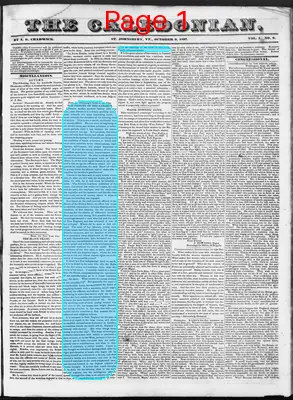
Letter to Editor
October 3, 1837
The Caledonian
Saint Johnsbury, Caledonia County, Vermont
What is this article about?
Excerpt from Dr. Channing's letter to Mr. Clay argues for the elevation of laborers in modern society, contrasting free labor in New England with slavery in the South, and asserts America's mission to promote human dignity through liberty.
Clipping
OCR Quality
95%
Excellent
Full Text
From Dr. Channing's Letter to Mr. Clay.
THE DIGNITY OF THE LABORER.
Whoever studies modern history with any care, must discern in it a steady growing movement towards one most interesting result. I mean towards the elevation of the laboring class of society. This is not a recent, accidental turn in human affairs. We can trace its beginning in the feudal times, and its slow advances in subsequent periods, until it has become the master movement of our age. Is it not plain, that those who toil with their hands, and whose productive industry is the spring of all wealth, are rising from the condition of beasts of burden, to which they were once reduced; to the consciousness, intelligence, self-respect, and proper happiness of men? Is it not the strong tendency of our times to diffuse among the many improvements once confined to the few? He who overlooks this has no comprehension of the great work of Providence, or of the most signal feature of his times; and is this an age for efforts to extend and perpetuate an institution, the very object of which is to keep down the laborer, and to make him a machine for another's gratification?
I know it has been said in reply to such views, that, do what we will with the laborer, I call him what we will, he is and must be in reality, a slave. The doctrine has been published at the south, that nature has made two classes, the rich and the poor, the employer and the employed, the capitalist and the operative, and that the class who work, are to all intents, slaves to those in whose services they are engaged.
In a report on the mail, recently offered to the Senate of the United States, an effort was made to establish resemblance between Slavery and the condition of free laborers, for the purpose of showing that the shades of difference between them are not very strong. Is it possible that such reasonings escaped a man who has trod the soil of New England, and was educated at one of her colleges? Whom did he meet at that college? The sons of her laborers, young men, whose hands had been hardened at the plough. Does he not know, that the families of laborers have furnished every department in life among us with illustrious men, have furnished our heroes in war, our statesmen in council, our orators in the pulpit and at the bar, our merchants, whose enterprises embrace the whole earth? What! the laborer of the free state a slave, and to be ranked with the despised negro, whom the lash drives to toil, and whose dearest rights are at the mercy of irresponsible power?
If there is a firm independent spirit on earth, it is to be found in the man who tills the fields of the free states, and moistens them with the sweat of his brow. I recently heard of a visitor from the South, compassionating the operatives of our manufactories, as in a worse condition than the slave. What carries the young woman to the manufactory? Not generally the want of a comfortable home, but sometimes the desire of supplying herself with a wardrobe, which ought to satisfy the affluent, and oftener the desire of furnishing in more than decent style the home where she is to sustain the nearest relations, and perform the most sacred duties of life. Generally speaking, each of these young women has her plan of life, her hopes, and bright dreams, her spring of action in her own free will—and amidst toil she contrives to find seasons for intellectual and religious culture.
It is common in New England for the sons of farmers to repair to the large towns, and there to establish themselves as domestics in families, a condition which the south will be disposed to identify with slavery. But what brings these young men to the city? The hope of earning in a shorter time a sum with which to purchase a farm at home, or in the West, perhaps to become traders; and in these vocations they not unfrequently rise to consideration, and what in their place of residence is called wealth. I have in my thought an individual distinguished alike by vigor and elevation of mind, who began life by hiring himself as a laborer to a farmer, and then entered a family as a domestic; and now is the honored associate of the most enlightened men, and devotes himself to the highest subjects of human thought. It is true that much remains to be done for the laboring class in the most favored regions; but the intelligence already spread through this class, is an earnest of brighter days, of the most glorious revolution in history, of the elevation of the mass of men to the dignity of human beings.
It is the great mission of this country to forward this revolution, and never was a sublimer work committed to a nation. Our mission is to elevate society through all its conditions, to secure every human being the means of progress, to substitute the Government of laws for that of irresponsible individuals, to prove that under popular institutions, the people may be carried forward, that the multitude who toil are capable of enjoying the noblest blessings of the social state. The prejudice, that labor is degradation, one of the worst principles handed down from barbarous ages, is to receive here a practical refutation.—The power of liberty is to raise up the whole people, this is the great idea on which our institutions rest, and which is to be wrought out in our history. Shall a nation, having such a mission abjure it, and even fight against the progress which it is specially called to promote?
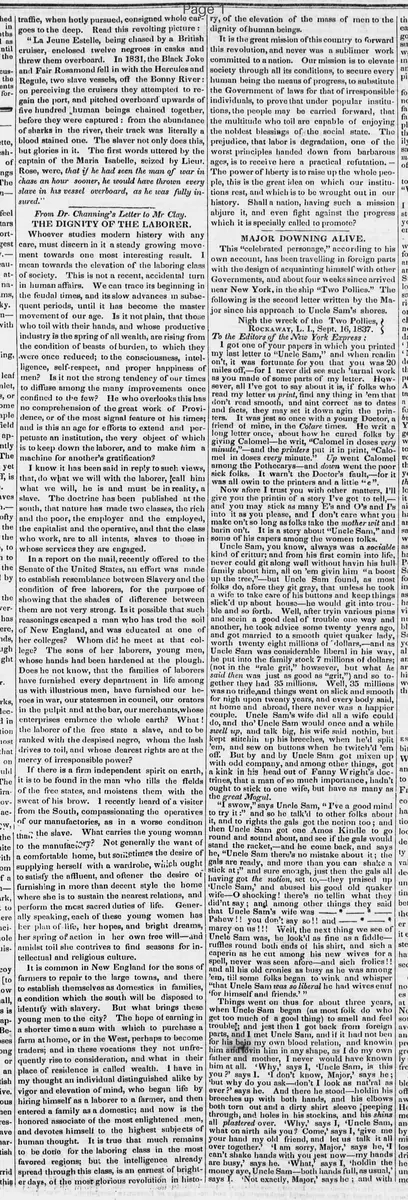
THE DIGNITY OF THE LABORER.
Whoever studies modern history with any care, must discern in it a steady growing movement towards one most interesting result. I mean towards the elevation of the laboring class of society. This is not a recent, accidental turn in human affairs. We can trace its beginning in the feudal times, and its slow advances in subsequent periods, until it has become the master movement of our age. Is it not plain, that those who toil with their hands, and whose productive industry is the spring of all wealth, are rising from the condition of beasts of burden, to which they were once reduced; to the consciousness, intelligence, self-respect, and proper happiness of men? Is it not the strong tendency of our times to diffuse among the many improvements once confined to the few? He who overlooks this has no comprehension of the great work of Providence, or of the most signal feature of his times; and is this an age for efforts to extend and perpetuate an institution, the very object of which is to keep down the laborer, and to make him a machine for another's gratification?
I know it has been said in reply to such views, that, do what we will with the laborer, I call him what we will, he is and must be in reality, a slave. The doctrine has been published at the south, that nature has made two classes, the rich and the poor, the employer and the employed, the capitalist and the operative, and that the class who work, are to all intents, slaves to those in whose services they are engaged.
In a report on the mail, recently offered to the Senate of the United States, an effort was made to establish resemblance between Slavery and the condition of free laborers, for the purpose of showing that the shades of difference between them are not very strong. Is it possible that such reasonings escaped a man who has trod the soil of New England, and was educated at one of her colleges? Whom did he meet at that college? The sons of her laborers, young men, whose hands had been hardened at the plough. Does he not know, that the families of laborers have furnished every department in life among us with illustrious men, have furnished our heroes in war, our statesmen in council, our orators in the pulpit and at the bar, our merchants, whose enterprises embrace the whole earth? What! the laborer of the free state a slave, and to be ranked with the despised negro, whom the lash drives to toil, and whose dearest rights are at the mercy of irresponsible power?
If there is a firm independent spirit on earth, it is to be found in the man who tills the fields of the free states, and moistens them with the sweat of his brow. I recently heard of a visitor from the South, compassionating the operatives of our manufactories, as in a worse condition than the slave. What carries the young woman to the manufactory? Not generally the want of a comfortable home, but sometimes the desire of supplying herself with a wardrobe, which ought to satisfy the affluent, and oftener the desire of furnishing in more than decent style the home where she is to sustain the nearest relations, and perform the most sacred duties of life. Generally speaking, each of these young women has her plan of life, her hopes, and bright dreams, her spring of action in her own free will—and amidst toil she contrives to find seasons for intellectual and religious culture.
It is common in New England for the sons of farmers to repair to the large towns, and there to establish themselves as domestics in families, a condition which the south will be disposed to identify with slavery. But what brings these young men to the city? The hope of earning in a shorter time a sum with which to purchase a farm at home, or in the West, perhaps to become traders; and in these vocations they not unfrequently rise to consideration, and what in their place of residence is called wealth. I have in my thought an individual distinguished alike by vigor and elevation of mind, who began life by hiring himself as a laborer to a farmer, and then entered a family as a domestic; and now is the honored associate of the most enlightened men, and devotes himself to the highest subjects of human thought. It is true that much remains to be done for the laboring class in the most favored regions; but the intelligence already spread through this class, is an earnest of brighter days, of the most glorious revolution in history, of the elevation of the mass of men to the dignity of human beings.
It is the great mission of this country to forward this revolution, and never was a sublimer work committed to a nation. Our mission is to elevate society through all its conditions, to secure every human being the means of progress, to substitute the Government of laws for that of irresponsible individuals, to prove that under popular institutions, the people may be carried forward, that the multitude who toil are capable of enjoying the noblest blessings of the social state. The prejudice, that labor is degradation, one of the worst principles handed down from barbarous ages, is to receive here a practical refutation.—The power of liberty is to raise up the whole people, this is the great idea on which our institutions rest, and which is to be wrought out in our history. Shall a nation, having such a mission abjure it, and even fight against the progress which it is specially called to promote?
What sub-type of article is it?
Persuasive
Ethical Moral
Social Critique
What themes does it cover?
Slavery Abolition
Social Issues
Morality
What keywords are associated?
Dignity Of Labor
Free Labor
Slavery Critique
American Mission
Social Elevation
New England Laborers
What entities or persons were involved?
Dr. Channing
Mr. Clay
Letter to Editor Details
Author
Dr. Channing
Recipient
Mr. Clay
Main Argument
the letter argues that modern history shows the elevation of laborers from degradation to dignity, contrasting free labor in the north with slavery in the south, and asserts that america's mission is to promote liberty and human progress, not perpetuate slavery.
Notable Details
References New England Laborers' Social Mobility
Critiques Southern Views Equating Free Labor To Slavery
Examples Of Factory Workers And Farm Boys Achieving Success
Mentions Senate Report On Mail Comparing Slavery To Free Labor