Thank you for visiting SNEWPapers!
Sign up free
The New York Journal, And Daily Patriotic Register
New York, New York County, New York
What is this article about?
Poplicola critiques Thomas McKean's speech supporting the new U.S. Constitution, arguing that a flawed system cannot be saved by good administration alone. He warns against despotism, even if wisely administered, and urges Americans to adopt a federal constitution that secures liberties without excessive central power, drawing on historical examples like Nero and England's monarchy.
Clipping
OCR Quality
Full Text
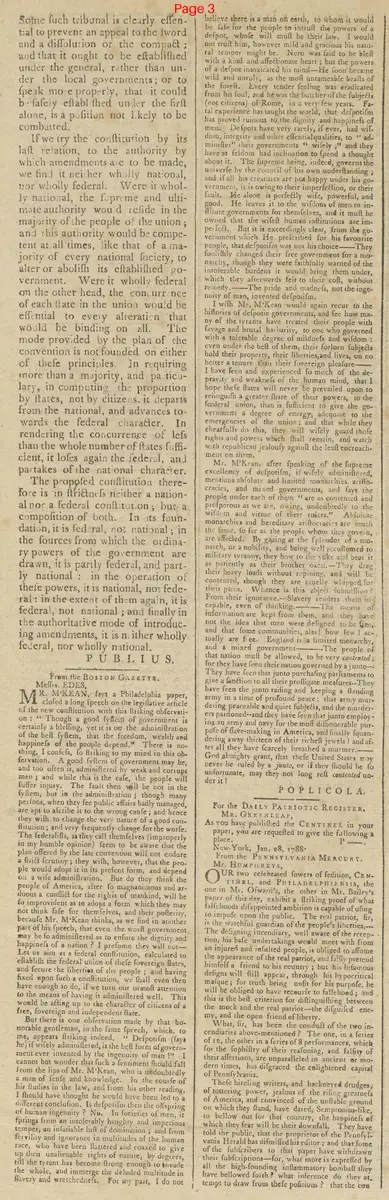
Messrs. EDES.
MR. M'KEAN, says a Philadelphia paper, closed a long speech on the legislative article of the new constitution with this striking observation: "Though a good system of government is certainly a blessing, yet it is on the administration of the best system, that the freedom, wealth and happiness of the people depend." There is nothing, I confess, so striking to my mind in this observation. A good system of government may be, and too often is, administered by weak and corrupt men; and while this is the case, the people will suffer injury. The fault then will be not in the system, but in the administration; though many persons, when they see public affairs badly managed, are apt to ascribe it to the wrong cause; and hence they wish to change the very nature of a good constitution; and very frequently change for the worse. The federalists, as they call themselves (improperly in my humble opinion) seem to be aware that the plan offered by the late convention will not endure a strict scrutiny; they wish, however, that the people would adopt it in its present form, and depend on a wise administration. But do they think the people of America, after so magnanimous and arduous a conflict for the rights of mankind, will be so improvident as to adopt a form which they may not think safe for themselves, and their posterity, because Mr. M'KEAN thinks, as we find in another part of his speech, that even the worst government may be so administered as to ensure the dignity and happiness of a nation? I presume they will not.
Let us aim at a federal constitution, calculated to establish the federal union of these sovereign states, and secure the liberties of the people; and having fixed upon such a constitution, we shall even then have enough to do, if we turn our utmost attention to the means of having it administered well. This would be acting up to the character of citizens of a free, sovereign and independent state.
But there is one observation made by that honorable gentleman, in the same speech, which, to me, appears striking indeed. "Despotism (says he) if wisely administered, is the best form of government ever invented by the ingenuity of man!" I cannot but wonder that such a sentiment should fall from the lips of Mr. M'KEAN, who is undoubtedly a man of sense and knowledge. In the course of his studies in the law, and from his other reading, I should have thought he would have been led to a different conclusion. Is despotism then the offspring of human ingenuity? No. In societies of men, it springs from an intolerably haughty and imperious temper, an insatiable lust of domination; and from servility and ignorance in multitudes of the human race, who have been flattered and coaxed to give up their unalienable rights of nature, by degrees, till the tyrant has become strong enough to invade the whole, and immerge the deluded multitude in slavery and wretchedness. For my part, I do not believe there is a man on earth, to whom it would be safe for the people to intrust the powers of a despot, whose will must be their law. I would not trust him, however mild and gracious his natural temper might be. Nero was said to be blest with a kind and affectionate heart; but the powers of a despot intoxicated his mind--He soon became wild and unruly, as the most untameable beasts of the forest. Every tender feeling was eradicated from his soul, and he was the butcher of the subjects (not citizens) of Rome, in a very few years. Fatal experience has taught the world, that despotism has proved ruinous to the dignity and happiness of men. Despots have very rarely, if ever, had wisdom, integrity and other essential qualities, to "administer" their governments "wisely;" and they have as seldom had inclination to spend a thought about it. The Supreme Being, indeed, governs the universe by the counsel of his own understanding; and if all his creatures are not happy under his government, it is owing to their imperfection, or their fault. He alone is perfectly wise, powerful, and good. He leaves it to the wisdom of men to institute governments for themselves, and it must be owned that the wisest human institutions are imperfect. But it is exceedingly clear, from the government which He prescribed for his favourite people, that despotism was not his choice--They foolishly changed their free government for a monarchy, though they were faithfully warned of the intolerable burdens it would bring them under, which they afterwards felt to their cost, without remedy.--The pride and madness, not the ingenuity of man, invented despotism.
I wish Mr. M'KEAN would again recur to the histories of despotic governments, and see how many of the tyrants have treated their people with savage and brutal barbarity, to one who governed with a tolerable degree of mildness and wisdom: even under the best of them, their forlorn subjects hold their property, their liberties, and lives, on no better a tenure than their sovereign's pleasure--
I have seen and experienced so much of the depravity and weakness of the human mind, that I hope these states will never be prevailed upon to relinquish a greater share of their powers, to the federal union, than is sufficient to give the government a degree of energy, adequate to the emergencies of the union: and that while they cheerfully do this, they will wisely guard those rights and powers which shall remain, and watch with republican jealousy against the least encroachment on them.
Mr. M'KEAN, after speaking of the supreme excellency of despotism, if wisely administered, mentions absolute and limited monarchies, aristocracies, and mixed governments, and says the people under each of them "are as contented and prosperous as we are, owing, undoubtedly to the wisdom and virtue of their rulers." Absolute monarchies and hereditary aristocracies are much the same, so far as the people whom they govern, are affected. By gazing at the splendor of a monarch, or a nobility, and being well accustomed to military tyranny, they bow to the yoke and bear it as patiently as their brother oxen.--They drag their heavy loads without repining, and will be contented, though they are cruelly whipped for their pains. Whence is this abject submission? From their ignorance.---Slavery renders them incapable, even of thinking.--The means of information are kept from them, and they have not the idea that men were designed to be free, and that some communities, alas! how few I actually are free. England is a limited monarchy, and a mixed government.--The people of that nation must be allowed, to be very contented; for they have seen their nation governed by a junto--- They have seen that junto purchasing parliaments to give a sanction to all their profligate measures.--They have seen the junto raising and keeping a standing army in a time of profound peace: that army murdering peaceable and quiet subjects, and the murderers pardoned--and they have seen that junto employing an army and navy for the most dishonorable purpose of slave-making in America, and finally quartering away thirteen of their richest jewels! and after all they have scarcely breathed a murmur.-- God almighty grant, that these United States may never be ruled by a junto, or if they should be so unfortunate, may they not long rest contented under it!
POPLICOLA.
What sub-type of article is it?
What themes does it cover?
What keywords are associated?
What entities or persons were involved?
Letter to Editor Details
Author
Poplicola
Recipient
Messrs. Edes.
Main Argument
a flawed governmental system cannot be reliably saved by good administration; the proposed federal constitution must be scrutinized to secure liberties and union without excessive central power, and despotism is inherently dangerous regardless of administration, as history shows.
Notable Details