Thank you for visiting SNEWPapers!
Sign up free
The Portland Gazette
Portland, Cumberland County, Maine
What is this article about?
Senate committee report on the Seminole War origins, General Jackson's unauthorized actions in raising forces and invading Spanish Florida, including captures of St. Marks and Pensacola, executions of Arbuthnot and Ambrister, and criticisms of constitutional violations.
Merged-components note: Continuation of the Senate report on the Seminole War across pages 1 and 2; relabeled the second part from foreign_news to domestic_news as the content pertains to US domestic military affairs involving the Seminole Indians and Florida incursions.
Clippings
1 of 2
OCR Quality
Full Text
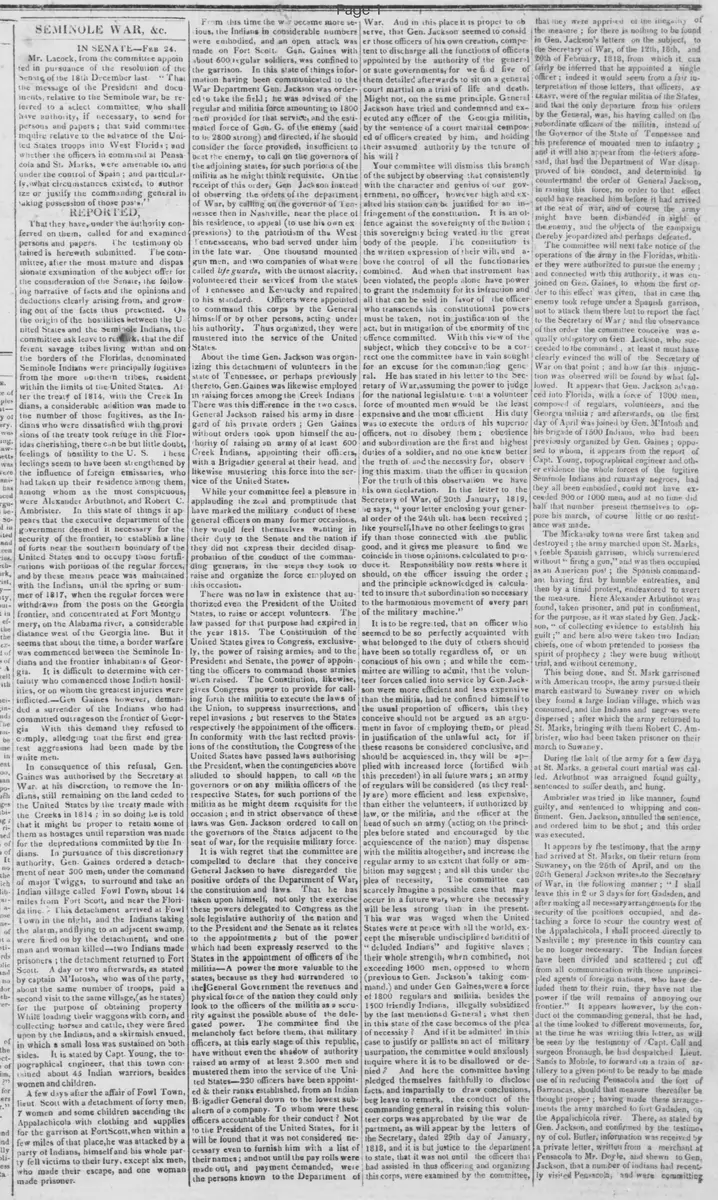
IN SENATE—FEB 24.
Mr. Lacock, from the committee appointed in pursuance of the resolution of the Senate of the 18th December last. "That the message of the President and documents, relative to the Seminole war, be referred to a select committee, who shall have authority, if necessary, to send for persons and papers; that said committee inquire relative to the advance of the United States troops into West Florida; and whether the officers in command at Pensacola and St. Marks, were amenable to, and under the control of Spain; and particularly, what circumstances existed, to authorize or justify the commanding general in taking possession of those posts."
REPORTED,
That they have, under the authority conferred on them, called for and examined persons and papers. The testimony obtained is herewith submitted. The committee, after the most mature and dispassionate examination of the subject offer for the consideration of the Senate, the following narrative of facts and the opinions and deductions clearly arising from, and growing out of the facts thus presented. On the origin of the hostilities between the United States and the Seminole Indians, the committee ask leave to remark, that the different savage tribes living within and on the borders of the Floridas, denominated Seminole Indians were principally fugitives from the more northern tribes, resident within the limits of the United States. After the treaty of 1814, with the Creek Indians, a considerable addition was made to the number of those fugitives, as the Indians who were dissatisfied with the provisions of the treaty took refuge in the Floridas cherishing, there can be but little doubt, feelings of hostility to the U. S. These feelings seem to have been strengthened by the influence of foreign emissaries, who had taken up their residence among them, among whom as the most conspicuous, were Alexander Arbuthnot, and Robert C. Ambrister. In this state of things it appears that the executive department of the government deemed it necessary for the security of the frontier, to establish a line of forts near the southern boundary of the United States and to occupy those fortifications with portions of the regular forces, and by these means peace was maintained with the Indians, until the spring or summer of 1817, when the regular forces were withdrawn from the posts on the Georgia frontier, and concentrated at Fort Montgomery, on the Alabama river, a considerable distance west of the Georgia line. But it seems that about the time, a border warfare was commenced between the Seminole Indians and the frontier inhabitants of Georgia. It is difficult to determine with certainty who commenced those Indian hostilities, or on whom the greatest injuries were inflicted. — Gen Gaines however, demanded a surrender of the Indians who had committed outrages on the frontier of Georgia With this demand they refused to comply, alleging that the first and greatest aggressions had been made by the white men. In consequence of this refusal, Gen. Gaines was authorised by the Secretary at War, at his discretion, to remove the Indians, still remaining on the land ceded to the United States by the treaty made with the Creeks in 1814; in so doing he is told that it might be proper to retain some of them as hostages until reparation was made for the depredations committed by the Indians. In pursuance of this discretionary authority, Gen. Gaines ordered a detachment of near 300 men, under the command of major Twiggs, to surround and take an Indian village called Fowl Town, about 14 miles from Fort Scott, and near the Florida line This detachment arrived at Fowl town in the night, and the Indians taking the alarm, and flying to an adjacent swamp, were fired on by the detachment, and one man and woman killed — two Indians made prisoners ; the detachment returned to Fort Scott. A day or two afterwards, as stated by captain M'Intosh, who was of the party, about the same number of troops, paid a second visit to the same village, (as he states) for the purpose of obtaining property While loading their waggons with corn, and collecting horses and cattle, they were fired upon by the Indians, and a skirmish ensued, in which a small loss was sustained on both sides. It is stated by Capt. Young, the topographical engineer, that this town contained about 45 Indian warriors, besides women and children. A few days after the affair of Fowl Town, lieutenant Scott with a detachment of forty men, 7 women and some children ascending the Appalachicola with clothing and supplies for the garrison at Fort Scott, when within a few miles of that place, he was attacked by a party of Indians, himself and his whole party fell victims to their fury, except six men, who made their escape, and one woman made prisoner. From this time the war became more serious, the Indians in considerable numbers were embodied, and an open attack was made on Fort Scott. Gen. Gaines with about 600 regular soldiers, was confined to the garrison. In this state of things information having been communicated to the War Department Gen. Jackson was ordered to take the field: he was advised of the regular and militia force amounting to 1800 men provided for that service, and the estimated force of Gen. G. of the enemy (said to be 2800 strong) and directed, if he should consider the force provided, insufficient to beat the enemy, to call on the governors of the adjoining states, for such portions of the militia as he might think requisite. On the receipt of this order, Gen Jackson instead of observing the orders of the department of War, by calling on the governor of Tennessee then in Nashville, near the place of his residence, to appeal (to use his own expressions) to the patriotism of the West Tennesseeans, who had served under him in the late war. One thousand mounted gun men, and two companies of what were called life guards, with the utmost alacrity, volunteered their services from the states of Tennessee and Kentucky and repaired to his standard. Officers were appointed to command this corps by the General himself or by other persons, acting under his authority. Thus organized, they were mustered into the service of the United States. About the time Gen. Jackson was organizing this detachment of volunteers in the state of Tennessee, or perhaps previously thereto, Gen. Gaines was likewise employed in raising forces among the Creek Indians There was this difference in the two cases, General Jackson raised his army in disregard of his positive orders ; Gen Gaines without orders took upon himself the authority of raising an army of at least 600 Creek Indians, appointing their officers, with a Brigadier general at their head, and likewise mustering this force into the service of the United States. While your committee feel a pleasure in applauding the zeal and promptitude that have marked the military conduct of these general officers on many former occasions, they would feel themselves wanting in their duty to the Senate and the nation if they did not express their decided disapprobation of the conduct of the commanding generals, in the steps they took to raise and organize the force employed on this occasion. There was no law in existence that authorized even the President of the United States, to raise or accept volunteers. The law passed for that purpose had expired in the year 1815. The Constitution of the United States gives to Congress, exclusively, the power of raising armies, and to the President and Senate, the power of appointing the officers to command those armies when raised. The Constitution, likewise, gives Congress power to provide for calling forth the militia to execute the laws of the Union, to suppress insurrections, and repel invasions ; but reserves to the States respectively the appointment of the officers. In conformity with the last recited provisions of the constitution, the Congress of the United States have passed laws authorising the President, when the contingencies above alluded to should happen, to call on the governors or on any militia officers of the respective States, for such portions of the militia as he might deem requisite for the occasion ; and in strict observance of these laws was Gen. Jackson ordered to call on the governors of the States adjacent to the seat of war, for the requisite military force. It is with regret that the committee are compelled to declare that they conceive General Jackson to have disregarded the positive orders of the Department of War, the constitution and laws. That he has taken upon himself, not only the exercise of these powers delegated to Congress as the sole legislative authority of the nation and to the President and the Senate as it relates to the appointments; but of the power which had been expressly reserved to the States in the appointment of officers of the militia — A power the more valuable to the states, because as they had surrendered to the General Government the revenues and physical force of the nation they could only look to the officers of the militia as a security against the possible abuse of the delegated power. The committee find the melancholy fact before them, that military officers, at this early stage of this republic, have without even the shadow of authority raised an army of at least 2,500 men and mustered them into the service of the United States — 230 officers have been appointed & their ranks established, from an Indian Brigadier General down to the lowest subaltern of a company. To whom were these officers accountable for their conduct? Not to the President of the United States, for it will be found that it was not considered necessary even to furnish him with a list of their names; and not until the pay rolls were made out, and payment demanded, were the persons known to the Department of War. And in this place it is proper to observe, that Gen. Jackson seemed to consider those officers of his own creation, competent to discharge all the functions of officers appointed by the authority of the general or state governments, for we find five of them detailed afterwards to sit on a general court martial on a trial of life and death. Might not, on the same principle, General Jackson have tried and condemned and executed any officer of the Georgia militia, by the sentence of a court martial composed of officers created by him, and holding their assumed authority by the tenure of his will? Your committee will dismiss this branch of the subject by observing that consistently with the character and genius of our government, no officer, however high and exalted his station can be justified for an infringement of the constitution. It is an offence against the sovereignty of the nation; this sovereignty being vested in the great body of the people. The constitution is the written expression of their will, and above the control of all the functionaries combined, And when that instrument has been violated, the people alone have power to grant the indemnity for its infraction and all that can be said in favor of the officer who transcends his constitutional powers must be taken, not in justification of the act, but in mitigation of the enormity of the offence committed. With this view of the subject, which they conceive to be a correct one the committee have in vain sought for an excuse for the commanding general. He has stated in his letter to the Secretary of War, assuming the power to judge for the national legislature. that a volunteer force of mounted men would be the least expensive and the most efficient His duty was to execute the orders of his superior officers, not to disobey them; obedience and subordination are the first and highest duties of a soldier, and no one knew better the truth of, and the necessity for, observing this maxim. than the officer in question For the truth of this observation we have his own declaration. In the letter to the Secretary of War, of 20th January, 1818, he says, "your letter enclosing your general order of the 24th ult. has been received; like yourself, I have no other feelings to gratify than those connected with the public good, and it gives me pleasure to find we coincide in those opinions. calculated to produce it. Responsibility now rests where it should, on the officer issuing the order ; and the principle acknowledged is calculated to insure that subordination so necessary to the harmonious movement of every part of the military machine." It is to be regretted, that an officer who seemed to be so perfectly acquainted with what belonged to the duty of others should have been so totally regardless of, or unconscious of his own; and while the committee are willing to admit, that the volunteer forces called into service by Gen. Jackson were more efficient and less expensive than the militia, had he confined himself to the usual proportion of officers, this they conceive should not be argued as an argument in favor of employing them, or plead in justification of the unlawful act, for if these reasons be considered conclusive, and should be acquiesced in, they will be applied with increased force (fortified with this precedent) in all future wars; an army of regulars will be considered (as they really are) more efficient and less expensive. than either the volunteers, if authorized by law, or the militia, and the officer at the head of such an army (acting on the principles before stated and encouraged by the acquiescence of the nation) may dispense with the militia altogether, and increase the regular army to an extent that folly or ambition may suggest; and all this under the plea of necessity, The committee can scarcely imagine a possible case that may occur in a future war, where the necessity will be less strong than in the present. This war was waged when the United States were at peace with all the world, except the miserable undisciplined banditti of "deluded Indians" and fugitive slaves; their whole strength, when combined, not exceeding 1000 men, opposed to whom (previous to Gen. Jackson's taking command,) and under Gen Gaines, were a force of 1800 regulars and militia, besides the 1500 friendly Indians, illegally subsidized by the last mentioned General; what then in this state of the case becomes of the plea of necessity? And if it be admitted in this case to justify or palliate an act of military usurpation, the committee would anxiously inquire where it is to be disallowed or denied? And here the committee having pledged themselves faithfully to disclose facts, and impartially to draw conclusions, beg leave to remark, the conduct of the commanding general in raising this volunteer corps was approbated by the war department, as will appear by the letters of the Secretary, dated 29th day of January, 1818, and it is but justice to the department to state, that it was not until the officers that had assisted in thus officering and organizing this corps, were examined by the committee, that they were apprised of the legality of the measure; for there is nothing to be found in Gen. Jackson's letters on the subject, to the Secretary of War, of the 12th, 18th, and 20th of February, 1818, from which it can fairly be inferred that he appointed a single officer: indeed it would seem from a fair interpretation of those letters, that officers, AT LEAST, were of the regular militia of the States, and that the only departure from his orders by the General, was, his having called on the subordinate officers of the militia, instead of the Governor of the State of Tennessee and his preference of mounted men to infantry : and it will also appear from the letters aforesaid, that had the Department of War disapproved of his conduct, and determined to countermand the order of General Jackson, in raising this force, no order to that effect could have reached him before it had arrived at the seat of war, and of course the army might have been disbanded in sight of the enemy, and the objects of the campaign thereby jeopardized and perhaps defeated. The committee will next take notice of the operations of the army in the Floridas, whither they were authorized to pursue the enemy; and connected with this authority, it was enjoined on Gen. Gaines, to whom the first order to this effect was given, that in case the enemy took refuge under a Spanish garrison, not to attack them there but to report the fact to the Secretary of War; and the observance of this order the committee conceive was equally obligatory on Gen Jackson, who succeeded to the command , at least it must have clearly evinced the will of the Secretary of War on that point ; and how far this injunction was observed will be found by what follows. It appears that Gen. Jackson advanced into Florida, with a force of 1300 men, composed of regulars, volunteers, and the Georgia militia; and afterwards, on the first day of April was joined by Gen. M'Intosh and his brigade of 1500 Indians, who had been previously organized by Gen. Gaines; opposed to whom, it appears from the report of Capt. Young, topographical engineer and other evidence the whole forces of the fugitive Seminole Indians and runaway negroes, had they all been embodied, could not have exceeded 900 or 1000 men, and at no time did half that number present themselves to oppose his march, of course little or no resistance was made. The Mickasucky towns were first taken and destroyed ; the army marched upon St. Marks, a feeble Spanish garrison, which surrendered without "firing a gun," and was then occupied as an American post ; the Spanish commandant having first by humble entreaties, and then by a timid protest, endeavored to avert the measure. Here Alexander Arbuthnot was found, taken prisoner, and put in confinement, for the purpose, as it was stated by Gen. Jackson, "of collecting evidence to establish his guilt ;" and here also were taken two Indian chiefs, one of whom pretended to possess the spirit of prophecy ; they were hung without trial. and without ceremony. This being done, and St. Marks garrisoned with American troops, the army pursued their march eastward to Suwaney river on which they found a large Indian village, which was consumed, and the Indians and negroes were dispersed; after which the army returned to St. Marks, bringing with them Robert C. Ambrister, who had been taken prisoner on their march to Suwaney. During the halt of the army for a few days at St. Marks. a general court martial was called. Arbuthnot was arraigned found guilty, sentenced to suffer death, and hung. Ambrister was tried in like manner. found guilty, and sentenced to whipping and confinement. Gen. Jackson, annulled the sentence, and ordered him to be shot; and this order was executed. It appears by the testimony, that the army had arrived at St. Marks, on their return from Suwaney, on the 25th of April, and on the 26th General Jackson writes to the Secretary of War, in the following manner; "I shall leave this in 2 or 3 days for fort Gadsden, and after making all necessary arrangements for the security of the positions occupied, and detaching a force to scour the country west of the Appalachicola, I shall proceed directly to Nashville ; my presence in this country can be no longer necessary. The Indian forces have been divided and scattered ; cut off from all communication with those unprincipled agents of foreign nations, who have deluded them to their ruin, they have not the power if the will remains of annoying our frontier." It appears however, by the conduct of the commanding general, that he had, at the time looked to different movements, for, at the time he was writing this letter, as will be seen by the testimony of Capt. Call and surgeon Bronaugh, he had despatched Lieut. Sands to Mobile, to forward on a train of artillery to a given point to be ready to be made use of in reducing Pensacola and the fort of Barrancas, should that measure thereafter be thought proper; having made these arrangements the army marched to fort Gadsden, on the Appalachicola river. There, as stated by Gen. Jackson, and confirmed by the testimony of col. Butler, information was received by a private letter, written from a merchant at Pensacola to Mr. Doyle, and shown to Gen. Jackson, that a number of indians had recently visited Pensacola, and were committing depredations on the frontier.
Preparations on the Spanish inhabitants of that place, and were receiving aid and comfort from the garrison. On the receipt of this intelligence, the resolution seems to have been taken, to garrison that place, with American troops: and after a march of about twenty days, having met his artillery. Gen. Jackson, with about 1200 men, the rest having been discharged, appeared before Pensacola, the capital of the province. The place was taken with scarce the show of resistance. The governor had escaped, and taken refuge, in the fort of the Barrancas; to which place, distant about 6 miles, the army marched, and the fortress was invested on the 20th of May: and a demand being made for its surrender, and refused, the attack was made on the fortress by land and water, and after the bombardment and cannonading had been kept up for a part of two days, and some lives lost, the fortress was surrendered, the garrison made prisoners of war; and the officers of government, civil and military, transported to the Havana, agreeable to terms of the capitulation: which terms, Gen. Jackson in his letter of the 2d of June, 1818, declares, "were more favourable than a conquered enemy would have merited." The civil and military government of Spain thus annulled, General Jackson thought it necessary to abolish the revenue laws of Spain, and establish those of the United States as more favorable to the commerce of the United States: and for this purpose, Capt. Gadsden was appointed collector, and by him under the authority of Gen. Jackson, that department of the new government was organized. The Spanish authorities being thus put down by the sword, both civil and military, a new government was established for this newly acquired territory, the powers of which, both civil and military were vested in military officers. And Gen. Jackson having declared in numerous communications to the Department of War that the Seminole war was closed, and the object of the campaign at an end he returned to his residence at Nashville, state of Tennessee. And here it would have given the committee sincere pleasure to have stated, that the history of the campaign had closed; but facts which it becomes now their duty to report, require that history to be continued.— On the 7th of August 1818, more than two months after his consummation of the conquest of West and part of East Florida, he issued an order to Gen. Gaines, directing him to take possession of St. Augustine, a strong fortress, and the capital of East Florida—A copy of this order is subjoined to this report, and his reasons for this measure are stated at large in the order, and reiterated and enforced by his letter to the Secretary of War, dated the 10th of the same month which reasons fully and beyond the possibility of doubt, discover the motives of the commanding general in all his movements against Spain.
[Remainder next week.]
What sub-type of article is it?
What keywords are associated?
What entities or persons were involved?
Where did it happen?
Domestic News Details
Primary Location
Florida
Event Date
Feb 24
Key Persons
Outcome
one man and woman killed at fowl town; skirmish with small losses; lt. scott and most of his party killed; two indian chiefs hanged without trial; arbuthnot hanged after court martial; ambrister shot after annulled sentence; st. marks and pensacola captured; spanish garrison at barrancas surrendered; spanish authorities transported to havana; new us government established in territory.
Event Details
Senate committee reports on Seminole War origins from 1817 hostilities, unauthorized raising of volunteer and Indian forces by Gens. Jackson and Gaines violating constitution and orders; Jackson's invasion of Florida, destruction of Indian towns, capture of St. Marks and Pensacola, executions of British traders and chiefs, establishment of US control despite Spanish sovereignty.