Thank you for visiting SNEWPapers!
Sign up free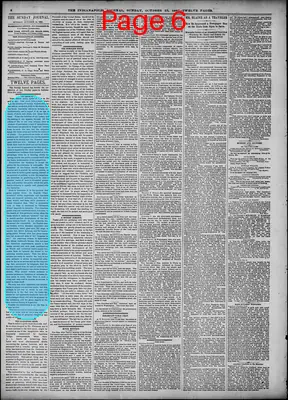
Editorial
October 23, 1887
The Indianapolis Journal
Indianapolis, Marion County, Indiana
What is this article about?
The editorial critiques modern society's pervasive pretense and lack of genuineness in housing, clothing, politics, literature, entertainment, and religion, lamenting the preference for show over substance and easy success over true merit.
Clipping
OCR Quality
98%
Excellent
Full Text
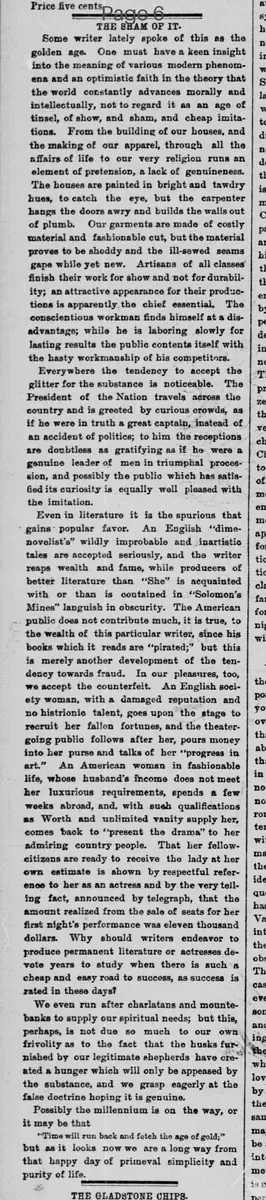
THE SHAM OF IT.
Some writer lately spoke of this as the golden age. One must have a keen insight into the meaning of various modern phenomena and an optimistic faith in the theory that the world constantly advances morally and intellectually, not to regard it as an age of tinsel, of show, and sham, and cheap imitations. From the building of our houses, and the making of our apparel, through all the affairs of life to our very religion runs an element of pretension, a lack of genuineness.
The houses are painted in bright and tawdry hues to catch the eye, but the carpenter hangs the doors awry and builds the walls out of plumb. Our garments are made of costly material and fashionable cut, but the material proves to be shoddy and the ill-sewed seams gape while yet new. Artisans of all classes finish their work for show and not for durability; an attractive appearance for their productions is apparently the chief essential. The conscientious workman finds himself at a disadvantage; while he is laboring slowly for lasting results the public contents itself with the hasty workmanship of his competitors.
Everywhere the tendency to accept the glitter for the substance is noticeable. The President of the Nation travels across the country and is greeted by curious crowds, as if he were in truth a great captain, instead of an accident of politics; to him the receptions are doubtless as gratifying as if he were a genuine leader of men in triumphal procession, and possibly the public which has satisfied its curiosity is equally well pleased with the imitation.
Even in literature it is the spurious that gains popular favor. An English "dime-novelist's" wildly improbable and inartistic tales are accepted seriously, and the writer reaps wealth and fame, while producers of better literature than "She" is acquainted with or than is contained in "Solomon's Mines" languish in obscurity. The American public does not contribute much, it is true, to the wealth of this particular writer, since his books which it reads are pirated; but this is merely another development of the tendency towards fraud. In our pleasures, too, we accept the counterfeit. An English society woman, with a damaged reputation and no histrionic talent, goes upon the stage to recruit her fallen fortunes, and the theater-going public follows after her, pours money into her purse and talks of her "progress in art." An American woman in fashionable life, whose husband's income does not meet her luxurious requirements, spends a few weeks abroad, and, with such qualifications as Worth and unlimited vanity supply her, comes back to "present the drama" to her admiring country people. That her fellow citizens are ready to receive the lady at her own estimate is shown by respectful reference to her as an actress and by the very telling fact, announced by telegraph, that the amount realized from the sale of seats for her first night's performance was eleven thousand dollars. Why should writers endeavor to produce permanent literature or actresses devote years to study when there is such a cheap and easy road to success, as success is rated in these days?
We even run after charlatans and mountebanks to supply our spiritual needs; but this, perhaps, is not due so much to our own frivolity as to the fact that the husks furnished by our legitimate shepherds have created a hunger which will only be appeased by the substance, and we grasp eagerly at the false doctrine hoping it is genuine.
Possibly the millennium is on the way, or it may be that Time will run back and fetch the age of gold; but as it looks now we are a long way from that happy day of primeval simplicity and purity of life.
Some writer lately spoke of this as the golden age. One must have a keen insight into the meaning of various modern phenomena and an optimistic faith in the theory that the world constantly advances morally and intellectually, not to regard it as an age of tinsel, of show, and sham, and cheap imitations. From the building of our houses, and the making of our apparel, through all the affairs of life to our very religion runs an element of pretension, a lack of genuineness.
The houses are painted in bright and tawdry hues to catch the eye, but the carpenter hangs the doors awry and builds the walls out of plumb. Our garments are made of costly material and fashionable cut, but the material proves to be shoddy and the ill-sewed seams gape while yet new. Artisans of all classes finish their work for show and not for durability; an attractive appearance for their productions is apparently the chief essential. The conscientious workman finds himself at a disadvantage; while he is laboring slowly for lasting results the public contents itself with the hasty workmanship of his competitors.
Everywhere the tendency to accept the glitter for the substance is noticeable. The President of the Nation travels across the country and is greeted by curious crowds, as if he were in truth a great captain, instead of an accident of politics; to him the receptions are doubtless as gratifying as if he were a genuine leader of men in triumphal procession, and possibly the public which has satisfied its curiosity is equally well pleased with the imitation.
Even in literature it is the spurious that gains popular favor. An English "dime-novelist's" wildly improbable and inartistic tales are accepted seriously, and the writer reaps wealth and fame, while producers of better literature than "She" is acquainted with or than is contained in "Solomon's Mines" languish in obscurity. The American public does not contribute much, it is true, to the wealth of this particular writer, since his books which it reads are pirated; but this is merely another development of the tendency towards fraud. In our pleasures, too, we accept the counterfeit. An English society woman, with a damaged reputation and no histrionic talent, goes upon the stage to recruit her fallen fortunes, and the theater-going public follows after her, pours money into her purse and talks of her "progress in art." An American woman in fashionable life, whose husband's income does not meet her luxurious requirements, spends a few weeks abroad, and, with such qualifications as Worth and unlimited vanity supply her, comes back to "present the drama" to her admiring country people. That her fellow citizens are ready to receive the lady at her own estimate is shown by respectful reference to her as an actress and by the very telling fact, announced by telegraph, that the amount realized from the sale of seats for her first night's performance was eleven thousand dollars. Why should writers endeavor to produce permanent literature or actresses devote years to study when there is such a cheap and easy road to success, as success is rated in these days?
We even run after charlatans and mountebanks to supply our spiritual needs; but this, perhaps, is not due so much to our own frivolity as to the fact that the husks furnished by our legitimate shepherds have created a hunger which will only be appeased by the substance, and we grasp eagerly at the false doctrine hoping it is genuine.
Possibly the millennium is on the way, or it may be that Time will run back and fetch the age of gold; but as it looks now we are a long way from that happy day of primeval simplicity and purity of life.
What sub-type of article is it?
Moral Or Religious
Social Reform
Satire
What keywords are associated?
Societal Sham
Superficiality
Moral Decline
Cheap Imitations
Pretension
Counterfeit Pleasures
Spiritual Charlatans
Age Of Tinsel
What entities or persons were involved?
The President
English Dime Novelist
English Society Woman
American Woman In Fashionable Life
Editorial Details
Primary Topic
Critique Of Societal Pretense And Lack Of Genuineness
Stance / Tone
Critical Lament Of Modern Superficiality And Sham
Key Figures
The President
English Dime Novelist
English Society Woman
American Woman In Fashionable Life
Key Arguments
Modern Life Is An Age Of Tinsel, Show, And Sham Rather Than Genuine Progress
Houses And Apparel Prioritize Appearance Over Quality And Durability
Artisans Focus On Attractive But Hasty Workmanship, Disadvantaging Conscientious Workers
Public Accepts Glitter Over Substance, Treating The President As A Show Rather Than A Leader
Spurious Literature Like Dime Novels Gains Fame While Better Works Languish
Piracy And Fraud Exemplify The Tendency Towards Counterfeit
Counterfeit Pleasures: Damaged Reputations Presented As Artistic Progress
Easy Success For Unqualified Actresses Due To Public Vanity And Spending
Spiritual Needs Unmet By Legitimate Sources Lead To Chasing Charlatans
Hunger For Substance Drives Grasp At False Doctrines