Thank you for visiting SNEWPapers!
Sign up free
The New Hampshire Gazette And Historical Chronicle
Portsmouth, Greenland, Rockingham County, New Hampshire
What is this article about?
This essay from a new London-published System of Agriculture praises country employment and husbandry as the noblest, most profitable pursuit. It critiques landowners' neglect leading to mortgages and farmers' ignorance, quoting Cowley, Weston, and ancients to advocate active land improvement for wealth and honor.
Merged-components note: These two components form a continuous essay on agriculture, with the second picking up exactly where the first ends ('As' continuation), so they should be merged into a single literary piece.
Clippings
1 of 2
OCR Quality
Full Text
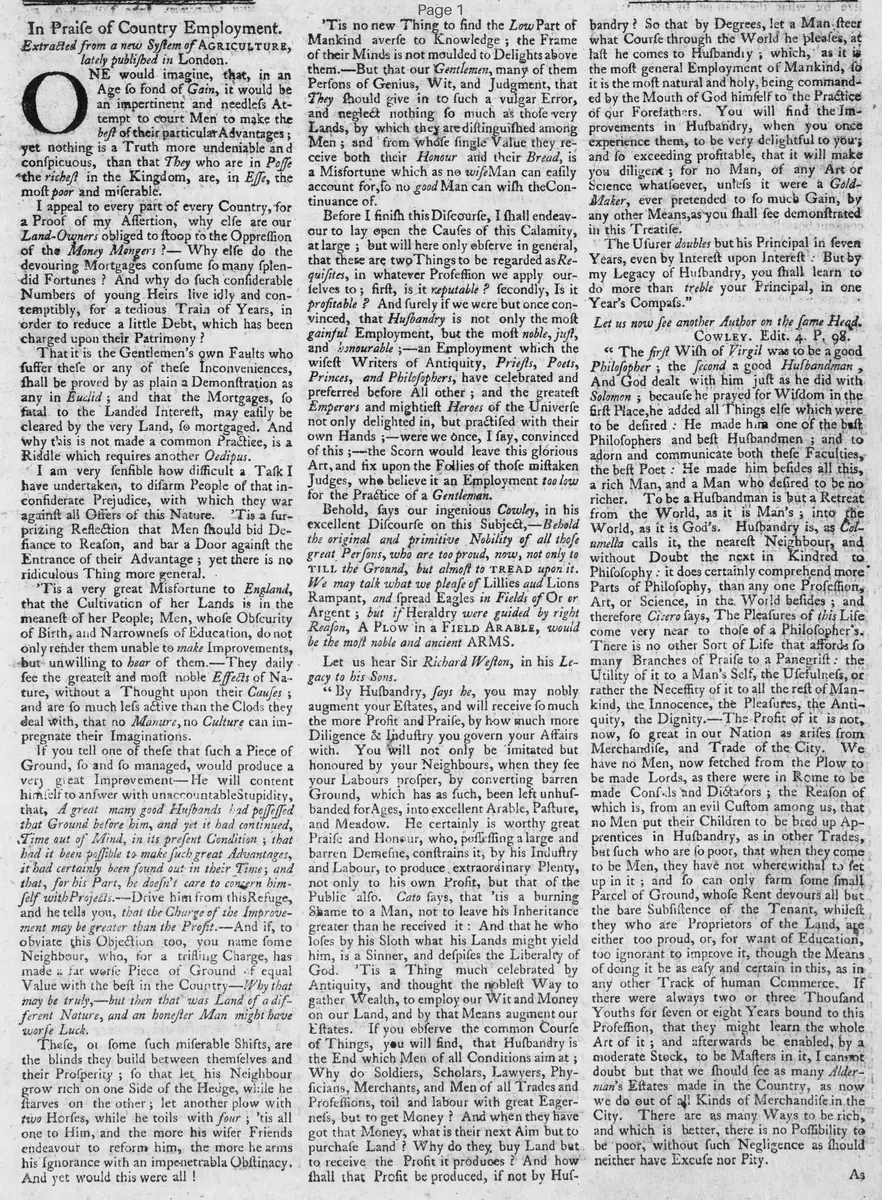
Extracted from a new System of AGRICULTURE, lately published in London.
One would imagine, that, in an Age so fond of Gain, it would be an impertinent and needless Attempt to court Men to make the best of their particular Advantages; yet nothing is a Truth more undeniable and conspicuous, than that They who are in Possession the richest in the Kingdom, are, in Use, the most poor and miserable.
I appeal to every part of every Country, for a Proof of my Assertion, why else are our Land-Owners obliged to stoop to the Oppression of the Money Mongers?-- Why else do the devouring Mortgages consume so many splendid Fortunes? And why do such considerable Numbers of young Heirs live idly and contemptibly, for a tedious Train of Years, in order to reduce a little Debt, which has been charged upon their Patrimony?
That it is the Gentlemen's own Faults who suffer these or any of these Inconveniences, Shall be proved by as plain a Demonstration as any in Euclid; and that the Mortgages, so fatal to the Landed Interest, may easily be cleared by the very Land, so mortgaged. And why this is not made a common Practice, is a Riddle which requires another Oedipus.
I am very sensible how difficult a Task I have undertaken, to disarm People of that inconsiderate Prejudice, with which they wage against all Offers of this Nature. 'Tis a surprizing Reflection that Men should bid Defiance to Reason, and bar a Door against the Entrance of their Advantage; yet there is no ridiculous Thing more general.
'Tis a very great Misfortune to England, that the Cultivation of her Lands is in the meanest of her People; Men, whose Obscurity of Birth, and Narrowness of Education, do not only render them unable to make Improvements. but unwilling to hear of them.---They daily see the greatest and most noble Effects of Nature, without a Thought upon their Causes; and are so much less active than the Clods they deal with, that no Manure, no Culture can impregnate their Imaginations.
If you tell one of these that such a Piece of Ground, so and so managed, would produce a very great Improvement--He will content himself to answer with unaccountable Stupidity, that, A great many good Husbands had possessed that Ground before him, and yet it had continued, Time out of Mind, in its present Condition; that had it been possible to make such great Advantages, it had certainly been found out in their Time; and that, for his Part, he doesn't care to concern himself with Projects.---Drive him from this Refuge, and he tells you, that the Charge of the Improvement may be greater than the Profit.--And if, to obviate this Objection too, you name some Neighbour, who, for a trifling Charge, has made a far worse Piece of Ground of equal Value with the best in the Country--Why that may be true,--but then that was Land of a different Nature, and an honester Man might have worse Luck.
These, or some such miserable Shifts, are the blinds they build between themselves and their Prosperity: so that let his Neighbour grow rich on one Side of the Hedge, while he starves on the other; let another plow with two Horses, while he toils with four; 'tis all one to Him, and the more his wiser Friends endeavour to reform him, the more he arms his Ignorance with an impenetrable Obstinacy.
And yet would this were all!
'Tis no new Thing to find the Low Part of Mankind averse to Knowledge: the Frame of their Minds is not moulded to Delights above them.--But that our Gentlemen, many of them Persons of Genius, Wit, and Judgment, that They Should give in to such a vulgar Error, and neglect nothing so much as those very Lands, by which they are distinguished among Men; and from whose single Value they receive both their Honour and their Bread, is a Misfortune which as no wise Man can easily account for, so no good Man can wish the Continuance of.
Before I finish this Discourse, I shall endeavour to lay open the Causes of this Calamity, at large; but will here only observe in general, that there are two Things to be regarded as Requisites, in whatever Profession we apply ourselves to: first, is it reputable? secondly, Is it profitable? And surely if we were but once convinced, that Husbandry is not only the most gainful Employment, but the most noble, just, and honourable: an Employment which the wisest Writers of Antiquity, Priests, Poets, Princes, and Philosophers, have celebrated and preferred before All other: and the greatest Emperors and mightiest Heroes of the Universe not only delighted in, but practiced with their own Hands ;--were we once, I say, convinced of this ;--the Scorn would leave this glorious Art, and fix upon the Follies of those mistaken Judges, who believe it an Employment too low for the Practice of a Gentleman.
Behold, says our ingenious Cowley, in his excellent Discourse on this Subject.--Behold the original and primitive Nobility of all those great Persons, who are too proud, now, not only to TILL the Ground, but almost to TREAD upon it. We may talk what we please of Lillies and Lions Rampant, and spread Eagles in Fields of Or or Argent; but if Heraldry were guided by right Reason, A PLOW in a FIELD ARABLE, Would be the most noble and ancient ARMS.
Let us hear Sir Richard Weston, in his Legacy to his Sons.
"By Husbandry, says he, you may nobly augment your Estates, and will receive so much the more Profit and Praise, by how much more Diligence & Industry you govern your Affairs with. You will not only be imitated but honoured by your Neighbours, when they see your Labours proper, by converting barren Ground, which has as such, been left unhusbanded for Ages, into excellent Arable, Pasture, and Meadow. He certainly is worthy great Praise and Honour, who, Possessing a large and barren Demesne, constrains it, by his Industry and Labour, to produce, extraordinary Plenty, not only to his own Profit, but that of the Public also. Cato says, that 'tis a burning Shame to a Man, not to leave his Inheritance greater than he received it: And that he who loses by his Sloth what his Lands might yield him, is a Sinner, and despises the Liberality of God. 'Tis a Thing much celebrated by Antiquity, and thought the noblest Way to gather Wealth, to employ our Wit and Money on our Land, and by that Means augment our Estates. If you observe the common Course of Things, you will find, that Husbandry is the End which Men of all Conditions aim at: Why do Soldiers, Scholars, Lawyers, Physicians, Merchants, and Men of all Trades and Professions, toil and labour with great Eagerness, but to get Money? And when they have got that Money, what is their next Aim but to purchase Land? Why do they buy Land but to receive the Profit it produces? And how shall that Profit be produced, if not by Husbandry? So that by Degrees, let a Man steer what Course through the World he pleases, at last he comes to Husbandry: which, as it is the most general Employment of Mankind, so it is the most natural and holy, being commanded by the Mouth of God himself to the Practice of our Forefathers. You will find the Improvements in Husbandry, when you once experience them, to be very delightful to you; and so exceeding profitable, that it will make you diligent; for no Man, of any Art or Science whatsoever, unless it were a Gold-Maker, ever pretended to so much Gain, by any other Means, as you shall see demonstrated in this Treatise.
The Usurer doubles but his Principal in seven Years, even by Interest upon Interest: But by my Legacy of Husbandry, you shall learn to do more than treble your Principal, in one Year's Compass."
Let us now see another Author on the same Head. Cowley. Edit. 4. P. 98.
"The first Wish of Virgil was to be a good Philosopher; the second a good Husbandman, And God dealt with him just as he did with Solomon; because he prayed for Wisdom in the first Place, he added all Things else which were to be desired: He made him one of the best Philosophers and best Husbandmen; and to adorn and communicate both these Faculties, the best Poet: He made him besides all this, a rich Man, and a Man who desired to be no richer. To be a Husbandman is but a Retreat from the World, as it is Man's; into the World, as it is God's. Husbandry is, as Columella calls it, the nearest Neighbour, and without Doubt the next in Kindred to Philosophy: it does certainly comprehend more Parts of Philosophy, than any one Profession, Art, or Science, in the World besides; and therefore Cicero says, The Pleasures of this Life come very near to those of a Philosopher's-- There is no other Sort of Life that affords so many Branches of Praise to a Panegyrist: the Utility of it to a Man's Self, the Usefulness, or rather the Necessity of it to all the rest of Mankind, the Innocence, the Pleasures, the Antiquity, the Dignity.--The Profit of it is not, now, so great in our Nation as arises from Merchandise, and Trade of the City. We have no Men, now fetched from the Plow to be made Lords, as there were in Rome to be made Consuls and Dictators; the Reason of which is, from an evil Custom among us, that no Men put their Children to be bred up Apprentices in Husbandry, as in other Trades, but such who are so poor, that when they come to be Men, they have not wherewithal to set up in it; and so can only farm some small Parcel of Ground, whose Rent devours all but the bare Subsistence of the Tenant, whilst they who are Proprietors of the Land, are either too proud, or, for want of Education, too ignorant to improve it, though the Means of doing it be as easy and certain in this, as in any other Track of human Commerce. If there were always two or three Thousand Youths for seven or eight Years bound to this Profession, that they might learn the whole Art of it; and afterwards be enabled, by a moderate Stock, to be Masters in it, I cannot doubt but that we should see as many Alderman's Estates made in the Country, as now we do out of all Kinds of Merchandise in the City. There are as many Ways to be rich, and which is better, there is no Possibility to be poor, without such Negligence as should neither have Excuse nor Pity.
As for the Necessity of this Art, it is evident enough; since this can live without all other, and no one without this. Many Nations have lived, and some do still, without any Art but this; and almost all others are obliged to this for most of their Materials.
The Innocence is the next Thing for which I commend it; and if Husbandmen preserve not that, they are much to blame; for no Men are so free from the Temptations to Iniquity: they live upon an Estate which is given them by their Mother, others upon an Estate which is cheated from their Brethren; they live by what they can get by Industry from the Earth, others by what they can Catch by Craft from Men; they live, like Sheep and Kine, by the Allowance of Nature; others, like Wolves and Foxes, by the Acquisitions of Rapine. We are here among the vast and noble Scenes of Nature; we are there among the pitiful Shifts of Policy. We walk here in the Light and open Ways of the divine Bounty; we are groping there in the dark and confounding Labyrinths of human Malice.
Our Senses are here feasted with the clear and genuine Taste of their Objects, which are all sophisticated there and overwhelmed with their Contraries. Here Pleasure looks like a constant beautiful and modest Wife; it is there a fickle impudent and painted Harlot. Here is harmless and cheap Plenty; there a guilty expensive Luxury.
The Antiquity of this Art is certainly not to be contested by any other. The three first Men in the World were a Gardner, a Plowman, and a Grazier; it is for this Reason, I suppose, that Ecclesiasticus forbids us to hate Husbandry -Because (Says he) the Most-High has created it. We were all born to this Art, and taught by Nature to nourish our Bodies out of the same Earth they were made of; and to which at last they must return, and pay for their Subsistence.
These Considerations make me fall into the Wonder and Complaint of Columella, how it should come to pass that all Arts or Sciences, Metaphysic, Physic, Morality, Mathematics, Logic, Rhetoric; nay even Vaulting, Fencing, Dancing, Cooking, Dressing, Carving, and such like Vanities, should all have public Schools and Masters; and yet that we should never see or hear of any Man who took upon him to profess an Art so virtuous, so profitable, so honorable, so necessary! - Who is there among our Gentry that does not entertain a Dancing-Master for his Children as soon as they are able to Walk? But did ever any Father provide a Tutor to instruct his Son betimes in the Nature and Improvements of that Estate which he intended to leave him? That is at least a Superfluity; and this a Defect in our Manner of Education; and therefore I could wish that One College in each University were erected and appropriated to this Study, as well as there are to Medicine and Civil Law.
Almost all the Poets, except those who were not able to eat Bread without the Bounty of Great Men, that is, without what they could get by flattering them, have not only withdrawn themselves from the Great World, into the Happiness of a retired Life; but have commended and adorned nothing so much by their everliving Poems. Hesiod was the first or second Poet in the World, that remains yet extant, and he is the first Writer, too, of the Art of Husbandry."
Again- "The only Gentlemanlike Way of growing rich, is, by the Art of Husbandry; all other Professions have something in them of the mean and subservient; this alone is free and noble; and the Wealth thus gotten may almost be said to be of a Man's own creating. Country People were, in all Ages, preferred before the Inhabitants of Cities, as having more Nobility affixed to their Practice, than such as living securely within Walls, were safe and idle under the Shadow of a Pent-house. How much less noble is the Man who sells his Blood, not for the Service, but the Pay of his Country! and how far below the Countryman must he be placed. who bawls at every Bar for Gain? and holds out his Hand to every Bidder!
The Necessity of this noble Art may be inferred from its Profit: for since Profit is not only most universally aim'd at, but universally requisite, this of all Arts is certainly most necessary because its Profit does so far exceed all other. But I would have Men know, that the Name of Husbandman is no Way due to the Clown, the Peasant, or the Ploughman-- No--He is a Creature of another Mould. - No Son of Adam, from the Cottage to the Crown, how excellent soever, if he is excellent indeed, can possibly assume a richer, better, or a greater Title, than that of HUSBANDMAN.
Austin, of Planting observes-- There are many good Wits exercised about Toys and Trifles, and who bestows excessive Time, Cost, and Labour, about mere Shadows. How much might these advantage themselves and others in searching out a thousand hidden Secrets in Nature, by the Study and Practice of Agriculture. Not he (says an ancient Author) who knows many Things, but he who knows profitable Things, is wise.
This Art is a mighty Store-House of Meat, Drink, and Money; 'tis a rich Mine, out of which we may dig profit and Pleasure, without Fear of ever coming to the Bottom; nay, if you will, 'tis The Philosopher's Stone, which turns Trees, Fruits, Earth, Iron, and Water, into Gold, without the smallest Hazard. The Excellence of this Employment, both in the Practice and the Theory, extends itself to every Place and Person in the World: from the Cradle to the Grave, and from the Beginning of the World to the End thereof. Nothing can be so universally good as THIS.
What sub-type of article is it?
What themes does it cover?
What keywords are associated?
What entities or persons were involved?
Literary Details
Title
In Praise Of Country Employment.
Author
Extracted From A New System Of Agriculture, Lately Published In London.
Subject
Praise Of Husbandry And Country Employment
Key Lines