Thank you for visiting SNEWPapers!
Sign up free
The New Hampshire Gazette
Portsmouth, Rockingham County, New Hampshire
What is this article about?
Chevalier Drucour's letter from October 1, 1758, recounts the French defense of Louisbourg against a British siege starting June 1, 1758. With limited forces and no timely relief, the fortress fell on July 26 after ships were destroyed and breaches made, leading to capitulation as prisoners of war. Casualties: ~330 killed/wounded.
Clipping
OCR Quality
Full Text
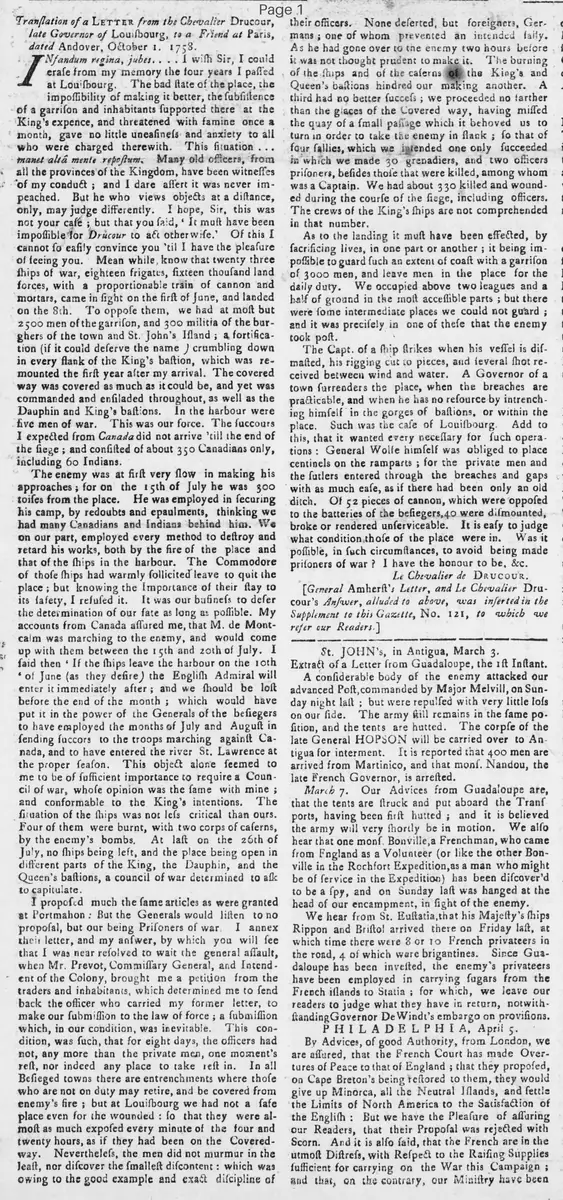
late Governor of Louisbourg, to a Friend at Paris,
dated Andover, October 1, 1758.
V Infandum regina, jubes... I wish, Sir, I could
erase from my memory the four years I passed
at Louisbourg. The bad state of the place, the
impossibility of making it better, the subsistence
of a garrison and inhabitants supported there at the
King's expense, and threatened with famine once a
month, gave no little uneasiness and anxiety to all
who were charged therewith. This situation ...
manet alta mente repositum. Many old officers from
all the provinces of the Kingdom, have been witnesses
of my conduct; and I dare assert it was never im-
peached. But he who views objects at a distance,
only, may judge differently. I hope, Sir, this was
not your case; but that you said, 'It must have been
impossible for Drucour to act otherwise.' Of this I
cannot so easily convince you 'til I have the pleasure
of seeing you. Meanwhile, know that twenty three
ships of war, eighteen frigates, sixteen thousand land
forces, with a proportionable train of cannon and
mortars, came in sight on the first of June, and landed
on the 8th. To oppose them, we had at most but
2500 men of the garrison, and 300 militia of the bur-
ghers of the town and St. John's Island; a fortifica-
tion (if it could deserve the name) crumbling down
in every flank of the King's bastion, which was re-
mounted the first year after my arrival. The covered
way was covered as much as it could be, and yet was
commanded and enfiladed throughout, as well as the
Dauphin and King's bastions. In the harbour were
five men of war. This was our force. The succours
I expected from Canada did not arrive 'till the end of
the siege; and consisted of about 350 Canadians only,
including 60 Indians.
The enemy was at first very slow in making his
approaches; for on the 15th of July he was 800
toises from the place. He was employed in securing
his camp by redoubts and epaulements, thinking we
had many Canadians and Indians behind him. We
on our part, employed every method to destroy and
retard his works, both by the fire of the place and
that of the ships in the harbour. The Commodore
of those ships had warmly solicited leave to quit the
place; but knowing the Importance of their stay to
its safety, I refused it. It was our business to defer
the determination of our fate as long as possible. My
accounts from Canada assured me, that M. de Mont-
calm was marching to the enemy, and would come
up with them between the 15th and 20th of July. I
said then 'If the ships leave the harbour on the 10th
of June (as they desire) the English Admiral will
enter it immediately after: and we should be lost
before the end of the month; which would have
put it in the power of the Generals of the besiegers
to have employed the months of July and August in
sending succors to the troops marching against Ca-
nada, and to have entered the river St. Lawrence at
the proper season. This object alone seemed to
me to be of sufficient importance to require a Coun-
cil of war, whose opinion was the same with mine;
and conformable to the King's intentions. The
situation of the ships was not less critical than ours.
Four of them were burnt, with two corps of caserns,
by the enemy's bombs. At last on the 26th of
July, no ships being left, and the place being open in
different parts of the King, the Dauphin, and the
Queen's bastions, a council of war determined to ask
to capitulate.
I proposed much the same articles as were granted
at Port Mahon: But the Generals would listen to no
proposal, but our being Prisoners of war. I annex
their letter, and my answer, by which you will see
that I was near resolved to wait the general assault,
when Mr. Prevot, Commissary General, and Intend-
ant of the Colony, brought me a petition from the
traders and inhabitants, which determined me to send
back the officer who carried my former letter, to
make our submission to the law of force; a submission
which, in our condition, was inevitable. This con-
dition, was such, that for eight days, the officers had
not, any more than the private men, one moment's
rest, nor indeed any place to take rest in. In all
Besieged towns there are entrenchments where those
who are not on duty may retire, and be covered from
enemy's fire; but at Louisbourg we had not a safe
place even for the wounded: so that they were al-
most as much exposed every minute of the four and
twenty hours, as if they had been on the Covered-
way. Nevertheless, the men did not murmur in the
least, nor discover the smallest discontent: which was
owing to the good example and exact discipline of
their officers. None deserted, but foreigners, Ger-
mans; one of whom prevented an intended sally.
As he had gone over to the enemy two hours before
it was not thought prudent to make it. The burning
of the ships and of the caserns of the King's and
Queen's bastions hindered our making another. A
third had no better success; we proceeded no farther
than the glacis of the Covered way, having missed
the quay of a small passage which it behoved us to
turn in order to take the enemy in flank; so that of
four sallies, which we intended one only succeeded
in which we made 30 grenadiers, and two officers
prisoners, besides those that were killed, among whom
was a Captain. We had about 330 killed and wound-
ed during the course of the siege, including officers.
The crews of the King's ships are not comprehended
in that number.
As to the landing it must have been effected, by
sacrificing lives, in one part or another; it being im-
possible to guard such an extent of coast with a garrison
of 3000 men, and leave men in the place for the
daily duty. We occupied above two leagues and a
half of ground in the most accessible parts; but there
were some intermediate places we could not guard;
and it was precisely in one of these that the enemy
took post.
The Capt. of a ship strikes when his vessel is dis-
masted, his rigging cut to pieces, and several shot re-
ceived between wind and water. A Governor of a
town surrenders the place, when the breaches are
practicable, and when he has no resource by intrench-
ing himself in the gorges of bastions, or within the
place. Such was the case of Louisbourg. Add to
this, that it wanted every necessary for such opera-
tions: General Wolfe himself was obliged to place
sentinels on the ramparts; for the private men and
the sutlers entered through the breaches and gaps
with as much ease, as if there had been only an old
ditch. Of 52 pieces of cannon, which were opposed
to the batteries of the besiegers, 40 were dismounted,
broke or rendered unserviceable. It is easy to judge
what condition those of the place were in.
Was it possible, in such circumstances, to avoid being made
prisoners of war? I have the honour to be, &c.
Le Chevalier de Drucour.
[General Amherst's Letter, and Le Chevalier Dru-
cour's Answer, alluded to above, was inserted in the
Supplement to this Gazette, No. 121, to which
we refer our Readers.]
What sub-type of article is it?
What keywords are associated?
What entities or persons were involved?
Where did it happen?
Foreign News Details
Primary Location
Louisbourg
Event Date
June 1 To July 26, 1758
Key Persons
Outcome
capitulation on july 26, 1758; french forces became prisoners of war; ~330 killed and wounded (garrison only); 4 ships burnt; 40 of 52 cannons dismounted or unserviceable; one successful sally capturing 30 grenadiers and 2 officers.
Event Details
Chevalier Drucour describes the siege of Louisbourg by British forces (23 ships of war, 18 frigates, 16,000 land troops) starting June 1, 1758. French had 2,500 garrison, 300 militia, 5 ships. Inadequate fortifications crumbled; expected relief from Canada (350 men) arrived too late. Ships refused to leave harbor to delay fall; 4 burnt by bombs. After breaches in bastions and failed sallies, council decided to capitulate as prisoners despite initial resistance.