Thank you for visiting SNEWPapers!
Sign up free
Letter to Editor
January 13, 1774
The Virginia Gazette
Richmond, Williamsburg, Richmond County, Virginia
What is this article about?
A colonial letter vehemently opposes imported tea for its detrimental health effects, economic drain, and threat to liberties, citing medical authorities like Boerhaave and Cullen. It proposes 17 native American plant-based tea alternatives with their medicinal benefits to promote health and self-reliance.
Clipping
OCR Quality
98%
Excellent
Full Text
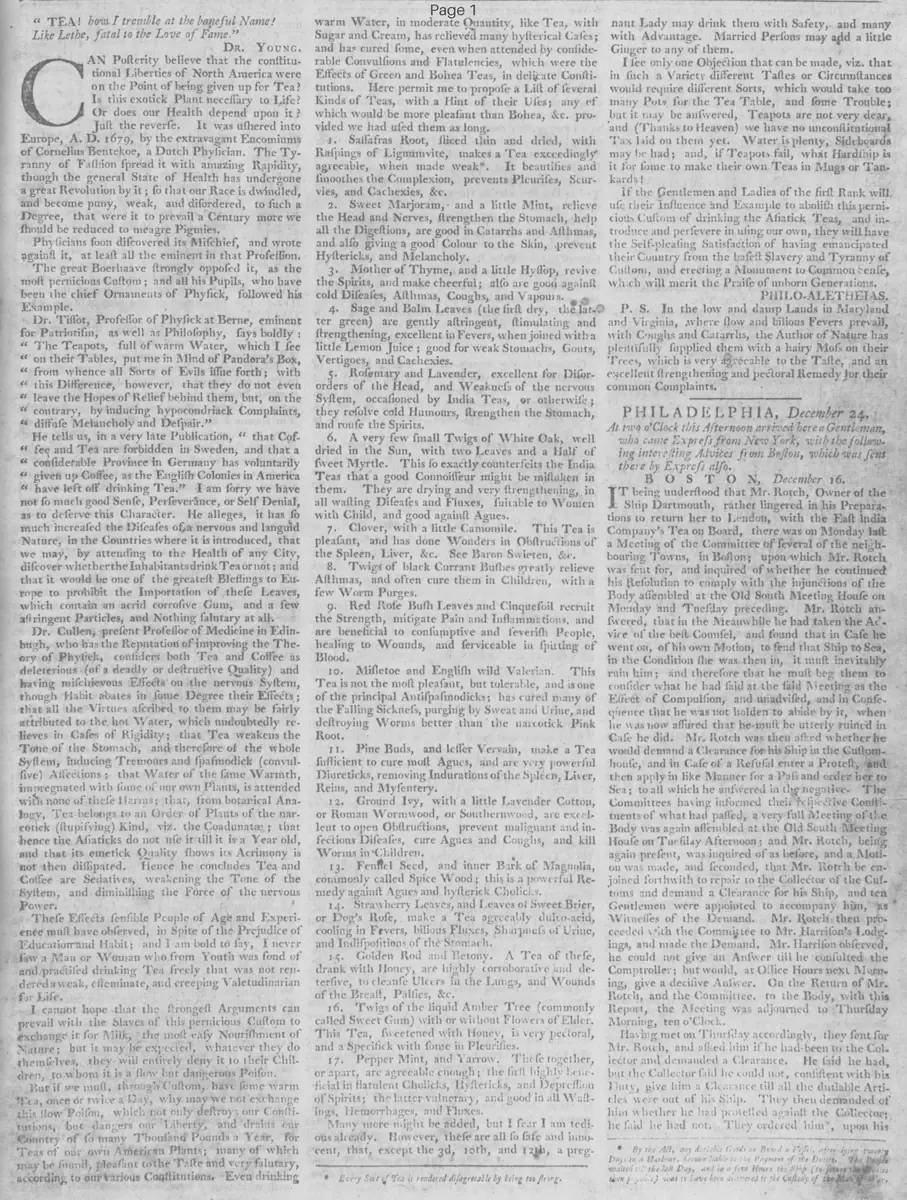
TEA! For I tremble at the baneful Name!
Like Lethe, fatal to the Love of Fame."
Dr. Young.
Can Posterity believe that the constitutional Liberties of North America were on the Point of being given up for Tea?
Is this exotick Plant necessary to Life? Or does our Health depend upon it?
Just the reverse. It was ushered into Europe, A. D. 1679, by the extravagant Encomiums of Cornelius Bontek oe, a Dutch Physician. The Tyranny of Fashion spread it with amazing Rapidity, though the general State of Health has undergone a great Revolution by it; so that our Race is dwindled, and become puny, weak, and disordered, to such a Degree, that were it to prevail a Century more we should be reduced to meagre Pigmies.
Physicians soon discovered its Mischief, and wrote against it, at least all the eminent in that Profession. The great Boerhaave strongly opposed it, as the most pernicious Custom; and all his Pupils, who have been the chief Ornaments of Physic, followed his Example.
Dr. Tissot, Professor of Physic at Berne, eminent for Patriotism, as well as Philosophy, says boldly:
"The Teapots, full of warm Water, which I see on their Tables, put me in Mind of Pandora's Box, from whence all Sorts of Evils issue forth; with this Difference, however, that they do not even leave the Hopes of Relief behind them, but, on the contrary, by inducing hypochondriack Complaints, diffuse Melancholy and Despair."
He tells us, in a very late Publication, "that Coffee and Tea are forbidden in Sweden, and that a considerable Province in Germany has voluntarily given up Coffee, as the English Colonies in America have left off drinking Tea." I am sorry we have not so much good Sense, Perseverance, or Self Denial, as to deserve this Character. He alleges, it has so much increased the Diseases of a nervous and languid Nature, in the Countries where it is introduced, that we may, by attending to the Health of any City, discover whether the Inhabitants drink Tea or not; and that it would be one of the greatest Blessings to Europe to prohibit the Importation of these Leaves, which contain an acrid corrosive Gum, and a few astringent Particles, and Nothing salutary at all.
Dr. Cullen, present Professor of Medicine in Edinburgh, who has the Reputation of improving the Theory of Physic, considers both Tea and Coffee as deleterious (of a deadly or destructive Quality) and having mischievous Effects on the nervous System, though Habit abates in some Degree their Effects; that all the Virtues ascribed to them may be fairly attributed to the hot Water, which undoubtedly relieves in Cases of Rigidity; that Tea weakens the Tone of the Stomach, and therefore of the whole System, inducing Tremours and spasmodick (convulsive) Affections; that Water of the same Warmth, impregnated with some of our own Plants, is attended with none of these Harms; that, from botanical Analogy, Tea belongs to an Order of Plants of the narcotic (stupifying) Kind, viz. the Coadunata; that hence the Asiatics do not use it till it is a Year old, and that its emetick Quality shows its Acrimony is not then dissipated. Hence he concludes Tea and Coffee are Sedatives, weakening the Tone of the System, and diminishing the Force of the nervous Power.
These Effects sensible People of Age and Experience must have observed, in Spite of the Prejudice of Education and Habit; and I am bold to say, I never saw a Man or Woman who from Youth was fond of and practised drinking Tea freely that was not rendered a weak, effeminate, and creeping Valetudinarian for Life.
I cannot hope that the strongest Arguments can prevail with the Slaves of this pernicious Custom to exchange it for Milk, the most easy Nourishment of Nature; but it may be expected, whatever they do themselves, they will entirely deny it to their Children, to whom it is a slow but dangerous Poison.
But if we must, through Custom, have some warm Tea, once or twice a Day, why may we not exchange this slow Poison, which not only destroys our Constitutions, but endangers our Liberty, and drains our Country of so many Thousand Pounds a Year, for Teas of our own American Plants; many of which may be found, pleasant to the Taste and very salutary, according to our various Constitutions. Even drinking warm Water, in moderate Quantity, like Tea, with Sugar and Cream, has relieved many hysterical Cases; and has cured some, even when attended by considerable Convulsions and Flatulencies, which were the Effects of Green and Bohea Teas, in delicate Constitutions. Here permit me to propose a List of several Kinds of Teas, with a Hint of their Uses; any of which would be more pleasant than Bohea, &c. provided we had used them as long.
1. Sassafras Root, sliced thin and dried, with Raspings of Lignumvitae, makes a Tea exceedingly agreeable, when made weak. It beautifies and smooths the Complexion, prevents Pleurisies, Scurvies, and Cachexies, &c.
2. Sweet Marjoram, and a little Mint, relieve the Head and Nerves, strengthen the Stomach, help all the Digestion, are good in Catarrhs and Asthmas, and also giving a good Colour to the Skin, prevent Hysteric ks, and Melancholy.
3. Mother of Thyme, and a little Hyssop, revive the Spirits, and make cheerful; also are good against cold Diseases, Asthmas, Coughs, and Vapours.
4. Sage and Balm Leaves (the first dry, the latter green) are gently astringent, stimulating and strengthening, excellent in Fevers, when joined with a little Lemon Juice; good for weak Stomachs, Gouts, Vertigoes, and Cachexies.
5. Rosemary and Lavender, excellent for Disorders of the Head, and Weakness of the nervous System, occasioned by India Teas, or otherwise; they resolve cold Humours, strengthen the Stomach, and rouse the Spirits.
6. A very few small Twigs of White Oak, well dried in the Sun, with two Leaves and a Half of Sweet Myrtle. This so exactly counterfeits the India Teas that a good Connoisseur might be mistaken in them. They are drying and very strengthening, in all wasting Diseases and Fluxes, suitable to Women with Child, and good against Agues.
7. Clover, with a little Camomile. This Tea is pleasant, and has done Wonders in Obstructions of the Spleen, Liver, &c. See Baron Swieten, &c.
8. Twigs of black Currant Bushes greatly relieve Asthmas, and often cure them in Children, with a few Worm Purges.
9. Red Rose Bush Leaves and Cinquefoil recruit the Strength, mitigate Pain and Inflammations, and are beneficial to consumptive and feverish People, healing to Wounds, and serviceable in spitting of Blood.
10. Mistletoe and English wild Valerian. This Tea is not the most pleasant, but tolerable, and is one of the principal Antispasmodicks; has cured many of the Falling Sickness, purging by Sweat and Urine, and destroying Worms better than the narcotic Pink Root.
11. Pine Buds, and lesser Vervain, make a Tea sufficient to cure most Agues, and are very powerful Diureticks, removing Indurations of the Spleen, Liver, Reins, and Mesentery.
12. Ground Ivy, with a little Lavender Cotton, or Roman Wormwood, or Southernwood, are excellent to open Obstructions, prevent malignant and infectious Diseases, cure Agues and Coughs, and kill Worms in Children.
13. Fennel Seed, and inner Bark of Magnolia, commonly called Spice Wood; this is a powerful Remedy against Agues and hysteric Cholics.
14. Strawberry Leaves, and Leaves of Sweet Brier, or Dog Rose, make a Tea agreeably sub-acid, cooling in Fevers, bilious Fluxes, Sharpness of Urine, and Indispositions of the Stomach.
15. Golden Rod and Betony. A Tea of these, drank with Honey, are highly corroborative and detergent, to cleanse Ulcers in the Lungs, and Wounds of the Breast. Palsies, &c.
16. Twigs of the liquid Amber Tree (commonly called Sweet Gum) with or without Flowers of Elder. This Tea, sweetened with Honey, is very pectoral, and a Specific with some in Pleurisies.
17. Pepper Mint, and Yarrow. These together, or apart, are agreeable enough; the first highly beneficial in flatulent Cholics, Hysteric ks, and Depression of Spirits; the latter vulnerary, and good in all Wastings, Haemorrhages, and Fluxes.
Many more might be added, but I fear I am tedious already. However, these are all so safe and innocent, that, except the 3d, 10th, and 12th, a pregnant Lady may drink them with Safety, and many with Advantage. Married Persons may add a little Ginger to any of them.
I see only one Objection that can be made, viz. that in such a Variety different Tastes or Circumstances would require different Sorts, which would take too many Pots for the Tea Table, and some Trouble: but it may be answered, Teapots are not very dear, and (Thanks to Heaven) we have no unconstitutional Tax laid on them yet. Water is plenty, Sideboards may be had; and, if Teapots fail, what Hardship is it for some to make their own Teas in Mugs or Tankards!
If the Gentlemen and Ladies of the first Rank will use their Influence and Example to abolish this pernicious Custom of drinking the Asiatick Teas, and introduce and persevere in using our own, they will have the Self-pleasing Satisfaction of having emancipated their Country from the basest Slavery and Tyranny of Custom, and erecting a Monument to Common Sense, which will merit the Praise of unborn Generations.
PHILO-ALETHEIAS.
P. S. In the low and damp Lands in Maryland and Virginia, where slow and bilious Fevers prevail, with Coughs and Catarrhs, the Author of Nature has plentifully supplied them with a hairy Moss on their Trees, which is very agreeable to the Taste, and an excellent strengthening and pectoral Remedy for their common Complaints.
Like Lethe, fatal to the Love of Fame."
Dr. Young.
Can Posterity believe that the constitutional Liberties of North America were on the Point of being given up for Tea?
Is this exotick Plant necessary to Life? Or does our Health depend upon it?
Just the reverse. It was ushered into Europe, A. D. 1679, by the extravagant Encomiums of Cornelius Bontek oe, a Dutch Physician. The Tyranny of Fashion spread it with amazing Rapidity, though the general State of Health has undergone a great Revolution by it; so that our Race is dwindled, and become puny, weak, and disordered, to such a Degree, that were it to prevail a Century more we should be reduced to meagre Pigmies.
Physicians soon discovered its Mischief, and wrote against it, at least all the eminent in that Profession. The great Boerhaave strongly opposed it, as the most pernicious Custom; and all his Pupils, who have been the chief Ornaments of Physic, followed his Example.
Dr. Tissot, Professor of Physic at Berne, eminent for Patriotism, as well as Philosophy, says boldly:
"The Teapots, full of warm Water, which I see on their Tables, put me in Mind of Pandora's Box, from whence all Sorts of Evils issue forth; with this Difference, however, that they do not even leave the Hopes of Relief behind them, but, on the contrary, by inducing hypochondriack Complaints, diffuse Melancholy and Despair."
He tells us, in a very late Publication, "that Coffee and Tea are forbidden in Sweden, and that a considerable Province in Germany has voluntarily given up Coffee, as the English Colonies in America have left off drinking Tea." I am sorry we have not so much good Sense, Perseverance, or Self Denial, as to deserve this Character. He alleges, it has so much increased the Diseases of a nervous and languid Nature, in the Countries where it is introduced, that we may, by attending to the Health of any City, discover whether the Inhabitants drink Tea or not; and that it would be one of the greatest Blessings to Europe to prohibit the Importation of these Leaves, which contain an acrid corrosive Gum, and a few astringent Particles, and Nothing salutary at all.
Dr. Cullen, present Professor of Medicine in Edinburgh, who has the Reputation of improving the Theory of Physic, considers both Tea and Coffee as deleterious (of a deadly or destructive Quality) and having mischievous Effects on the nervous System, though Habit abates in some Degree their Effects; that all the Virtues ascribed to them may be fairly attributed to the hot Water, which undoubtedly relieves in Cases of Rigidity; that Tea weakens the Tone of the Stomach, and therefore of the whole System, inducing Tremours and spasmodick (convulsive) Affections; that Water of the same Warmth, impregnated with some of our own Plants, is attended with none of these Harms; that, from botanical Analogy, Tea belongs to an Order of Plants of the narcotic (stupifying) Kind, viz. the Coadunata; that hence the Asiatics do not use it till it is a Year old, and that its emetick Quality shows its Acrimony is not then dissipated. Hence he concludes Tea and Coffee are Sedatives, weakening the Tone of the System, and diminishing the Force of the nervous Power.
These Effects sensible People of Age and Experience must have observed, in Spite of the Prejudice of Education and Habit; and I am bold to say, I never saw a Man or Woman who from Youth was fond of and practised drinking Tea freely that was not rendered a weak, effeminate, and creeping Valetudinarian for Life.
I cannot hope that the strongest Arguments can prevail with the Slaves of this pernicious Custom to exchange it for Milk, the most easy Nourishment of Nature; but it may be expected, whatever they do themselves, they will entirely deny it to their Children, to whom it is a slow but dangerous Poison.
But if we must, through Custom, have some warm Tea, once or twice a Day, why may we not exchange this slow Poison, which not only destroys our Constitutions, but endangers our Liberty, and drains our Country of so many Thousand Pounds a Year, for Teas of our own American Plants; many of which may be found, pleasant to the Taste and very salutary, according to our various Constitutions. Even drinking warm Water, in moderate Quantity, like Tea, with Sugar and Cream, has relieved many hysterical Cases; and has cured some, even when attended by considerable Convulsions and Flatulencies, which were the Effects of Green and Bohea Teas, in delicate Constitutions. Here permit me to propose a List of several Kinds of Teas, with a Hint of their Uses; any of which would be more pleasant than Bohea, &c. provided we had used them as long.
1. Sassafras Root, sliced thin and dried, with Raspings of Lignumvitae, makes a Tea exceedingly agreeable, when made weak. It beautifies and smooths the Complexion, prevents Pleurisies, Scurvies, and Cachexies, &c.
2. Sweet Marjoram, and a little Mint, relieve the Head and Nerves, strengthen the Stomach, help all the Digestion, are good in Catarrhs and Asthmas, and also giving a good Colour to the Skin, prevent Hysteric ks, and Melancholy.
3. Mother of Thyme, and a little Hyssop, revive the Spirits, and make cheerful; also are good against cold Diseases, Asthmas, Coughs, and Vapours.
4. Sage and Balm Leaves (the first dry, the latter green) are gently astringent, stimulating and strengthening, excellent in Fevers, when joined with a little Lemon Juice; good for weak Stomachs, Gouts, Vertigoes, and Cachexies.
5. Rosemary and Lavender, excellent for Disorders of the Head, and Weakness of the nervous System, occasioned by India Teas, or otherwise; they resolve cold Humours, strengthen the Stomach, and rouse the Spirits.
6. A very few small Twigs of White Oak, well dried in the Sun, with two Leaves and a Half of Sweet Myrtle. This so exactly counterfeits the India Teas that a good Connoisseur might be mistaken in them. They are drying and very strengthening, in all wasting Diseases and Fluxes, suitable to Women with Child, and good against Agues.
7. Clover, with a little Camomile. This Tea is pleasant, and has done Wonders in Obstructions of the Spleen, Liver, &c. See Baron Swieten, &c.
8. Twigs of black Currant Bushes greatly relieve Asthmas, and often cure them in Children, with a few Worm Purges.
9. Red Rose Bush Leaves and Cinquefoil recruit the Strength, mitigate Pain and Inflammations, and are beneficial to consumptive and feverish People, healing to Wounds, and serviceable in spitting of Blood.
10. Mistletoe and English wild Valerian. This Tea is not the most pleasant, but tolerable, and is one of the principal Antispasmodicks; has cured many of the Falling Sickness, purging by Sweat and Urine, and destroying Worms better than the narcotic Pink Root.
11. Pine Buds, and lesser Vervain, make a Tea sufficient to cure most Agues, and are very powerful Diureticks, removing Indurations of the Spleen, Liver, Reins, and Mesentery.
12. Ground Ivy, with a little Lavender Cotton, or Roman Wormwood, or Southernwood, are excellent to open Obstructions, prevent malignant and infectious Diseases, cure Agues and Coughs, and kill Worms in Children.
13. Fennel Seed, and inner Bark of Magnolia, commonly called Spice Wood; this is a powerful Remedy against Agues and hysteric Cholics.
14. Strawberry Leaves, and Leaves of Sweet Brier, or Dog Rose, make a Tea agreeably sub-acid, cooling in Fevers, bilious Fluxes, Sharpness of Urine, and Indispositions of the Stomach.
15. Golden Rod and Betony. A Tea of these, drank with Honey, are highly corroborative and detergent, to cleanse Ulcers in the Lungs, and Wounds of the Breast. Palsies, &c.
16. Twigs of the liquid Amber Tree (commonly called Sweet Gum) with or without Flowers of Elder. This Tea, sweetened with Honey, is very pectoral, and a Specific with some in Pleurisies.
17. Pepper Mint, and Yarrow. These together, or apart, are agreeable enough; the first highly beneficial in flatulent Cholics, Hysteric ks, and Depression of Spirits; the latter vulnerary, and good in all Wastings, Haemorrhages, and Fluxes.
Many more might be added, but I fear I am tedious already. However, these are all so safe and innocent, that, except the 3d, 10th, and 12th, a pregnant Lady may drink them with Safety, and many with Advantage. Married Persons may add a little Ginger to any of them.
I see only one Objection that can be made, viz. that in such a Variety different Tastes or Circumstances would require different Sorts, which would take too many Pots for the Tea Table, and some Trouble: but it may be answered, Teapots are not very dear, and (Thanks to Heaven) we have no unconstitutional Tax laid on them yet. Water is plenty, Sideboards may be had; and, if Teapots fail, what Hardship is it for some to make their own Teas in Mugs or Tankards!
If the Gentlemen and Ladies of the first Rank will use their Influence and Example to abolish this pernicious Custom of drinking the Asiatick Teas, and introduce and persevere in using our own, they will have the Self-pleasing Satisfaction of having emancipated their Country from the basest Slavery and Tyranny of Custom, and erecting a Monument to Common Sense, which will merit the Praise of unborn Generations.
PHILO-ALETHEIAS.
P. S. In the low and damp Lands in Maryland and Virginia, where slow and bilious Fevers prevail, with Coughs and Catarrhs, the Author of Nature has plentifully supplied them with a hairy Moss on their Trees, which is very agreeable to the Taste, and an excellent strengthening and pectoral Remedy for their common Complaints.
What sub-type of article is it?
Persuasive
Informative
Ethical Moral
What themes does it cover?
Health Medicine
Economic Policy
Politics
What keywords are associated?
Tea Health Risks
American Herbal Teas
Colonial Boycott
Boerhaave Opposition
Cullen Medicine
Nervous Disorders
Liberty Tea
Native Remedies
What entities or persons were involved?
Philo Aletheias
Letter to Editor Details
Author
Philo Aletheias
Main Argument
imported tea is harmful to health, weakens the body and mind, drains colonial wealth, and endangers liberties; replace it with native american plant teas that are salutary and promote independence.
Notable Details
Quotes Dr. Young On Tea's Baneful Effects
Cites Cornelius Bontek Oe's Introduction Of Tea In 1679
References Opposition By Boerhaave And His Pupils
Quotes Dr. Tissot Comparing Teapots To Pandora's Box
Cites Dr. Cullen On Tea's Deleterious Effects
Lists 17 American Plant Tea Alternatives With Medicinal Uses
P.S. On Hairy Moss Remedy In Maryland And Virginia