Thank you for visiting SNEWPapers!
Sign up free
Story
December 28, 1925
Casper Daily Tribune
Casper, Natrona County, Wyoming
What is this article about?
In a Sunday sermon at First Congregational church, Rev. A. E. Cooke addresses whether Christians should attend movies, promoting liberty to enjoy uplifting films like 'The Birth of a Nation' while condemning immoral ones, to elevate the industry.
Clipping
OCR Quality
98%
Excellent
Full Text
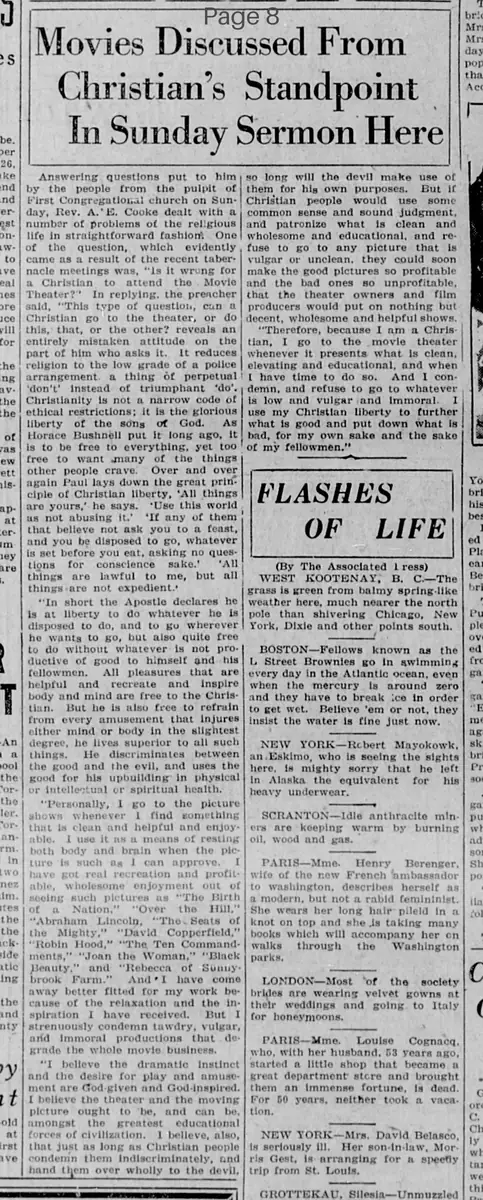
Movies Discussed From
Christian's Standpoint
In Sunday Sermon Here
Answering questions put to him by the people from the pulpit of First Congregational church on Sunday, Rev. A. E. Cooke dealt with a number of problems of the religious life in straightforward fashion. One of the questions, which evidently came as a result of the recent tabernacle meetings was, "Is it wrong for a Christian to attend the Movie Theater?" In replying, the preacher said, "This type of question, can a Christian go to the theater, or do this, that, or the other? reveals an entirely mistaken attitude on the part of him who asks it. It reduces religion to the low grade of a police arrangement, a thing of perpetual 'don't' instead of triumphant do's."
Christianity is not a narrow code of ethical restrictions: it is the glorious liberty of the sons of God. As Horace Bushnell put it long ago, it is to be free to everything, yet too free to want many of the things other people crave. Over and over again Paul lays down the great principle of Christian liberty, 'All things are yours,' he says. Use this world as not abusing it.' 'If any of them that believe not ask you to a feast, and you be disposed to go, whatever is set before you eat, asking no questions for conscience sake.' 'All things are lawful to me, but all things are not expedient."
In short the Apostle declares he is at liberty to do whatever he is disposed to do, and to go wherever he wants to go, but also quite free to do without whatever is not productive of good to himself and his fellowmen. All pleasures that are helpful and recreate and inspire body and mind are free to the Christian. But he is also free to refrain from every amusement that injures either mind or body in the slightest degree, he lives superior to all such things. He discriminates between the good and the evil, and uses the good for his upbuilding in physical or intellectual or spiritual health.
Personally, I go to the picture shows whenever I find something that is clean and helpful and enjoyable. I use it as a means of resting both body and brain when the picture is such as I can approve. I have got real recreation and profitable, wholesome enjoyment out of seeing such pictures as "The Birth of a Nation," "Over the Hill," "Abraham Lincoln," "The Seats of the Mighty," "David Copperfield," "Robin Hood," "The Ten Commandments," "Joan the Woman," "Black Beauty," and "Rebecca of Sunnybrook Farm."
And I have come away better fitted for my work because of the relaxation and the inspiration I have received. But I strenuously condemn tawdry, vulgar and immoral productions that degrade the whole movie business.
"I believe the dramatic instinct and the desire for play and amusement are God-given and God-inspired. I believe the theater and the moving picture ought to be, and can be, amongst the greatest educational forces of civilization. I believe, also, that just as long as Christian people condemn them indiscriminately, and hand them over wholly to the devil, so long will the devil make use of them for his own purposes. But if Christian people would use some common sense and sound judgment, and patronize what is clean and wholesome and educational, and refuse to go to any picture that is vulgar or unclean, they could soon make the good pictures so profitable and the bad ones so unprofitable, that the theater owners and film producers would put on nothing but decent, wholesome and helpful shows.
"Therefore, because I am a Christian, I go to the movie theater whenever it presents what is clean, elevating and educational, and when I have time to do so. And I condemn, and refuse to go to whatever is low and vulgar and immoral. I use my Christian liberty to further what is good and put down what is bad, for my own sake and the sake of my fellowmen."
Christian's Standpoint
In Sunday Sermon Here
Answering questions put to him by the people from the pulpit of First Congregational church on Sunday, Rev. A. E. Cooke dealt with a number of problems of the religious life in straightforward fashion. One of the questions, which evidently came as a result of the recent tabernacle meetings was, "Is it wrong for a Christian to attend the Movie Theater?" In replying, the preacher said, "This type of question, can a Christian go to the theater, or do this, that, or the other? reveals an entirely mistaken attitude on the part of him who asks it. It reduces religion to the low grade of a police arrangement, a thing of perpetual 'don't' instead of triumphant do's."
Christianity is not a narrow code of ethical restrictions: it is the glorious liberty of the sons of God. As Horace Bushnell put it long ago, it is to be free to everything, yet too free to want many of the things other people crave. Over and over again Paul lays down the great principle of Christian liberty, 'All things are yours,' he says. Use this world as not abusing it.' 'If any of them that believe not ask you to a feast, and you be disposed to go, whatever is set before you eat, asking no questions for conscience sake.' 'All things are lawful to me, but all things are not expedient."
In short the Apostle declares he is at liberty to do whatever he is disposed to do, and to go wherever he wants to go, but also quite free to do without whatever is not productive of good to himself and his fellowmen. All pleasures that are helpful and recreate and inspire body and mind are free to the Christian. But he is also free to refrain from every amusement that injures either mind or body in the slightest degree, he lives superior to all such things. He discriminates between the good and the evil, and uses the good for his upbuilding in physical or intellectual or spiritual health.
Personally, I go to the picture shows whenever I find something that is clean and helpful and enjoyable. I use it as a means of resting both body and brain when the picture is such as I can approve. I have got real recreation and profitable, wholesome enjoyment out of seeing such pictures as "The Birth of a Nation," "Over the Hill," "Abraham Lincoln," "The Seats of the Mighty," "David Copperfield," "Robin Hood," "The Ten Commandments," "Joan the Woman," "Black Beauty," and "Rebecca of Sunnybrook Farm."
And I have come away better fitted for my work because of the relaxation and the inspiration I have received. But I strenuously condemn tawdry, vulgar and immoral productions that degrade the whole movie business.
"I believe the dramatic instinct and the desire for play and amusement are God-given and God-inspired. I believe the theater and the moving picture ought to be, and can be, amongst the greatest educational forces of civilization. I believe, also, that just as long as Christian people condemn them indiscriminately, and hand them over wholly to the devil, so long will the devil make use of them for his own purposes. But if Christian people would use some common sense and sound judgment, and patronize what is clean and wholesome and educational, and refuse to go to any picture that is vulgar or unclean, they could soon make the good pictures so profitable and the bad ones so unprofitable, that the theater owners and film producers would put on nothing but decent, wholesome and helpful shows.
"Therefore, because I am a Christian, I go to the movie theater whenever it presents what is clean, elevating and educational, and when I have time to do so. And I condemn, and refuse to go to whatever is low and vulgar and immoral. I use my Christian liberty to further what is good and put down what is bad, for my own sake and the sake of my fellowmen."
What sub-type of article is it?
Biography
Historical Event
What themes does it cover?
Moral Virtue
Social Manners
What keywords are associated?
Christian Liberty
Movie Theaters
Sermon
Wholesome Entertainment
Moral Discernment
What entities or persons were involved?
Rev. A. E. Cooke
Horace Bushnell
Paul
Where did it happen?
First Congregational Church
Story Details
Key Persons
Rev. A. E. Cooke
Horace Bushnell
Paul
Location
First Congregational Church
Event Date
Sunday
Story Details
Rev. A. E. Cooke answers a question on whether Christians should attend movie theaters, emphasizing Christian liberty to enjoy clean, helpful films while avoiding vulgar ones, and shares personal examples of beneficial movies.