Thank you for visiting SNEWPapers!
Sign up free
Literary
February 22, 1900
The Hope Pioneer
Hope, Steele County, Griggs County, North Dakota
What is this article about?
In a Philippine military camp, General King confers gravely with officers on runaways and regiment readiness, interrupted by merry laughter from visitors in his tent. He joins young ladies, including Mrs. Garrison and Miss Prime, for tea, learning of a search for a missing brother, revealing personal sorrows amid wartime duties.
Clipping
OCR Quality
95%
Excellent
Full Text
BY BRIGADIER
GENERAL
CHARLES
KING.
A stirring Story of
Army Life in The Philippines
[Copyright, 1898, by F. Tennyson Neely.]
CHAPTER
II
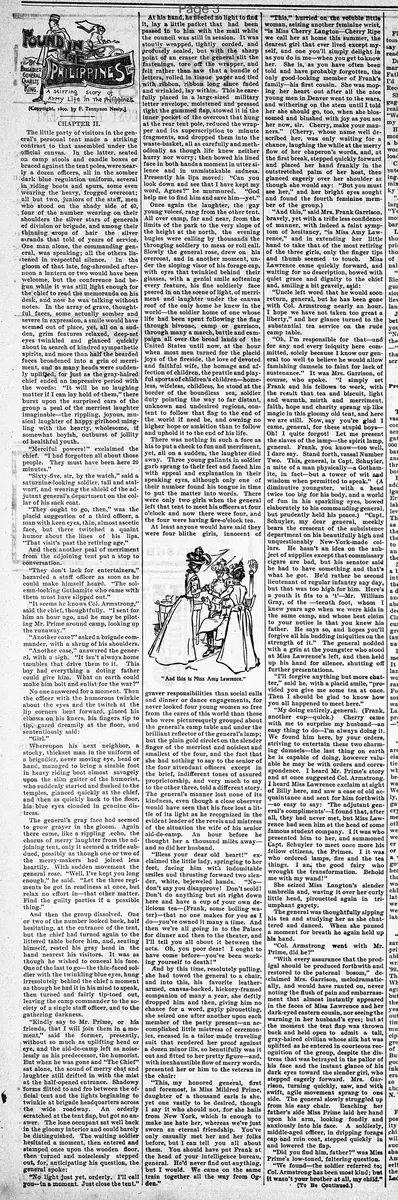
The little party of visitors in the general's personal tent made a striking contrast to that assembled under the official canvas. In the latter, seated on camp stools and candle boxes or braced against the tent poles, were nearly a dozen officers, all in the somber dark blue regulation uniform, several in riding boots and spurs, some even wearing the heavy, frogged overcoat; all but two, juniors of the staff, men who stood on the shady side of 40, four of the number wearing on their shoulders the silver stars of generals of division or brigade, and among their thinning crops of hair the silver strands that told of years of service. One man alone, the commanding general, was speaking; all the others listened in respectful silence. In the gloom of that late, fog-shrouded afternoon a lantern or two would have been welcome; but the conference had begun while it was still light enough for the chief to read the memoranda on his desk, and now he was talking without notes. In the array of grave, thoughtful faces, some actually somber and severe in expression, a smile would have seemed out of place, yet, all on a sudden, grim features relaxed, deep-set eyes twinkled and glanced quickly about in search of kindred sympathetic spirits, and more than half the bearded faces broadened into a grin of merriment, and as many heads were suddenly uplifted, for just as the gray-haired chief ended an impressive period with the words: "It will be no laughing matter if I can lay hold of them," there burst upon the surprised ears of the group a peal of the merriest laughter imaginable—the rippling, joyous, musical laughter of happy girlhood mingling with the hearty, wholesome, if somewhat boyish, outburst of jollity of healthful youth.
"Merciful powers!" exclaimed the chief. "I had forgotten all about those people. They must have been here 20 minutes."
"Sixty-five, sir, by the watch," said a saturnine-looking soldier, tall and stalwart, and wearing the shield of the adjutant general's department on the collar of his sack coat.
"They ought to go, then," was the placid suggestion of a third officer, a man with keen eyes, thin, almost ascetic face, but there twitched a quaint humor about the lines of his lips.
"That visit's past the retiring age."
And then another peal of merriment from the adjoining tent put a stop to conversation.
"They don't lack for entertainers," hazarded a staff officer as soon as he could make himself heard. "The solemn-looking Gothamite who came with them must have slipped out."
"It seems he knows Col. Armstrong," said the chief, thoughtfully. "I sent for him an hour ago, and he may be piloting Mr. Prime around camp, looking up the runaway."
"Another case?" asked a brigade commander, with a shrug of his shoulders.
"Another case," answered the general, with a sigh. "It isn't always home troubles that drive them to it. This boy had everything a doting father could give him. What on earth could make him bolt and enlist for the war?"
No one answered for a moment. Then the officer with the humorous twinkle about the eyes and the twitch at the lip corners bent forward, placed his elbows on his knees, his fingers tip to tip, gazed dreamily at the floor, and sententiously said:
"Girl."
Whereupon his next neighbor, a stocky, thickset man in the uniform of a brigadier, never moving eye, head or hand, managed to bring a sizable foot in heavy riding boot almost savagely upon the slim gaiter of the humorist, who suddenly started and flushed to the temples, glanced quickly at the chief, and then as quickly back to the floor, his blue eyes clouded in genuine distress.
The general's gray face had seemed to grow grayer in the gloom. Again there came, like a rippling echo, the chorus of merry laughter from the adjoining tent, only it seemed a trifle subdued, possibly as though one or two of the merry-makers had joined less heartily. With sudden movement the general rose. "Well, I've kept you long enough," he said. "Let the three regiments be got in readiness at once, but relax no effort in—that other matter. Find the guilty parties if possible."
And then the group dissolved. One or two of the number looked back, half hesitating, at the entrance of the tent, but the chief had turned again to the littered table before him, and, seating himself, rested his gray head in the hand nearest his visitors. It was as though he wished to conceal his face. One of the last to go—the thin-faced soldier with the twinkling blue eyes—hung irresolutely behind the chief a moment as though he had it in his mind to speak, then turned and fairly tip-toed out, leaving the camp commander to the society of a single staff officer, and to the gathering darkness.
"Kindly say to Mr. Prime, or his friends, that I will join them in a moment," said the former, presently, without so much as uplifting head or eye, and the aid-de-camp left as noiselessly as his predecessor, the humorist. But when he was gone and "The Chief" sat alone, the sound of merry chat and laughter still drifted in with the mist at the half-opened entrance. Shadowy forms flitted to and fro between the official tent and the lights beginning to twinkle at brigade headquarters across the wide roadway. An orderly scratched at the tent flap, but got no answer. The lone occupant sat well back in the gloomy interior and could barely be distinguished. The waiting soldier hesitated a moment, then entered and stamped once upon the wooden floor, then turned and noiselessly stepped out, for, anticipating his question, the general spoke:
"No light just yet, orderly. I'll call you in a moment. Just close the tent."
At his hand, he needed no light to find it, lay a little packet that had been passed in to him with the mail while the council was still in session. It was stoutly wrapped, tightly corded, and profusely sealed, but with the sharp point of an eraser the general slit the fastenings, tore off the wrapper, and felt rather than saw that a bundle of letters, rolled in tissue paper and tied with ribbon, ribbon long since faded and wrinkled, lay within. This he carefully placed in a large-sized military letter envelope, moistened and pressed tight the gummed flap, stowed it in the inner pocket of the overcoat that hung at the rear tent pole, reduced the wrapper and its superscription to minute fragments, and dropped them into the waste-basket, all as carefully and methodically as though life knew neither hurry nor worry; then bowed his lined face in both hands a moment in utter silence and in unmistakable sadness.
Presently his lips moved: "Can you look down and see that I have kept my word, Agnes?" he murmured.
"God help me to find him and save him—yet."
Once again the laughter, the gay young voices, rang from the other tent. All over camp, far and near, from the limits of the park to the very slope of the height at the north, the evening bugles were calling by thousands the thronging soldiery to mess or roll call. Slowly the general rose, drew on his overcoat, and in another moment, under the sloping visor of his forage cap, with eyes that twinkled behind their glasses, with a genial smile softening every feature, his fine soldierly face peered in on the scene of light, of merriment and laughter under the canvas roof of the only home he knew in the world—the soldier home of one whose life had been spent following the flag through bivouac, camp or garrison, through many a march, battle and campaign all over the broad lands of the United States until now, at the hour when most men turned for the placid joys of the fireside, the love of devoted and faithful wife, the homage and affection of children, the prattle and playful sports of children's children—homeless, wifeless, childless, he stood at the border of the boundless sea, soldier duty pointing the way to far distant, unknown and undesired regions, content to follow that flag to the end of the world if need be, and owning no higher hope or ambition than to follow and uphold it to the end of his life.
There was nothing in such a face as his to put a check to fun and merriment, yet, all on a sudden, the laughter died away. Three young gallants in soldier garb sprang to their feet and faced him with appeal and explanation in their speaking eyes, although only one of their number found his tongue in time to put the matter into words. There were only two girls when the general left that tent to meet his officers at four o'clock and now there were four, and the four were having five-o'clock tea. At least anyone would have said they were four blithe girls, innocent and this is Miss Amy Lawrence."
graver responsibilities than social calls and dinner or dance engagements, for never looked four young women so free from the cares of this world than those who were picturesquely grouped about the general's camp table and under the brilliant reflector of the general's lamp; but the plain gold circle on the slender finger of the merriest and noisiest and smallest of the four, and the fact that she had nothing to say to the senior of the four attendant officers except in the brief, indifferent tones of assured proprietorship, and very much to say to the other three, told a different story. The general's manner lost none of its kindness, even though a close observer would have seen that his face lost a little of its light as he recognized in the evident leader of the revels and mistress of the situation the wife of his senior aid-de-camp.
An hour before he thought her a thousand miles away—and so did her husband.
"Bless your dear old heart!" exclaimed the little lady, springing to her feet, facing him with indomitable smiles and thrusting forward two slender, white, bejeweled hands.
"No—don't say you disapprove! Don't scold! Don't do anything but sit right down here and have a cup of your own delicious tea—that no one makes for you as I do—you've owned it many a time. And then we're all going in to the Palace for dinner and then to the theater, and I'll tell you all about it between the acts. Oh, you poor dear! I ought to have come before—you've been working yourself to death!"
And by this time, resolutely pulling, she had towed the general to a chair, and into this, his favorite leather-armed, canvas-backed, hickory-framed companion of many a year, she deftly dropped him and then, giving him no chance for a word, gayly pirouetting, she seized one after another upon each member of the party present—an accomplished little mistress of ceremonies, encased in a tailor-made traveling suit that rendered her proof against a dozen minor ills, so beautifully was it cut and fitted to her pretty figure—and, with inexhaustible flow of merry words, presented her or him to the veteran in the chair:
"This, my honored general, first and foremost, is Miss Mildred Prime, daughter of a thousand earls is she, yet one vastly to be desired, though I say it who should not, for she hails from New York, which is enough to make me hate her, whereas we've just sworn an eternal friendship. You've only casually met her and her folks before, but I can tell you all about them. You should have put Frank at the head of your intelligence bureau, general. He'd never find out anything, but I would. We came on the same train together all the way from Ogden."
"This," hurried on the voluble little woman, seizing another feminine wrist, "is Miss Cherry Langton—Cherry Ripe we call her at home this summer, the dearest girl that ever lived except my self, and one you'll simply delight in as you do in me—when you get to know her. She is, as you have often been told and have probably forgotten, the only good-looking member of Frank's family—his first cousin. She was moping her heart out after all the nice young men in Denver went to the wars, and withering on the stem until I told her she should go, too, when she blossomed and blushed with joy as you see her now, sir. Cherry, make your manners."
(Cherry, whose name well described her, was only waiting for a chance, laughing the while at the merry flow of her chaperon's words, and, at the first break, stepped quickly forward and placed her hand frankly in the outstretched palm of her host, then glanced eagerly over her shoulder as though she would say: "But you must see her," and her bright eyes sought and found the fourth feminine member of the group.)
"And this," said Mrs. Frank Garrison, bravely, yet with a trifle less confidence of manner, with indeed a faint symptom of hesitancy, "is Miss Amy Lawrence," and in extending her little hand to take that of the most retiring of the three girls, only the finger tips and thumb seemed to touch. Miss Lawrence came quickly forward, and waiting for no description, bowed with quiet grace and dignity to the chief and, smiling a bit gravely, said:
"Uncle left word that he would soon return, general, but he has been gone with Col. Armstrong nearly an hour. I hope we have not taken too great a liberty," and her glance turned to the substantial tea service on the rude camp table.
"Oh, I'm responsible for that—and for any and every iniquity here committed, solely because I know our general too well to believe he would allow famishing damsels to faint for lack of sustenance." It was Mrs. Garrison, of course, who spoke. "I simply set Frank and his fellows to work, with the result that tea and biscuit, light and warmth, mirth and merriment, faith, hope and charity sprang up like magic in this gloomy old tent, and here we are still. Now, say you're glad I came, general, for these stupid boys—Oh! I quite forgot! Let me present the slaves of the lamp—the spirit lamp, general. Frank, you know—too well, I dare say. Stand forth, vassal Number Two. This, general, is Capt. Schuyler—a mite of a man physically—a Gothamite, in fact—but a tower of wit and wisdom when permitted to speak." (A diminutive youngster, with a head twice too big for his body, and a world of fun in his sparkling eyes, bowed elaborately to his commanding general but prudently held his peace.) "Capt. Schuyler, my dear general, meekly bears the crescent of the subsistence department on his beautifully high and unquestionably New-York-made collars. He hasn't an idea on the subject of supplies except that commissary cigars are bad, but his senator said he had to have something and that's what he got. He'd rather be second lieutenant of regular infantry any day, but that was too high for him. Here's a youth it fits to a t'—Mr. William Gray, of the -teenth foot, whom I knew years ago when we were kids in the same camp, and whose best claim to your notice is that you knew his father. He says so, and hopes you'll forgive all his budding iniquities on the strength of it." The general nodded with a grin at the youngster who stood at Miss Lawrence's left, and then held up his hand for silence, shutting off further presentations.
"I'll forgive anything but more chatter," said he, with a placid smile, "provided you give me some tea at once. Then I should be glad to know how you all happened to meet here."
"My doing entirely, general. (Frank, another cup—quick.) Cherry came with me to surprise my husband—an easy thing to do—I'm always doing it. We found him here, by your orders, striving to entertain these two charming damsels—the last thing on earth he is capable of doing, however valuable he may be with orders and correspondence. I heard Mr. Prime's story and at once suggested Col. Armstrong. I heard Miss Lawrence exclaim at sight of Billy here, and saw a case of old acquaintance and sent for him forthwith—so easy to say: 'The adjutant general's compliments'—I found that, after all, they had never met, but Miss Lawrence had seen him at the head of some famous student company. I it was who presented him to her, and summoned Capt. Schuyler to meet once more his fellow citizens, the Primes. I it was who ordered lamps, fire and the tea things. I am the good fairy who wrought the transformation. Behold me with my wand!"
She seized Miss Langton's slender umbrella and, waving it over her curly little head, pirouetted again in triumphant gayety.
The general was thoughtfully sipping his tea and studying her as she chattered and danced. When she paused a moment for breath he again held up his hand.
"Col. Armstrong went with Mr. Prime, did he?"
"With every assurance that the prodigal should be produced forthwith and restored to the paternal bosom," declared Mrs. Garrison, melodramatically, and would have ranted on, never noting the flush of pain and embarrassment that almost instantly appeared in the faces of Miss Lawrence and her dark-eyed eastern cousin, nor seeing the warning in her husband's eyes; but at the moment the tent flap was thrown back and held open to admit a tall, gray-haired civilian whose silk hat was uplifted as he entered in courteous recognition of the group, despite the distress that was betrayed in the pallor of his face and the instant glance of his dark eyes toward the slender girl, who stepped eagerly forward. Mrs. Garrison, turning quickly, saw, and with swift, agile movement sprang to one side. The general slowly struggled up from his easy chair. Reaching her father's side Miss Prime laid her hand upon his arm, looking fondly and anxiously into his face. A soldierly, middle-aged officer, in dripping forage cap and rain coat, stepped quickly in and lowered the flap.
"Did you find him, father?" was Miss Prime's low-toned, faltering question.
"We found—the soldier referred to. Col. Armstrong has been most kind; but it wasn't your brother at all, my child."
GENERAL
CHARLES
KING.
A stirring Story of
Army Life in The Philippines
[Copyright, 1898, by F. Tennyson Neely.]
CHAPTER
II
The little party of visitors in the general's personal tent made a striking contrast to that assembled under the official canvas. In the latter, seated on camp stools and candle boxes or braced against the tent poles, were nearly a dozen officers, all in the somber dark blue regulation uniform, several in riding boots and spurs, some even wearing the heavy, frogged overcoat; all but two, juniors of the staff, men who stood on the shady side of 40, four of the number wearing on their shoulders the silver stars of generals of division or brigade, and among their thinning crops of hair the silver strands that told of years of service. One man alone, the commanding general, was speaking; all the others listened in respectful silence. In the gloom of that late, fog-shrouded afternoon a lantern or two would have been welcome; but the conference had begun while it was still light enough for the chief to read the memoranda on his desk, and now he was talking without notes. In the array of grave, thoughtful faces, some actually somber and severe in expression, a smile would have seemed out of place, yet, all on a sudden, grim features relaxed, deep-set eyes twinkled and glanced quickly about in search of kindred sympathetic spirits, and more than half the bearded faces broadened into a grin of merriment, and as many heads were suddenly uplifted, for just as the gray-haired chief ended an impressive period with the words: "It will be no laughing matter if I can lay hold of them," there burst upon the surprised ears of the group a peal of the merriest laughter imaginable—the rippling, joyous, musical laughter of happy girlhood mingling with the hearty, wholesome, if somewhat boyish, outburst of jollity of healthful youth.
"Merciful powers!" exclaimed the chief. "I had forgotten all about those people. They must have been here 20 minutes."
"Sixty-five, sir, by the watch," said a saturnine-looking soldier, tall and stalwart, and wearing the shield of the adjutant general's department on the collar of his sack coat.
"They ought to go, then," was the placid suggestion of a third officer, a man with keen eyes, thin, almost ascetic face, but there twitched a quaint humor about the lines of his lips.
"That visit's past the retiring age."
And then another peal of merriment from the adjoining tent put a stop to conversation.
"They don't lack for entertainers," hazarded a staff officer as soon as he could make himself heard. "The solemn-looking Gothamite who came with them must have slipped out."
"It seems he knows Col. Armstrong," said the chief, thoughtfully. "I sent for him an hour ago, and he may be piloting Mr. Prime around camp, looking up the runaway."
"Another case?" asked a brigade commander, with a shrug of his shoulders.
"Another case," answered the general, with a sigh. "It isn't always home troubles that drive them to it. This boy had everything a doting father could give him. What on earth could make him bolt and enlist for the war?"
No one answered for a moment. Then the officer with the humorous twinkle about the eyes and the twitch at the lip corners bent forward, placed his elbows on his knees, his fingers tip to tip, gazed dreamily at the floor, and sententiously said:
"Girl."
Whereupon his next neighbor, a stocky, thickset man in the uniform of a brigadier, never moving eye, head or hand, managed to bring a sizable foot in heavy riding boot almost savagely upon the slim gaiter of the humorist, who suddenly started and flushed to the temples, glanced quickly at the chief, and then as quickly back to the floor, his blue eyes clouded in genuine distress.
The general's gray face had seemed to grow grayer in the gloom. Again there came, like a rippling echo, the chorus of merry laughter from the adjoining tent, only it seemed a trifle subdued, possibly as though one or two of the merry-makers had joined less heartily. With sudden movement the general rose. "Well, I've kept you long enough," he said. "Let the three regiments be got in readiness at once, but relax no effort in—that other matter. Find the guilty parties if possible."
And then the group dissolved. One or two of the number looked back, half hesitating, at the entrance of the tent, but the chief had turned again to the littered table before him, and, seating himself, rested his gray head in the hand nearest his visitors. It was as though he wished to conceal his face. One of the last to go—the thin-faced soldier with the twinkling blue eyes—hung irresolutely behind the chief a moment as though he had it in his mind to speak, then turned and fairly tip-toed out, leaving the camp commander to the society of a single staff officer, and to the gathering darkness.
"Kindly say to Mr. Prime, or his friends, that I will join them in a moment," said the former, presently, without so much as uplifting head or eye, and the aid-de-camp left as noiselessly as his predecessor, the humorist. But when he was gone and "The Chief" sat alone, the sound of merry chat and laughter still drifted in with the mist at the half-opened entrance. Shadowy forms flitted to and fro between the official tent and the lights beginning to twinkle at brigade headquarters across the wide roadway. An orderly scratched at the tent flap, but got no answer. The lone occupant sat well back in the gloomy interior and could barely be distinguished. The waiting soldier hesitated a moment, then entered and stamped once upon the wooden floor, then turned and noiselessly stepped out, for, anticipating his question, the general spoke:
"No light just yet, orderly. I'll call you in a moment. Just close the tent."
At his hand, he needed no light to find it, lay a little packet that had been passed in to him with the mail while the council was still in session. It was stoutly wrapped, tightly corded, and profusely sealed, but with the sharp point of an eraser the general slit the fastenings, tore off the wrapper, and felt rather than saw that a bundle of letters, rolled in tissue paper and tied with ribbon, ribbon long since faded and wrinkled, lay within. This he carefully placed in a large-sized military letter envelope, moistened and pressed tight the gummed flap, stowed it in the inner pocket of the overcoat that hung at the rear tent pole, reduced the wrapper and its superscription to minute fragments, and dropped them into the waste-basket, all as carefully and methodically as though life knew neither hurry nor worry; then bowed his lined face in both hands a moment in utter silence and in unmistakable sadness.
Presently his lips moved: "Can you look down and see that I have kept my word, Agnes?" he murmured.
"God help me to find him and save him—yet."
Once again the laughter, the gay young voices, rang from the other tent. All over camp, far and near, from the limits of the park to the very slope of the height at the north, the evening bugles were calling by thousands the thronging soldiery to mess or roll call. Slowly the general rose, drew on his overcoat, and in another moment, under the sloping visor of his forage cap, with eyes that twinkled behind their glasses, with a genial smile softening every feature, his fine soldierly face peered in on the scene of light, of merriment and laughter under the canvas roof of the only home he knew in the world—the soldier home of one whose life had been spent following the flag through bivouac, camp or garrison, through many a march, battle and campaign all over the broad lands of the United States until now, at the hour when most men turned for the placid joys of the fireside, the love of devoted and faithful wife, the homage and affection of children, the prattle and playful sports of children's children—homeless, wifeless, childless, he stood at the border of the boundless sea, soldier duty pointing the way to far distant, unknown and undesired regions, content to follow that flag to the end of the world if need be, and owning no higher hope or ambition than to follow and uphold it to the end of his life.
There was nothing in such a face as his to put a check to fun and merriment, yet, all on a sudden, the laughter died away. Three young gallants in soldier garb sprang to their feet and faced him with appeal and explanation in their speaking eyes, although only one of their number found his tongue in time to put the matter into words. There were only two girls when the general left that tent to meet his officers at four o'clock and now there were four, and the four were having five-o'clock tea. At least anyone would have said they were four blithe girls, innocent and this is Miss Amy Lawrence."
graver responsibilities than social calls and dinner or dance engagements, for never looked four young women so free from the cares of this world than those who were picturesquely grouped about the general's camp table and under the brilliant reflector of the general's lamp; but the plain gold circle on the slender finger of the merriest and noisiest and smallest of the four, and the fact that she had nothing to say to the senior of the four attendant officers except in the brief, indifferent tones of assured proprietorship, and very much to say to the other three, told a different story. The general's manner lost none of its kindness, even though a close observer would have seen that his face lost a little of its light as he recognized in the evident leader of the revels and mistress of the situation the wife of his senior aid-de-camp.
An hour before he thought her a thousand miles away—and so did her husband.
"Bless your dear old heart!" exclaimed the little lady, springing to her feet, facing him with indomitable smiles and thrusting forward two slender, white, bejeweled hands.
"No—don't say you disapprove! Don't scold! Don't do anything but sit right down here and have a cup of your own delicious tea—that no one makes for you as I do—you've owned it many a time. And then we're all going in to the Palace for dinner and then to the theater, and I'll tell you all about it between the acts. Oh, you poor dear! I ought to have come before—you've been working yourself to death!"
And by this time, resolutely pulling, she had towed the general to a chair, and into this, his favorite leather-armed, canvas-backed, hickory-framed companion of many a year, she deftly dropped him and then, giving him no chance for a word, gayly pirouetting, she seized one after another upon each member of the party present—an accomplished little mistress of ceremonies, encased in a tailor-made traveling suit that rendered her proof against a dozen minor ills, so beautifully was it cut and fitted to her pretty figure—and, with inexhaustible flow of merry words, presented her or him to the veteran in the chair:
"This, my honored general, first and foremost, is Miss Mildred Prime, daughter of a thousand earls is she, yet one vastly to be desired, though I say it who should not, for she hails from New York, which is enough to make me hate her, whereas we've just sworn an eternal friendship. You've only casually met her and her folks before, but I can tell you all about them. You should have put Frank at the head of your intelligence bureau, general. He'd never find out anything, but I would. We came on the same train together all the way from Ogden."
"This," hurried on the voluble little woman, seizing another feminine wrist, "is Miss Cherry Langton—Cherry Ripe we call her at home this summer, the dearest girl that ever lived except my self, and one you'll simply delight in as you do in me—when you get to know her. She is, as you have often been told and have probably forgotten, the only good-looking member of Frank's family—his first cousin. She was moping her heart out after all the nice young men in Denver went to the wars, and withering on the stem until I told her she should go, too, when she blossomed and blushed with joy as you see her now, sir. Cherry, make your manners."
(Cherry, whose name well described her, was only waiting for a chance, laughing the while at the merry flow of her chaperon's words, and, at the first break, stepped quickly forward and placed her hand frankly in the outstretched palm of her host, then glanced eagerly over her shoulder as though she would say: "But you must see her," and her bright eyes sought and found the fourth feminine member of the group.)
"And this," said Mrs. Frank Garrison, bravely, yet with a trifle less confidence of manner, with indeed a faint symptom of hesitancy, "is Miss Amy Lawrence," and in extending her little hand to take that of the most retiring of the three girls, only the finger tips and thumb seemed to touch. Miss Lawrence came quickly forward, and waiting for no description, bowed with quiet grace and dignity to the chief and, smiling a bit gravely, said:
"Uncle left word that he would soon return, general, but he has been gone with Col. Armstrong nearly an hour. I hope we have not taken too great a liberty," and her glance turned to the substantial tea service on the rude camp table.
"Oh, I'm responsible for that—and for any and every iniquity here committed, solely because I know our general too well to believe he would allow famishing damsels to faint for lack of sustenance." It was Mrs. Garrison, of course, who spoke. "I simply set Frank and his fellows to work, with the result that tea and biscuit, light and warmth, mirth and merriment, faith, hope and charity sprang up like magic in this gloomy old tent, and here we are still. Now, say you're glad I came, general, for these stupid boys—Oh! I quite forgot! Let me present the slaves of the lamp—the spirit lamp, general. Frank, you know—too well, I dare say. Stand forth, vassal Number Two. This, general, is Capt. Schuyler—a mite of a man physically—a Gothamite, in fact—but a tower of wit and wisdom when permitted to speak." (A diminutive youngster, with a head twice too big for his body, and a world of fun in his sparkling eyes, bowed elaborately to his commanding general but prudently held his peace.) "Capt. Schuyler, my dear general, meekly bears the crescent of the subsistence department on his beautifully high and unquestionably New-York-made collars. He hasn't an idea on the subject of supplies except that commissary cigars are bad, but his senator said he had to have something and that's what he got. He'd rather be second lieutenant of regular infantry any day, but that was too high for him. Here's a youth it fits to a t'—Mr. William Gray, of the -teenth foot, whom I knew years ago when we were kids in the same camp, and whose best claim to your notice is that you knew his father. He says so, and hopes you'll forgive all his budding iniquities on the strength of it." The general nodded with a grin at the youngster who stood at Miss Lawrence's left, and then held up his hand for silence, shutting off further presentations.
"I'll forgive anything but more chatter," said he, with a placid smile, "provided you give me some tea at once. Then I should be glad to know how you all happened to meet here."
"My doing entirely, general. (Frank, another cup—quick.) Cherry came with me to surprise my husband—an easy thing to do—I'm always doing it. We found him here, by your orders, striving to entertain these two charming damsels—the last thing on earth he is capable of doing, however valuable he may be with orders and correspondence. I heard Mr. Prime's story and at once suggested Col. Armstrong. I heard Miss Lawrence exclaim at sight of Billy here, and saw a case of old acquaintance and sent for him forthwith—so easy to say: 'The adjutant general's compliments'—I found that, after all, they had never met, but Miss Lawrence had seen him at the head of some famous student company. I it was who presented him to her, and summoned Capt. Schuyler to meet once more his fellow citizens, the Primes. I it was who ordered lamps, fire and the tea things. I am the good fairy who wrought the transformation. Behold me with my wand!"
She seized Miss Langton's slender umbrella and, waving it over her curly little head, pirouetted again in triumphant gayety.
The general was thoughtfully sipping his tea and studying her as she chattered and danced. When she paused a moment for breath he again held up his hand.
"Col. Armstrong went with Mr. Prime, did he?"
"With every assurance that the prodigal should be produced forthwith and restored to the paternal bosom," declared Mrs. Garrison, melodramatically, and would have ranted on, never noting the flush of pain and embarrassment that almost instantly appeared in the faces of Miss Lawrence and her dark-eyed eastern cousin, nor seeing the warning in her husband's eyes; but at the moment the tent flap was thrown back and held open to admit a tall, gray-haired civilian whose silk hat was uplifted as he entered in courteous recognition of the group, despite the distress that was betrayed in the pallor of his face and the instant glance of his dark eyes toward the slender girl, who stepped eagerly forward. Mrs. Garrison, turning quickly, saw, and with swift, agile movement sprang to one side. The general slowly struggled up from his easy chair. Reaching her father's side Miss Prime laid her hand upon his arm, looking fondly and anxiously into his face. A soldierly, middle-aged officer, in dripping forage cap and rain coat, stepped quickly in and lowered the flap.
"Did you find him, father?" was Miss Prime's low-toned, faltering question.
"We found—the soldier referred to. Col. Armstrong has been most kind; but it wasn't your brother at all, my child."
What sub-type of article is it?
Prose Fiction
What themes does it cover?
War Peace
What keywords are associated?
Army Life
Philippines
Military Camp
Officers Conference
Social Gathering
Runaway Soldier
Family Reunion
War Preparations
What entities or persons were involved?
By Brigadier General Charles King.
Literary Details
Title
Chapter Ii
Author
By Brigadier General Charles King.
Subject
A Stirring Story Of Army Life In The Philippines
Key Lines
"It Will Be No Laughing Matter If I Can Lay Hold Of Them,"
"Girl."
"Can You Look Down And See That I Have Kept My Word, Agnes?" He Murmured. "God Help Me To Find Him And Save Him—Yet."
"Bless Your Dear Old Heart!" Exclaimed The Little Lady, Springing To Her Feet, Facing Him With Indomitable Smiles And Thrusting Forward Two Slender, White, Bejeweled Hands.
"We Found—The Soldier Referred To. Col. Armstrong Has Been Most Kind; But It Wasn't Your Brother At All, My Child."