Thank you for visiting SNEWPapers!
Sign up free
Literary
July 12, 1836
Rutland Herald
Rutland, Rutland County, Vermont
What is this article about?
An essay from the N. H. Argus & Spectator condemns slander as a destructive vice stemming from envy and jealousy, especially damaging to women's reputations in society. It argues that no excuse justifies it and calls for virtuous conversation.
Clipping
OCR Quality
95%
Excellent
Full Text
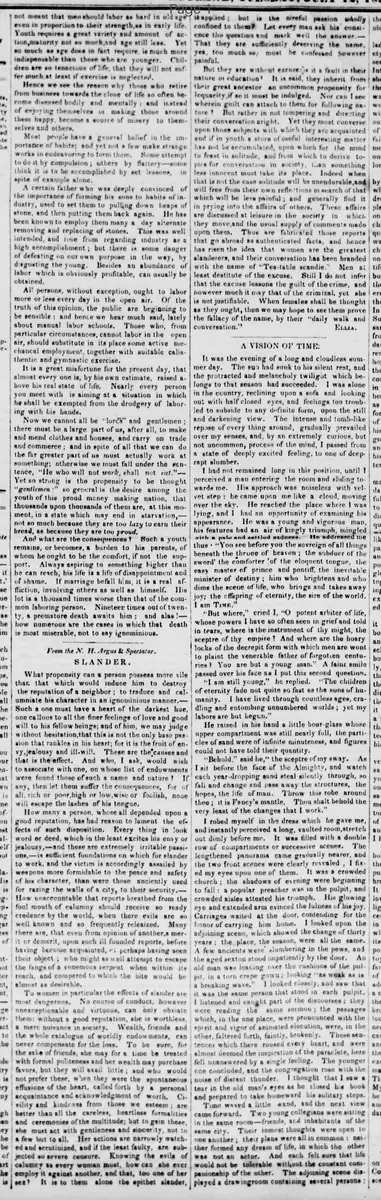
From the N. H. Argus & Spectator.
SLANDER.
What propensity can a person possess more vile
than that which would induce him to destroy
the reputation of a neighbor: to traduce and calumniate
his character in an ignominious manner.—
Such a one must have a heart of the darkest hue,
one callous to all the finer feelings of love and good
will to his fellow beings; and of him, we may judge
without hesitation, that this is not the only base passion
that rankles in his heart; for it is the fruit of envy,
jealousy and ill-will. These are the causes and
that is the effect. And who, I ask, would wish
to associate with one, on whose list of endowments
were found those of such a name and nature? If
any, then let them suffer the consequences, for of
all, rich or poor, high or low, wise or foolish, none
will escape the lashes of his tongue.
How many a person, whose all depended upon a
good reputation, has had reason to lament the effects
of such disposition. Every thing in look
word or deed, which in the least excites his envy or
jealousy,—and these are extremely irritable passions,—
is sufficient foundations on which for slander
to work, and the victim is accordingly assailed by
weapons more formidable to the peace and safety
of his character, than were those anciently used
for razing the walls of a city, to their security.—
How unaccountable that reports breathed from the
foul mouth of calumny should receive so ready
credence by the world, when there evils are so
well known and so frequently realized. Many
there are, that even from opinion of another's merit
or demerit, upon such ill founded reports, before
having become acquainted, or perhaps having seen
their object; who might as well attempt to escape
the fangs of a venomous serpent when within its
reach, and compared to which the bite would be
almost as desirable.
To women in particular the effects of slander are
most dangerous. No course of conduct, however
unexceptionable and virtuous, can only obviate
them: without a good reputation, she is worthless,
a mere nuisance in society. Wealth, friends and
the whole catalogue of worldly endowments, can
never compensate for the loss. To be sure, for
the sake of friends, she may for a time be treated
with formal politeness and her wealth may purchase
favors, but they will avail little; and who would
not prefer these, when they were the spontaneous
effusions of the heart, called forth by a personal
acquaintance and acknowledgment of worth. Civility
and kindness from those we esteem; are
better than all the careless, heartless formalities
and ceremonies of the multitude; but to gain these,
she must act with gentleness and sincerity, not to
a few but to all. Her actions are narrowly watched
and scrutinized, and if the least faulty. are subjected
so severe censure. Knowing the evils of
calumny as every woman must, how can she ever
employ it against another, and that, too one of her
own sex? It is to them alone the epithet slander,
is applied; but is the direful passion wholly
confined to them? Let every man ask his conscience
the question and mark well the answer.—
That they are sufficiently deserving the name,
yea, too much so; must be confessed however
painful.
But they are without excuse: is it a fault in their
nature or education? It is said, they inherit from
their great ancestor an uncommon propensity for
loquacity, if so it must be indulged. Nor can I see
wherein guilt can attach to them for following nature?
But rather in not tempering and directing
their conversation aright. Yet they must converse
upon those subjects with which they are acquainted
and if in youth a store of useful interesting matter
has not been accumulated, upon which for the mind
to feast in solitude, and from which to derive topics
for conversation in society, something
less innocent must take its place. Indeed when
that is not the case solitude will be unendurable, and
will flee from their own reflections in search of that
which will be less painful: and generally find it
in prying into the affairs of others. These affairs
are discussed at leisure in the society in which
they move, and the usual supply of comments made
upon them. Thus are fabricated those reports
that go abroad as authenticated facts, and hence
has risen the idea that women are the greatest
slanderers, and their conversation has been branded
with the name of "Tea-table scandal." Men at
least destitute of the excuse. Still I do not infer
that the excuse lessens the guilt of the crime, and
however much it may that of the criminal, yet she
is not justifiable. When females shall be thought
as they ought, then we may hope to see them prove
the fallacy of the name, by their "daily walk and
Conversation."
ELLIA.
SLANDER.
What propensity can a person possess more vile
than that which would induce him to destroy
the reputation of a neighbor: to traduce and calumniate
his character in an ignominious manner.—
Such a one must have a heart of the darkest hue,
one callous to all the finer feelings of love and good
will to his fellow beings; and of him, we may judge
without hesitation, that this is not the only base passion
that rankles in his heart; for it is the fruit of envy,
jealousy and ill-will. These are the causes and
that is the effect. And who, I ask, would wish
to associate with one, on whose list of endowments
were found those of such a name and nature? If
any, then let them suffer the consequences, for of
all, rich or poor, high or low, wise or foolish, none
will escape the lashes of his tongue.
How many a person, whose all depended upon a
good reputation, has had reason to lament the effects
of such disposition. Every thing in look
word or deed, which in the least excites his envy or
jealousy,—and these are extremely irritable passions,—
is sufficient foundations on which for slander
to work, and the victim is accordingly assailed by
weapons more formidable to the peace and safety
of his character, than were those anciently used
for razing the walls of a city, to their security.—
How unaccountable that reports breathed from the
foul mouth of calumny should receive so ready
credence by the world, when there evils are so
well known and so frequently realized. Many
there are, that even from opinion of another's merit
or demerit, upon such ill founded reports, before
having become acquainted, or perhaps having seen
their object; who might as well attempt to escape
the fangs of a venomous serpent when within its
reach, and compared to which the bite would be
almost as desirable.
To women in particular the effects of slander are
most dangerous. No course of conduct, however
unexceptionable and virtuous, can only obviate
them: without a good reputation, she is worthless,
a mere nuisance in society. Wealth, friends and
the whole catalogue of worldly endowments, can
never compensate for the loss. To be sure, for
the sake of friends, she may for a time be treated
with formal politeness and her wealth may purchase
favors, but they will avail little; and who would
not prefer these, when they were the spontaneous
effusions of the heart, called forth by a personal
acquaintance and acknowledgment of worth. Civility
and kindness from those we esteem; are
better than all the careless, heartless formalities
and ceremonies of the multitude; but to gain these,
she must act with gentleness and sincerity, not to
a few but to all. Her actions are narrowly watched
and scrutinized, and if the least faulty. are subjected
so severe censure. Knowing the evils of
calumny as every woman must, how can she ever
employ it against another, and that, too one of her
own sex? It is to them alone the epithet slander,
is applied; but is the direful passion wholly
confined to them? Let every man ask his conscience
the question and mark well the answer.—
That they are sufficiently deserving the name,
yea, too much so; must be confessed however
painful.
But they are without excuse: is it a fault in their
nature or education? It is said, they inherit from
their great ancestor an uncommon propensity for
loquacity, if so it must be indulged. Nor can I see
wherein guilt can attach to them for following nature?
But rather in not tempering and directing
their conversation aright. Yet they must converse
upon those subjects with which they are acquainted
and if in youth a store of useful interesting matter
has not been accumulated, upon which for the mind
to feast in solitude, and from which to derive topics
for conversation in society, something
less innocent must take its place. Indeed when
that is not the case solitude will be unendurable, and
will flee from their own reflections in search of that
which will be less painful: and generally find it
in prying into the affairs of others. These affairs
are discussed at leisure in the society in which
they move, and the usual supply of comments made
upon them. Thus are fabricated those reports
that go abroad as authenticated facts, and hence
has risen the idea that women are the greatest
slanderers, and their conversation has been branded
with the name of "Tea-table scandal." Men at
least destitute of the excuse. Still I do not infer
that the excuse lessens the guilt of the crime, and
however much it may that of the criminal, yet she
is not justifiable. When females shall be thought
as they ought, then we may hope to see them prove
the fallacy of the name, by their "daily walk and
Conversation."
ELLIA.
What sub-type of article is it?
Essay
What themes does it cover?
Moral Virtue
Social Manners
What keywords are associated?
Slander
Reputation
Envy
Jealousy
Women
Society
Moral
Calumny
Conversation
What entities or persons were involved?
Ellia.
Literary Details
Title
Slander.
Author
Ellia.
Key Lines
What Propensity Can A Person Possess More Vile Than That Which Would Induce Him To Destroy The Reputation Of A Neighbor: To Traduce And Calumniate His Character In An Ignominious Manner.
To Women In Particular The Effects Of Slander Are Most Dangerous. No Course Of Conduct, However Unexceptionable And Virtuous, Can Only Obviate Them: Without A Good Reputation, She Is Worthless, A Mere Nuisance In Society.
When Females Shall Be Thought As They Ought, Then We May Hope To See Them Prove The Fallacy Of The Name, By Their "Daily Walk And Conversation."