Thank you for visiting SNEWPapers!
Sign up free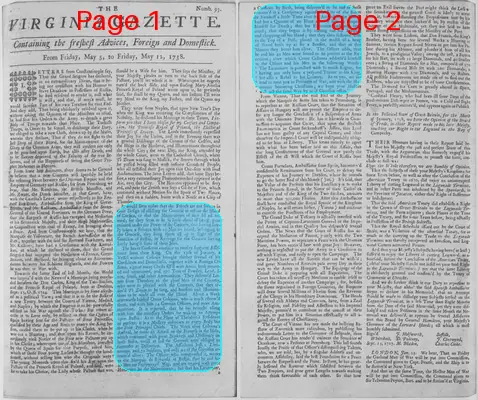
The Virginia Gazette
Richmond, Williamsburg, Richmond County, Virginia
What is this article about?
Corsican rebels hang 21 Genoese prisoners near Bastia in revenge. They receive aid from King Theodore on January 15, including officers, arms, and ammunition, followed by Count Colonna and more support. Colonna attacks and captures Isola fortress, with 74 Corsican casualties and 49 Genoese survivors taken prisoner. A Corsican-born lieutenant is cruelly executed for treason.
Merged-components note: This is a clear continuation of the Corsica story across pages, as the text of the first component ends mid-sentence and the second picks up directly.
Clippings
1 of 2
OCR Quality
Full Text
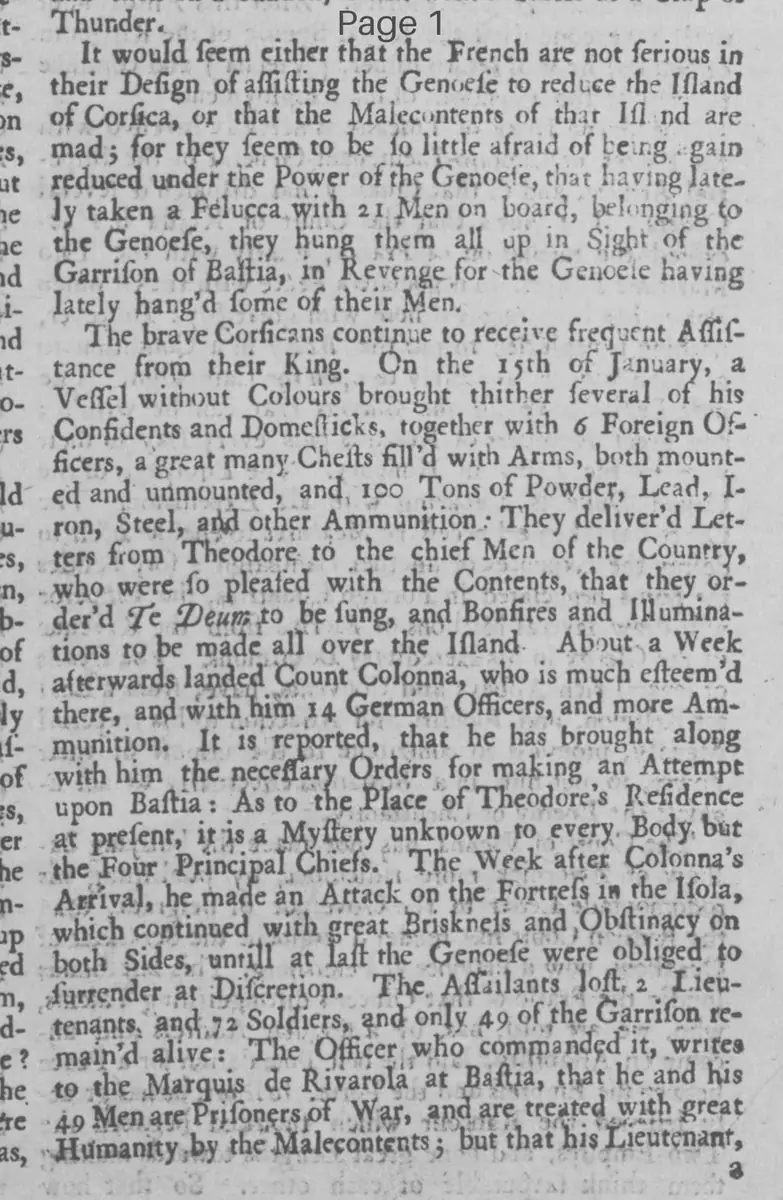
The brave Corsicans continue to receive frequent Assistance from their King. On the 15th of January, a Vessel without Colours brought thither several of his Confidents and Domesticks, together with 6 Foreign Officers, a great many Chests fill'd with Arms, both mounted and unmounted, and, 100 Tons of Powder, Lead, Iron, Steel, and other Ammunition: They deliver'd Letters from Theodore to the chief Men of the Country, who were so pleased with the Contents, that they order'd Te Deum to be sung, and Bonfires and Illuminations to be made all over the Island. About a Week afterwards landed Count Colonna, who is much esteem'd there, and with him 14 German Officers, and more Ammunition. It is reported, that he has brought along with him the necessary Orders for making an Attempt upon Bastia: As to the Place of Theodore's Residence at present, it is a Mystery unknown to every Body but the Four Principal Chiefs.
The Week after Colonna's Arrival, he made an Attack on the Fortress in the Isola, which continued with great Briskness and Obstinacy on both Sides, until at last the Genoese were obliged to surrender at Discretion. The Assailants lost 2 Lieutenants and 72 Soldiers, and only 49 of the Garrison remain'd alive: The Officer who commanded it, writes to the Marquis de Rivarola at Bastia, that he and his 49 Men are Prisoners of War, and are treated with great Humanity by the Malecontents; but that his Lieutenant,
A Corsican by birth, being discovered to be one of those concerned in a conspiracy against the life of the Baron de Newhoff a little time after his arrival in the island, had but a quarter of an hour allowed him to prepare himself for death; that his execution had been very cruel; that they began it by cutting out his tongue, and chopping off his hand; that they then fastened him to the top of a post, placed in the midst of a heap of wood built up as for a bonfire, and that in this manner they burnt him alive. The officer adds, that he and his 49 men were forced to be present at the execution; after which Count Colonna addressed himself to the officer and his men in the following words: The lieutenant is punished with so much rigour, for having not only been a perjured traitor to his king, but also a rebel to his country. As to you, we intend to treat you as prisoners of war, and with the humanity becoming Christians; we hope your masters will act the same way by us if occasion offers.
What sub-type of article is it?
What keywords are associated?
What entities or persons were involved?
Where did it happen?
Foreign News Details
Primary Location
Corsica
Event Date
January 15
Key Persons
Outcome
corsicans hang 21 genoese prisoners; attack on isola fortress results in 2 corsican lieutenants and 72 soldiers killed, 49 genoese garrison members survive as prisoners; cruel execution of traitorous lieutenant by mutilation and burning alive.
Event Details
Corsican rebels, unafraid of French-Genoese efforts, hang 21 captured Genoese in view of Bastia garrison in revenge. They receive aid from King Theodore on January 15 via a vessel with confidants, 6 foreign officers, arms, and 100 tons of ammunition, prompting celebrations. A week later, Count Colonna arrives with 14 German officers and more ammunition, planning an attempt on Bastia. The following week, Colonna attacks Isola fortress, forcing Genoese surrender; the garrison commander reports humane treatment for prisoners but describes the brutal execution of his Corsican-born lieutenant for conspiring against Baron de Newhoff. Colonna justifies the punishment and promises Christian treatment for the prisoners.