Thank you for visiting SNEWPapers!
Sign up free
The Morning News
Savannah, Chatham County, Georgia
What is this article about?
In the last century, two Indian brothers loved the same woman, whom the elder married despite her preference for the younger. While hunting near Clearwater canyon, the younger betrays the elder by stranding him on a ledge to die while retrieving eagle young. The elder survives by eating eagles' food, catches rain, and eventually hitches a ride on the fledging eagles to escape. He returns home and kills both the brother and the woman in revenge.
Clipping
OCR Quality
Full Text
This is Event 2 of 2. The full text below covers all events in this component.
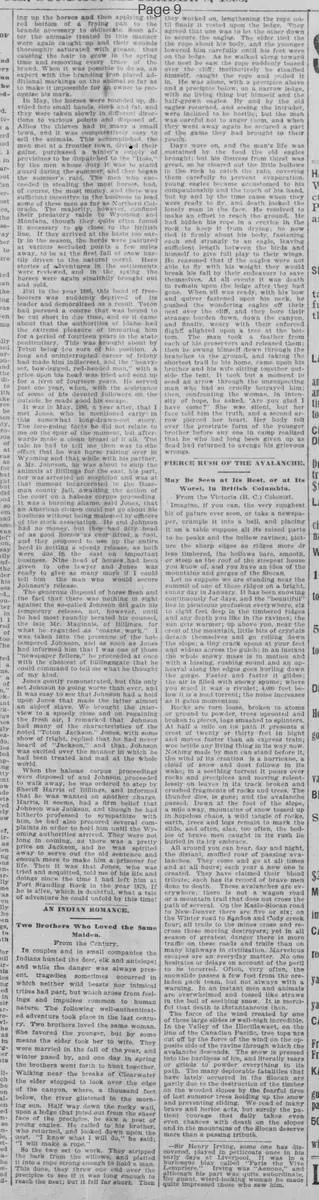
Two Brothers Who Loved the Same Maiden.
From the Century.
In couples and in small companies the Indians hunted the deer, elk and antelope; and while the danger was always present, tragedies sometimes occurred in which neither wild beasts nor inimical tribes had part, but which arose from feelings and impulses common to human nature. The following well-authenticated adventure took place in the last century. Two brothers loved the same woman. She favored the younger, but by some means the elder took her to wife. They were married in the fall of the year, and winter passed by, and one day in spring the brothers went forth to hunt together. Walking near the breaks of Clearwater the elder stopped to look over the edge of the canyon, where, a thousand feet below, the river glistened in the morning sun. Half way down the rocky wall, upon a ledge that jutted out from the sheer face of the precipice, he saw a nest of young eagles. He called to his brother, who returned, and looked down upon the nest.
"I know what I will do," he said; "I will make a rope."
So the two set to work. They stripped the bark from the willows, and plaited it into a rope strong enough to hold a man. This done, they threw one end over the precipice to see if it was long enough to reach the nest; but it fell far short. Then they worked on, lengthening the rope until finally it rested upon the ledge. They agreed that one was to let the other down to secure the eagles. The elder tied the rope about his body, and the younger lowered him carefully until his feet were on the ledge. As he walked along toward the nest he saw the rope suddenly tossed over the cliff; instinctively he steadied himself, caught the rope and pulled it in. He was alone, with a precipice above and a precipice below, on a narrow ledge, with no living thing but himself and the half-grown eagles. By and by the old eagles returned, and seeing the intruder, were inclined to be hostile; but the man was careful not to anger them, and when they went away again he secured a part of the game they had brought to their young.
Days wore on, and the man's life was sustained by the food the old eagles brought; but his distress from thirst was great, so he cleared out the little hollows in the rock to catch the rain, covering them carefully to prevent evaporation. The young eagles became accustomed to his companionship and the touch of his hand, but by and by the time came when they were ready to fly, and death looked the lonely man in the face. He resolved to make an effort to reach the ground. He had hidden his rope in a crevice in the rock to keep it from drying; he now tied it firmly about his body, fastening each end strongly to an eagle, leaving sufficient length between the birds and himself to give full play to their wings. He reasoned that if the eagles were not able to fly with his weight they would break his fall by their endeavors to save themselves. At all events it was death to remain upon the ledge after they had gone. When all was ready, with his bow and quiver fastened upon his neck, he pushed the wondering eagles off their nest over the cliff, and they bore their strange burden down, down the canyon, and finally, weary with their enforced flight, alighted upon a tree at the bottom. The man took a feather from each of his preservers and released them; then he swung himself down through the branches to the ground, and taking the shortest trail to his home, came upon his brother and his wife sitting together outside the tent. It took but a moment to send an arrow through the unsuspecting man who had so cruelly betrayed him; then, confronting the woman, in intensity of hope, he asked, "Are you glad I have come?" She was silent, but her face told him the truth, and a second arrow pierced her heart. Her body fell over the prostrate form of the younger brother before any one in camp realized that he who had long been given up as dead had returned to avenge his grievous wrongs.
What sub-type of article is it?
What themes does it cover?
What keywords are associated?
What entities or persons were involved?
Literary Details
Title
An Indian Romance. Two Brothers Who Loved The Same Maiden.
Author
From The Century.
Key Lines