Thank you for visiting SNEWPapers!
Sign up free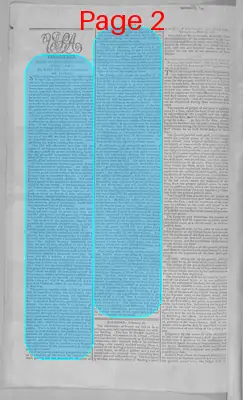
Story
March 12, 1791
Gazette Of The United States
New York, New York County, New York
What is this article about?
On February 4, in the House of Representatives, Mr. Jackson delivers a speech opposing the Bank Bill, arguing its unconstitutionality, interference with states' rights, potential for monopoly, and lack of necessity, urging postponement.
Clipping
OCR Quality
98%
Excellent
Full Text
CONGRESS.
HOUSE OF REPRESENTATIVES.
FRIDAY, Feb. 4.
The BANK BILL under consideration.
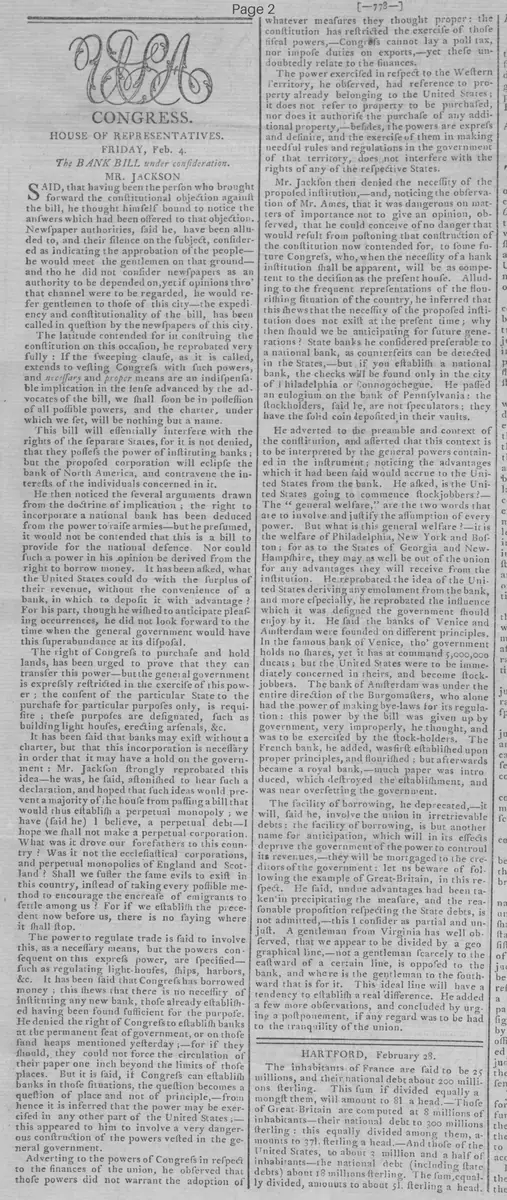
MR. JACKSON said, that having been the person who brought forward the constitutional objection against the bill, he thought himself bound to notice the answers which had been offered to that objection. Newspaper authorities, said he, have been alluded to, and their silence on the subject, considered as indicating the approbation of the people— he would meet the gentlemen on that ground— and though he did not consider newspapers as an authority to be depended on, yet if opinions through that channel were to be regarded, he would refer gentlemen to those of this city—the expediency and constitutionality of the bill, has been called in question by the newspapers of this city.
The latitude contended for in construing the constitution on this occasion, he reprobated very fully: If the sweeping clause, as it is called, extends to vesting Congress with such powers, and necessary and proper means are an indispensable implication in the sense advanced by the advocates of the bill, we shall soon be in possession of all possible powers, and the charter, under which we act, will be nothing but a name.
This bill will essentially interfere with the rights of the separate States, for it is not denied, that they possess the power of instituting banks; but the proposed corporation will eclipse the bank of North America, and contravene the interests of the individuals concerned in it.
He then noticed the several arguments drawn from the doctrine of implication; the right to incorporate a national bank has been deduced from the power to raise armies but he presumed, it would not be contended that this is a bill to provide for the national defence. Nor could such a power in his opinion be derived from the right to borrow money. It has been asked, what the United States could do with the surplus of their revenue, without the convenience of a bank, in which to deposit it with advantage? For his part, though he wished to anticipate pleasing occurrences, he did not look forward to the time when the general government would have this superabundance at its disposal.
The right of Congress to purchase and hold lands, has been urged to prove that they can transfer this power but the general government is expressly restricted in the exercise of this power; the consent of the particular State to the purchase for particular purposes only, is requisite; these purposes are designated, such as building light houses, erecting arsenals, &c.
It has been said that banks may exist without a charter, but that this incorporation is necessary in order that it may have a hold on the government: Mr. Jackson strongly reprobated this idea—he was, he said, astonished to hear such a declaration, and hoped that such ideas would prevent a majority of the house from passing a bill that would thus establish a perpetual monopoly; we have (said he) I believe, a perpetual debt—I hope we shall not make a perpetual corporation.
What was it drove our forefathers to this country! Was it not the ecclesiastical corporations, and perpetual monopolies of England and Scotland? Shall we suffer the same evils to exist in this country, instead of taking every possible method to encourage the increase of emigrants to settle among us? For if we establish the precedent now before us, there is no saying where it shall stop.
The power to regulate trade is said to involve this, as a necessary means, but the powers consequent on this express power, are specified such as regulating light-houses, ships, harbors, &c. It has been said that Congress has borrowed money; this shews that there is no necessity of instituting any new bank, those already established having been found sufficient for the purpose.
He denied the right of Congress to establish banks at the permanent seat of government, or on those sand heaps mentioned yesterday; for if they should, they could not force the circulation of their paper one inch beyond the limits of those places. But it is said, if Congress can establish banks in those situations, the question becomes a question of place and not of principle,—from hence it is inferred that the power may be exercised in any other part of the United States;— this appeared to him to involve a very dangerous construction of the powers vested in the general government.
Adverting to the powers of Congress in respect to the finances of the union, he observed that those powers did not warrant the adoption of whatever measures they thought proper: the constitution has restricted the exercise of those fiscal powers,—Congress cannot lay a poll tax, nor impose duties on exports,—yet these undoubtedly relate to the finances.
The power exercised in respect to the Western territory, he observed, had reference to property already belonging to the United States; it does not refer to property to be purchased, nor does it authorize the purchase of any additional property, besides, the powers are express and definite, and the exercise of them in making needful rules and regulations in the government of that territory, does not interfere with the rights of any of the respective States.
Mr. Jackson then denied the necessity of the proposed institution, and, noticing the observation of Mr. Ames, that it was dangerous on matters of importance not to give an opinion, observed, that he could conceive of no danger that would result from postponing that construction of the constitution now contended for, to some future Congress, who, when the necessity of a bank institution shall be apparent, will be as competent to the decision as the present house. Alluding to the frequent representations of the flourishing situation of the country, he inferred that this shews that the necessity of the proposed institution does not exist at the present time; why then should we be anticipating for future generations? State banks he considered preferable to a national bank, as counterfeits can be detected in the States,—but if you establish a national bank, the checks will be found only in the city of Philadelphia or Conococheague. He passed an eulogium on the bank of Pennsylvania: the stockholders, said he, are not speculators; they have the solid coin deposited in their vaults.
He adverted to the preamble and context of the constitution, and asserted that this context is to be interpreted by the general powers contained in the instrument; noticing the advantages which it had been said would accrue to the United States from the bank. He asked, is the United States going to commence stockjobbers?— The "general welfare," are the two words that are to involve and justify the assumption of every power. But what is this general welfare?—it is the welfare of Philadelphia, New York and Boston; for as to the States of Georgia and New-Hampshire, they may as well be out of the union for any advantages they will receive from the institution. He reprobated the idea of the United States deriving any emolument from the bank, and more especially, he reprobated the influence which it was designed the government should enjoy by it. He said the banks of Venice and Amsterdam were founded on different principles.
In the famous bank of Venice, tho' government holds no shares, yet it has at command 5,000,000 ducats; but the United States were to be immediately concerned in theirs, and become stock-jobbers. The bank of Amsterdam was under the entire direction of the Burgomasters, who alone had the power of making bye-laws for its regulation: this power by the bill was given up by government, very improperly, he thought, and was to be exercised by the stock-holders. The French bank, he added, was first established upon proper principles, and flourished; but afterwards became a royal bank,—much paper was introduced, which destroyed the establishment, and was near oversetting the government.
The facility of borrowing, he deprecated,—it will, said he, involve the union in irretrievable debts: the facility of borrowing, is but another name for anticipation, which will in its effects deprive the government of the power to controul its revenues, —they will be mortgaged to the creditors of the government: let us beware of following the example of Great-Britain, in this respect. He said, undue advantages had been taken in precipitating the measure, and the reasonable proposition respecting the State debts, is not admitted, this I consider as partial and unjust. A gentleman from Virginia has well observed, that we appear to be divided by a geographical line, not a gentleman scarcely to the eastward of a certain line, is opposed to the bank, and where is the gentleman to the southward that is for it. This ideal line will have a tendency to establish a real difference. He added a few more observations, and concluded by urging a postponement, if any regard was to be had to the tranquility of the union.
HOUSE OF REPRESENTATIVES.
FRIDAY, Feb. 4.
The BANK BILL under consideration.
MR. JACKSON said, that having been the person who brought forward the constitutional objection against the bill, he thought himself bound to notice the answers which had been offered to that objection. Newspaper authorities, said he, have been alluded to, and their silence on the subject, considered as indicating the approbation of the people— he would meet the gentlemen on that ground— and though he did not consider newspapers as an authority to be depended on, yet if opinions through that channel were to be regarded, he would refer gentlemen to those of this city—the expediency and constitutionality of the bill, has been called in question by the newspapers of this city.
The latitude contended for in construing the constitution on this occasion, he reprobated very fully: If the sweeping clause, as it is called, extends to vesting Congress with such powers, and necessary and proper means are an indispensable implication in the sense advanced by the advocates of the bill, we shall soon be in possession of all possible powers, and the charter, under which we act, will be nothing but a name.
This bill will essentially interfere with the rights of the separate States, for it is not denied, that they possess the power of instituting banks; but the proposed corporation will eclipse the bank of North America, and contravene the interests of the individuals concerned in it.
He then noticed the several arguments drawn from the doctrine of implication; the right to incorporate a national bank has been deduced from the power to raise armies but he presumed, it would not be contended that this is a bill to provide for the national defence. Nor could such a power in his opinion be derived from the right to borrow money. It has been asked, what the United States could do with the surplus of their revenue, without the convenience of a bank, in which to deposit it with advantage? For his part, though he wished to anticipate pleasing occurrences, he did not look forward to the time when the general government would have this superabundance at its disposal.
The right of Congress to purchase and hold lands, has been urged to prove that they can transfer this power but the general government is expressly restricted in the exercise of this power; the consent of the particular State to the purchase for particular purposes only, is requisite; these purposes are designated, such as building light houses, erecting arsenals, &c.
It has been said that banks may exist without a charter, but that this incorporation is necessary in order that it may have a hold on the government: Mr. Jackson strongly reprobated this idea—he was, he said, astonished to hear such a declaration, and hoped that such ideas would prevent a majority of the house from passing a bill that would thus establish a perpetual monopoly; we have (said he) I believe, a perpetual debt—I hope we shall not make a perpetual corporation.
What was it drove our forefathers to this country! Was it not the ecclesiastical corporations, and perpetual monopolies of England and Scotland? Shall we suffer the same evils to exist in this country, instead of taking every possible method to encourage the increase of emigrants to settle among us? For if we establish the precedent now before us, there is no saying where it shall stop.
The power to regulate trade is said to involve this, as a necessary means, but the powers consequent on this express power, are specified such as regulating light-houses, ships, harbors, &c. It has been said that Congress has borrowed money; this shews that there is no necessity of instituting any new bank, those already established having been found sufficient for the purpose.
He denied the right of Congress to establish banks at the permanent seat of government, or on those sand heaps mentioned yesterday; for if they should, they could not force the circulation of their paper one inch beyond the limits of those places. But it is said, if Congress can establish banks in those situations, the question becomes a question of place and not of principle,—from hence it is inferred that the power may be exercised in any other part of the United States;— this appeared to him to involve a very dangerous construction of the powers vested in the general government.
Adverting to the powers of Congress in respect to the finances of the union, he observed that those powers did not warrant the adoption of whatever measures they thought proper: the constitution has restricted the exercise of those fiscal powers,—Congress cannot lay a poll tax, nor impose duties on exports,—yet these undoubtedly relate to the finances.
The power exercised in respect to the Western territory, he observed, had reference to property already belonging to the United States; it does not refer to property to be purchased, nor does it authorize the purchase of any additional property, besides, the powers are express and definite, and the exercise of them in making needful rules and regulations in the government of that territory, does not interfere with the rights of any of the respective States.
Mr. Jackson then denied the necessity of the proposed institution, and, noticing the observation of Mr. Ames, that it was dangerous on matters of importance not to give an opinion, observed, that he could conceive of no danger that would result from postponing that construction of the constitution now contended for, to some future Congress, who, when the necessity of a bank institution shall be apparent, will be as competent to the decision as the present house. Alluding to the frequent representations of the flourishing situation of the country, he inferred that this shews that the necessity of the proposed institution does not exist at the present time; why then should we be anticipating for future generations? State banks he considered preferable to a national bank, as counterfeits can be detected in the States,—but if you establish a national bank, the checks will be found only in the city of Philadelphia or Conococheague. He passed an eulogium on the bank of Pennsylvania: the stockholders, said he, are not speculators; they have the solid coin deposited in their vaults.
He adverted to the preamble and context of the constitution, and asserted that this context is to be interpreted by the general powers contained in the instrument; noticing the advantages which it had been said would accrue to the United States from the bank. He asked, is the United States going to commence stockjobbers?— The "general welfare," are the two words that are to involve and justify the assumption of every power. But what is this general welfare?—it is the welfare of Philadelphia, New York and Boston; for as to the States of Georgia and New-Hampshire, they may as well be out of the union for any advantages they will receive from the institution. He reprobated the idea of the United States deriving any emolument from the bank, and more especially, he reprobated the influence which it was designed the government should enjoy by it. He said the banks of Venice and Amsterdam were founded on different principles.
In the famous bank of Venice, tho' government holds no shares, yet it has at command 5,000,000 ducats; but the United States were to be immediately concerned in theirs, and become stock-jobbers. The bank of Amsterdam was under the entire direction of the Burgomasters, who alone had the power of making bye-laws for its regulation: this power by the bill was given up by government, very improperly, he thought, and was to be exercised by the stock-holders. The French bank, he added, was first established upon proper principles, and flourished; but afterwards became a royal bank,—much paper was introduced, which destroyed the establishment, and was near oversetting the government.
The facility of borrowing, he deprecated,—it will, said he, involve the union in irretrievable debts: the facility of borrowing, is but another name for anticipation, which will in its effects deprive the government of the power to controul its revenues, —they will be mortgaged to the creditors of the government: let us beware of following the example of Great-Britain, in this respect. He said, undue advantages had been taken in precipitating the measure, and the reasonable proposition respecting the State debts, is not admitted, this I consider as partial and unjust. A gentleman from Virginia has well observed, that we appear to be divided by a geographical line, not a gentleman scarcely to the eastward of a certain line, is opposed to the bank, and where is the gentleman to the southward that is for it. This ideal line will have a tendency to establish a real difference. He added a few more observations, and concluded by urging a postponement, if any regard was to be had to the tranquility of the union.
What sub-type of article is it?
Historical Event
What themes does it cover?
Justice
Moral Virtue
What keywords are associated?
Bank Bill
Constitutionality
House Of Representatives
Mr Jackson
National Bank
States Rights
Monopoly
What entities or persons were involved?
Mr. Jackson
Mr. Ames
A Gentleman From Virginia
Where did it happen?
House Of Representatives
Story Details
Key Persons
Mr. Jackson
Mr. Ames
A Gentleman From Virginia
Location
House Of Representatives
Event Date
Friday, Feb. 4.
Story Details
Mr. Jackson argues against the Bank Bill's constitutionality, claiming it expands federal powers excessively, interferes with states' rights to establish banks, creates a perpetual monopoly, and is unnecessary given existing state banks; he urges postponement to preserve union tranquility.