Thank you for visiting SNEWPapers!
Sign up free
The Wheeling Daily Intelligencer
Wheeling, Ohio County, West Virginia
What is this article about?
Hon. Jos. Medill speaks to Young Men's Republican Club, denouncing Ohio Democrats' financial policy as repudiation via irredeemable notes, contrasting with national debt payment norms, and predicting economic ruin. Ex-Gov. Dennison follows, criticizing Democratic ties to South.
Merged-components note: These components form a continuous story on 'THE OHIO CANVASS' with the speech by Hon. Jos. Medill, split due to initial parsing but coherent in topic and flow.
Clipping
OCR Quality
Full Text
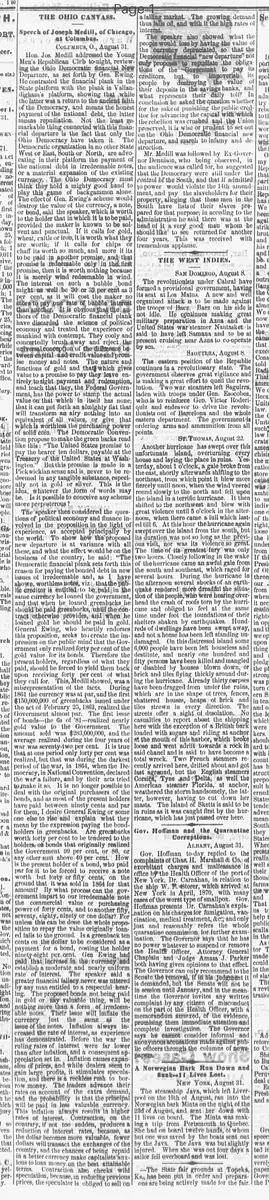
Hon. Jos. Medill addressed the Young Men's Republican Club to-night, reviewing the Ohio Democratic financial New Departure, as set forth by Gen. Ewing. He contrasted the financial plank in the State platform with the plank in Vallandigham's platform, showing that while the latter was a return to the ancient faith of the Democracy, and means the honest payment of the national debt, the latter means repudiation. Not the least remarkable thing connected with this financial departure is the fact that only the Ohio Democracy have taken it. The Democratic organization in no other State West or East, South or North, are advocating in their platform the payment of the national debt in irredeemable notes, or a material expansion of the existing currency. The Ohio Democracy must think they hold a mighty good hand to play this game of backgammon alone.
The effect of Gen. Ewing's scheme would destroy the value of the currency, a note, or bond, said the speaker, which is worth to the holder that in which it is to be paid, provided the maker is known to be solvent and punctual. If it calls for gold, wheat, cattle or iron, it is worth what they are worth; if it calls for chips or chaff its worth so much, and more if its to be paid in another promise, and that promise is redeemable only in the first promise, then it is worth nothing because it is merely wind redeemable in wind.
The interest on such a bubble bond might as well be 30 or 35 per cent as 3 per cent, as it will cost the maker no more to pay one rate of bubble interest than another. It is obvious that the authors of the Democratic financial plank have discarded the science of political economy and treated the experience of mankind with contempt. They cooly and concertedly brush away and reject the universal conception of the difference between capital and credit value and promise money and notes. The nature and functions of gold and that which gives value to a promise to pay they leave entirely to sight payment and redemption, and teach that they, the Federal Government, has the power to stamp the actual value on that which in itself has none; that it can put forth an almighty fiat that will transform an airy nothing into an equivalent of all values, or give that which is worthless the purchasing power of solid coin. The Democratic Convention propose to make the greenbacks read like this: "The United States promise to pay the bearer ten dollars, payable at the Treasury of the United States at Washington." But this promise is made in a Pickwickian sense and is never to be redeemed in any tangible substance, especially not in gold or silver. This is the idea, whatever the form of words may be. Is it possible to conceive any scheme more preposterous?
The speaker then considered the questions of political economy and finance involved in the proposition in the light of experience, as accepted principally by the world. To show how the proposed new departure is at variance with all these, and what the effect would be on the business of the country, he said: "The Democratic financial plank sets forth this reason for paying the bonded debt in new issues of irredeemable and, as I have shown, worthless notes, viz: that the public creditor is entitled to be paid in the same currency he loaned the government, and that when he loaned greenbacks he should be paid greenbacks, until the contract otherwise provides, and when he loaned gold he should be paid in gold. General Ewing, who heartily endorses this proposition, seeks to create the impression on the public mind that the Government only realized forty per cent of the gold value for its bonds. Therefore the present holders, regardless of what they paid, should be forced to yield them back upon receiving forty per cent of what they call for. This, Medill showed, was a misrepresentation of the facts. During 1861 the currency was at par, and the first $150,000,000 of greenbacks issued under the act of February 25, 1862, realized the Government almost par. The first issue of bonds—the 5s of '81—realized nearly gold value to the Government. The amount sold was $283,000,000, and the average realized during the four years of war was seventy-two per cent. It is true that at one period only forty per cent was realized, but that was during the darkest period of the war, in 1864, when the Democracy, in National Convention, declared the war a failure, and by their acts tried to make it so. It is no longer possible to deal with the original purchasers of the bonds, and as most of the present holders have paid between ninety cents and par for them, I desire General Ewing or some one else to rise and explain what they mean by the expression paying the bond-holders in greenbacks. Are greenbacks worth forty per cent to be tendered to the holders of bonds that originally realized the Government 90 per cent, or 86, or any other sum above 40 per cent. How is the present holder of a bond, who paid par for it to be forced to receive a note worth but forty or fifty cents, on the ground that it was sold in 1864 for that amount? By what process can the government impart to our irredeemable note the commercial value or purchasing power of forty cents, and to another fifty, seventy, eighty, ninety or one dollar? For unless this can be done the whole proposition to repay the value originally loaned falls to the ground. Is a greenback ten cents on the dollar to be considered as a payment for a bond, costing the holder ninety-eight per cent. Gen. Ewing had paid that increase in the currency and establish a moderate and nearly uniform rate of interest. The speaker said a greater financial fallacy never was uttered by any man entitled to a respectful hearing. The proposed bonds not being paid in gold or any valuable thing, will be nothing more than a form of irredeemable notes. Their issue will inflate the currency just the same as the issue of the notes. Inflation always increased the rate of interest, as experience has demonstrated. Before the war the ruling rates of interest were far lower than after inflation, and a consequent appreciation set in. Inflation causes expansion of prices, and while dealers seem to gain large profits, it stimulates speculation, and there is a reckless rush to borrow money. The lenders advance their rates on account of the extra demand and the probability is that the principal will be paid in less valuable currency. This inflation always results in higher rates of interest. Contraction, on the contrary, if not too sudden, produces a reduction of interest rates, because, as the dollar becomes more valuable, fewer dollars will transact the exchanges of the country, and the chances of being repaid in a better currency make capitalists anxious to loan money on the best attainable terms. Contraction also checks wild speculation, because, in reducing previous prices, the speculator is obliged to sell on a falling market.
A falling market. The growing demand thus falls off, and with it the high rates of interest.
The speaker also showed what the people would lose by having the value of the currency depreciated, so that the Democratic financial "new departure" not only proposes to repudiate the obligations of the Government to pay its creditors, but to impoverish its people by destroying the value of their deposits in the savings banks, and what represents their daily toil? In conclusion he asked the question whether for the sake of punishing the public creditor for advancing the capital with which the rebellion was crushed and the Union preserved, it is wise or prudent to set out on the Ohio Democratic financial new departure, and march to infamy and destruction.
Mr. Medill was followed by Ex-Governor Dennison, who being observed in the audience was called for, he suggested that the Democracy were still under the control of the South, and that if admitted to power would violate the 14th amendment, and pay the slaveholders for their property, alleging that these men in the South have lists of their slaves prepared for that purpose; in acceding to the administration he said there was at the head of it a very good man whom he should like to see returned for another four years. This was received with tremendous applause.
What sub-type of article is it?
What themes does it cover?
What keywords are associated?
What entities or persons were involved?
Where did it happen?
Story Details
Key Persons
Location
Ohio
Story Details
Hon. Jos. Medill criticizes Ohio Democratic financial policy as repudiation, contrasting it with traditional views, and warns of economic harm; Ex-Governor Dennison follows, accusing Democrats of Southern control and supporting the administration.